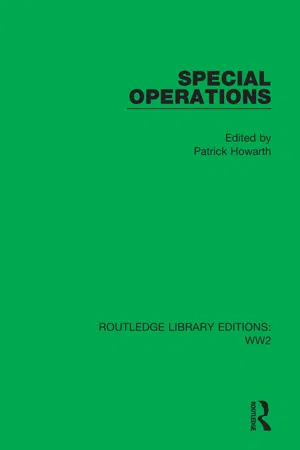
This book, first published in 1955, collects together accounts of some of the men and women who served as members of the remarkable S.O.E. This organisation was set up by Britain to encourage, help and organise resistance movements in occupied countries, and this book provides a valuable record of the types of people involved, and the work that they undertook.
- 252 pages
- English
- ePUB (mobile friendly)
- Available on iOS & Android
eBook - ePub
Special Operations
RESISTANCE IN EASTERN EUROPE
By Hugh Seton-Watson
The two opposed notions of resistance and collaboration are products of the Second World War. Small-scale banditry and full-scale guerrilla had of course been known before, especially in the three southern peninsulas of Europe—Spain, Italy and the Balkans. But it was usually accepted in European wars of the last century that in territory occupied in war the conquering power established a system of government with recognized rules, which were obeyed by the civilian population. To obey them was not treason to the lawful government, and there was no obligation to undertake sabotage or armed warfare against the occupying forces. The change is due to the ‘total’ nature of modern war and to the ideological nature of the Nazi German regime. Regarding Slavs and Jews as racially inferior, and both liberal and Marxist ideas as heresies to be extirpated, the Germans behaved in such a manner as to provoke resistance. Moreover, they met with nationalist and revolutionary fanaticism no less implacable than their own. When it is added that both the anti-German Power groups—the Anglo-Saxons and the Soviet Union—deliberately encouraged resistance, and supplied some of the means to make it effective, the general reasons are clear.
Resistance movements varied considerably, but certain basic conditions were required for all. The first was widespread national hatred of a foreign invader as such. This was almost universal among Czechs, Poles, Serbs and Greeks. It was much less strong, particularly in the first years, among Slovaks and Croats, who had received from the Germans a national independence which was not immediately felt to be a sham. It hardly existed at all among Rumanians and Bulgarians, whose states were allied with the Axis and were not subject to occupation. This was also true of Hungary up to March 1944, after which opinion undoubtedly changed. A second condition was a state of intolerable oppression, such as to drive people into action. This existed in Poland and Yugoslavia, and as a result of the famine of 1941-2 it existed also in Greece. Once resistance started, it brought reprisals, and these further increased hatred. In Czechoslovakia, however, these conditions did not exist to the same extent. The Czech peasants and workers enjoyed material prosperity, and thus showed little inclination to revolt. Persecution was concentrated against the intellectuals, who reacted by the means at their disposal but were not able to organize a mass movement. This brings us to the third condition, the nature of the country. In mountainous and forested areas, armed resistance on a large scale was possible, as the rebels were able to take refuge in remote places which it was too troublesome for the enemy, with the time and personnel at his disposal, to explore. Yugoslavia, Greece and Albania abound in such country, and Poland has suitable forests. The Czech lands, however, are thickly populated and low-lying: in the mountainous parts of Bohemia, Germans predominated. Where conditions do not favour armed resistance, sabotage, assassinations, espionage and the rescue of escaped Allied prisoners or baled-out pilots are possible forms of resistance.
Polish resistance had a military and a civilian origin. From the officers and soldiers who escaped through Rumania and Hungary to France, a small Polish army was created on Allied soil. At the same time a new government in exile was set up, led no longer by the politicians of the Pilsudski-Beck regime but by the great soldier General Sikorski and the representatives of the traditional Polish parties who had been opposed to the old regime—National Democrats, Socialists, People’s (peasant) Party and Labour (Catholic) Party. After the first period of confusion, communications began to be established between the exiles and patriots inside Poland. Couriers could pass through Slovakia and Hungary without great difficulty, and radio communications were soon restored for shorter messages. Political ideas and organization plans began to be exchanged between Poland and the free world. The successive Polish governments in exile never lost this contact. After the Polish government moved from France to Britain, and the entry of Italy into the war reduced the value of the Slovakia-Hungary route, there was still contact by radio, and courier Unes were organized, not only to send special messages but also to evacuate escaped Allied prisoners of war, right through Germany, France and Spain to Gibraltar. The Polish governments in exile were more constantly in touch with opinion at home than any of the others from Eastern Europe.
The official policy of the exiled government and of the leaders of the underground movement which grew up, was non-recognition of the German and Soviet occupations of Poland. The Polish state was considered still existing. The underground movement was to build up a sçcret government, administration, army, press, and even law courts and schools.
The German invasion of the Soviet Union greatly increased the military value of the Polish Home Army. During the following years the Poles performed valuable services by destroying rail communications in the rear of the German armies. At times they engaged in considerable battles with German troops. Owing to the different nature of the terrain, these were never on the scale of the battles of the Balkan resistance movements. One of the most important battles took place near Kielce in March 1944, when a force of some 4,000 S.S. troops were engaged. The Polish underground movement also carried out sabotage in factories, and passed valuable information to the Allies. As Poles were employed in industry throughout the Reich, they were able to inform the Allies also about conditions inside Germany. All these activities of course brought brutal reprisals on the population. Already in May 1940 the Germans were sufficiently alarmed by Polish resistance to carry out a special repressive movement, of arrests and executions, known as the ‘A.B. Action’. The Poles decided to fight reprisals with counter-reprisals. When Polish patriots were executed Polish resisters executed prominent German officials. Among those thus executed were Colonel Gassier, head of S.S. in Cracow, and General Kutschera, military commandant of Warsaw (1 February 1944). An attempt on Governor-General Hans Frank on 29 January 1944 was unsuccessful.
Special mention should be made of the resistance of the Jewish ghetto in Warsaw from 19 to 28 April 1943, which was independent of the Home Army’s actions. Of the 400,000 Jews who had inhabited this ghetto at the end of 1940, some 300,000 had been deported to extermination camps. The remnant were being slowly starved. When the Germans decided to finish them off, they resisted desperately, with no weapons. Of 56,000 persons accounted for in the official German report, 7,000 were killed fighting, while an unknown additional number perished in the sewers or in burning buildings. German losses were fifteen dead. The German commander saw fit to congratulate his men on their heroism.
The climax of the Polish resistance was the battle for Warsaw. Just as Paris rose before the arrival of the American and British forces and freed itself from the Germans, so Warsaw rose as the Red Army approached. But there the resemblance ended. The Red Army did not help the Poles, and after sixty-three days of heroic resistance, Warsaw surrendered to the Germans on 3 October. The reasons for this horrible tragedy have never been made fully clear. Perhaps the Red Army failed to cross the Vistula because it could not, because German resistance was too strong. But this the Soviet leaders, and their native and foreign propagandists, cannot admit: to them the invincibility of the Red Army is a dogma. Or it is possible that the front in Poland was temporarily depleted in order to send troops round through the gap in the German defences left by Rumania’s defection of 23 August, which opened all Central Europe to the Soviet forces. This would have been a perfectly defensible military manoeuvre, and was also recommended by political considerations, as it gave Soviet troops a chance to get into the Balkan peninsula before their Western allies and rivals. But this again has not been given as the reason by Soviet propaganda. This propaganda instead has denounced General Komarowski (‘Bór’), the Polish commander-in-chief, for plunging into an adventure without co-ordinating his action with the Soviet command. It does not explain how the general could have done this, in the absence of diplomatic relations between his government and the Soviet government, except by asking his government in exile, with which he had wireless contact, to communicate through the British government, and by attempting to make local contact with Marshal Rokossovsky’s forces. Both these means General Bór used. A Captain Kalugin of Rokossovsky’s army reached Warsaw, and sent a message to Stalin, through the London radio link, explaining the situation in Warsaw and the needs of the defenders. It, and the repeated representations by the British authorities, remained unanswered. Yet up till the outbreak of the rising the Polish broadcasts of the ‘Koáciuszko station’, directed by the Union of Polish Patriots in the U.S.S.R., were urging Warsaw to rise against the Germans.
The rising started on 1 August. It was ordered by the Polish government in exile, with the agreement of the Delegate in Poland, the Home Council of Ministers under him, the Council of National Unity, and the Commander of the Home Army.1 The regular units of the Home Army were three ‘divisions’ forming the ‘Warsaw army corps’ numbering 35,000 troops.2 About one-third of their arms had been dropped by parachute from British and Polish aircraft based on the British Isles, one-third produced by underground arms plants organized by the resistance, and the rest mainly captured from the Germans in previous engagements. Apart from these regular units, most of the civil population, both male and female, joined in the rising, arranging hospitals, supplies, improvised fortifications and other essential services. The Germans used against them five divisions, including the S.S. ‘Death’s Head’ and ‘Viking’ divisions. After a week they had succeeded in splitting up the Polish forces into four sections.
In response to Polish requests for help, the Allied governments asked the Soviet government to allow their aircraft to use Soviet aerodromes in order to operate a ‘shuttle service’ to help the insurgents. Whether from considerations of prestige3 or other reasons, the Soviet government refused until 18 September. Meanwhile, Polish, British and South African pilots based on Italy made several journeys in unusually risky conditions and with extremely high casualties. This help was, of course, on far too small a scale to influence the battle. In mid-September the Red Army captured Praga, the suburb immediately opposite Warsaw across the Vistula. Contact was for a time established, Soviet artillery fire was co-ordinated with Polish fighting, and a few supplies were dropped by Soviet planes, most of which were broken because no parachutes were attached. At the end of the month the Soviet forces ceased their frontal attack, and decided to by-pass Warsaw in their advance. The Polish soldiers were reduced to two isolated groups, both cut off from the river.
When all resistance became hopeless, General Bór surrendered, in the hope of protecting the surviving civil population. The Germans had decided to recognize the Home Army as combatants, entitled to prisoner-of-war treatment. Eleven thousand soldiers, 942 officers and six generals were taken prisoner.
The first effect of defeat on the Yugoslavs, and especially on the Serbs, was depression and bewilderment. The Serbian Army, with its glorious traditions, had crumpled up in a few days. The state machine, which had seemed so powerful, and had been so heavy a burden on the citizen and peasant, was smashed to pieces. The political parties disintegrated. Families were divided by new frontiers. There was general disillusionment with the old political, military and bureaucratic chiefs, with the ruling class as a whole. There was disappointment with Britain, which all had admired, but which had given no help, and which now seemed threatened by great dangers of its own.
The earliest active resistance was in Bosnia, where Serbs began to defend themselves with arms against the Ustash bands of Pavelic. The leaders were in some cases regular army or Chetnik officers, in others simply local men of initiative and and courage. The groups included people of all social classes and most political opinions. Their motive was protection of themselves and their families. In so far as they had a common political idea, it was nationalism and hostility to the Croats as such.
The whole situation was transformed by the German invasion of Russia. Throughout Yugoslavia, and particularly in the Serbian provinces, sympathy for Russia was deep-rooted and traditional. The Serbs not only loved Russia, but greatly over-estimated her strength. The mood of the Serbian people now suddenly changed from bewildered despair to extravagant optimism. Now at last the Serbs had a great ally on land, who would destroy the Germans and liberate Yugoslavia within a few weeks. Meanwhile it was their duty to do what they could by resistance to help their ‘big brother’. The new mood was fully exploited by the Yugoslav Communist Party, which for some time had been building up an underground military organization. The attack on Russia was the signal for action.
In July fighting began in Serbia. It was due partly to communist planning and partly to the spontaneous reaction of the peasants, who, carried away by patriotic fervour and the optimism of the moment, joined any bands in their neighbourhood—communist, Chetnik, regular army remnants, or any other—which seemed likely to fight the Germans. The enemy was taken by surprise, and his forces in Serbia were soon confined to the neighbourhood of Belgrade and the Morava valley.
The communist forces took the name of partisans.1 They were directed by a ‘Supreme Staff’ which took all political and military decisions. The leader of the whole movement was Joseph Broz, the Secretary-General of the party, soon known by his nom de guerre of Tito. In accordance with the official Comintern policy of a People’s Front of all patriotic forces against the invaders, the communist leaders approached the nationalist resistance groups with suggestions for common action. Tito had several conversations with Colonel Mihailovic between September and November. Mihailovic was against large-scale armed resistance, on the grounds that the Yugoslavs could not stand up to the Germans with inadequate equipment, and that the invaders would carry out merciless reprisals on the civil population. He believed that they should husband their resources, and await a more suitable moment when a general revolt could be launched. But when, despite his wishes, fighting broke out on a large scale, he was forced to join in, and for a time his forces co-operated with the partisans.
This did not last long. There were many minor causes of conflict between the partisans and Mihailovic, but the essential cause was the incompatibility of their political outlook. By the middle of November they were irreconcilable enemies. First the partisans beat Mihailovic. Then during November the Germans, who had brought up considerable reinforcements, attacked on a serious scale, using armour and aircraft. By the end of the month the partisans were driven from their base at Užce, and fled in confusion to the south. Mihailovic’s forces also disintegrated, and many of his men joined the troops of General Nedic.
The defeat in Serbia taught the partisans that they could not face the Germans in open country, and that it was unwise to operate in areas where they could not protect the civil population. From now onwards they abandoned the plain-lands, and withdrew to the central mountain massif of Bosnia, Hercegovina and Montenegro.
Three separate sections of Yugoslavia were of strategic interest to the enemy—the Slavonian plain, the Morava and Vardar valleys, and the Adriatic coast. The first affected communications between Austria and the Black Sea, and the second communications with Greece and Turkey, while the third was regarded as a possible objective for an Allied landing. Between these three sections lay the mountain stronghold of the partisans. Within this area the partisans were a constant menace to the invaders, and from the end of 1943 onwards they extended their activities outside it, into the strategic areas. Within the mountain area, movements of enemy troops and supplies always needed strong guards. The few railways and roads which cross the mountain barrier, and link the Danubian plain with the coast, were constantly cut. Attacks were also made, from the north Bosnian ranges and from the outlying base in the Slavonian hills, on the main Zagreb-Belgrade railway, the most important single line in southeastern Europe. Factories and mines were raided and put out of action for weeks at a time. Smaller enemy units were surrounded and destroyed, and arms and ammunition stores captured. Considerable numbers of enemy troops, dearly needed on other fronts, were permanently tied down.1
The partisans, as far as possible, avoided engaging strong enemy forces. But from time to time the Axis Command undertook major ‘cleaning-up’ operations. The partisans then had to defend themselves, break up into smaller formations and scatter into the least accessible fastnesses. These enemy ‘offensives’ caused the partisans heavy losses, and on one occasion at least their main force narrowly escaped annihilation.2 But each time they survived, and the cost to the enemy was also severe.
Table of contents
- Cover
- Half-Title Page
- Title Page
- Copyright Page
- Original Title Page
- Original Copyright Page
- Table of Contents
- List of Illustrations
- Acknowledgments
- Introduction
- An Ammunition Train in Greece
- Blessed Little Virgin
- The Capture of the General
- Christmas ’40
- Invitation to Albania
- Partisan Life in Albania
- The Cost
- Resistance in Eastern Europe
- Arrest in France
- Descent to the Maquis
- Semnoz
- Women of the French Resistance
- How Yeo-Thomas went to France
- The Training of Agents
- Flood in the Desert
- Arab Radio Station
- Nightmare Journeys
- The Great Elephant Trek
- Our Secret Service
- Biographical Notes
Trusted by 375,005 students
Access to over 1.5 million titles for a fair monthly price.
Study more efficiently using our study tools.
Frequently asked questions
Yes, you can cancel anytime from the Subscription tab in your account settings on the Perlego website. Your subscription will stay active until the end of your current billing period. Learn how to cancel your subscription
No, books cannot be downloaded as external files, such as PDFs, for use outside of Perlego. However, you can download books within the Perlego app for offline reading on mobile or tablet. Learn how to download books offline
Perlego offers two plans: Essential and Complete
- Essential is ideal for learners and professionals who enjoy exploring a wide range of subjects. Access the Essential Library with 800,000+ trusted titles and best-sellers across business, personal growth, and the humanities. Includes unlimited reading time and Standard Read Aloud voice.
- Complete: Perfect for advanced learners and researchers needing full, unrestricted access. Unlock 1.5M+ books across hundreds of subjects, including academic and specialized titles. The Complete Plan also includes advanced features like Premium Read Aloud and Research Assistant.
We are an online textbook subscription service, where you can get access to an entire online library for less than the price of a single book per month. With over 1.5 million books across 990+ topics, we’ve got you covered! Learn about our mission
Look out for the read-aloud symbol on your next book to see if you can listen to it. The read-aloud tool reads text aloud for you, highlighting the text as it is being read. You can pause it, speed it up and slow it down. Learn more about Read Aloud
Yes! You can use the Perlego app on both iOS and Android devices to read anytime, anywhere — even offline. Perfect for commutes or when you’re on the go.
Please note we cannot support devices running on iOS 13 and Android 7 or earlier. Learn more about using the app
Please note we cannot support devices running on iOS 13 and Android 7 or earlier. Learn more about using the app
Yes, you can access Special Operations by Patrick Howarth in PDF and/or ePUB format, as well as other popular books in History & Military & Maritime History. We have over 1.5 million books available in our catalogue for you to explore.