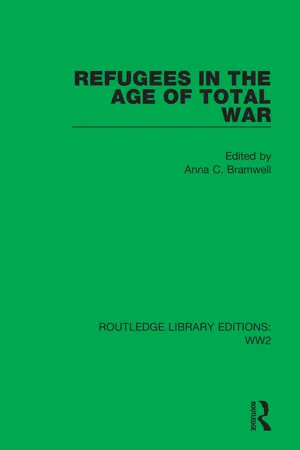
This book, first published in 1988, charts society's responses to the huge numbers of refugees in Europe and the Middle East during and after the Second World War. At the close of the war large areas of Europe lay in ruins, and large numbers of refugees faced upheaval and famine. Political considerations influenced the decisions as to who received assistance, and refugees were forcibly repatriated or resettled – and in the analysis of these matters and more, both the refugee crises of the 1940s and their relevance today are highlighted.
- 372 pages
- English
- ePUB (mobile friendly)
- Available on iOS & Android
eBook - ePub
Refugees in the Age of Total War
1 The concept of the term ‘refugee’
GÖran Melander
Though refugees have always existed, mankind has never been faced with refugee problems of such formidable dimensions as during the present century. A large-scale influx was caused by the Russian revolution, when millions of people were compelled to leave their home country. At present the total number of refugees is estimated at some ten to fifteen million people throughout the world.
It has been affirmed in various contexts that the refugee problem is international in scope and character and that the responsibility for the international protection of refugees rests with the international community.1 International bodies have been established for the purpose of providing material and legal assistance to refugees.2 The legal protection has been complemented through treaties concerning the status of refugees.3
There have been various attempts to produce a legal definition of what is a refugee. Between the two world wars international instruments on refugees contained ad hoc and generalised definitions of the term. The important criterion was that the person came from a certain state or that he or she was lacking the protection of that state. Refugees were identified by reference to a certain nationality. Implicitly it was indicated that political events in the named country had forced the person to escape. A typical example can be found in the 1926 Arrangement modifying and completing the Arrangements concerning the Issue of Certificates of Identity to Russian and Armenian Refugees dated 5 July 1922 and 31 May 1924, in which a Russian refugee was defined as follows: ‘Any person of Russian origin who does not enjoy or no longer enjoys the protection of the Government of the Union of Socialist Soviet Republics and who has not acquired another nationality’.4
In 1936, when the Provisional Agreement concerning the Status of Refugees coming from Germany was adopted, the same course was followed: the term refugee covered all persons coming from Germany.5 However, when the provisional agreement was replaced by a permanent treaty in 1938, a minor but fundamental change was made. A person was excluded from refugee status, if he had left Germany ‘for reasons of purely personal convenience’.6
The exclusion clause had consequences in several respects. Although still an ad hoc definition it was now necessary to look into the underlying reason for a person’s flight. For the first time it also became necessary to determine refugee status on an individual basis. And from the travaux préparatoires it appears that a substantial change was intended. During the 1938 Diplomatic Conference the new additional paragraph was commented upon in the following way: ‘The text . . . implies a criticism - a perfectly well-founded criticism - of the Government of the Reich: it undoubtedly was not fair that a country which did not desire to have certain categories of persons residing in its territory should compel other States to take charge of them’.7
The refugee problem was a subject of constant concern for the Allied Powers during the Second World War. At the Bermuda Conference in 1943 it was decided that protection should be given to persons who, ‘as a result of events in Europe, have had to leave, or may have to leave, their countries of residence because of the danger to their lives or liberties on account of their race, religious or political beliefs’.8 Through its general wording it was still an ad hoc definition in so far as a geographical limitation was included. In practical terms the purpose was to protect refugees from Germany, Italy and Spain.9 The exclusion clause in the 1938 Convention had been rephrased and the causes for leaving a country were explicitly enumerated. Refugee status should be determined on an individual basis.
The main task of the United Nations Relief and Rehabilitation Administration (UNRRA), which was established in 1943, was to assist so-called displaced persons, i.e. ‘victims of war in any area under the control of any of the United Nations’.10 At the first session of the Council of UNRRA the mandate of the new organization was described as ‘assistance in caring for, and maintaining records of, persons found in any areas under the control of any of the United Nations who by reason of war have been displaced from their homes and, in agreement with the appropriate governments, military authorities or other agencies, in securing their repatriation or return’.11 There were, however, persons who refused to be repatriated and this problem led to an open conflict between the Soviet Union and the Western Allies, who maintained that there were persons who, for reasons of race, religious or political opinion, had legitimate reasons not to return to their country of origin. This view was contested by the Soviet Union, which argued that all displaced persons were to be repatriated. Finally it was agreed that the Administration should assist those having ‘valid reasons’ not to return. Initially, in respect of these persons the mandate was limited to six months,12 but this period was later extended.13
In 1946 UNRRA was replaced by the International Refugee Organization (IRO), which became responsible for both displaced persons and refugees.14 In the IRO definition of the term ‘refugee’ the important part of the Constitution prescribed that a person could refuse repatriation, provided he expressed valid objections to return to his country of origin. Valid objections included ‘persecution, or fear based on grounds of persecution because of race, religion, nationality or political opinions, provided these opinions are not in conflict with the principles of the United Nations, as laid down in the Preamble of the Charter of the United Nations’.15 By now the phrase ‘danger to their lives and liberties’ in the Bermuda declaration, had been replaced by the criterion ‘persecution’, which term for the first time was used in an international instrument in order to describe a refugee.
The IRO definition of the term ‘refugee’ was also an ad hoc definition. The intention was to protect persons from countries under communist domination and the definition was meant to describe the situation in those countries. A strong political element had been inserted in defining the term ‘refugee’.
In this context it should be noted that the IRO was established as a UN specialized agency, i.e. an autonomous, intergovernmental organization having its own constitution, members, budget, etc. It is a notable fact that only few states became members of the IRO, although quite a number contributed to the IRO budget. One explanation for this anomaly may be the fact that the definition of the term ‘refugee’ was aimed at describing asylum seekers from Eastern Europe. One may speculate that the majority of states were not prepared at this stage to take sides vis a vis the Soviet Union.
In 1950 the UN General Assembly established a new organization in favour of refugees, the Office of the United Nations High Commissioner for Refugees. The following year, 1951, the Convention relating to the Status of Refugees was adopted.16 The term ‘refugee’ is in all essentials described in the same way in the two instruments. A refugee is a person who, owing to well-founded fear of being persecuted for reasons of race, religion, nationality, membership of a particular social group or political opinion, is outside the country of his nationality and is unable or, owing to such fear, is unwilling to avail himself of the protection of that country. There is, however, an important difference between the mandate of the UNHCR and the Refugee Convention, as the latter contains a date-line. The cause of a refugee situation must have taken place prior to 1 January 1951, while the High Commissioner’s mandate covers also future groups of refugees.
The definitions were worked out in the period 1949-51, i.e. at a time when the cold war had reached its height and when in fact the Eastern Bloc boycotted the United Nations. The Korean War started during this period. It was mainly in Europe that refugee problems existed and the refugees emanated almost exclusively from East European states. [The Korean war produced two million refugees, Ed.]
Because of the boycott by the East European states of the organs of the United Nations, the Statute of the Office of the UNHCR and the Refugee Convention were drafted by Western states only. It was quite natural to claim persecution in the country of origin. All the refugees emanated from East European states. Countries of asylum, i.e. Western states, were not obliged to take any political considerations into account. The relations between Eastern and Western states at that time could hardly have been worse.
It is also interesting to note that the Office of the UNHCR is established as a subsidiary organ under the UN General Assembly. Accordingly, the statute of the UNHCR is not a treaty which should be ratified by member states. It is annexed to a resolution, adopted by the General Assembly under the ordinary voting rules of the UN.
The 1951 definition of the term ‘refugee’ functioned well for about ten years. However, when in the 1960s new refugee problems arose, it was impossible to consider the refugees to be within the 1951 Refugee Convention. The date-line was felt to be a serious obstacle in providing international protection to refugees. Accordingly, a new international agreement was adopted, stemming from the ECOSOC resolution of 18 November 1966 and a resolution of 16 December 1966, which entered into force in October 1967 as the Protocol relating to the Status of Refugees,17, an instrument which can be seen as an amendment to the 1951 Refugee Convention by which the date-line has been deleted.
As stated before, the definition of the term ‘refugee’ in the Statute of the UNHCR and in the 1951 Refugee Convention/1967 Refugee Protocol is generally considered to be a product of the cold war. It is also looked upon as a European definition, applicable first and foremost to asylum seekers coming from socialist countries. Simultaneously it must be underlined that the definition is a product of a continuous development, starting with the 1938 Convention concerning the Status of Refugees coming from Germany. Group determination was repealed and refugee status had to be decided on an individual basis. The various definitions since 1938 also contained a criterion which implies a condemnation of the situation in the country of origin.
The final definition of the term refugee was not established by the adoption of the 1967 Refugee Protocol, which created a more or less complete correspondence between the mandate of the UNHCR and treaty law. Already by the late 1950s, groups of refugees were assisted by the UNHCR outside its mandate. By various resolutions adopted by the UN General Assembly, the High Commissioner was authorized to lend his ‘good offices’ in respect of refugees who do not come within the competence of the United Nations’.18 Originally the so-called good offices resolutions applied to refugees in Africa. Later refugees in Asia and Latin America were also assisted and entitled to protection by virtue of similar resolutions. It has been increasingly common to name this new type of refugee as (external) displaced persons. It should be noted that the new category of displaced persons has little in common with the displaced persons after World War II.
An important element with regard to the new refugees is the large-scale influx, thus making any attempt to decide refugee status on an individual basis virtually impossible. Furthermore the admittance of refugees does not imply any form of condemnation of the country of origin. A third difference is the lack of the persecution criterion. In fact, the great majority of the displaced persons would not be granted refugee status, should their applications be considered under the 1951 Refugee Convention/1967 Refugee Protocol. The former High Commissioner, Mr Felix Schnyder, has stated that the absence of political considerations is all the more conspicuous in that, with respect to ‘other’ refugees, the General Assembly did not lay down any definition connecting a given group of refugees with some political event. By the good offices procedure, the United Nations had created an apolitical instrument for coordinating international action on behalf of new groups of refugees.19 The good offices function of the Office of the UNHCR has made it possible for the Office to assist refugees without making an evaluation of the political conditions in the country of origin.
From a legal point of view, only the African states and the Organization of African Unity have drawn the conclusion that it is necess...
Table of contents
- Cover
- Half-Title Page
- Title Page
- Copyright Page
- Original Title Page
- Original Copyright Page
- Table of Contents
- List of contributors
- Preface
- List of abbreviations
- Introduction
- 1 The concept of the term ‘refugee’
- 2 A historical survey of twentieth century expulsions
- 3 Armenian refugees: accidents of diplomacy or victims of ideology?
- 4 Weimar Germany and the Ostjuden, 1918–1923: acceptance or expulsion?
- 5 German and European Jewish refugees 1933–45: reflections on the Jewish condition under Hitler and the Western World’s response to their expulsion and flight
- 6 Religion, refugees and the U.S. Government
- 7 The re-settlement of ethnic Germans, 1939–41
- 8 Refugees from the Eastern provinces of Italy after 1943
- 9 German refugee scholars in Great Britain, 1933–1945
- 10 German refugees after 1945: a British dilemma
- 11 Refugees and Ruhr miners: a case study of the impact of refugees on post-war German society
- 12 Repatriation and resistance: Ukrainian refugees and displaced persons in occupied Germany and Austria, 1945–1948
- 13 Polish refugees as military potential: policy objectives of the Polish government in exile
- 14 The absorption of Poles into civilian employment in Britain, 1945–1950
- 15 The initial absorption of the Palestinian refugees in the Arab host countries, 1948–1949
- 16 Palestinians in Lebanon: Status ambiguity, insecurity and flux
- 17 Palestine refugees, economic integration and durable solutions
- 18 Bureaucratization and political commitment: challenges for NGO refugee assistance
- 19 The refugee determination procedure in Belgium and the role of the United Nations High Commission for Refugees
- Index
Trusted by 375,005 students
Access to over 1.5 million titles for a fair monthly price.
Study more efficiently using our study tools.
Frequently asked questions
Yes, you can cancel anytime from the Subscription tab in your account settings on the Perlego website. Your subscription will stay active until the end of your current billing period. Learn how to cancel your subscription
No, books cannot be downloaded as external files, such as PDFs, for use outside of Perlego. However, you can download books within the Perlego app for offline reading on mobile or tablet. Learn how to download books offline
Perlego offers two plans: Essential and Complete
- Essential is ideal for learners and professionals who enjoy exploring a wide range of subjects. Access the Essential Library with 800,000+ trusted titles and best-sellers across business, personal growth, and the humanities. Includes unlimited reading time and Standard Read Aloud voice.
- Complete: Perfect for advanced learners and researchers needing full, unrestricted access. Unlock 1.5M+ books across hundreds of subjects, including academic and specialized titles. The Complete Plan also includes advanced features like Premium Read Aloud and Research Assistant.
We are an online textbook subscription service, where you can get access to an entire online library for less than the price of a single book per month. With over 1.5 million books across 990+ topics, we’ve got you covered! Learn about our mission
Look out for the read-aloud symbol on your next book to see if you can listen to it. The read-aloud tool reads text aloud for you, highlighting the text as it is being read. You can pause it, speed it up and slow it down. Learn more about Read Aloud
Yes! You can use the Perlego app on both iOS and Android devices to read anytime, anywhere — even offline. Perfect for commutes or when you’re on the go.
Please note we cannot support devices running on iOS 13 and Android 7 or earlier. Learn more about using the app
Please note we cannot support devices running on iOS 13 and Android 7 or earlier. Learn more about using the app
Yes, you can access Refugees in the Age of Total War by Anna C. Bramwell in PDF and/or ePUB format, as well as other popular books in History & Military & Maritime History. We have over 1.5 million books available in our catalogue for you to explore.