Awarded the Verbruggen Prize 2022 for the best book on medieval military history.
Baldwin of Bourcq left his home in France in 1096 to join the great crusade summoned by Pope Urban II for the liberation of the holy sites and Christian peoples of Syria and Palestine from the domination of the Muslim Turks. In 1100 he became ruler of the Franco-Armenian county of Edessa. In 1118 he succeeded to the kingdom of Jerusalem. In just over two decades this younger son of a minor French count had become one of only a dozen kings in Western Christendom. To defend the principalities of Outremer against their Turkish and Egyptian enemies he travelled thousands of miles and led his troops in over two dozen campaigns. He spent two extended periods in Turkish captivity, yet he outlived almost all of his fellow crusaders, and died leaving the succession to his kingdom secure.
This is the first biography in any language of a remarkable man. Drawing on a wide range of narrative and documentary sources, it gives an account of Baldwin's ancestry and life from his first recorded appearance up to his death in 1131. It explains the complex and shifting geopolitics of the principalities of Outremer and the Muslim territories around them, and explores Baldwin's character as a ruler and leader in war, the significance of his wide-ranging kinship network, and the succession to the kingdom of Jerusalem.
Baldwin of Bourcqwill appeal to students, teachers and researchers in Medieval History, especially Crusade Studies and Military History.
Despite his later renown, Baldwin appears relatively rarely in those parts of the Latin narratives dealing with the course of the First Crusade, as opposed to the subsequent history of Outremer.1 He is mentioned most often by Albert of Aachen, who devoted particular attention to the army of Godfrey of Bouillon, duke of Lower Lotharingia, in which Baldwin served. Albert gives his name as Balduinus de Burg (with some manuscript variants giving Burch or Bruch), and he continues to use this designation for the period after the crusade.2 It is only when Baldwin succeeded to the county of Edessa in 1100 that Albert reveals something about his parentage. When describing his relationship to his predecessor there, the chronicler states that he was a son of ‘Count Hugh of the castle of Rethel’, information which is confirmed by Guibert, abbot of Nogent-sous-Coucy.3 Albert, writing in the city of Aachen in the Rhineland, and Guibert, writing in an abbey situated between the cities of Laon and Soissons, were the two crusade chroniclers whose locations were closest to Rethel (dép. Ardennes, arr. Rethel), the seat of a county in the northern part of the diocese of Rheims. A regional writer, Laurence of Liège, in his history of the bishops of Verdun, names Baldwin in a list of crusaders from ‘our territory’ immediately after Godfrey of Bouillon and his brother Baldwin of Boulogne as ‘the other Baldwin, from the castle of Rethel (Balduinus de Retexto castro), the grandson of Count Manasses’, connecting him with an earlier count of Rethel mentioned previously in his history.4
William of Tyre, writing in Palestine in the 1180s, was less interested in Baldwin as a crusader than as a king and progenitor of a line of monarchs who ruled the kingdom of Jerusalem in his own day. He introduces Baldwin at the time of the mustering of the crusade with the description Balduinus … qui cognominatus est de Burgo, adding that he was the son of Count Hugh of Rethel.5 He gives much more detailed information about Baldwin on the occasion of his accession as king of Jerusalem in 1118. William states that he was ‘of the French nation, from the bishopric of Rheims, the son of Hugh, count of Rethel, and the illustrious countess Melisende’, going on to detail the names and connections of Baldwin’s brothers and sisters.6
The Latin surname de Burg(o) or de Burch clearly derives from a vernacular placename by which Baldwin was already well known at the point that the crusade armies departed from Europe, and the combined information from the four chroniclers that he originated in the diocese of Rheims and was a son of a count of Rethel gives us the clearest indication of the location of this place. Since the beginnings of the modern study of the crusades in the mid-nineteenth century, the surname has occasioned much confusion among historians, who have frequently referred to him in English as ‘Baldwin of Bourg’, ‘Baldwin of Le Bourg’, or in French in the contracted form ‘Baudouin du Bourg’, without indicating where the place might be located.7 There are over 60 examples of places called Bourg, Le Bourg, or similar throughout France, but very few in the four départements making up the modern region of Champagne-Ardennes, which approximates to most of the area covered by the archbishopric of Rheims. Of these, the likeliest candidate for the vernacular name written as Burg(o) or Burch is the small village of Bourcq (dép. Ardennes, arr. Vouziers) in the southern Ardennes, as suggested well over a century ago by Reinhold Röhricht, and later supported by Jean Richard.8
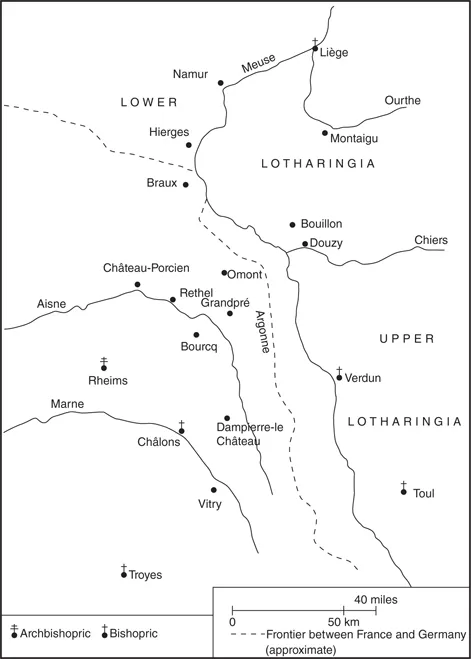
Bourcq is situated just over 26 kilometres south-east of the town of Rethel, a distance that could be covered easily in a day on horseback. It is some 50 kilometres east of the cathedral city of Rheims. To its south there is an impressive view across the rolling plains of Champagne. To the east, across the winding River Aisne, the ground gradually rises to the Argonne massif. Some 125 metres to the north-east of the church of St Nicholas (whose oldest parts date from the eleventh century) are the remains of a motte, situated on a hilly spur projecting outwards from the village centre to the north-east. The fortification is protected on three sides by slopes, and on the fourth side, which links it to the settlement, by a ditch.9
The presence of a fortification, however primitive, is an indication of the existence of a lordship, and there is evidence showing that the castle at Bourcq remained in the possession of the counts of Rethel after Baldwin’s departure on the crusade. A castellan named Rainald (Rainaldo castellano de Barcho) is mentioned in a charter issued around 1120; the holder of this office would have been the local administrator of the lordship.10 Around 1191 Count Manasses V of Rethel confirmed the transfer of his castle of Bourcq (Burcum, castellum meum) as the dower for Felicity, daughter of Simon, lord of Beaufort, on the occasion of her marriage to his son Hugh II. This charter and earlier documents issued in 1176 and 1185 also name knights whose surnames are derived from the toponym.11 In 1251 Count Gaucher of Rethel gave the castle of Bourcq to his brother Manasses, and around this time it was recorded among the fiefs dependent on the county of Champagne.12
Both Rethel and Bourcq lay in a region which lacked a wider political unity, but which was nevertheless distinct from the territories around it. Champagne was bounded to the north and east by the kingdom of Germany, and – within the kingdom of France – to the south by the duchy of Burgundy and to the west by the lands of the French royal demesne in the Ile-de-France, the Orléannais and Gâtinais. The region thus corresponded to the eastern half of the ecclesiastical province of Rheims, that is the dioceses of Rheims proper and Châlons, plus the dioceses of Meaux and Troyes in the province of Sens. As its name suggests, Champagne (Latin Campania, from campus ‘plain’) consisted mostly of rolling plains devoted to wheat-growing, with important cultivation of wine in a smaller area in the west. Settlements were situated further apart than in Picardy and the Paris basin to the west, and the population was consequently less dense. The eastern and northern parts of the region were hill country, bounded by the Argonne massif and the Ardennes, which also formed much of the frontier with Germany.13
The greatest political power in the region was exercised by a dynasty whose members historians have designated by the name Thibaudians, from the forename Thibaud that many of them were given. They held extensive lands in the south of Champagne around Troyes, Meaux and Châlons, and to the south of Rheims, and they were the lords of most of the other counts and lords in these areas. However, the power of the Thibaudians did not extend to the north of Champagne.14 Here the archbishopric of Rheims was the major power, exercising secular lordship over the city of Rheims and the areas around Mézières, Mouzon and Douzy. There were a number of smaller counties, some or all of whose lands were held as fiefs from the archbishop: Astenois (centred on Dampierre-le-Château), Porcien (centred on Château-Porcien), Grandpré, Roucy and Rethel.15
The counts of Rethel
The dynasty to which Baldwin of Bourcq belonged can first be glimpsed at the end of the tenth century.16 Its first known member, conventionally known as Manasses I and described as ‘count’ (without further territorial designation), is recorded as an ally of the archbishop of Rheims in 988–989. In 996 he witnessed a charter of Odo I, count of Blois.17 The name Manasses continues to appear among a line of counts associated firstly with the castle of Omont (dép. Ardennes, arr. Charleville-Mézières) in the extreme north-east of the kingdom of France, and later with the castle of Rethel, situated further south on a crossing of the River Aisne. In 1026 Rambert, bishop of Verdun, confirmed donations made by Dada, wife of Count Manasses of Rethel (Dada, uxor comitis de Manasse de Reiteste), to the abbey of Saint-Vanne in Verdun. This Manasses (II) was probably the son (or grandson) of his namesake known at the end of the tenth century, and father of Manasses III.18
It is only with the generation of Baldwin’s grandparents that we begin to gain a clearer picture of the family’s genealogy. On 26 September 1081 Manasses III, together with his wife Judith and son Hugh, made various donations to the church of Braux near Monthermé (dép. Ardennes, arr. Charleville-Mézières) on the western bank of the River Meuse.19 Manasses III and Hugh I were respectively the grandfather and father of the crusader. However, there is considerable uncertainty about the identity of Baldwin’s grandmother, Judith. A genealogy compiled at the abbey of Foigny and the chronicle of Alberic of Troisfontaines both identify her as a sister of Ebles I, count of Roucy, who became archbishop of Rheims in 1021 and died in 1033.20 However, Jean-Noël Mathieu has objected that a woman who was still alive in 1081 could simply not have been the sister of an adult who died half a century before. A more plausible explanation, he argues, is that the medieval genealogists confused generations, and that the sister of Ebles of Roucy who married into the Rethel line was in fact Dada, wife of Manasses II. If this was the case, then Baldwin’s grandmother belonged to a quite different family, although we can only speculate about her parentage.21
Map 1.1 Champagne and Neighbouring Areas
The identity of the crusader’s mother, by contrast, is in no doubt. Count Hugh I’s wife was Melisende, a daughter of Guy the Great, lord of Montlhéry (dép. Essonne, arr. Palaiseau). No single source names all of their children, but there were in fact at least three sons and three daughters, although the order of their birth cannot be established with certainty: (1) Manasses IV, who succeeded his father in or after 1118, but died childless. (2) Gervase, who was elected as archbishop of Rheims in 1106, but lacked the support to assert his position against a rival candidate, Ralph. At some point after this he renounced his clerical status, and married Isabella, daughter of Godfrey, count of Namur, and eventually succeeded his brother Manasses as count.22 (3) Baldwin, who...
Table of contents
Cover
Half Title Page
Series Page
Title Page
Copyright Page
Contents
List of figures
List of maps
Preface
List of abbreviations
A note on names
Introduction
Part I Crusader (1096–1100)
Part II Count of Edessa (1100–1118)
Part III King of Jerusalem (1118–1131)
Appendix 1: Genealogical tables
Appendix 2: The succession to the kingdom of Jerusalem in the Old French Crusade Cycle
Appendix 3: The reign of Baldwin of Bourcq in the Leeds Genealogical History Roll
Chronology
Bibliography
Index
Trusted by 375,005 students
Access to over 1.5 million titles for a fair monthly price.
Study more efficiently using our study tools.
Frequently asked questions
Yes, you can cancel anytime from the Subscription tab in your account settings on the Perlego website. Your subscription will stay active until the end of your current billing period. Learn how to cancel your subscription
No, books cannot be downloaded as external files, such as PDFs, for use outside of Perlego. However, you can download books within the Perlego app for offline reading on mobile or tablet. Learn how to download books offline
Perlego offers two plans: Essential and Complete
Essential is ideal for learners and professionals who enjoy exploring a wide range of subjects. Access the Essential Library with 800,000+ trusted titles and best-sellers across business, personal growth, and the humanities. Includes unlimited reading time and Standard Read Aloud voice.
Complete: Perfect for advanced learners and researchers needing full, unrestricted access. Unlock 1.5M+ books across hundreds of subjects, including academic and specialized titles. The Complete Plan also includes advanced features like Premium Read Aloud and Research Assistant.
Both plans are available with monthly, semester, or annual billing cycles.
We are an online textbook subscription service, where you can get access to an entire online library for less than the price of a single book per month. With over 1.5 million books across 990+ topics, we’ve got you covered! Learn about our mission
Look out for the read-aloud symbol on your next book to see if you can listen to it. The read-aloud tool reads text aloud for you, highlighting the text as it is being read. You can pause it, speed it up and slow it down. Learn more about Read Aloud
Yes! You can use the Perlego app on both iOS and Android devices to read anytime, anywhere — even offline. Perfect for commutes or when you’re on the go. Please note we cannot support devices running on iOS 13 and Android 7 or earlier. Learn more about using the app
Yes, you can access Baldwin of Bourcq by Alan V. Murray in PDF and/or ePUB format, as well as other popular books in History & World History. We have over 1.5 million books available in our catalogue for you to explore.