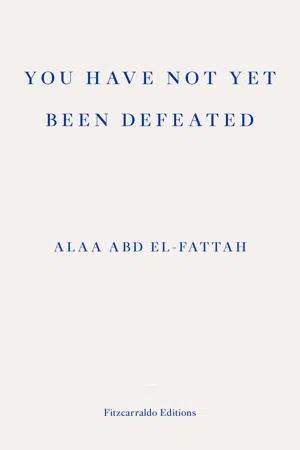
Alaa Abd el-Fattah is arguably the most high-profile political prisoner in Egypt, if not the Arab world, rising to international prominence during the revolution of 2011. A fiercely independent thinker who fuses politics and technology in powerful prose, an activist whose ideas represent a global generation which has only known struggle against a failing system, a public intellectual with the rare courage to offer personal, painful honesty, Alaa's written voice came to symbolize much of what was fresh, inspiring and revolutionary about the uprisings that have defined the last decade. Collected here for the first time in English are a selection of his essays, social media posts and interviews from 2011 until the present. He has spent the majority of those years in prison, where many of these pieces were written. Together, they present not only a unique account from the frontline of a decade of global upheaval, but a catalogue of ideas about other futures those upheavals could yet reveal. From theories on technology and history to profound reflections on the meaning of prison, You Have Not Yet Been Defeated is a book about the importance of ideas, whatever their cost.
- 280 pages
- English
- ePUB (mobile friendly)
- Available on iOS & Android
eBook - ePub
About this book
Information
Subtopic
Social Science BiographiesIndex
Social Sciences2014
GRAFFITI FOR TWO
Alaa has been in prison for two months when this piece is released. It’s the third anniversary of the revolution, 25 January 2014. Here, he combines his prose with the poetry of another political prisoner, Ahmad Douma. The original coda to the piece read as follows:
‘We apologize to readers for any confusion or incoherences in the text – they’re due to the circumstances of its writing. It was not easy for those used to instant expression on mobiles and keyboards to get through a two-week process of writing with pencil and paper (mostly) in solitary. And neither of us were ever able to spend time with the complete text.
We apologize also to our colleagues in Ward A, Political, Torah Prison, for what they put up with, as a poet who lived in the first cell in the ward and a blogger who lived in the last tried to cooperate. Both preferred to discuss their text by yelling in the night rather than use up the few hours of exercise in the open air.
We tried in this text to express our gratitude to those who dispelled the loneliness of our cells with their love and their care, and our deep belief in a generation that refused to queue for a place at Authority’s table. And it would be remiss not to thank the Authority – were it not for the new ‘paint’ we would not have found the space to think and draw.
Alaa and Douma’
I.
I know that despair is treason
but the revolutionary in my country
– even if he’s a sinless prophet –
who sees the tyrant empowered
at the oppressed’s command
amid the rejoicing of the poor
will lose his faith.
but the revolutionary in my country
– even if he’s a sinless prophet –
who sees the tyrant empowered
at the oppressed’s command
amid the rejoicing of the poor
will lose his faith.
They say that despair is treason. I was never comfortable with the slogan. I understand its motivation, but I’m worried the word is used lightly. The denial of a natural feeling scares me.
It reminds me of angry crowds circling the square carrying a bloodied shirt, searching for any traitor who allowed despair to steal into his mind or heart. They ruin the sweetness of the square. We pretend to forget them while we weave the myth of those eighteen shining days48 – but they are always in my nightmares.
In my nightmares they surround my mother; they want to throw her out of the square. Laila Soueif resists them. Laila Soueif who was born from the womb of defeat and so went into the square in 1972 and never came back. Despair never dared come near her – yet they called her a traitor to exorcize their own doubts and fears.
From my mother I inherited a stone cake49 and from my father a prison cell.50 And, in line with our traditions, I was given an inheritance better than my sisters, for they inherited morgues and victims of torture and the embrace of grieving mothers. I’m scared to even ask about their nightmares.
They say that despair is treason. I understood but I wasn’t convinced. They also said, ‘Brother, behind bars you are free.’ And here I am behind bars, stripped of my will and my dream. And I know from experience that part of me will stay behind these bars even when the decision comes to let me go.
Myths are part of my inheritance. People say, ‘Who can – for one hour – imprison Egypt?’51 They say it even though everyone knows that Generals Tapioca and Alcázar and all the other generals will imprison Egypt for as many hours as their dreams of clocks with green hands dictate.52
People say, ‘You can’t kill an idea.’ But they said nothing about the usefulness of immortal ideas unheard in the noise of gunfire.
Why are we afraid to admit weakness? To admit that we are human, that APCs crush us and prisons desolate us and bullets scar our thoughts and our dreams. That we are humans suffering defeats, let down by our bodies, made weak by the whisperings of our selves, burned by our dreams and paralyzed by our nightmares. Humans looking to love for support against despair.
II.
Hope
like the key to paradise
you own it
and you’re saved.
But paradise we enter
in our dreams…
And after death.
like the key to paradise
you own it
and you’re saved.
But paradise we enter
in our dreams…
And after death.
If despair is treason, what is hope? At least despair speaks frankly. Hope is treacherous. Have we seen treason uglier than that committed in hope’s name?
The army, the people, one hand. The law-abiding state. The constitution first. The people. The elected institutions. Yesterday’s comrades. The veteran fighters. The judiciary that fears only God. The masses. The guardians of the square. The coalition. The organization. The party. The independent media. The patriotic wing. The national council. The honour of officers…
Is there treason worse than hope in some – or all, or any – of the above?
Is there treason worse than hope in the ratification of a new constitution that breaks its own foundational promise – that it would not be completed until every last prisoner was released?
Is there treason worse than hope in a state whose institutions do nothing but kill, torture and betray?
Is there treason worse than hope in elections steeped in a national discourse designed to guarantee least competition and most certainty of results?
Is there treason worse than hope in the ‘candidate of necessity’ – even though his only qualification is ‘necessity’?
Is there treason worse than hope in a civilian candidate afraid to look like he’s actually in competition with the General?
Is there treason worse than hope in masses that march under images of murderers and torturers? Or hope in comrades who deny defeat out of pride rather than defiance? Comrades who, when the infection spreads and revolutionaries return to the streets and the prisons and the morgue, are not there with them?
Hope, like despair, is treason. But also, like despair, it’s a normal human weakness. Here in my cell I wrestle with my dreams and my nightmares, and I don’t know which hurts more. Both despair and hope pull at me – but I am never a traitor.
III.
We are not free
confess
but we
cling to tomorrow.
People’s tragedy: they committed
the sin of the wish
with no limit.
confess
but we
cling to tomorrow.
People’s tragedy: they committed
the sin of the wish
with no limit.
On a clear day, after two hunger strikes and a snowstorm, the sky quietens and in our hearts there’s calm.
We drink tea in the courtyard. We’ve passed the stage of discussing the use of our resilience, the chances of our release. After a month of disclosures and revisions all that’s left to us is memories.
And while we tell stories of past imprisonments, when the cells seemed more friendly and comrades more loyal, even though the revolution was, then, an ‘impossible dream’, I think back and find myself there, in the past, in the metro, with a friend, in my high school uniform, handing out an investigative report complete with photographs of the torture of an old ‘cattle thief’ they set alight with kerosene in Fayoum police station. We change trains quickly before someone recovers from the shock of the image and arrests us.
I didn’t tell my father I had come into my inheritance that day. It didn’t seem important. We were just trying to get rid of some of the anger, to get that terrible photograph out of the house. Hope had no part in this.
There, in the past, I find myself less experienced and wiser. I write of a generation that fought without despair and without hope, that won only small victories and wasn’t shaken by major defeats because they were the natural order of things. A generation whose ambitions were humbler than those who came before, but whose dreams were bigger.
There’s a lot wrong with me – but I’m no traitor. I’ve committed acts of cowardice and selfishness, I was impatient often and rash sometimes, I was proud and I was lazy, but I was never a traitor. I will not betray the revolution with despair or with hope. This is a promise.
IV.
Who said we were
unequalled?
Or that we’re
an enchanted generation?
We’re human
but
in the dark
we wish for light
unequalled?
Or that we’re
an enchanted generation?
We’re human
but
in the dark
we wish for light
Our sin was pride, not treachery. We said, ‘We’re not like those who came before us; the young Muslim Brothers are different and the young Nasserists are different and the young Leftists are different and the young Liberals are different.’ The weakness of our myth was exposed when we came up against the young officers.
Today I see that we are flawed, like those who came before us, making the same mistakes they made. Despite all our claims to uniqueness and rebellion we are nothing more than the loyal children of our families and our motherland, holding on to their beliefs, their habits and their traditions. Our inheritance. And we hold on to it for our children.
We’ll say to them, ‘You’re different, you won’t repeat our mistakes,’ but forget to tell them this is a hope, not a prophecy. We’ll sing them the songs of Ahmad Fouad Negm and Sheikh Imam,53 or the anthems of Sayyed Qutb54 and Hashim el-Rifae55 but forget to tell them that this is heritage, not resistance. They’ll rebel, and in the end they’ll return to their heritage of their own free will. But we’ll forget to tell them that this is not fate, but failure.
How can we not forget when we’re so preoccupied with the myth of the square that we neglect the revolution, so preoccupied with the myth of our uniqueness that we neglect our dreams? How can we not get lost when we’re busy fighting a second wave that drowns us? We spend so long telling them that we‘re not conspiring against them we forgot that they are all conspiring against us. Or was it, maybe, us conspiring against ourselves? I forget, but I’m sure it’s happened before.
They claim the first waves were dark and murky, but I have no doubts about them. Their details are clear and transparent and accounted for. But the myth, in its attempt to erase weakness and anxiety, violence, absurdity and the anguish of pain and the fragility of the dream, opens the door to their dark doubts.
They claim it’s the second wave that was clear and transparent, but I felt from the start a familiar murkiness, a darkness scattered in my heritage in terse phrases: Black September – Sabra and Shatila – a unified right wing – the Naksa – Khamis and Baqari – the Defresoir – coups and camp wars – Gulf wars…56 words we inherited without details or explanatory songs or even mocking jokes. As though those words were only a small part of the consciousness of those who came before us. They forgot to tell us, and we didn’t tell them that, in our ignorance, we had held them responsible. And today we pretend that we’re not living similar nightmares. We won’t admit that, like them, we are powerless.
V.
The crowding squares
and the millions
the crowding revolutions
made us forget:
that ‘the dream is the square’
and the revolution
lives in the self.
and the millions
the crowding revolutions
made us forget:
that ‘the dream is the square’
and the revolution
lives in the self.
Being an adult has strict rules. It’s important not to talk about yourself, not to boast or you’ll look conceited and trivial. But in prison you have nothing to talk about except yourself; time stops and your will is restricted to the boundaries of your body.
When you talk about yourself with a freedom born of necessity – that’s when you find yourself.
There in the past I find myself hunched over a keyboard, building with my wife a website that collected every Egyptian blog, refusing to be bound by rules or categories or borders. Blogs found refuge with us when they were rejected by the Tunisian aggregator whose admins suspected the patriotism of refugees and activists in exile. I see myself printing out calls for citizen journalism and an alternative media and for years handing them out wherever I went.
We didn’t try to form a bloc or claim a unified identity; we just wanted to express ourselves. We never aimed to dispel the mystery of our contemporary history, or to deny its confusion and our naivety; we just wanted to make sure that its mystery couldn’t be exploited – despite, or by, us – to deny our experiences or rewrite our stories; to erase things that troubled the authorities, or troubled us.
There, in the past, I find myself with less experience and more wisdom, writing about independent selves resisting their isolation with communal work but refusing to melt into the collective. We cooperated with those who came before us, willing to engage with their projects and their theories so long as we didn’t have to believe in or proselytize for them. We didn’t have generational wars or claim uniqueness but we insisted – and still do – on our tools.
In the absence of both despair and hope, nothing remains but the self. Our aim is to affirm our will in a country that aims to crush us. Our instinct was to see...
Table of contents
- PRAISE
- TITLE PAGE
- CONTENTS
- CHRONOLOGY: EGYPT 1952–2021
- FOREWORD BY NAOMI KLEIN
- INTRODUCTION
- 2011
- 2012
- 2013
- 2014
- 2016
- 2017
- 2019
- 2020
- 2021
- ABOUT THE AUTHOR
- COPYRIGHT
Trusted by 375,005 students
Access to over 1.5 million titles for a fair monthly price.
Study more efficiently using our study tools.
Frequently asked questions
Yes, you can cancel anytime from the Subscription tab in your account settings on the Perlego website. Your subscription will stay active until the end of your current billing period. Learn how to cancel your subscription
No, books cannot be downloaded as external files, such as PDFs, for use outside of Perlego. However, you can download books within the Perlego app for offline reading on mobile or tablet. Learn how to download books offline
Perlego offers two plans: Essential and Complete
- Essential is ideal for learners and professionals who enjoy exploring a wide range of subjects. Access the Essential Library with 800,000+ trusted titles and best-sellers across business, personal growth, and the humanities. Includes unlimited reading time and Standard Read Aloud voice.
- Complete: Perfect for advanced learners and researchers needing full, unrestricted access. Unlock 1.5M+ books across hundreds of subjects, including academic and specialized titles. The Complete Plan also includes advanced features like Premium Read Aloud and Research Assistant.
We are an online textbook subscription service, where you can get access to an entire online library for less than the price of a single book per month. With over 1.5 million books across 990+ topics, we’ve got you covered! Learn about our mission
Look out for the read-aloud symbol on your next book to see if you can listen to it. The read-aloud tool reads text aloud for you, highlighting the text as it is being read. You can pause it, speed it up and slow it down. Learn more about Read Aloud
Yes! You can use the Perlego app on both iOS and Android devices to read anytime, anywhere — even offline. Perfect for commutes or when you’re on the go.
Please note we cannot support devices running on iOS 13 and Android 7 or earlier. Learn more about using the app
Please note we cannot support devices running on iOS 13 and Android 7 or earlier. Learn more about using the app
Yes, you can access You Have Not Yet Been Defeated by Alaa Abd el-Fattah in PDF and/or ePUB format, as well as other popular books in Social Sciences & Social Science Biographies. We have over 1.5 million books available in our catalogue for you to explore.