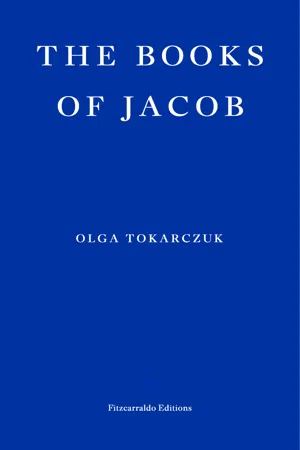
In the mid-eighteenth century, as new ideas begin to sweep the continent, a young Jew of mysterious origins arrives in a village in Poland. Before long, he has changed not only his name but his persona; visited by what seem to be ecstatic experiences, Jacob Frank casts a charismatic spell that attracts an increasingly fervent following. In the decade to come, Frank will traverse the Hapsburg and Ottoman empires, throngs of disciples in his thrall as he reinvents himself again and again, converts to Islam and then Catholicism, is pilloried as a heretic and revered as the Messiah, and wreaks havoc on the conventional order, Jewish and Christian alike, with scandalous rumours of his sect's secret rituals and the spread of his increasingly iconoclastic beliefs. In The Books of Jacob, her masterpiece, 2018 Nobel Prize in Literature laureate Olga Tokarczuk writes the story of Frank through the perspectives of his contemporaries, capturing Enlightenment Europe on the cusp of precipitous change, searching for certainty and longing for transcendence.
- 920 pages
- English
- ePUB (mobile friendly)
- Available on iOS & Android
eBook - ePub
The Books of Jacob
About this book
Information
BOOK III.
THE BOOK OF THE ROAD
XIII.
OF THE WARM DECEMBER OF 1755, OTHERWISE KNOWN AS THE MONTH OF TEVET 5516, OF THE COUNTRY OF POLIN, AND PESTILENCE IN MIELNICA
The travellers stand grouped together on the shore of the Dniester, on its low-lying southern bank. The frail winter sun casts red shadows over all that it can reach. December is warm – strangely, abnormally so. The ai r is an interleaving of warm gusts with freezing, and smells of newly dug-up earth.
Before them is the high, steep bank on the other side, now vanishing into shadow, the sun having dipped below the dark face they must now scale.
‘Polin,’ says Old Shorr.
‘Poland, Poland,’ everyone repeats joyfully, and their eyes are made narrow as slits by their smiles. Shlomo, Shorr’s son, begins to pray, to thank the Lord that they have made it in one piece, all together. Quietly he speaks the words of his prayer; the others all join in, mumbling, careless, their minds on other things, loosening the saddles, removing their sweaty hats. Now they will eat, drink. They need to rest before the crossing.
They don’t wait long. Night has barely started to fall when the Turkish smuggler arrives. They know him, it’s Saakadze, they’ve worked with him many times. When it is completely dark they ford the river on horseback and in their carriages. The only sound is the splash of the water beneath the horses’ hooves.
On the other side, they separate. The steep wall seems dangerous only when seen from the other bank. Saakadze leads them along a path that slopes up gently. Both Shorrs, with their Polish papers, ride ahead to the guardhouse, while Nahman and a few of the others wait a bit in perfect silence, then go down some side paths.
Polish sentries guard the village, not admitting travellers from Turkey due to the plague. Old Shorr and his son, whose papers and permits are in order, argue with them for a while to divert their attention, then bribe them, for it gets quiet, and the travellers continue on their way.
Jacob has Turkish papers that say he is the sultan’s subject. That’s how he looks, too, in his tall hat and his fur-lined Turkish coat. Only his beard sets him apart from a real Turk. He appears fully at ease, with just the tip of his nose sticking out above his collar. Perhaps he’s even sleeping?
They reach the village, quiet and pitch-black at this time of night. No one stops them; there are no sentries. The Turk bids them farewell, stuffing the coins they give him under his belt; he is proud of the job he’s done. He smiles, baring a set of white teeth. He has deposited them before a little inn, where a slumbering innkeeper evinces great surprise at these late arrivals, at their having been admitted into town.
Jacob falls asleep immediately, but Nahman spends the whole night tossing and turning in his not particularly comfortable bed, burning candles and examining the sheets for bedbugs. The tiny windows are filthy, with desiccated stalks upon the sills; perhaps they were once flowers. In the morning, their host, a middle-aged Jew, thin and ill at ease, serves them heated water with some matzah crumbled in. The inn looks quite luxurious, but their host explains that as the plague has racked up victims, people have grown more and more afraid to leave their homes, terrified to purchase things from those who have been stricken. They have already eaten their own stores here at the inn, so he begs their forgiveness and urges them to arrange for their meals on their own. As he says all this, he keeps his distance, avoiding their breath and their touch.
This strange, warm December has reinvigorated those minuscule creatures that ordinarily, fearing frost, spend this season hibernating underground; spurred by this unseasonable warmth, they have surfaced to destroy and kill. They lurk in the dense, ineffable fog, in the stuffy, toxic cloud that hangs over the villages and towns, in the fetid vapours given off by infected bodies that people everywhere refer to as ‘pestilential air’. As soon as they make their way into a person’s lungs, they enter her bloodstream, igniting it, and then they squeeze into her heart – and at that point, she dies.
When in the morning the newcomers go out onto the streets of this village, which is called Mielnica, they see a big, almost completely empty market square with low homes around its edges and three streets that issue from it. There is a terrible damp chill – apparently the warm days are over now, or else here, on this high embankment, the climate is completely different. In the puddles in the mud they marvel at the low-racing clouds. All the shops are closed. Only one empty stall still stands on the square; a hemp rope flutters before it, the kind a hangman might employ. Somewhere a door creaks open, and a bundled-up figure flits past the houses. This is what the world will look like after the Final Judgement, emptied of people. How hostile, how nefarious it is, thinks Nahman, as he counts the money in his pocket.
‘They don’t take money from people with the plague,’ Jacob said when he saw Nahman about to go shopping. He was washing up in the icy water, the southern sun still preserved in the skin of his naked torso. ‘Don’t pay them,’ he added, splashing cold water all around him.
Nahman has ventured confidently into a little Jewish shop, having seen someone emerge from it. Behind the counter stands a little old man, as though his family has required this of him, to make contact with the world so that its younger members will not have to.
‘I would like wine, cheese and bread,’ says Nahman. ‘Several loaves.’
The old man gives Nahman the loaves of bread, not taking his eyes off him, as if surprised by his foreign-looking costume, though here at the border he shouldn’t be surprised by much of anything any more.
When Nahman, having paid, starts to leave, he sees that the old man is staggering strangely, unsteady on his feet.
Nahman’s stories are not always to be believed – even less so when he writes them down. He has a propensity for exaggeration. He detects signs in everything; in everything, he seeks and finds connections. What happens is never quite enough for Nahman – he wants what happens also to have some heavenly, definitive meaning. He wants it to be meaningful, to have consequences for the future – wants even minor causes to provoke great effects. This is why he slumps so often into melancholy – has he not mentioned that himself?
When he gets back to Jacob, he tells him the old man fell down dead as soon as he handed over Nahman’s purchases, before he even had a chance to take his money. Jacob laughs at this, pleased. Nahman likes to bring him pleasure in this way. He likes his deep, hoarse laughter.
WHAT IS GLEANED BY THE SHARP GAZE OF EVERY VARIETY OF SPY
Since crossing the Dniester, Jacob has been followed by spies, although Yente sees them better than they see Jacob. She watches them scribble inept reports on dirty roadhouse tabletops, entrusting them to messengers who will carry them to Kamieniec and Lwów. There they are transformed in chancelleries, taking on a more refined character, becoming disquisitions, rubrics of events; they wind up on better paper and earn seals – and so, as official dispatches, they go by post to Warsaw, to the tired clerks of that collapsing state, to the papal nuncio’s palace that drips with so much luxury, and also, via the secretaries of the kahalim, to Wilno, Kraków and even Altona and Amsterdam. They are read by Bishop Dembowski, who is freezing in his dilapidated mansion in Kamieniec, and by the rabbis of the Lwów and Satanów kahalim, Hayim haKohen Rapaport and David ben Abraham, who send each other frequent messages riddled with insinuations and vague hints, as this whole shameful matter is difficult to express in straightforward holy Hebrew words. Finally, they’re read by officials in Turkey, who need to know what’s happening in this neighbouring country, especially since they’re in business with its noblemen. The hunger for information is great all around.
The spies, whether royal, ecclesiastic or Jewish, report that Jacob has proceeded to Korolówka, where he was born and where a portion of his family still lives, in particular his uncle, Yankiel, the rabbi of Korolówka, with his son, Israel, and his wife, Sobla.
Here – according to the spies’ reports – some twenty people have come to join him; most of them are relatives, all have ceremoniously written down their names, in so doing vowing to keep their faith in spite of any threats of persecution and without fear. And if it becomes necessary to convert to another religion, they will follow Jacob in this. They are like soldiers, one of the spies writes in a flight of poetic fancy – ready for anything.
The spies also know about Yente in the woodshed by the house. They describe her as ‘one holy old lady’, ‘an elderly woman who doesn’t want to die’ and ‘a witch who is three hundred years old’.
It is to her Jacob goes first.
Sobla leads him to the woodshed, opens the wooden door and shows him what he asked to see as soon as he arrived. Jacob stands transfixed. The woodshed has been transformed into an elegant room, kilims woven by the local peasants hanging on the walls, striped and colourful, the floor covered in the same. In the centre of the room stands a wide bed with beautiful bedding, embroidered, now a little dusty – Sobla sweeps the blades of grass and cobwebs away with her hand. A human face, meanwhile, peeks out from under the covers; on top of them lie her arms and her pale, bony hands, so that Jacob, who has remained irreverent, who is still quick to make a joke, now finds his knees going weak. This is his grandmother, after all. Others, too – Nahman and Nussen, Reb Mordke and old Moshe from Podhajce, who is also here to say hello to Jacob – come and peer down at Yente. At first, Jacob just stands there petrified, but then he starts to sob, theatrically; the others follow. Sobla stands in the doorway, keeping out the curious; men have crowded into their small yard, pale and bearded under their fur hats, stamping their feet in the fresh snow to stay warm.
This is Sobla’s big moment, and she is proud that Yente looks so lovely.
She shuts the door and comes inside so she can show them how Yente’s eyelids tremble slightly, how her eyeballs move beneath them, travelling through unimaginable worlds.
‘She’s alive,’ Sobla reassures them. ‘Touch her, she’s even a little bit warm.’
Obediently, without hesitation, Jacob touches his finger to Yente’s hand. Then he jerks it back. Sobla giggles.
What, Wise Jacob, do you have to say about this?
It is known, of course, that Israel’s wife is opposed to these true believers, which is what they call themselves, twisting things round, since they are not true to the traditional faith at all. Like many women, she doesn’t like Jacob. Especially when she sees him praying without phylacteries! And when he contorts his body in strange ways, gritting his teeth. Up to his old tricks, thinks Sobla. Jacob tells her to go to the gentiles’ shop – higher up there is a village of goyim – to get some Christian bread. Sobla declines. Someone else fetches the bread, and Jacob starts to pass out pieces of it, and some are so in awe of him that they receive it, committing sacrilege. His behaviour is bizarre, too; he suddenly stops to listen as though hearing voices only he can hear. He says nonsensical things in some strange language, repeating, for instance, ‘ze, ze, ze’, and trembling all over. What that is supposed to mean, Sobla has no idea – no one knows, but his disciples take it seriously. Moshe from Podhajce explains to Israel that what Jacob’s chanting is just ‘Ma’asim Zarim, Ma’asim Zarim’, that he’s talking about the ‘Strange Deeds’ – in other words, that from which it would be necessary to begin. Foreign deeds, bizarre, strange things, incomprehensible at first glance, that would seem very odd indeed to the uninitiated – though the initiated, those closest to Jacob, would understand. They now have to do everything that was once prohibited. Hence that Christian bread, formerly impure.
Israel thinks about this all afternoon. Since the long-awaited, much-anticipated messianic times have dawned, Jacob is right: the laws of this world – the laws of the Torah – cannot be in effect any more. Now everything is the other way round. But this idea fills Israel with fear. He sits on a bench and watches with his mouth open as the world is utterly transformed. His head is spinning. In the yard, Jacob promises there will be more of them, these ‘Strange Deeds’, and that they must be performed concertedly, with zeal. Breaking the old laws is necessary, is the only thing that will hasten the arrival of salvation. In the evening, Israel asks for some of that gentile bread, and he chews it slowly, laboriously, thoroughly.
Meanwhile, Sobla is an exceptionally practical person and not at all interested in such things. Were it not for her sound reasoning, they would have starved to death a long time ago, given that Israel’s only pursuits are things like tikkun, Devekut, salvation and the like. Besides, he has an ailment in his lungs that means he can’t even chop wood properly. So Sobla gets the water heated so she can cook some chickens, oversees the preparation of a thick broth. She goes about her business. She’s helped by Pesel, who is eight and resolute – the two of them are peas in a pod. Sobla is breastfeeding yet another child – Freyna. Freyna is voracious, which is why Sobla is so thin. The rest of the children run around the house.
Sobla would be quite curious to see the wife of this off-putting cousin she has to host in her home – they say she’s given him a daughter. Is she ever going to come to Poland to join her husband? What’s she like? And what sort of family is it that they have out there in Nikopol? Is it true that Jacob is rich there, and that he has his own vineyard? And if so, what could he be after here?
On the first day, there isn’t time for anything, since people are always clustering around him, touching him, tugging at his sleeves. Jacob gives a lengthy talk to those assembled, full of parables. He proclaims a new religion, one accessible exclusively through Esau, meaning Christianity, just as Sabbatai crossed over to Ishmael, meaning the Turkish faith. The progress of salvation depends upon extracting from those religions the seeds of revelation and sowing them in one great divine revelation, the Torah of Atzilut: Torah of the World of Emanations. In this religion of the end of days, all three religions will be braided into one. On hearing this, some people spit into the snow and leave.
Then there is a feast, which leaves Jacob so tired or drunk that he goes to bed immediately – not alone, of course, for in Sabbatian homes a particular type of hospitality is practised. To ke...
Table of contents
- TITLE PAGE
- PRAISE
- CONTENTS
- PROLOGUE
- I.: THE BOOK OF FOG
- II: THE BOOK OF SAND
- III: THE BOOK OF THE ROAD
- IV: THE BOOK OF THE COMET
- V: THE BOOK OF METAL AND SULPHUR
- VI: THE BOOK OF THE DISTANT COUNTRY
- VII: THE BOOK OF NAMES
- A NOTE ON SOURCES
- AUTHOR’S ACKNOWLEDGEMENTS
- TRANSLATOR’S ACKNOWLEDGEMENTS
- ABOUT THE AUTHOR
- COPYRIGHT
Trusted by 375,005 students
Access to over 1.5 million titles for a fair monthly price.
Study more efficiently using our study tools.
Frequently asked questions
Yes, you can cancel anytime from the Subscription tab in your account settings on the Perlego website. Your subscription will stay active until the end of your current billing period. Learn how to cancel your subscription
No, books cannot be downloaded as external files, such as PDFs, for use outside of Perlego. However, you can download books within the Perlego app for offline reading on mobile or tablet. Learn how to download books offline
Perlego offers two plans: Essential and Complete
- Essential is ideal for learners and professionals who enjoy exploring a wide range of subjects. Access the Essential Library with 800,000+ trusted titles and best-sellers across business, personal growth, and the humanities. Includes unlimited reading time and Standard Read Aloud voice.
- Complete: Perfect for advanced learners and researchers needing full, unrestricted access. Unlock 1.5M+ books across hundreds of subjects, including academic and specialized titles. The Complete Plan also includes advanced features like Premium Read Aloud and Research Assistant.
We are an online textbook subscription service, where you can get access to an entire online library for less than the price of a single book per month. With over 1.5 million books across 990+ topics, we’ve got you covered! Learn about our mission
Look out for the read-aloud symbol on your next book to see if you can listen to it. The read-aloud tool reads text aloud for you, highlighting the text as it is being read. You can pause it, speed it up and slow it down. Learn more about Read Aloud
Yes! You can use the Perlego app on both iOS and Android devices to read anytime, anywhere — even offline. Perfect for commutes or when you’re on the go.
Please note we cannot support devices running on iOS 13 and Android 7 or earlier. Learn more about using the app
Please note we cannot support devices running on iOS 13 and Android 7 or earlier. Learn more about using the app
Yes, you can access The Books of Jacob by Olga Tokarczuk, Jennifer Croft in PDF and/or ePUB format, as well as other popular books in Literature & Literature General. We have over 1.5 million books available in our catalogue for you to explore.