Biological Control: Global Impacts, Challenges and Future Directions of Pest Management provides a historical summary of organisms and main strategies used in biological control, as well as the key challenges confronting biological control in the 21st century.
Biological control has been implemented for millennia, initially practised by growers moving beneficial species from one local area to another. Today, biological control has evolved into a formal science that provides ecosystem services to protect the environment and the resources used by humanity. With contributions from dedicated scientists and practitioners from around the world, this comprehensive book highlights important successes, failures and challenges in biological control efforts. It advocates that biological control must be viewed as a global endeavour and provides suggestions to move practices forward in a changing world.
Biological Control is an invaluable resource for conservation specialists, pest management practitioners and those who research invasive species, as well as students studying pest management science.
Biological control successes and failures: Oceania region
Michael D. Day, Matthew J.W. Cock, Patrick Conant, Brian Cooke, Michael J. Furlong, Quentin Paynter, Mohsen M. Ramadan and Mark G. Wright
Introduction
The geographical scope of this chapter covers the Oceania region, that is, Australia, New Zealand, the 22 Pacific island countries and territories (PICTs) and the Hawaiian Islands, extending from ~28°N to 51°S (see Fig. 14.1). The area of the Pacific region, not including Australia, New Zealand or the Hawaiian Islands is ~30 million km2, of which only ~2% is land mass (Shine et al. 2003). Outside Australia and New Zealand, the area, including the Hawaiian Islands, comprises thousands of islands of volcanic origin or of low-lying coral atolls. Australia is a large land mass (over 7 million km2), composed of a diverse landscape and climate, from tropical rainforests to subtemperate forests, snow fields, alpine meadows and deserts. New Zealand comprises two main islands (totalling 268 000 km2) and numerous smaller ones that experience a predominantly temperate oceanic climate ranging from subtropical in Northland to glaciated peaks on both of the main islands.
The cost of invasive alien species in loss of production and control can run into the billions of dollars. In Australia, the cost of invasive species, including economic losses and control, was estimated at around A$13.6 billion (Hoffmann and Broadhurst 2016). For New Zealand, the impact of introduced pests on the economy was estimated at approximately NZ$1.3 billion in 2018 terms (Bertram and Hackwell 1999). However, Saunders et al. (2017) state that the costs of the impact of weeds alone through loss of production is estimated at NZ$1.66 billion, which doesn’t consider the associated costs of control. Considering the widespread nature of many of these invasive alien species, conventional control is not feasible or practical and thus biological control is often seen as the only feasible, long-term management option available (Hoddle 2003).
Biological control in the Oceania region began in the late 1880s, when five natural enemies from Australia were deliberately introduced into New Zealand, Hawai'i and California to control the Australian cottony cushion scale, Icerya purchasi Maskell (Hemiptera: Monophlebidae) (Cameron et al. 1989; Waterhouse and Sands 2001). There is also a report that the eleven-spotted lady beetle, Coccinella undecimpunctata L. (Coleoptera: Coccinellidae) was imported into New Zealand in 1874 to control aphids, but this report is unsubstantiated and it is considered to be an accidental introduction. The hedgehog, Erinaceus europaeus L. (Mammalia: Erinaceidae), was also reported to be introduced into New Zealand in the 1870s to control the brown garden snail, Cornu aspersum (O.F. Müller) ( = Helix aspersa) (Gastropoda: Helicidae), but the impacts were never documented (Cameron et al. 1989).
Fig. 14.1. Map showing the countries and territories (shaded and/or labelled) in the Oceania region and covered in this chapter.
Biological control of weeds in the region began in 1902, when 23 species of phytophagous insects were sent to the Hawaiian Islands from Mexico for the control of lantana, Lantana camara L. sens lato (Verbenaceae) (Swezey 1923). Only a few of the insects survived the long voyage and later established in Hawai'i. Some of these, such as the fruit-mining fly, Ophiomyia lantanae (Froggatt) (Diptera: Agromyzidae), were subsequently introduced into other countries, such as Fiji and New Caledonia (1911) and Australia (1914). One of the more well-known efforts was the control of prickly pear, Opuntia stricta (Haworth) Haworth (Cactaceae), by the moth, Cactoblastis cactorum Berg (Lepidoptera: Pyralidae) in Australia in the 1930s. Weed biological control in New Zealand began in 1929, with the release of the cinnabar moth, Tyria jacobaeae (L.) (Lepidoptera: Erebidae), to control ragwort, Jacobaea vulgaris Gaertner (Asteraceae) (Winston et al. 2014).
Since then, numerous biological control programs for both weeds and arthropods have been undertaken in the region. Fiji was very active in the 1920s and 1930s, implementing several successful programs against the weed Koster’s curse, Clidemia hirta (L.) D. Don (Melastomataceae), using Liothrips urichi Karny (Thysanoptera: Phlaeothripidae) and various coconut pests, for example coconut scale, Aspidiotus destructor Signoret (Hemiptera: Diaspididae) (Rao 1971; Cock 1987). There are good accounts of other earlier arthropod biological control programs in the Pacific, targeting over 30 pest species, including coconut rhinoceros beetle, Oryctes rhinoceros (L.) (Coleoptera: Scarabaeidae), green vegetable bug, Nezara viridula (L.) (Hemiptera: Pentatomidae), diamondback moth, Plutella xylostella (L.) (Lepidoptera: Plutellidae), spiralling whitefly, Aleurodicus dispersus Russell (Hemiptera: Aleyrodidae), banana skipper, Erionota thrax (L.) (Lepidoptera: Hesperiidae), and breadfruit mealybug, Icerya aegyptiaca (Douglas) (Hemiptera: Monophlebidae) (see Waterhouse and Norris 1987, 1989; Waterhouse 1993). However, one of the more notable and recent examples has been the successful control of the papaya mealybug, Paracoccus marginatus Williams & Granara de Willink (Hemiptera: Pseudococcidae), by several parasitoids and a ladybird beetle (Meyerdirk et al. 2004).
Winston et al. (2014) provides an excellent record of all weed biological control efforts globally, reporting on the release of over 500 biological control agents against nearly 200 weed species in almost 100 countries, including Australia, New Zealand and 17 PICTs.
There have been a few attempts at biological control of vertebrates in the region. The European rabbit, Oryctolagus cuniculus (L.) (Lagomorpha: Leporidae), was successfully controlled in Australia following the introduction of the Leporipoxvirus myxoma virus (Poxviridae) in the 1950s. This was followed by the introduction of two strains of the Lagovirus rabbit haemorrhagic disease virus (Caliciviridae) in the 1990s, resulting in the significant suppression of rabbit numbers throughout Australia (Saunders et al. 2010). However, there have been some introductions that have had adverse effects, such as the introduction of the mongoose, Herpestes javanicus (É. Geoffroy Saint-Hilaire) (Carnivora: Herpestidae) on various islands, including Hawai'i. We will examine this example and the introduction of the cane toad, Rhinella marina (L.) (Anura: Bufonidae), into Australia in the 1930s to control the grey-backed cane beetle, Dermolepida albohirtum (Waterhouse) (Coleoptera: Scarabaeidae) as a separate case study, as neither of these are examples of biological control per se.
To date, there have been no successful attempts at marine biological control. However, the feasibility of several programs, including the possibility of trying to control the invasive sea star, Asterias amurensis Lütken (Forcipulatida: Asteriidae), in Australia; the European green crab, Carcinus maenas (L.) (Decapoda: Portunidae), which is now problematic in numerous countries around the world including Australia; and two species of red algae, Acanthophora spicifera (Vahl) Børgesen (Rhodomelaceae) and Hypnea musciformis (Wufen) J.V. Lamouroux (Cystocloniaceae), which are problematic in Hawai'i, have been investigated (Lafferty and Kuris 1996; Secord 2003).
In general, the main countries and territories in the region researching biological control of invasive species today are Australia (both Commonwealth and state organisations), New Zealand (through various government-owned Crown research institutes) and Hawai'i (through federal and state organisations), with funding mainly coming from government sources. Biological control in all other countries and territories in the region has usually involved the importation of biological control agents that had been tested in Australia, New Zealand or Hawai'i and deemed suitable and effective elsewhere. Quite often funding was from donor organisations or from the Secretariat of the Pacific Community.
This chapter documents the biological control efforts in the region and highlights some of the spectacular (and little-known successes), as well as biological control programs that have not been successful. Attempts have been made to explain why some programs were less successful than others and offer possible solutions to improve efficacy.
Targets and agents
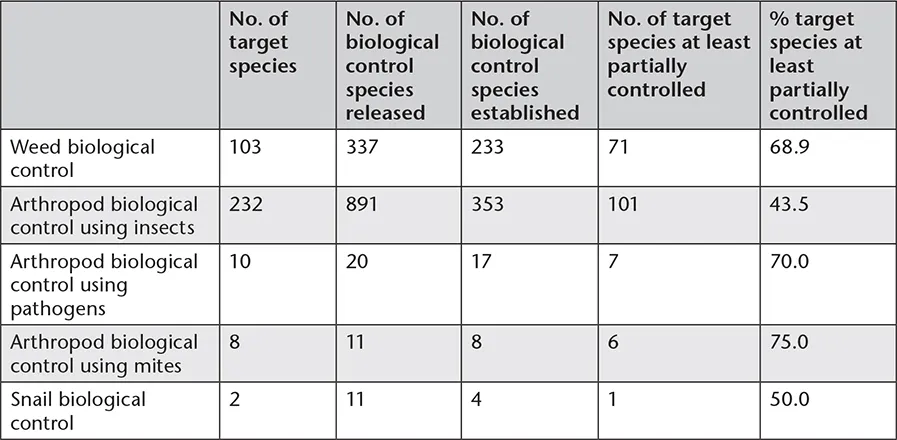
Collectively, there have been over 1200 biological control agents, including herbivorous arthropods, parasitoids, pathogens and mites, released into the Oceania region since the 1880s in an attempt to control over 300 target species, including weeds and arthropods (Table 14.1).
The number of weed biological control targets, biological control agents released and their status has been well documented in a global catalogue (Winston et al. 2014). There is also an online version, which is updated periodically, as new information becomes available (http://www.ibiocontrol.org/catalog/).
Table 14.1 Summary of biological control efforts in the Pacific region targeting weeds, arthropods and snails, using insects, pathogens and mites.
As data for arthropod biological control arose from different sources, arthropod biological control has been separated by the type of biological control agent.
Source: Summarised from Tables 14.2–14.6.
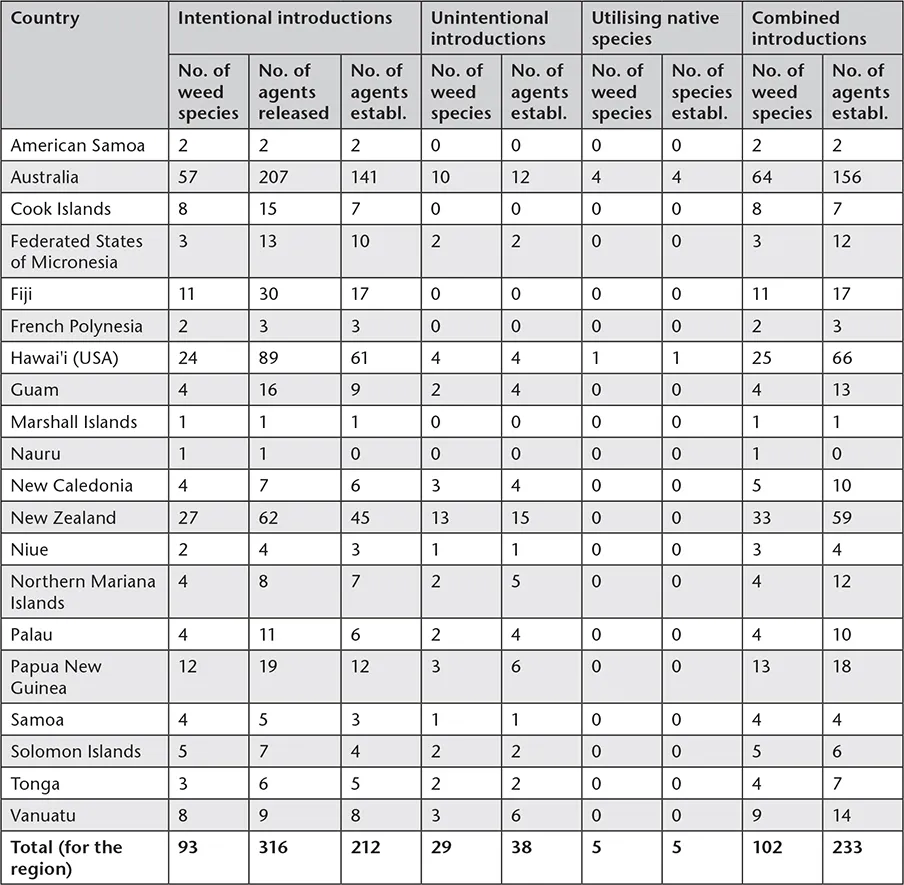
Table 14.2 The number of weed species targeted for biological control, the number of biological control agent species that have been deliberately introduced (intentional), and biological control agents that were not deliberately introduced but have been found (unintentional) and their impact in Australia, New Zealand, Hawai'i and the PICTs.
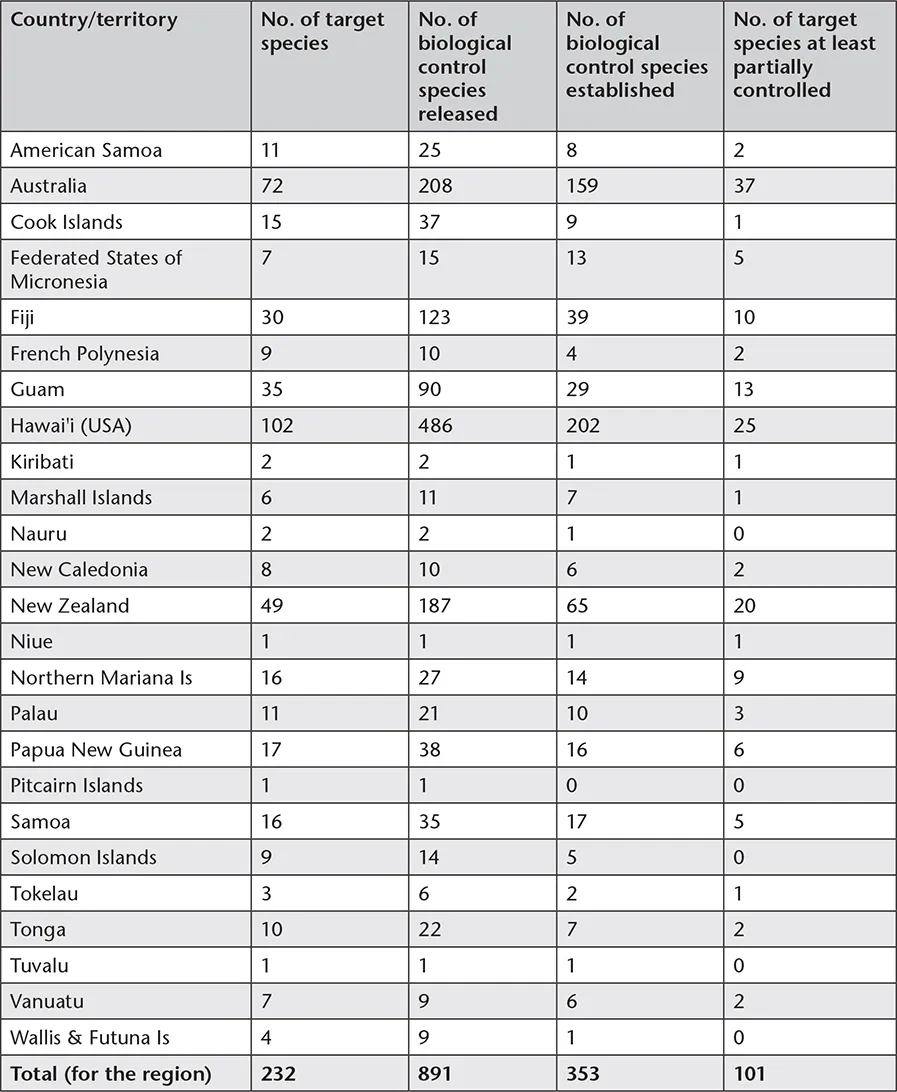
Table 14.3 The number of insect species targeted for biological control, the number of insect species deliberately introduced and their impact in Australia, New Zealand, Hawai'i and the PICTs.
Source: BIOCAT2010.3 database as described and summarised by Cock et al. (2016) with subsequent corrections.
To date, over 90 weed species, representing 37 plant families, have been targeted for biological control in all but five countries and territories (Kiribati, Pitcairn Islands, Tokelau, Tuvalu, and Wallis and Futuna) within the Oceania region, where over 310 biological control agent species, representing 59 families of insects, mites and pathogens, have been deliberately released (Winston et al. 2014). Reviews on weed biological control in Australia (Julien et al. 2012), the 22 PICTs (Day and Winston 2016) and Hawai'i (since 1980) (Conant et al. 2013) have been published in the l...
Table of contents
Cover
Half Title
Dedication
Title Page
Copyright
Contents
Acknowledgements
List of contributors
Introduction
HISTORY OF BIOLOGICAL CONTROL
BIOLOGICAL CONTROL IN THE 21ST CENTURY
SOCIOECONOMIC IMPACTS OF BIOLOGICAL CONTROL
BIOLOGICAL CONTROL SUCCESSES AND FAILURES
FUTURE PROSPECTS FOR BIOLOGICAL CONTROL
Index
Trusted by 375,005 students
Access to over 1.5 million titles for a fair monthly price.
Study more efficiently using our study tools.
Frequently asked questions
Yes, you can cancel anytime from the Subscription tab in your account settings on the Perlego website. Your subscription will stay active until the end of your current billing period. Learn how to cancel your subscription
No, books cannot be downloaded as external files, such as PDFs, for use outside of Perlego. However, you can download books within the Perlego app for offline reading on mobile or tablet. Learn how to download books offline
Perlego offers two plans: Essential and Complete
Essential is ideal for learners and professionals who enjoy exploring a wide range of subjects. Access the Essential Library with 800,000+ trusted titles and best-sellers across business, personal growth, and the humanities. Includes unlimited reading time and Standard Read Aloud voice.
Complete: Perfect for advanced learners and researchers needing full, unrestricted access. Unlock 1.5M+ books across hundreds of subjects, including academic and specialized titles. The Complete Plan also includes advanced features like Premium Read Aloud and Research Assistant.
Both plans are available with monthly, semester, or annual billing cycles.
We are an online textbook subscription service, where you can get access to an entire online library for less than the price of a single book per month. With over 1.5 million books across 990+ topics, we’ve got you covered! Learn about our mission
Look out for the read-aloud symbol on your next book to see if you can listen to it. The read-aloud tool reads text aloud for you, highlighting the text as it is being read. You can pause it, speed it up and slow it down. Learn more about Read Aloud
Yes! You can use the Perlego app on both iOS and Android devices to read anytime, anywhere — even offline. Perfect for commutes or when you’re on the go. Please note we cannot support devices running on iOS 13 and Android 7 or earlier. Learn more about using the app
Yes, you can access Biological Control by Peter G. Mason in PDF and/or ePUB format, as well as other popular books in Technology & Engineering & Ecology. We have over 1.5 million books available in our catalogue for you to explore.