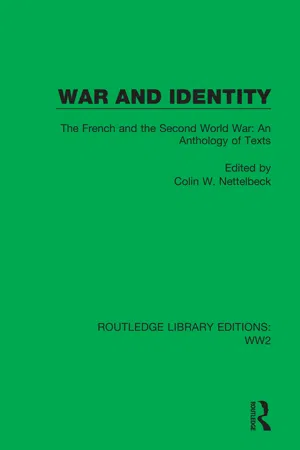
This book, first published in 1987, examines the elements that constitute the French identity through the experience of the Second World War – a constant point of reference, a landmark to which the collective consciousness returns again and again. The Occupation period and the national humiliation of the French military and political collapse has been perceived as more than a series of traumatic events, and in fact as a reality of mythical proportions that became a symbol of something grander, French identity itself.
eBook - ePub
War and Identity
The French and the Second World War: An Anthology of Texts
- 118 pages
- English
- ePUB (mobile friendly)
- Available on iOS & Android
eBook - ePub
1 On the eve of war: a nation divided
In France, national pride has often flourished alongside internal turmoil. One has only to think of the savage religious wars of the sixteenth and seventeenth centuries, or of the bloody campaign of terror during the Revolution, or of the ruthless repression of the Paris Commune rebellion in 1871, to be reminded that deep, and often violent, discord is a historical constant. It is thus not especially surprising to find that the France of the 1930s was racked with dissensions, but it is useful to examine the particular forms that these took, as they were to have considerable bearing on subsequent events and reactions.
Hitler’s rise to power in Germany had a destabilizing effect on Europe generally and from 1933 onwards this context of instability exacerbated France’s domestic conflicts. Social, economic, political, and religious problems were all inextricably linked to the possibility of confrontation with a traditional enemy whose aggressive stance could not but be threatening. Studies of France’s foreign policies at this time reveal confusion and contradiction, and if there was any general trend, it was that of a nation willing to try anything, and with some desperation, to avoid a war that at the same time it believed inevitable.
France’s inner turmoil surfaced with bitter passion at the time of the Stavisky Affair in early 1934. Serge Alexandre Stavisky was an urbane and clever swindler who had built up a vast financial empire, implicating police and politicians in a series of progressively more elaborate confidence tricks. When the scandal broke, the government handled it so badly that not only was the administration of the day toppled, but the very bases of the parliamentary institutions of the Republic were called into question. For the nationalists of the political Right, Stavisky, a Russian Jew, became the focus of antisemitic and antibolshevist sentiment. Stirred by the extremists of the Action Française,1 conservative groups actually laid siege to the Assemblée Nationale, sparking the 6th of February riots in the Place de la Concorde, where many were killed. Two days later, a counter-rally by the Left — the Radical, Socialist and Communist Parties — resulted in more deaths. More than symbolically, the riots of February 1934 mark the emergence of a public conflict of ideologies, none the less acute for being as yet ill-defined in the minds of ordinary people. For the British journalist Alexander Werth,2 France was in a state of latent civil war. Certainly the level of conflict in political and intellectual circles was high, and would remain so for the rest of the pre-war period, sustained by a vitriolic press that was largely unconstrained by laws of libel or defamation.
LEON BLUM AND THE ‘FRONT POPULAIRE’
From the early 1930s, many antifascist groups had sprung up in France, and after the February 1934 riots they were an important stimulus to the creation, in July 1935, of the Rassemblement populaire. This Front populaire, as it soon came to be called, enjoyed the enthusiastic participation of the major political parties of the Left and Centre-left (Communists, Socialists, and Radicals), of the major union organizations, as well as of numerous intellectual, cultural and professional associations. By the time of the 1936 national elections, the movement had been forged into a political machine, with a programme which, despite the hysterical ravings of the Right, won the favour of the electorate. In May 1936, the Front populaire became a government.
Its leader was Léon Blum (1872-1950), the head of the Socialist Party. He was a distinguished and cultivated writer and member of parliament, a committed idealist and pacifist, and a member of the powerful Conseil d’Etat.3 An object of admiration for his followers, Blum, with his internationalist philosophy and Jewish origins, was the very incarnation of everything that the Right feared and hated. Before the elections, and for the whole of the single year that his government lasted, he was subjected to an unremitting campaign of villification. Maurras said of him: ‘ce juif allemand naturalisé […] est un homme à fusilier, mais dans le dos.’4
The lasting achievements of the Front populaire were in the field of social justice for workers: the introduction of the forty-hour week and of paid holidays. Legislation emphasizing cultural development and the needs of the young also had long-term significance. Generally, however, the election was divisive, rather than unifying, of the national spirit. In a Europe where the expression of a strong French position was becoming more and more imperative, Blum’s government, while buoyed up by the enthusiasm for many for its social reforms, was lacking clear direction or commitment in its foreign policy.
The two following texts are from newspaper reports of the traditional May gathering at the Mur des Fédérés at the Père-Lachaise cemetery in Paris, just after the elections that brought the Front populaire to power. The occasion was the commemoration of the Commune of 1871, a revolutionary government set up in Paris in the wake of Napoleon III’s defeat by the Prussians. Although it was also recognized by a number of major provincial centres, and was thus an embryonic federation, it was brutally crushed by the army loyal to the national government led by Thiers. The last week of May — known as ‘la semaine sanglante’ — was especially bad, and included firing-squad executions along the wall of the Pére-Lachaise cemetery. (Hence ‘le mur des fédérés’.)
The first text is by Blum himself, and is taken from the socialist newspaper he directed, Le Populaire. He expresses his belief that the spirit of the Republic in France is inseparable from the revolutionary passion of the people. The repression of 1871 is recalled in some detail, and the electoral victory of the Front populaire is linked to the tradition of struggle for truth, freedom, and justice, that allowed the Commune’s defeat to be turned into moral victory. It is with considerable subtlety that Blum also implies a link between the earlier royalist and religious reactionaries and the fascists of 1936: ‘la menace fasciste’ is thus associated with precise images of execution, prison, and exile, as well as with the more general threat to democracy and the Republic.
The second text is from the right-wing weekly Gringoire, and is more pointed in tone and content. Anonymously written, it uses the techniques of making Blum appear guilty by his association with communists and a gangster. Then, by extension, the entire crowd, described as a mass, not as people, is drawn into the same comparison. The cemetery, personified, becomes the victim of an odious and vandalous invasion. The symbolism here would have been obvious for Gringoire’s readers: the Père-Lachaise, burial site of many of France’s most illustrious figures, is more than a national monument, it is a microcosm of the nation. The mobs of hooligans who defile the cemetery symbolize the defiling of France itself by the Front populaire. If the opening of the text is typical of the way in which the Right obsessively singled Blum out for personal attack, the three-part conclusion is a heavy rhetorical sneer of disgust: after the screaming of revolutionary songs from the graveyard crosses, and the picnics on the tomb-slabs, there was ‘worse still’: the reader’s imagination is incited to dwell on whatever additional horrors it might invent.
Each of the passages shows clearly its ideological bias. Together, they reveal the extent of ideological conflict.
«Ils sont morts pour la Republique»: Léon Blum
Vive la Commune! Vive le Gouvernement de Front populaire!
Ces deux cris ne sont pas rapprochés arbitrairement l’un de l’autre pour les besoins de l’actualité. Ils traduisent la même vérité. Ils expriment le même espoir. Pour reprendre la formule inscrite hier dans la manchette du Populaire, la commémoration des morts de la Commune dira l’espoir vivant des hommes d’aujourd’hui. Ils sont morts pour la Liberté. Ils sont morts pour la Justice sociale. Ils sont morts pour la République. Ils sont morts pour tout ce que le Front populaire incarne. Les combattants héroïques des barricades — à Paris et dans les villes de provinces, levées à l’appel de Paris — ont payé de leur sang le salut de la démocratic
Une répression féroce les a décimés. Ceux qui avaient échappé aux exécutions sur place ou aux fusillades méthodiques de Satory5 sont partis pour le bagne6 ou pour l’exil.
On les croyait vaincus, extirpés à jamais. Mais ces vaincus étaient cependant des vainqueurs. Sans la Commune révolutionnaire la réaction monarchique et cléricale se fût installé souverainement en France. Thiers avait écrasé la commune, et c’est la Commune qui imposa la République à Thiers. C’est le souvenir légendaire de la Commune, c’est la leçon des ses forçats et de ses qui préserva et qui prolongea la grande tradition de la democratic sociale.
Jamais, en France, on n’a pu séparer impuné-ment ces deux forces vivantes: l’idée républicaine, la passion révolutionnaire du peuple.
Le Rassemblement populaire contre la menace fasciste, la victoire électorate du 26 avril et du 3 mai sont dus à la combination de ces deux forces. Nous avons donc le droit d’invoquer aujourd’hui les morts glorieux en leur disant:
«Notre victoire est la vôtre . . . Vive la Commune! Vive le Front populaire!»
Source: Le Populaire, 24 mai 1936 (droits reserves)
Au Père-Lachaise
M. Léon Blum en personne avait sonné, le matin même, le rassemblement. Et c’est le poing tendu7 et grimaçant un rictus de haine qu’il a tenu à se faire photographier au pied du fameux Mur, entre les camarades Marcel Cachin8 et Maurice Thorez,9 et dans le voisinage du policier-gangster Bonny.10
Combien étaient-ils? Deux cent mille, trois cent mille peut-être? Il est difficile de chiffrer cette foule répandue sur les rues, les boulevards et à travers le Père-Lachaise.
Le grand cimetière fut livrè pendant toute l’après-midi à des bandes d’énergumènes déchaînés et sans respect pour la mort. Combien de chapelles furent odieusement souillées? Combien de fleurs arrachées? Combien de pauvres morts troublés dans leur sommeil par les vociférations, des ricanements, les plaisanteries de mauvais lieu et les insultes grossières inspirées soit par un nom gravé sur une dalle, soit par un monument pieusement élevé par une famille en deuil?
On vit, à cheval sur des croix, des voyous hurler La Carmagnole et L’Internationale.11
On vit des faucons rouges casser démocratique-ment la croÛte12 sur des dalles funéraires.
On vit pis encore.
Source: Gringoire, 29 mai 1936 (droits réservés)
CIVIL WAR IN SPAIN
The outbreak of civil war in Spain in July 1936 gave Europe a foretaste of what was to come a few years later. France and Britain, afraid that any effort on behalf of the legitimate Spanish Republican government might lead to a widening of the conflict, decided on a policy of nonintervention. The fascist governments of Italy and Germany provided considerable aid, in men and materials, to the Falangists, led by General Franco. Only the USSR sent official aid to the Republicans, but volunteers from all over the world flooded into Spain to join the ‘International Brigades’ in the fight to save democracy.
Acts of savagery and brutality were numerous on both sides. Republicans massacred priests and nuns and burned down churches. Falangists indiscriminately executed workers and peasants, and bombed civilian populations. For the French, what was happening south of the Pyrenees had obvious relevance to their own situation. The Right used the chaos and the atrocities committed by the Spanish Republicans to issue warnings of what would result from the government of the French Front populaire. The parties of the Left saw in the Spanish struggle an image of their own fight for liberty and justice and against fascism.
André Malraux (1901-1976) was one of France’s most brilliant and adventurous intellectuals and novelists. For him, the Spanish situation was both a personal challenge and a moral imperative. With extraordinary energy and initiative, he managed to gather enough men and materials for the creation of a small airforce squadron, which he directed, and which played a useful role for the Republicans in the early stages of the war. Although he remained only a short time in Spain, he produced from the experience an important novel, L’Espoir (1937), made a film of the same name, and travelled widely in Europe and to the USA to lecture on the dangers of the rising fascist tide.
Malraux’s actions and attitudes prefigure the spirit that during the Second World War would motivate the resistance (in which Malraux was moreover to play a significant part). His personal boldness and courage, and above all his willingness to take risks to defend the causes in which he believed, were signs of a vital responsiveness and responsibility sadly lacking in the weak and worried inactivity of successive French governments. Malraux in Spain is a prototype of the de Gaulle who in 1940 would refuse to accept defeat. Inspired by a similarly grand vision of History, the two men would, after the Second World War, ultimately become colleagues in the government of the new France.
The following extract from L’Espoir recounts an episode in which Malraux had no direct involvement: a major engagement of the International Brigades, in the siege of Madrid. There is realistic detail, however, in the portrayal of the battle scene at the University City, as three soldiers try to retrieve a wounded comrade in the wet fog of a night illuminated by reflections of the burning city. The text also translates some of the civil war’s more painful paradoxes: such as the adversaries being the Moors of Franco’s Foreign Legion and the Germans of the International Brigades. (The latter were also involved in a ‘civil war’, in that they were being bombed by Hitler’s Condor Legion.) Through these symbols, Malraux succeeds in suggesting the wider implications of the war for Europe and the world. At this level, the stalemate described at the end of the text evokes the gloom and high tension so widely spread in the Europe of 1937. The use of the present tense creates immediacy and urgency, and renders the author...
Table of contents
- Cover
- Half-Title Page
- Title Page
- Copyright Page
- Original Title Page
- Original Copyright Page
- Table of Contents
- Acknowledgements
- Introduction: a story of trauma and recovery
- 1 On the eve of war: a nation divided
- 2 The débâcle (10 May–20 June 1940)
- 3 Occupation I: disillusionment and illusions
- 4 Occupation II: abjection and hope
- 5 Liberation, purge, and the quest for a new France
- 6 Looking back
- Conclusions
- Chronology
- Notes
- Further reading
- Index
Trusted by 375,005 students
Access to over 1.5 million titles for a fair monthly price.
Study more efficiently using our study tools.
Frequently asked questions
Yes, you can cancel anytime from the Subscription tab in your account settings on the Perlego website. Your subscription will stay active until the end of your current billing period. Learn how to cancel your subscription
No, books cannot be downloaded as external files, such as PDFs, for use outside of Perlego. However, you can download books within the Perlego app for offline reading on mobile or tablet. Learn how to download books offline
Perlego offers two plans: Essential and Complete
- Essential is ideal for learners and professionals who enjoy exploring a wide range of subjects. Access the Essential Library with 800,000+ trusted titles and best-sellers across business, personal growth, and the humanities. Includes unlimited reading time and Standard Read Aloud voice.
- Complete: Perfect for advanced learners and researchers needing full, unrestricted access. Unlock 1.5M+ books across hundreds of subjects, including academic and specialized titles. The Complete Plan also includes advanced features like Premium Read Aloud and Research Assistant.
We are an online textbook subscription service, where you can get access to an entire online library for less than the price of a single book per month. With over 1.5 million books across 990+ topics, we’ve got you covered! Learn about our mission
Look out for the read-aloud symbol on your next book to see if you can listen to it. The read-aloud tool reads text aloud for you, highlighting the text as it is being read. You can pause it, speed it up and slow it down. Learn more about Read Aloud
Yes! You can use the Perlego app on both iOS and Android devices to read anytime, anywhere — even offline. Perfect for commutes or when you’re on the go.
Please note we cannot support devices running on iOS 13 and Android 7 or earlier. Learn more about using the app
Please note we cannot support devices running on iOS 13 and Android 7 or earlier. Learn more about using the app
Yes, you can access War and Identity by Colin W. Nettelbeck in PDF and/or ePUB format, as well as other popular books in History & Military & Maritime History. We have over 1.5 million books available in our catalogue for you to explore.