In this book, first published in 1940, Leonard Woolf lays out the necessity for the establishment of a system providing for the rule of international law and cooperation, control of international power and collective defence against international aggression. He lays bare the issues at stake in the Second World War and draws lines on which a lasting peace could be framed.
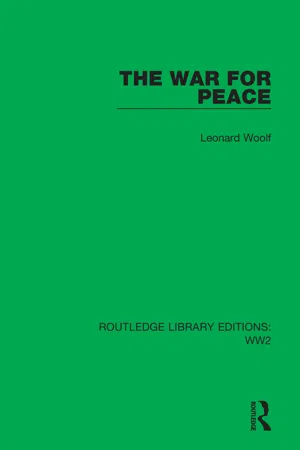
- 250 pages
- English
- ePUB (mobile friendly)
- Available on iOS & Android
eBook - ePub
The War for Peace
CHAPTER I WAR
BETWEEN 1914 and 1918 the Great Powers of Europe fought what came to be known as the Great War, and before it ended the two Great Powers outside Europe, the United States of America and Japan, and most of the smaller states of the world had been drawn into it. A world war is a world war; a world war means that all over the habitable globe, in Europe, in the Far East, in central Africa, and around the coasts of the two Americas, human beings kill or try to kill one another. That was, in plain and unadorned language, what people were doing or trying to do on a vast scale in 1918. It is to be presumed that they had, or thought they had, some object in doing so.
The war ended on November 11, 1918, and the world was once more at peace. Twenty-one years later another war broke out between those European Great Powers which had been the protagonist combatants of 1914 to 1918. It is not yet a world war, but it belongs to the category of great wars. This page is being written on the first day of the year 1940. To-day four out of five of the Great Powers of Europe are at war; at the other end of the world, in the Far East, Japan is engaged in a private war of her own, which involves 450,000,000 unfortunate inhabitants of China. Once more, therefore, hundreds of millions of the earth’s population are engaged, with solemn concentration, in an organized effort to kill one another. The effort is meeting with considerable success, as it has done on previous occasions, and, since the human race is supposed to have a certain amount of reason and intelligence and to have attained a modest standard of civilization, one is forced to assume, at any rate on the first page of a book, that, as in 1914, those who are to-day engaged in this organized effort have, or think they have, an object in making it.
The statements in the last two paragraphs are platitudinous truisms. They sound a little silly. The bare truth, expressed in simple and homely language, such as a man is accustomed to use to his wife, his child, or his dog, nearly always sounds silly in politics and history, but it is none the less true. It is rarely thought of and never stated. The plain, unadorned truths which are the roots of politics and determine history get covered over by the complication of events, obscured by long words, resounding phrases, fierce emotions, the intricate criss-cross of human desires and objects, the cunning of the politician, and the ingenuity of learned theorists. They are nearly always forgotten until it is too late to remember them, but they continue to exist; they are the stark, stupid realities which in the end mainly determine the success of those who remember and the failure of those who forget them.
This book is concerned with international relations and war and peace. It will have to deal with the complicated organization and practice of the relations between states, the tangled history of foreign policy, the fierce emotions of patriotism and nationalism, the intricate objects of national policy, the relation between power and national interests. All these things are relevant to the problem of war and peace, to the question, which is the main subject of this book, whether, when this war ends, it is or is not possible to regulate and organize the relations of Europeans and their states in such a way that periodic great wars become improbable. To-day and during the last twenty-five years the most important element in regulating those relations has been and is war. It is therefore necessary to start from this homely, if stupid, truth about war. War is to-day an organized effort by vast numbers of Europeans to kill one another, and it must be presumed that they have, or think they have, an object in doing this. The question which this book really tries to answer is: What is their object or what do they think it to be, and is war in fact a good method of attaining it? The question is not a simple one; it leads one far afield into history, politics, psychology, and even perhaps philosophy. I am well aware that, like everyone else, I shall be again and again in danger of forgetting, during the argument, what war really is. That is why I wish, both for my own sake and for the sake of the reader, to insist upon this simple truth about the nature of war. Whatever be its cause or its object, it remains an organized effort by vast numbers of human beings to kill one another. Provided that we have got that firmly fixed in our mind, we are in a position to go on to consider whether such action is a necessary or appropriate method of regulating the relations of human beings, organized in nations or states. Let us begin by examining the nature of war a little more closely. War is the supreme instrument of national power, the means by which in the last resort a state tests its power in relation to other states or, in other words, whether it can impose its will upon them by force. The power of states in relation to one another depends upon a large number of different factors, e.g. size of population, extent of territory, geographical position in so far as that may give it strategical or economic advantages or disadvantages, its control of raw materials, the organization of its industries, the capacities and training of its citizens, and the efficiency of its government. The relative power of two states is simply the relative ability of each to impose its will upon the other by force or the threat of force. Suppose you have a state A with a government X and a state B with a government Y; then A is more powerful than B if X can compel Y to do what X desires; B is less powerful than A, if Y cannot do what Y desires owing to X.
The power of one state may in certain circumstances be used hostilely with effect against another without war. Before the war of 1914 the geographical position of Austria gave it considerable power, mainly of an economic nature, over Serbia, and the Austrian government used this economic power on more than one occasion to compel the Serbian government to do, against its own will, the will of the Austrian government. But the ultimate arbiter of national power in the world of states, as we have known it for the last hundred years, has been war, and behind the use of economic power as an instrument of policy in peace has always lain the threat of military force. This was certainly the case as between Serbia and Austria; Austria’s economic power over Serbia was always exercised in peace, and was only effective, because behind it was the threat of war, and the great war actually began because the Austrian government decided that the time had come when the threat must be carried out and the final test of power should be made in war. That particular case shows another important fact about national power, namely that it does not depend solely upon the intrinsic possessions, position, qualities, etc., of a state. Its potential power may also depend upon alliances, and a state, like Serbia, which by itself was unable to resist the will of Austria, may with the help of allies not only successfully resist, but destroy its more powerful opponent.
War is, then, the ultimate test or arbiter of national power as between states. It decides, or is intended to decide, which of two states is the stronger, i.e. which can impose its will upon the other by force. That does not alter the fact which was stated in the first paragraphs of this book, and which the reader, I hope, will keep in his mind until the book ends, the fact that war is an organized effort of human beings to kill one another in large numbers. On the contrary, the one fact is the corollary of the other. A state is not a person, though metaphorically we all speak of it as such and some deluded people have even believed that some mystic personality attaches to states. A state is a group or association of separate persons, inhabiting a certain defined territory, united under a common government. A state, as compared with a person, is an abstraction—no one has ever seen, touched, smelt, or tasted a state; no one has ever heard a state speaking, even out of the thunder on Mount Sinai or on the radio. A state cannot therefore bring its power or force to bear directly on another state, nor can the “government” of a state exercise power or force directly against the “government” of another state. For political purposes power can only be used against individuals and force can only be made operative or effective against individuals. A state has no power, no force, and no will except metaphorically; in the world of real life its power, force, and will can only be applied by individuals against individuals.
When, therefore, we speak of the power of one state being greater than that of another or of the power of one state being used to compel another state to do this or that or not to do this or that, we mean in the last resort that certain individuals in state A are able to take certain action which effectively compels certain individuals in state B to do this or not to do that. Power is always applied by individuals to individuals; there are many different ways of exercising it, but there is a family likeness in most forms of force. The more powerful man confronts the weaker man with some form of physical force and a choice of evils, the least of the evils being, ex hypothesi, to yield to the will of the stronger. In societies in which the use of sheer physical force by individuals has not been regulated and circumscribed, the strong man uses his power over the weak man by compelling him to choose between death, torture, or beating and doing what the strong man wants. If you hear a noise downstairs in the middle of the night and, on investigation, find yourself confronted in your dining-room by a burglar holding your silver spoons in one hand and a revolver in the other, his power is exercised by confronting you with a choice between being shot and letting him escape with your spoons. In more civilized societies, power is often exercised in accordance with the laws of economics rather than ballistics, and the individual in an economically strong position may force his weaker brother to work for a certain wage by confronting him with a choice between starvation and doing what the strong man asks him to do. In all these cases the weaker individual may resist and then the actual force may be applied—then there will be killing, beating, or starving.
A state or a government cannot be killed, beaten, or starved; it is individuals, citizens of the state, or members of the government, who can be killed, beaten, or starved. Or they may be imprisoned or put into concentration camps or made to drink castor oil—but no one has ever tried to imprison a state or dose it with castor oil. It is, therefore, only metaphorically that we can say that a state has power or can exercise power; what we really mean when we say that a state like Germany is more powerful than Poland, or Italy than Albania, or Britain than the Transvaal, is that the inhabitants of a certain area of territory, owing to the possession of certain advantages, such as numbers or strategical position or arms or control of raw materials or the development of their industry or agriculture, can compel the inhabitants of the other area of territory by force to do what they want them to do. National policy is what the inhabitants of a state want to do, or more usually what their government wants to do in their name, in relation to the inhabitants of other states; it is the political objective or purpose which the individuals inhabiting a particular area of territory pursue in their relations with individuals outside that territory. The connection of power with policy is, therefore, of the utmost importance. Power policy, as it is called, or the use of power as an instrument of national policy, means that the individuals inhabiting a certain territory use their power against the individuals outside their territory in order to achieve by force their purpose or objective.
Many people will think that in the previous paragraph I am still uselessly announcing obvious platitudes and irrelevant truisms. On the contrary, these are by far the most important and relevant, and most neglected, truths about policy and international relations. They are the real facts which lie behind history and war and peace; they will probably decide the fate of civilization and may determine whether you who read this sentence live to old age and die in your bed or are needlessly blown to pieces in youth by a high explosive shell. If the governments and the doomed citizens of these fictitious “Great Powers” really understood these facts and kept them steadily before their minds when they thought and talked about “international policy”, they would cease to believe nearly all the deadly nonsense and fairy tales which now determine the relations of sovereign states, questions of war and peace, and the future of civilization. And if learned writers on history and politics would do the same, they would not only turn a great deal of rubbish out of their own minds and books, but might cease to spin out of the same deadly nonsense and fairy tales the cleverest theories to support or rationalize our social savagery and political stupidity.
These childish and elementary facts about states, individuals, power, force, and policy are peculiarly relevant if you are considering the problem of war and international relations, the question whether war is a necessary element in human society. War is the ultimate instrument of national policy when that policy is based upon power. War breaks out when, to use the inaccurate language in which we normally talk about politics, a state decides to impose its policy upon another, if necessary, by force, and the other decides to resist. Translated into the world of facts and reality this means that a large number of individuals inhabiting a certain area have to use such power as they possess individually and collectively to compel a large number of individuals in another area to do what they do not want to do. The exercise of power by an individual against an individual or by a few individuals against a few individuals in immediate contact with one another is a comparatively simple matter. The question who is the stronger can be settled on the spot by physical force, if there is resistance on one side or the other, and the instruments of effective power are beating, torturing, imprisonment, or in the last resort killing. But for enormous numbers of individuals to exercise power, individually and collectively, against enormous numbers of individuals hundreds or thousands of miles away is a much more complicated business. Germany cannot beat, torture, imprison, or kill Britain, and in fact 78,000,000 Germans living in Germany cannot beat, imprison, or kill 46,000,000 Britons living in England, Scotland, and Wales. The exercise of direct physical violence by the government against the government, e.g. by Adolf Hitler against Neville Chamberlain, is also not feasible,1 or at least has not so far been accepted as a method of settling international disputes by force. The ingenuity of man has therefore devised war and gradually elaborated the complicated system of modern war by which national groups of individuals can test their power and so regulate their differences by force.
Modern war is extremely complicated, but all war merely adapts to large numbers of individuals the ordinary methods of using power or force against a single individual or a few individuals. This is inevitable because the ways in which power can be exerted and force used are strictly limited. In the playground of any school you may watch a large boy exert his power over a small boy by methods which were certainly used in the same way and for similar purposes by our ancestors in the Stone Age. It was my duty at one time as a representative of His Majesty King Edward VII to stand in a prison courtyard and see that a sentence of flogging was duly executed upon a prisoner or that a condemned murderer was hanged by the neck until he was dead. The scene was in Asia, the period the twentieth century a.d., the time an early tropical morning before breakfast, which was always chosen for these ceremonies. As I stood with the Superintendent of the Prison, who came from Wormwood Scrubbs, the Superintendent of Police, who came from Repton, and the Medical Officer, who came from Edinburgh, with the mountains towering up into the clear sky above the prison walls, the representative of the “power of the state” and of “the force of society”—inappropriately dressed in a white suit and a sun-helmet—who had come to see that the ultimate instruments of that social power and force should be used in due form against an individual, I was aware that 3,800 years ago, not so very far away beyond the mountains in the valley of the great Asiatic rivers, the bearded representatives of Hammurabi, Emperor of Sumer and Akkad, had watched the power of the state and the force of society executed in precisely the same way and by the same methods against the recalcitrant individual. And to-day in Europe, when a Hitler in Germany, a Mussolini in Italy, or a Stalin in Russia sets up a dictatorship, which is a personal or oligarchic government based upon power and force, they may call it fascism, national-socialism, or communism, but the methods by which they establish and maintain their power, use their force, and impose their will—the executions, purges, liquidations, imprisonments, beatings, castor oil, concentration camps, and forced labour—are the same which all dictators have been compelled to use from the time of Melchisidek to the year 1940.
These facts apply to interstate relations no less than to relations between individuals and between governments and their own citizens. They set narrow limits to the way in which the “power of a state” can be exercised against another, if it is no longer a question of threats, but of the use of force and physical violence. Power, as we have seen, can only be exercised upon individuals, and, if it comes actually to the use of force, only by confronting individuals physically with a choice of evils. War is only the necessary adaptation of these facts to the use of power and force by large masses of men against large masses of men. The power of an individual A is operative and successful against an individual B, when A is able to force B to do unwillingly what A wants him to do, because B would rather do that than suffer some physical evil, such as pain, imprisonment, hunger, or death which A can inflict on him. Under similar circumstances, a large number of individuals, whom we personify as a state, can only impose their will upon another large number of individuals, whom we personify as another state, if the first can force the second to do what they want, because the second group would rather do this than suffer the physical evils which the first group is able to inflict upon them. Experience has proved that death is a physical evil which most human beings will do almost anything to avoid. Imprisonment, beating, torture, starvation are all excellent and well-tried instruments of power, effective varieties of force, but, when all is said and done, there is nothing like death.
The efficacy of killing and death as forms of force and therefore as instruments of power has determined the nature of war, which is the instrument of national power. War has a long history and has changed its superficial characteristics from age to age, in accordance with the changes in men’s way of life and the weapons which they have devised for killing one another. It has always used and still uses the lesser forms of misery through which power is made effective and groups of individuals may be forced to do what they do not want to do. Starvation, for instance, has always been a pretty good instrument of national power. If the individuals inhabiting Great Britain, owing to geographical position, possession of ships, and some other things, are able to inflict starvation or semi-starvation upon the individuals inhabiting Germany, the former will probably be able to impose their will on the latter and “Great Britain” will then have proved herself a more powerful state than “Germany”. But the trouble about starvation and other similar forms of force is that they lead almost logically and inevitably to killing, simply because in a world ordered by force death is king. The starving will resist the starvers by every means in their power, and to kill your opponent is the most convincing form of resistance. Also the starver says to the starved: “If you don’t do what I want, I shall starve you, and if you won’t be starved, well, I must kill you.” And further, where you have large numbers of individuals attempting in the name of states or nations to apply force to one another, killing is extraordinarily effective, or at first sight appears to be so; by killing enough individuals on the other side you may put the fear of death into the survivors so that they will do what you want in order to escape being killed. So that from whatever side you start in this system of national power, force, and war, you get back to death and killing.
These are the causes which de...
Table of contents
- Cover
- Half-Title Page
- Title Page
- Copyright Page
- Original Title Page
- Original Copyright Page
- Table of Contents
- The War for Peace
- I War
- II Power, Interests, and Politics
- III Peace
- IV A Note on Reason
Trusted by 375,005 students
Access to over 1.5 million titles for a fair monthly price.
Study more efficiently using our study tools.
Frequently asked questions
Yes, you can cancel anytime from the Subscription tab in your account settings on the Perlego website. Your subscription will stay active until the end of your current billing period. Learn how to cancel your subscription
No, books cannot be downloaded as external files, such as PDFs, for use outside of Perlego. However, you can download books within the Perlego app for offline reading on mobile or tablet. Learn how to download books offline
Perlego offers two plans: Essential and Complete
- Essential is ideal for learners and professionals who enjoy exploring a wide range of subjects. Access the Essential Library with 800,000+ trusted titles and best-sellers across business, personal growth, and the humanities. Includes unlimited reading time and Standard Read Aloud voice.
- Complete: Perfect for advanced learners and researchers needing full, unrestricted access. Unlock 1.5M+ books across hundreds of subjects, including academic and specialized titles. The Complete Plan also includes advanced features like Premium Read Aloud and Research Assistant.
We are an online textbook subscription service, where you can get access to an entire online library for less than the price of a single book per month. With over 1.5 million books across 990+ topics, we’ve got you covered! Learn about our mission
Look out for the read-aloud symbol on your next book to see if you can listen to it. The read-aloud tool reads text aloud for you, highlighting the text as it is being read. You can pause it, speed it up and slow it down. Learn more about Read Aloud
Yes! You can use the Perlego app on both iOS and Android devices to read anytime, anywhere — even offline. Perfect for commutes or when you’re on the go.
Please note we cannot support devices running on iOS 13 and Android 7 or earlier. Learn more about using the app
Please note we cannot support devices running on iOS 13 and Android 7 or earlier. Learn more about using the app
Yes, you can access The War for Peace by Leonard Woolf in PDF and/or ePUB format, as well as other popular books in History & Military & Maritime History. We have over 1.5 million books available in our catalogue for you to explore.