The existence of water, energy, and food (WEF) is critical for people to fulfil their basic needs, to achieve welfare, and to support the Sustainable Development Goals (SDGs). The WEF security topic is becoming widely discussed in developing and developed countries. Major components of WEF security i.e. availability, accessibility, and quality should be achieved integratedly to avoid unexpected impacts. The interconnectedness among endogenous and exogenous variables such as environmental, socio-economic, and political factors makes this issue immensely complex. The nexus approach attempts to integrate management and governance across sectors and scales to improve WEF security. This study aims to grasp WEF security in a local context and evaluate the implications of planned local interventions by developing a conceptual and quantitative analysis with local stakeholders. Karawang Regency in Indonesia is chosen as the case study. Several strategies for WEF-related sectors are formulated using location quotient (LQ) and competitive position (CP) methods. In addition, qualitative and quantitative system dynamics models are established by involving related stakeholders through group model building. Finally, a nexus-based framework for WEF security is developed to assist local policymakers in doing the evaluation and planning of WEF resources in the region.
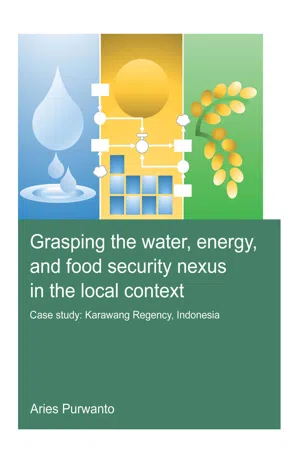
eBook - ePub
Grasping the Water, Energy, and Food Security Nexus in the Local Context
Case study: Karawang Regency, Indonesia
- 174 pages
- English
- ePUB (mobile friendly)
- Available on iOS & Android
eBook - ePub
Grasping the Water, Energy, and Food Security Nexus in the Local Context
Case study: Karawang Regency, Indonesia
About this book
Information
1
Introduction
1.1 Background
The existence of water, energy and food are important for people to achieve welfare, alleviate poverty and reach a sustainable level of development (FAO, 2014 ). Based on world projection in the next decades, Hoff (2011) concludes there will be a prominent increase of water, energy, and food demand due to the pressure of population growth, economic activities, the changes in diets, culture, technology, and climate. In addition, notwithstanding the global development process has quickly sped up over the past 50 years, there is still lack of equity in distribution between and within countries in gaining advantages especially in water, energy and food security. Water, energy, and food security-related challenges are getting urgent and need to be resolved simultaneously in an integrative manner. This is exacerbated by diminishing resource bases both in quantity and quality due to natural and human activities pressuring these resources. De Fraiture & Wichelns (2010) underline that increasing water demand for urban, industrial and environmental protection will escalate competition with the rising need of water for agriculture. Globally, the energy demand will almost double, while the demand of water and food are foreseen to escalate by more than 50% in 2050 (IRENA, 2015 ).
The World Food Summit in 1996 defined food security as where ‘all people at all times have physical and economic access to sufficient safe and nutritious food to meet their dietary needs and food preferences for an active and healthy life’. Food production, food accessibility and food quality are three key elements in food security. Almost in the same way, water security as described by UN-Water is ‘the capacity of a population to safeguard sustainable access to adequate quantities of acceptable quality water for sustaining livelihoods, human well-being, and socio-economic development, for ensuring protection against water-borne pollution and water-related disasters, and for preserving ecosystems in a climate of peace and political stability” (UN-Water, 2013). In terms of energy security, the International Energy Agency (IEA) in 1974 defined it in a clear way as ‘an uninterrupted availability of energy sources at an affordable price’. Hoff (2011) underlines that resources availability is not the one and only factor of security.
Accessibility and quality are also crucial to be covered especially in the extreme condition that exist naturally, economically, and socially. Resource availability can be defined as physical existence of the resource to meet demand in all level (from household to national level). Furthermore, accessibility of resource means that the resource is easily to obtain and in affordable price, while quality aspect interpreted as the ability of the resource to meet quality standard which has been set for certain purpose such as the guideline on drinking water quality established by World Health Organization (see WHO, 2017).
Water, energy, and food security are becoming a major topic that is vigorously discussed not only in developing countries but also in developed countries. The interaction among their components internally and interconnection with environment condition, social, governance and even political situation make this issue is immensely complex. Achieving certain levels of water, energy and food security simultaneously is a complex challenge that will influence, and is influenced by other sectors including social, political, and environmental condition (Bizikova et al., 2013; Endo et al., 2015). Resolving one problem partially without considering its interlinkage will only shift problems from one resource perspective to another and may cause unexpected effects (Kenway et al., 2011; Bizikova et al., 2013; FAO, 2014 ; El Gafy et al., 2016). Additionally, focusing only on one certain aspect of security, without considering others may also cause unbalanced supply and ineffective target achievement, or could even damage the sustainable us of other resources.
1.1.1 WEF security nexus concepts
The basic concept of the water, energy, and food security nexus approach has been developed and extensively discussed in Bonn 2011 Conference. In its background paper, the nexus approach is defined as ‘an approach that integrates management and governance across sectors and scales’ (Hoff, 2011). The paper also provided evidence that this approach is effective to enhance water, energy, and security by improving efficiency, lowering trade-offs, developing synergies, and improving governance. Nevertheless, there are still knowledge gaps in this approach including analytical framework disharmony for overcoming institutional disjunctions and power imparity among sectors. There is no sole technique able to be applied for every specific circumstance suitably (Endo et al., 2015). Thus, to deal with different and specific situation in each region, deconstruction of the nexus approach (Lele et al., 2013) and specific context elaboration (El Gafy et al, 2016) have to be considered in order to make more effective and contextualized solutions on water, energy, and food security and to assist decision makers in managing resources. The WEF security nexus framework established by Holger Hoff becomes the main reference of many WEF nexus studies all over the world.
1.1.2 WEF security in Indonesia
Indonesia has almost all the resources that are needed in achieving WEF security such as oil...
Table of contents
- Cover
- Half Title
- Series Page
- Title Page
- Copyright Page
- Dedication
- Summary
- Contents
- 1 Introduction
- 2 WEF nexus: Knowledge gaps, criticisms, and improvements
- 3 WEF-related sectors in local economic development
- 4 Group model building on qualitative WEF security nexus dynamics
- 5 Quantitative simulation of WEF security nexus
- 6 Synthesis and recommendation
- Appendix
- References
- List of Acronyms
- List of Tables
- List of Figures
- Acknowledgements
- About the Author
Trusted by 375,005 students
Access to over 1.5 million titles for a fair monthly price.
Study more efficiently using our study tools.
Frequently asked questions
Yes, you can cancel anytime from the Subscription tab in your account settings on the Perlego website. Your subscription will stay active until the end of your current billing period. Learn how to cancel your subscription
No, books cannot be downloaded as external files, such as PDFs, for use outside of Perlego. However, you can download books within the Perlego app for offline reading on mobile or tablet. Learn how to download books offline
Perlego offers two plans: Essential and Complete
- Essential is ideal for learners and professionals who enjoy exploring a wide range of subjects. Access the Essential Library with 800,000+ trusted titles and best-sellers across business, personal growth, and the humanities. Includes unlimited reading time and Standard Read Aloud voice.
- Complete: Perfect for advanced learners and researchers needing full, unrestricted access. Unlock 1.5M+ books across hundreds of subjects, including academic and specialized titles. The Complete Plan also includes advanced features like Premium Read Aloud and Research Assistant.
We are an online textbook subscription service, where you can get access to an entire online library for less than the price of a single book per month. With over 1.5 million books across 990+ topics, we’ve got you covered! Learn about our mission
Look out for the read-aloud symbol on your next book to see if you can listen to it. The read-aloud tool reads text aloud for you, highlighting the text as it is being read. You can pause it, speed it up and slow it down. Learn more about Read Aloud
Yes! You can use the Perlego app on both iOS and Android devices to read anytime, anywhere — even offline. Perfect for commutes or when you’re on the go.
Please note we cannot support devices running on iOS 13 and Android 7 or earlier. Learn more about using the app
Please note we cannot support devices running on iOS 13 and Android 7 or earlier. Learn more about using the app
Yes, you can access Grasping the Water, Energy, and Food Security Nexus in the Local Context by Aries Purwanto in PDF and/or ePUB format, as well as other popular books in Biological Sciences & Environmental Science. We have over 1.5 million books available in our catalogue for you to explore.