- 104 pages
- English
- ePUB (mobile friendly)
- Available on iOS & Android
eBook - ePub
The Lodger (NHB Modern Plays)
About this book
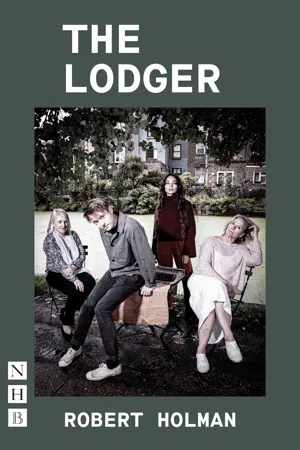
Sisters Dolly and Esther grow up in ultra-conservative Harrogate in the 1960s. Fifty years later, following the death of their mother, Dolly comes to stay with Esther – now a successful novelist and living in Little Venice with her younger, inscrutable lodger, Jude.
The three go to Norway to meet the rock-star grandfather Jude has only ever heard about. Instead, he meets Anila who changes his world. To make a new future, these four people will have to be honest, heal old wounds – and two sisters learn to laugh together again.
The Lodger by Robert Holman is an enlightening, cathartic and acerbic play about identity, maturity and reconciliation. It premiered at The Coronet Theatre, London, in September 2021.
'Great riches… A story of sisters and midlife reckonings, [Robert Holman's play] puts two older women centre stage and comes with a seismic sibling betrayal… stuffed full of wise statements about life, love and death' - Guardian
'Robert Holman [is] the most instinctive and humane of British playwrights' - Evening Standard
Information
ACT ONE
Scene One
A spacious utility room in the basement of a flat (on two floors) in Little Venice. A July day, after midnight. There is a big, shuttered window and a door close by, both open to let in the air. The traffic sounds of London come into the room too easily through the heat of the night. Outside are metal steps down from the street above, and a yellow street light. A washing machine on the dry cycle. An old cooker and a new fridge. A square sink with old taps. A new boiler. A sideboard and a wardrobe with a broken door. A good oak table, chairs, and the paraphernalia of lives lived. There are pictures on the walls and rugs on the floor.
JUDE, a young man in his twenties, is on the sofa. He is throwing darts at a dartboard on the wall some distance away. Most of the darts miss and hit the wall or simply land on the floor. There are hundreds of them and many marks splintered in the wood. ESTHER, in her sixties, comes down the steps outside and into the room. She has a bunch of red flowers. She switches on the light. She puts the flowers on the table and starts to deal with them.
ESTHER. I haven’t seen you for a day or two.
JUDE. I’m here now. Is there a problem?
ESTHER. I went for a walk along the canal on the hottest evening of the year. The air is about to burst. (She smells one of the blooms.) I hope it was legal.
JUDE. I’m as honest as Jesus. Would I ever be anything else?
ESTHER. When did growing cannabis in a pot plant become a good idea? (She finds scissors to cut the stems.) We’d go along to the old cricket pavilion, tumbled down with nails sticking up, to smoke dried banana skins and make believe we were marrying The Beatles, in my case John. Be careful. I’m always more cunning than I need to be.
JUDE (he throws a dart. He sits up). The twenty-four-hour shop closes at eleven so you can’t have got them there.
ESTHER. What?
JUDE. The flowers, they’re beautiful.
ESTHER. A forgetful soul put them down by a bench on the towpath and left them there, like we frequently misplace umbrellas.
JUDE. It’s not like you.
ESTHER. What’s not like me?
JUDE. To pick up something that doesn’t belong to you. It’s such a servant thing to do.
ESTHER. At this second, I’d be happy to be a servant.
JUDE. If you’d ever been a servant you’d soon change your mind.
ESTHER. It’s a splendid thing to have no responsibilities, I imagine.
JUDE (he gets to his feet). What’s the matter?
ESTHER. Jude, since I’ve just come in, I’ve obviously been out.
JUDE. I didn’t ask you about that.
ESTHER. The canal is a good place to think from time to time. Be useful and find me a vase.
JUDE takes a vase from the cupboard near the sink and takes it to the table.
It might be more helpful if you’d think to put water in it.
JUDE. Something is wrong, and I’m not happy about it.
ESTHER. My mother died last night in the small hours of the morning.
They are both still.
The old witch has gone, she’s finally popped her clogs.
JUDE. I’ve two ears, I can listen.
ESTHER. It’s why finding these flowers has been so timely and fortuitous because every day there were new flowers about the house. There have been many times I’ve wanted a garden to grow shrubs, and flowers. It’s the only thing we had in common. She certainly couldn’t write a book, although I think, when she was a girl, she did write letters to my father. Or teach a class, she couldn’t do that. She did needlecraft until her fingers were too slow. Have I said this to you before?
JUDE. No.
ESTHER. I’m sure I have.
JUDE. No, never. Esther, you’ve not told me this before.
ESTHER. I know I say odd little things over and again as if for the first time, but only to people I care about. I can count those people on the fingers of less than one hand. My mother was a Harrogate woman in every way, which won’t mean much to you, since you’re a London boy. This city has your skin. I’m a Harrogate girl. I’ve had these rooms in Little Venice for half a century, but London still isn’t in me. My home town was too genteel, which wasn’t to my taste. As a young girl I wanted to spit on some of it. My mother was the wife of a GP and that’s the life she lived. She did her best to make every day a Sunday afternoon, and don’t ever say what you think. A vaginaless life for ninety-eight years. I taught myself to be unpleasant. To be rude was a way to grow up, or so it seemed then. I didn’t love my mother, but I didn’t not love her either. I’m conflicted at this moment. My head is jumping hither and thither, which is not like me at all, as you know.
JUDE (he points to a flower). This one’s dead.
ESTHER. Where?
JUDE. There. I’ve never seen you like this before.
ESTHER (she takes out the flower). I’ve not seen myself like this before.
JUDE. And another one here.
ESTHER. Yes.
JUDE. You’re not yourself.
ESTHER (she deals with the flower). One of the canal-boat crowd has just asked me where you were.
JUDE. Who?
ESTHER. I don’t know who. A few minutes ago.
JUDE. There’s nothing poisonous in somebody saying hello on the canal. I should open a bottle of wine and we can both get drunk as soggy biscuits.
ESTHER. She knew who I was and even my name. We go for a walk and in our heads we’re invisible, like a child who thinks she can’t be seen if she shuts her eyes.
JUDE (he takes the vase to the sink). I’m anonymous.
ESTHER. Are you?
JUDE (he fills the vase with water). I know who’s behind and who’s in front of me.
ESTHER. Do you?
JUDE. Yes.
ESTHER. I’m obviously not as anonymous as you.
JUDE. No.
ESTHER. I only wish I was.
JUDE (he puts the vase on the table). You don’t wish that.
ESTHER. I think I do.
JUDE. You would hate to be anonymous, it would make you ordinary.
ESTHER (she arranges the flowers). You’re being truthful today.
JUDE. The boy in the top flat goes into a bookshop and sees your picture on a cover, and he’s speechless. And you think it’s wonderful he’s so tongue-tied that he he he he stammers. I remember you taking me to a bookshop in Primrose Hill. You wore a funny hat as a disguise.
ESTHER. He’s seventeen, so I gave him the books for his birthday in a pile.
JUDE. He’s a lucky boy.
ESTHER. I gave them to you, but Buster read them, and found the courage to ask me a hundred pointless questions about characters I can’t remember writing. I did my best to be a friend and not to be a teacher, but I got short-tempered.
JUDE. I want to see the silly you.
The phone rings loudly.
ESTHER. Leave it. It’s my sister Dolly. She’s been ringing every hour on the hour for the last twelve hours.
JUDE. The infamous sister Dolly.
ESTHER. Why is she infamous?
JUDE. The elusive sister Dolly.
ESTHER. You’re being quite silly.
JUDE. I’ve not met her.
ESTHER. I know.
JUDE. Something weird is telling me I’m about to meet your family.
ESTHER. Yes.
JUDE. What a crazy thing.
E...
Table of contents
- Cover
- Title page
- Contents
- Original Production Details
- Characters
- The Lodger
- About the Author
- Copyright and Performing Rights Information
Trusted by 375,005 students
Access to over 1.5 million titles for a fair monthly price.
Study more efficiently using our study tools.
Frequently asked questions
Yes, you can cancel anytime from the Subscription tab in your account settings on the Perlego website. Your subscription will stay active until the end of your current billing period. Learn how to cancel your subscription
No, books cannot be downloaded as external files, such as PDFs, for use outside of Perlego. However, you can download books within the Perlego app for offline reading on mobile or tablet. Learn how to download books offline
Perlego offers two plans: Essential and Complete
- Essential is ideal for learners and professionals who enjoy exploring a wide range of subjects. Access the Essential Library with 800,000+ trusted titles and best-sellers across business, personal growth, and the humanities. Includes unlimited reading time and Standard Read Aloud voice.
- Complete: Perfect for advanced learners and researchers needing full, unrestricted access. Unlock 1.5M+ books across hundreds of subjects, including academic and specialized titles. The Complete Plan also includes advanced features like Premium Read Aloud and Research Assistant.
We are an online textbook subscription service, where you can get access to an entire online library for less than the price of a single book per month. With over 1.5 million books across 990+ topics, we’ve got you covered! Learn about our mission
Look out for the read-aloud symbol on your next book to see if you can listen to it. The read-aloud tool reads text aloud for you, highlighting the text as it is being read. You can pause it, speed it up and slow it down. Learn more about Read Aloud
Yes! You can use the Perlego app on both iOS and Android devices to read anytime, anywhere — even offline. Perfect for commutes or when you’re on the go.
Please note we cannot support devices running on iOS 13 and Android 7 or earlier. Learn more about using the app
Please note we cannot support devices running on iOS 13 and Android 7 or earlier. Learn more about using the app
Yes, you can access The Lodger (NHB Modern Plays) by Robert Holman in PDF and/or ePUB format, as well as other popular books in Literature & British Drama. We have over 1.5 million books available in our catalogue for you to explore.