In this comprehensive tour of the long history and philosophy of expertise, from ancient Greece to the 20th century, Jamie Carlin Watson tackles the question of expertise and why we can be skeptical of what experts say, making a valuable contribution to contemporary philosophical debates on authority, testimony, disagreement and trust.
His review sketches out the ancient origins of the concept, discussing its early association with cunning, skill and authority and covering the sort of training that ancient thinkers believed was required for expertise. Watson looks at the evolution of the expert in the middle ages into a type of "genius" or "innate talent" , moving to the role of psychological research in 16th-century Germany, the influence of Darwin, the impact of behaviorism and its interest to computer scientists, and its transformation into the largely cognitive concept psychologists study today.
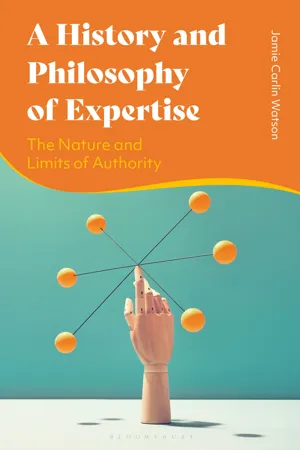
eBook - ePub
A History and Philosophy of Expertise
The Nature and Limits of Authority
- 288 pages
- English
- ePUB (mobile friendly)
- Available on iOS & Android
eBook - ePub
About this book
Information
1
Expertise and Its Discontents
Socrates: And the same holds of the relation of rhetoric to all the other arts; the rhetorician need not know the truth about things; [they have] only to discover some way of persuading the ignorant that [they have] more knowledge than those who know?
Gorgias: Yes, Socrates, and is not this a great comfort?—not to have learned the other arts, but the art of rhetoric only, and yet to be in no way inferior to the professors of them?
(Plato, Gorgias, 459b–c, trans. Benjamin Jowett, 1892)
Some people are skeptical of what we might call “traditional experts”—scientists, physicians, engineers, accountants, computer scientists, pharmacists, attorneys, public policymakers, toxicologists, economists, and so on, along with those who work in traditional academic disciplines. Skeptics either doubt that these folks are experts, or they accept that they are experts but doubt whether experts have authority worth taking seriously. It is noteworthy that these skeptics do not doubt that people in traditional expert domains are highly educated or extensively trained; rather, they doubt that “expert” means what has traditionally been claimed for it, namely, authority, that what experts say should have some bearing on their beliefs or behavior.
Popular media and political commentators have made much of what appears to be a global phenomenon of rejecting expertise, from the reinvigorated Flat Earth Society, to COVID-deniers, to an international community of anti-vaxxers. One of my favorite memes goes like this:
90s scientists: we cloned a sheep! we landed a robot on mars!
scientists today: for the last time, the earth is *round*
What is frustrating is that, despite their often proud, hard-nosed doubt, expert skeptics seem to get through life pretty well. They work alongside us at our jobs, their kids are fairly normal, they vacation, they retire, they buy motor homes, and so on. Even with public health threats as seemingly well-supported as SARS-CoV-2, expertise-deniers seem to get on with their lives.
One person I know never wore a mask during the COVID-19 pandemic, and he did not stop working, which involved his being in contact with many people. His rationale? COVID-19 is a hoax perpetrated by mainstream media, mainstream medicine and pharmaceutical companies, and liberals for the purpose of making more money (for the researchers) and restricting civil liberties (for the politicians). His justification for this hoax? Among other things, he says the virus has not affected him or anyone he knows. Anyone who says it has is either lying or a dupe.
Interestingly, since we know that about 80 percent of COVID-19 cases are asymptomatic, and another percentage have mild symptoms that mimic the flu or a cold, my acquaintance may never know personally anyone affected by COVID-19. So, is his skepticism warranted? Even if his beliefs are false, they don’t seem to be doing him or anyone else any harm. If any of us were walking in his shoes living where he lives, in a mid-sized city in a rural US state, could we say that his beliefs don’t fit some rational assessment of the evidence?
It is worth noting that expert skeptics tend to choose which kind of expertise to doubt rather shrewdly. They may be happy to go to the doctor for broken bones or an ear infection even if they would never get the flu or varicella vaccine. They may be happy to ride on an airplane even if they think the moon landing was faked. They know that the daily work of software engineers, chemists, and mathematicians is far beyond anything they could comprehend. This suggests that, for the types of expertise they doubt, they perceive some lack of connection between some scientific claims and their relevance for the skeptic that motivates their skepticism. There is not enough correlation, to their minds, to justify believing there is a causal relationship. And they take themselves to be competent to judge such things. Could they be right?
Perhaps it is the non-skeptics who are too gullible. Perhaps many experts lack the importance most of us think they have. Sure, we should only hire carpenters and accountants and concert pianists who have a solid track record of competent work, but the measure of their competence is available to novices, on Angie’s List and other customer review sites. But for other domains, where issues are not strongly correlated with results that novices can evaluate, it is not worth our time and energy to try to figure out when to trust them. Can we trust ourselves to evaluate everything we need to evaluate?
1.1 Expert Skepticism and the Enlightenment
As we will see in Chapter 3, the idea that we should think for ourselves and not rely on authorities has been a rallying cry for political liberalism since the Enlightenment. Early modern philosophers like René Descartes and Immanuel Kant encourage people to trust in reason rather than scholars or religious leaders. Natural philosophers like Francis Bacon and Robert Boyle encourage people to trust only what they can test with their own senses. The claim seems to be that the only epistemically responsible way to form beliefs is to think and judge for yourself. Following Kant’s famous imperative, “Sapere aude!1 Have the courage to think for yourself!” (1784), I will call this claim the Enlightenment Mandate.
We might say that early Enlightenment thinkers lived in simpler times and that they could not have imagined the complexity of technology or science, so the Enlightenment Mandate made more sense than it does today with the dizzying hyper-specialization in almost every domain. But we will also see in Chapter 3 that this interpretation of the Enlightenment Mandate was largely aspirational, even for them, and was practically impossible to follow. By 1835, Alexis de Tocqueville worried that by shifting authority from monarchs to individuals, the people of the United States would simply rely on others to do their thinking for them. Rather than turning to monarchs or experts, they would turn to their neighbors:
In the United States, the majority takes charge of furnishing individuals with a host of ready-made opinions, and it thus relieves them of the obligation to form their own. There are a great number of theories on matters of philosophy, morality, or politics that everyone thus adopts without examination, on the faith of the public. (2010: 719)
People are busy and tired, and only have time to take an interest in so many domains of knowledge and skill. So, de Tocqueville worried that “public opinion” would, by default, become the authority, and a no less an oppressive one than a mo narch. The solution? More individualism:
As for the action that the intelligence of one man can have on that of another, it is necessarily very limited in a country where citizens, having become more or less similar, all see each other at very close range; and, not noticing in any one of them the signs of incontestable greatness and superiority, they are constantly brought back to their own reason as the most visible and nearest source of truth. Then it is not only confidence in a particular man that is destroyed, but the taste to believe any man whatsoever on his word. So each person withdraws narrowly into himself and claims to judge the world from there. (2010: 700–1)
The problem, of course, is that we do recognize superiority in others. If not in moral qualities, at least in competence, experience, knowledge, and training. This is precisely why we go to the doctor (we want their advice, not just access to controlled substances), why we hire attorneys (who know how to navigate complex legal issues), and information technology specialists (because few of us can understand the latest technologies). The moment we acknowledge superiority in others, we are faced with a decision about how to interpret the Enlightenment Mandate.
On one interpretation, we are only justified in trusting our own abilities to understand a domain. On the other, we let expert testimony count as a source of evidence alongside that our minds and our senses. If the latter interpretation is more plausible—as even the expert skeptics seem to acknowledge, at least for some types of expertise—then both the expert skeptics and non-skeptics have to wrestle with the questions introduced in the preface: How do we distinguish genuine experts from hobbyists and frauds? What does it mean to say a genuine expert has authority? How strong is that authority for what we should believe or do, and what considerations can justifiably undermine or override it? How can we (whether we are novices or experts) assess the strength of that authority?
To answer these questions, I start with a history of expertise to get a sense of the various meanings of expertise over time and what those imply for belief and behavior. I show how these conceptions have informed a variety of empirical research on expertise. But these descriptive projects only orient us to the problem. They do not offer normative tools for assessing epistemically responsible trust in experts. For these, I turn to social epistemology, starting with the concepts of testimony and epistemic placement, and I show how these inform an adequate account of expert authority. In the final third of the book, I address the “recognition problem” for expertise, which is the challenge of how to adequately identify and assess expert competence. I close with a discussion of how my account of expert authority and solutions to the recognition problem help inform debates on the tension between expertise and democracy.
But before I dive in, we need a sense of the skeptical challenge. What does contemporary expert skepticism look like? Are some versions of it warranted, and, if so, under what conditions? What resources are available to non-skeptics for responding to expert skepticism? Are those resources enough?
1.2 Contemporary Expert Skepticism
The meme I mentioned earlier (“for the last time, the earth is *round*”) suggests that expert skepticism is a relatively recent affair, as if the 2000s brought a wave of mistrust in science and medicine. But has the situation really changed much since the 1990s? Did more people accept experts in the 1990s?
The answer is complicated. Groups have long defended a flat earth, denied the moon landing, raised alarm over fluoride in tap water, spun tales of the Illuminati, and flocked to Roswell, NM, rejecting the official story that there was no “UFO incident” in hopes of getting the real story for themselves. There are also dozens of less extreme forms of expert skepticism: belief in naturopathy over and against “mainstream” medicine, belief that farming by astrological signs is more reliable than farming by growing cycles, belief that fad diets are more effective than the basics of scientific nutrition, and the belief that crystals have metaphysical “energy” that affects health and well-being. Part of the complication is that popular media outlets go through waves of reporting on these beliefs, so it is difficult to know precisely when expert skepticism is growing or when it is simply more visible to non-skeptics.
It is, however, easy to find examples that suggest expert skepticism is more prominent now than ever. In the early 2000s, South Africa’s ministers of health, the president of Gambia, and a prominent group of medical physicists in Australia began publicly denying the link between HIV and AIDS. Until the end of his presidency in 2008, South African president Thabo Mbeki endorsed his ministers’ recommendations to reject standard AIDS treatments in favor of unproven herbal remedies such as ubhejane, garlic, beetroot, and lemon juice (Specter 2007).
In 2007, actress and model Jenny McCarthy appeared on Larry King Live claiming that vaccines cause autism. McCarthy’s charisma was soon combined with medical researcher Andrew Wakefield’s 1998 journal article that suggested a link between the combined MMR vaccine and autism. Despite public controversy over Wakefield’s article, the subsequent revelation that Wakefield had manipulated his data to promote his own financial interests, and his paper’s retraction in 2010 (Rao and Andrade 2011), the anti-vax movement has now swept across the world (Hussein et al. 2018).
Starting in 2008, public trust in financial institutions dropped 20 percent over the course of two years after political and economic analysts either failed to notice or failed to act on signs of the impending financial collapse in the US mortgage lending market (Smith and Son 2013). In 2009, the emails of scientists at the University of East Anglia’s Climatic Research Unit were hacked and made public in a fiasco now called “ClimateGate.” One reading of these emails suggests that climate scientists were doing exactly what expert skeptics had accused them of, which was admitting their data was insufficient, fudging the data they had, and biasing the literature by collectively refusing to publish in certain journals.2
In her book about immunization, cultural commentator Eula Biss (2014) writes of this period:
It was not a good season for trust. The United States was engaged in two ongoing wars that seemed to be benefiting no one other than military contractors. People were losing their houses and their jobs while the government was bailing out financial institutions it deemed too big to fail and using taxpayer money to shore up the banks. It did not seem unlikely that our government favored the intere sts of corporations over the well-being of its citizens. (9)
But, again, was this really any different from previous generations? There have always been skeptics, activists, fringe groups, and conspiracy theorists. Even if skepticism was aimed at new issues or became more visible in the early 2000s, this does not tell us whether expert skepticism has increased in any generally concerning way.
Perhaps surprisingly, trust in scientific experts has “remained stable for decades,” though it is, admittedly, not as high as many of us believe is warranted. A Pew Research Center study found that public trust in science has remained at around 40 percent since 1973 (Funk and Kennedy 2019). This study also...
Table of contents
- Cover
- Half-Title
- Series
- Dedication
- Title
- Contents
- List of Figures
- Preface: What Do Experts Look Like?
- Acknowledgments
- 1 Expertise and Its Discontents
- 2 English and Ancient Roots
- 3 Expertise from the Middle Ages to the Twentieth Century
- 4 A Brief History of Expertise Studies
- 5 Epistemic Placement and Expert Testimony
- 6 Expert Authority
- 7 The Easy Recognition Problem for Expertise
- 8 The Hard Recognition Problem, Disagreement, and Trust
- Notes
- References and Further Reading
- Index
- Copyright
Trusted by 375,005 students
Access to over 1.5 million titles for a fair monthly price.
Study more efficiently using our study tools.
Frequently asked questions
Yes, you can cancel anytime from the Subscription tab in your account settings on the Perlego website. Your subscription will stay active until the end of your current billing period. Learn how to cancel your subscription
No, books cannot be downloaded as external files, such as PDFs, for use outside of Perlego. However, you can download books within the Perlego app for offline reading on mobile or tablet. Learn how to download books offline
Perlego offers two plans: Essential and Complete
- Essential is ideal for learners and professionals who enjoy exploring a wide range of subjects. Access the Essential Library with 800,000+ trusted titles and best-sellers across business, personal growth, and the humanities. Includes unlimited reading time and Standard Read Aloud voice.
- Complete: Perfect for advanced learners and researchers needing full, unrestricted access. Unlock 1.5M+ books across hundreds of subjects, including academic and specialized titles. The Complete Plan also includes advanced features like Premium Read Aloud and Research Assistant.
We are an online textbook subscription service, where you can get access to an entire online library for less than the price of a single book per month. With over 1.5 million books across 990+ topics, we’ve got you covered! Learn about our mission
Look out for the read-aloud symbol on your next book to see if you can listen to it. The read-aloud tool reads text aloud for you, highlighting the text as it is being read. You can pause it, speed it up and slow it down. Learn more about Read Aloud
Yes! You can use the Perlego app on both iOS and Android devices to read anytime, anywhere — even offline. Perfect for commutes or when you’re on the go.
Please note we cannot support devices running on iOS 13 and Android 7 or earlier. Learn more about using the app
Please note we cannot support devices running on iOS 13 and Android 7 or earlier. Learn more about using the app
Yes, you can access A History and Philosophy of Expertise by Jamie Carlin Watson in PDF and/or ePUB format, as well as other popular books in Filosofia & Epistemologia in filosofia. We have over 1.5 million books available in our catalogue for you to explore.