Voice Male
eBook - ePub

Voice Male

The Untold Story of the Pro-Feminist Men's Movement

  1. 480 pages
  2. English
  3. ePUB (mobile friendly)
  4. Available on iOS & Android
eBook - ePub

Voice Male

The Untold Story of the Pro-Feminist Men's Movement

About this book

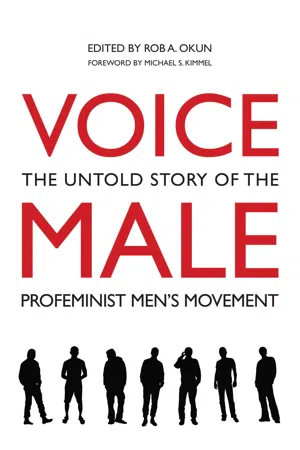
Here is a stunning new book that succeeds in doing nothing less than chronicling the social transformation of masculinity over a three-decade span. Through thematically arranged essays by leading experts, Voice Male illustrates how a growing movement of men is redefining masculinity. In this collection, Rob Okun directs a chorus of pro-feminist voices, introducing readers to men examining contemporary manhood from a variety of perspectives: from overcoming violence, fatherhood, and navigating life as a man of color, a gay man, or a boy on the journey to manhood. It also provides a critical forum for both male survivors and GBTQ men to speak out. This inspired book is evidence of a new direction for men, brightly illuminating what's around the bend on the path to gender justice.
Frequently asked questions

Yes, you can cancel anytime from the Subscription tab in your account settings on the Perlego website. Your subscription will stay active until the end of your current billing period. Learn how to cancel your subscription.
No, books cannot be downloaded as external files, such as PDFs, for use outside of Perlego. However, you can download books within the Perlego app for offline reading on mobile or tablet. Learn more here.
Perlego offers two plans: Essential and Complete
  • Essential is ideal for learners and professionals who enjoy exploring a wide range of subjects. Access the Essential Library with 800,000+ trusted titles and best-sellers across business, personal growth, and the humanities. Includes unlimited reading time and Standard Read Aloud voice.
  • Complete: Perfect for advanced learners and researchers needing full, unrestricted access. Unlock 1.4M+ books across hundreds of subjects, including academic and specialized titles. The Complete Plan also includes advanced features like Premium Read Aloud and Research Assistant.
Both plans are available with monthly, semester, or annual billing cycles.
We are an online textbook subscription service, where you can get access to an entire online library for less than the price of a single book per month. With over 1 million books across 1000+ topics, we’ve got you covered! Learn more here.
Look out for the read-aloud symbol on your next book to see if you can listen to it. The read-aloud tool reads text aloud for you, highlighting the text as it is being read. You can pause it, speed it up and slow it down. Learn more here.
Yes! You can use the Perlego app on both iOS or Android devices to read anytime, anywhere — even offline. Perfect for commutes or when you’re on the go.
Please note we cannot support devices running on iOS 13 and Android 7 or earlier. Learn more about using the app.
Yes, you can access Voice Male by Rob A. Okun in PDF and/or ePUB format, as well as other popular books in Social Sciences & Gender Studies. We have over one million books available in our catalogue for you to explore.

Information

OVERCOMING VIOLENCE
What do we think happens to men when they are not allowed to cry? Bullets, I think, are hardened tears.
—Eve Ensler
Though occasionally perpetrated by women, domestic violence, sexual assault, and rape remain overwhelmingly within the domain of male violence. What about our culture perpetuates such violence in men? How can men overcome their own violent histories and change for the better? How do aspects of men’s lives such as sports, war, and pornography contribute to making such violence permissible? This section asks these questions and others as it explores the culture of violence that permeates men’s lives and how it is linked to traditional masculinity.
When Men Do Nothing
Stephen McArthur
Summer 2012
(Inspired by Martin Niemoller’s “When they came for me...”)
First, he began to tell her what to wear, and I did nothing because, obviously, he cares what she looks like.
Then, he came home from a bad day at work and told her the house looked like crap and said she was a pig, and I did nothing because it is his house, isn’t it?
Then, he started calling her bitch and stupid fat whore when he was angry, and I did nothing because I give money to breast cancer research and wear a pink ribbon;
Then, he warned her not to go anywhere with her bitchy best friend, and I did nothing because he was just trying to protect her;
Then, when she did meet her best friend for lunch, he put his fist through the wall a foot from her head, seething with anger and spittle, and I did nothing because he did tell her not to, didn’t he?
Then, he told her not to go anywhere without him, and I did nothing because it’s not really my business;
Then, when she did, he showed her the gun he bought, and I did nothing because I am active in the peace movement;
Then, when she threatened to call the police, he told her they wouldn’t believe her, and I did nothing because the cops can handle this type of thing;
Then, when she told him she didn’t want to have sex anymore and he forced her, I did nothing because she’s his wife, isn’t she?
And then, when she said she was leaving him, he said he would commit suicide if she did, and I did nothing because it was just an idle threat;
And then when she did leave, he found her and shot her, and I did nothing because it was too late.
And besides, isn’t there some kind of woman’s group that could have dealt with this?
The Macho Paradox
By Jackson Katz
Spring 2006
Most people think violence against women is a women’s issue. And why wouldn’t they? Just about every woman in this society thinks about it every day. If they’re not getting harassed on the street, living in an abusive relationship, recovering from a rape, or in therapy to deal with the sexual abuse they suffered as children, they’re ordering their daily lives around the threat of men’s violence.
But it’s a mistake to call men’s violence a women’s issue. Take the subject of rape. Many people reflexively consider rape to be a women’s issue. But let’s take a closer look. What percentage of rape do women commit? Is it 10 percent, 5 percent? No. Women commit less than 1 percent of rape. Let’s state this another way: men perpetrate over 99 percent of rape. Whether the victims are female or male, men are overwhelmingly the perpetrators. But we call it a women’s issue?
It’s my premise that the long-running American tragedy of sexual and domestic violence—including rape, battering, sexual harassment, and the sexual exploitation of women and girls—is more revealing about men than it is about women. Men, after all, are the ones committing the vast majority of the violence. Men are the ones doing most of the battering and almost all of the raping. Men are the ones paying the prostitutes (and killing them in video games), going to strip clubs, renting sexually degrading pornography, writing and performing misogynistic music.
When men’s role in gender violence is discussed—in newspaper articles, sensational TV news coverage, or everyday conversation—the focus is typically on men as perpetrators, or potential perpetrators. These days, you don’t have to look far to see evidence of the pain and suffering these men cause. But it’s rare to find any in-depth discussion about the culture that’s producing these violent men. It’s almost as if the perpetrators were aliens who landed here from another planet. It’s rarer still to hear thoughtful discussions about the ways our culture defines “manhood,” and how that definition might be linked to the endless string of stories about husbands killing wives, or groups of young men raping girls (and sometimes videotaping the rape) that we hear about on a regular basis.
Why isn’t there more conversation about the underlying social factors that contribute to the pandemic of violence against women? Why aren’t men’s attitudes and behaviors toward women the focus of more critical scrutiny and coordinated action? In the early twenty-first century, the 24/7 news cycle brings us a steady stream of gender violence tragedies: serial killers on the loose, men abducting young girls, domestic violence homicides, sexual abuse scandals in powerful institutions like the Catholic Church and the Air Force Academy. You can barely turn on the news these days without coming across another gruesome sex crime—whether it’s a group of boys gang-raping a girl in a middle school bathroom, or a young pregnant mother who turns up missing, and a few days later her husband emerges as the primary suspect.
Isn’t it about time we had a national conversation about the male causes of this violence, instead of endlessly lingering on its consequences in the lives of women? Thanks to the US battered women’s and rape crisis movements, it is no longer taboo to discuss women’s experience of sexual and domestic violence. This is a significant achievement. To an unprecedented extent, American women today expect to be supported—not condemned—when they disclose what men have done to them (unless the man is popular, wealthy, or well-connected, in which case all bets are off).
This is all to the good. Victims of violence and abuse—whether they’re women or men—should be heard and respected. Their needs come first. But let’s not confuse concern for victims with the political will to change the conditions that led to their victimization in the first place. On talk shows, in brutally honest memoirs, at Take Back the Night rallies, and even in celebrity interviews, our society now grants many women the platform to discuss the sexual abuse and mistreatment that have sadly been a part of women’s lives here and around the world for millennia. But when was the last time you heard someone in public or private life talk about violence against women in a way that went beyond the standard victim fixation and put a sustained spotlight on men—either as perpetrators or as bystanders? It is one thing to focus on the “against women” part of the phrase. But someone’s responsible for doing it, and (almost) everyone knows that it’s overwhelmingly men. Why aren’t people talking about this? Is it realistic to talk about preventing violence against women if no one even wants to say out loud who’s responsible for it?
For the past two decades I’ve been part of a growing movement of men, in North America and around the world, whose aim is to reduce violence against women by focusing on those aspects of male culture—especially male peer culture—that provide active or tacit support for some men’s abusive behavior. This movement is racially and ethnically diverse, and it brings together men from both privileged and poor communities, and everyone in between. This is challenging work on many levels, and no one should expect rapid results. For example, there is no way to gloss over some of the race, class, and sexual orientation divisions between and among the men ourselves. It is also true that it takes time to change social norms that are so deeply rooted in structures of gender and power. Even so, there is room for optimism. We’ve had our successes: There are arguably more men today who are actively confronting violence against women than at any time in human history.
Make no mistake. Women blazed the trail that we are riding down. Men are in the position to do this work precisely because of the great leadership of women. The battered women’s and rape crisis movements and their allies in local, state, and federal government have accomplished a phenomenal amount over the past generation. Public awareness about violence against women is at an all-time high. The level of services available today for female victims and survivors of men’s violence is—while not yet adequate—nonetheless historically unprecedented.
But one area where our society still has a very long way to go is in preventing perpetration. We continue to produce in the United States hundreds of thousands of physically and emotionally abusive—and sexually dangerous—boys and men each year. Millions more men participate in sexist behaviors on a continuum that ranges from mildly objectifying women to literally enslaving them in human trafficking syndicates. We can provide services to the female victims of these men until the cows come home. We can toughen enforcement of rape, domestic violence, and stalking laws, arrest and incarcerate even more men than we do currently. But this is all reactive and after the fact. It is essentially an admission of failure.
What I am proposing is that we adopt a much more ambitious approach. If we are going to bring down the rates of violence against women dramatically—not just at the margins—we will need a far-reaching cultural revolution. At its heart this revolution must be about changing the sexist social norms in male culture, from the elementary school playground to the common room in retirement communities—and every locker room, pool hall, and boardroom in between. For us to have any hope of achieving historic reductions in incidents of violence against women, at a minimum we will need to dream big and act boldly. It almost goes without saying that we will need the help of a lot more men—at all levels of power and influence—than are currently involved. Obviously we have our work cut out for us. As a measure of just how far we have to go, consider that in spite of the misogyny and sexist brutality all around us, millions of nonviolent men today fail to see gender violence as their issue. “I’m a good guy,” they say. “This isn’t my problem.”
For years, women of every conceivable ethnic, racial, and religious background have been trying to get men around them—and men in power—to do more about violence against women. They have asked nicely, and they have demanded angrily. Some women have done this on a one-to-one basis with boyfriends and husbands, fathers and sons. They have patiently explained to men they care about how much they—and all women—have been harmed by men’s violence. Others have gone public with their grievances. They have written songs and slam poetry. They have produced brilliant academic research. They have made connections between racism and sexism. They have organized speakouts on college campuses and in communities large and small. They have marched. They have advocated for legal and political reform at the state and national level. On both a micro and a macro level, women in this era have successfully broken through their historical silence about violence against women and found their voice—here in the United States and around the world.
Yet even with all of these achievements, women continue to face an uphill struggle in trying to make meaningful inroads into male culture. Their goal has not been simply to get men to listen to women’s stories and truly hear them—although that is a critical first step. The truly vexing challenge has been getting men to actually go out and do something about the problem, in the form of educating and organizing other men in numbers great enough to prompt a real cultural shift. Some activist women—even those who have had great faith in men as allies—have been beating their heads against the wall for a long time, and are frankly burned out on the effort. I know this because I have been working with many of these women for a long time. They are my colleagues and friends.
My work is dedicated to getting more men to take on the issue of violence against women, and thus to build on what women have achieved. The area that I focus on is not law enforcement or offender treatment but the prevention of sexual and domestic violence and all their related social pathologies—including violence against children. To do this, I and other men here and around the world have been trying to get our fellow men to see that this problem is not just personal for a small number of men who happen to have been touched by the issue. We try to show them that it is personal for them, too. For all of us. We talk about men not only as perpetrators but also as victims. We try to show them that violence by men against one another—from simple assaults to gay bashing—is linked to the same structures of gender and power that produce so much men’s violence against women.
But there is no point in being naïve about why women have had such a difficult time convincing men to make violence against women a men’s issue. In spite of significant social change in recent decades, men continue to grow up with, and are socialized into, a deeply misogynistic, male-dominated culture where violence against women—from the subtle to the homicidal—is disturbingly common. It’s normal. And precisely because the mistreatment of women is such a pervasive characteristic of our patriarchal culture, most men, to a greater or lesser extent, have played a role in its perpetuation. This gives us a strong incentive to avert our eyes.
Women, of course, have also been socialized into this misogynistic culture. Some of them resist and fight back. In fact, women’s ongoing resistance to their subordinate status is one of the most momentous developments in human civilization over the past two centuries. Just the same, plenty of women show little appetite for delving deeply into the cultural roots of sexist violence. It’s much less daunting simply to blame “sick” individuals for the problem. You hear women all the time explaining away men’s bad behavior as the result of individual pathology: “Oh, he just had a bad childhood,” or “He’s an angry drunk. The booze gets to him. He’s never been able to handle it.”
But regardless of how difficult it can be to show some women that violence against women is a social problem that runs deeper than the abusive behavior of individual men, it is still much easier to convince women—of all races, ethnicities, and religious beliefs—that dramatic change is in their best interest than it is to convince men. In fact, many people would argue that, since men are the dominant sex-class, and violence serves to reinforce this dominance, it is not in men’s best interests to reduce violence against women, and that the very attempt to enlist a critical mass of men in this effort amounts to a fool’s errand.
For those of us who reject this line of reasoning, the big question, then, is how do we reach men? We know we’re not going to transform, overnight or over many decades, certain structures of male power and privilege that have developed over thousands of years. Nevertheless, how are we going to bring more men—many more men—into a conversation about sexism and violence against women? And how are we going to do this without turning them off, without berating them, without blaming them for centuries of sexist oppression? Moreover, how are we going to move beyond talk and get substantial numbers of men to partner with women in reducing men’s violence, instead of working against them in some sort of fruitless and counterproductive gender struggle?
That is the $64,000 question. Esta Soler, executive director of Futures Without Violence (formerly Family Violence Prevention Fund) and an influential leader in the domestic violence movement, says that activating men is “the next frontier” in the women-led movement. “In the end,” she says, “we cannot change society unless we put more men at the table, amplify men’s voices in the debate, enlist men to help change social norms on the issue, and convince men to teach their children that violence against women is always wrong.”
Call me a starry-eyed optimist, but I have long been convinced that there are millions of men in our society who are ready to respond well to a positive message about this subject. If you go to a group of men with your finger pointed (“Stop treating women so badly!”) you’ll often get a defensive response. But ...

Table of contents

  1. Cover
  2. Advance
  3. Voice Male
  4. Copyright
  5. Dedicate
  6. Contents
  7. Introduction
  8. Foreword
  9. A Short History of One of the Most Important Social Justice Movements
  10. Boys to Men
  11. Changing Men
  12. ColorLines
  13. Fathering
  14. Male Survivors
  15. Men and Feminism
  16. Men’s Health
  17. Overcoming Violence
  18. OutProud: GBTQ Voices
  19. What is Healthy Masculinity?
  20. A Farewell to Arms: Manhood After Newtown
  21. Afterword: The Tears of the Sandy Hook Fathers by Rob Okun
  22. Resources
  23. Acknowledgements
  24. Contributors
  25. Credits