Sicily
eBook - ePub

Sicily

A Cultural History

  1. 256 pages
  2. English
  3. ePUB (mobile friendly)
  4. Available on iOS & Android
eBook - ePub

Sicily

A Cultural History

About this book

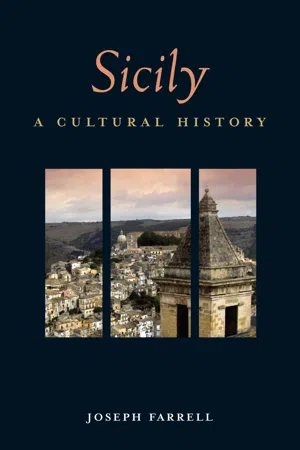
"Reading these guides is the next best thing to actually going there with them in hand." —Foreword Magazine AN ENGAGING INTRODUCTION TO A CULTURAL GIANT Long before it became an Italian offshore island, Sicily was the land in the center of the Mediterranean where the great civilizations of Europe and Northern Africa met. Sicily today is familiar and unfamiliar, modernized and unchanging. Visitors will find in an out-of-the-way town an Aragonese castle, will stumble across a Norman church by the side of a lesser travelled road, will see red Muslim-styles domes over a Christian shrine, will find a Baroque church of breathtaking beauty in a village, will catch a glimpse from the motorway of a solitary Greek temple on the horizon and will happen on a the celebrations of the patron saint of a run-down district of a city, and will stop and wonder. There is more to Sicily than the Godfather and the mafia.
Frequently asked questions

Yes, you can cancel anytime from the Subscription tab in your account settings on the Perlego website. Your subscription will stay active until the end of your current billing period. Learn how to cancel your subscription.
At the moment all of our mobile-responsive ePub books are available to download via the app. Most of our PDFs are also available to download and we're working on making the final remaining ones downloadable now. Learn more here.
Perlego offers two plans: Essential and Complete
  • Essential is ideal for learners and professionals who enjoy exploring a wide range of subjects. Access the Essential Library with 800,000+ trusted titles and best-sellers across business, personal growth, and the humanities. Includes unlimited reading time and Standard Read Aloud voice.
  • Complete: Perfect for advanced learners and researchers needing full, unrestricted access. Unlock 1.4M+ books across hundreds of subjects, including academic and specialized titles. The Complete Plan also includes advanced features like Premium Read Aloud and Research Assistant.
Both plans are available with monthly, semester, or annual billing cycles.
We are an online textbook subscription service, where you can get access to an entire online library for less than the price of a single book per month. With over 1 million books across 1000+ topics, we’ve got you covered! Learn more here.
Look out for the read-aloud symbol on your next book to see if you can listen to it. The read-aloud tool reads text aloud for you, highlighting the text as it is being read. You can pause it, speed it up and slow it down. Learn more here.
Yes! You can use the Perlego app on both iOS or Android devices to read anytime, anywhere — even offline. Perfect for commutes or when you’re on the go.
Please note we cannot support devices running on iOS 13 and Android 7 or earlier. Learn more about using the app.
Yes, you can access Sicily by Joseph Farrell in PDF and/or ePUB format, as well as other popular books in Personal Development & Travel. We have over one million books available in our catalogue for you to explore.

Information

Year
2014
Print ISBN
9781623719579
eBook ISBN
9781623710507
Edition
2
Subtopic
Travel
Chapter Sixteen
THE CAPITAL CITY
PALERMO
PALERMO FELIX
Palermo today is not an easy city to love, as those enthusiasts who do love it will openly admit. The novelist Dacia Maraini once said that her idea of hell was a Palermo without the cake-shops. Love at first sight for Palermo as it is now is as rare as any other variation of the same passion, and those who claim to have experienced it are likely to prove unbalanced or mendacious. All the inhabitants of the city are in agreement that once it was different, once it was more ordered, once it was better, even if there is some dispute over the opening and closing of the imprecisely remembered golden period. In the late eighteenth century it was common to talk of Palermo felix (Happy Palermo), and Goethe wrote lyrically about the beauty of the bay and the surrounding chain of mountains. Augustus Hare, that most refined of travelers in Italy, took up the refrain in 1905.
As the traveller approaches Palermo, he finds Monte Pellegrino with its stupendous limestone cliffs towering above the palest of blue skies on his right, and perhaps dove-coloured clouds pouring over from it over towards the calm sea, throwing patches of it into shadow, so that the beautiful grey and orange tones of it scarcely show. This is Hertke which Pyrrhus stormed, driving out its Carthaginian garrison. After this, Palermo and the magnificent conca d’oro, with its theatre of lofty mountains comes full into view, with possibly snow silvering the remotest ridges. All the valley breathes the lemon-blossom and gives the impression of being a paradise, a land at any rate flowing with milk and honey. No wonder Palermo became called felix.
The air breathed today carries less mellifluous scents, and the milk and honey are in shorter supply. Palermo had its own belle époque at the turn of the nineteenth-twentieth century when Hare arrived, and there are graceful art nouveau residences in the area around Via Libertà and in Palermo’s resort town, Mondello, but today it is not a city which caresses, seduces, or beckons invitingly to the visitor. There are cities which are delicate, coy, or seductive such as Paris and Prague, or Ragusa and Marsala in Sicily itself, and other more muscular places which are initially forbidding or alienating and which reveal a more alluring side only to suitors who persevere. Affection for Palermo must be allowed to germinate and blossom after careful cultivation, but once the plant has flowered, it will prove to be an evergreen. Today at first sight Palermo can seem like a city of endless, unregulated chaos and a slightly fearsome place, or even a collection of sorry sights and stages of decay, but there are buildings, piazzas, streets, and corners of the city which are beguiling and of fetching beauty. And the city itself is ultimately enthralling.
Palermo is a port city, but although some promenades along the sea front near Porta Felice have been opened up, much of the coastline is still in use as docks, and in other stretches the sea water is polluted in a way which makes the thought of bathing impossible, so Palermitans have to go outside the city to Mondello to enjoy the pleasures of sea and sand. Elsewhere, there are areas even in the center which have not yet been rebuilt after Allied bombing in the Second World War. There have been many recent “Palermo springs,” but never a Palermo summer. Perhaps more than any other city in Europe, Palermo has experienced age after age demolition, devastation, reconstruction, re-planning, reimagining, and restoration, sometimes by conquerors anxious to remake the capital in their own image and likeness, sometimes by well-intentioned improvers, and sometimes by corrupt politicians in complicity with criminal societies. The best and the worst, the most cowardly and the most heroic, the most altruistic and the most venal of men have ruled in Palermo, sometimes embellishing, sometimes brutalizing, sometimes respecting the work of their predecessors, sometimes eliminating all trace of their existence.
It is hard to know which approach to Palermo will offer the most favorable first view to the visitor. Arrival by sea has many advantages and permits a view of the city cradled by the chain of mountains which cut it off from the inland areas. If the approach is accurately timed at sunrise or sunset, the view from on board of the rays of the sun will give all the explanation needed of why the plain and the gulf where the city stands were named the conca d’oro, the golden shell. The disembarkation area in the docks is, however, unwelcoming. Arrival by rail is unlikely to be quite so stimulating. Exit from the station onto the grandly named but overpowering Piazza Giulio Cesare (Julius Caesar Square) might be too abrupt for sensitive souls since it will not allow for any gradual initiation into Palermo’s chaotic traffic conditions, noise, and endless, unordered movement. Arrival by car will involve being swept onto the ring road, the Viale della Regione Siciliana, which was supposed to keep traffic out of the city center but which has only added to the congestion. The traffic lights are an occasion for women and children to dart forward offering to clean the windscreen, to sell lighters, paper handkerchiefs, or dish towels.
Those who arrive by air may be troubled by the imposing mountain, Monte Pellegrino, which stands alarmingly close to the runways, and indeed has caused crashes in the past. The mountain is part of the city’s history and assuming the pilot has negotiated the landing successfully, it is at some stage worth taking a trip up the mountain which Goethe considered “the most beautiful promontory in the world.” Halfway up stands the Castello Utveggio, which is no castle but a late nineteenth-century villa now housing municipal offices, but you will be welcome to take a coffee and savor the panoramic view of the city. The shrine of Santa Rosalia, patron saint of Palermo, is further up. Here the saint lived in solitude until her death in 1166. Her bones were providentially rediscovered in 1624 when the city was being devastated by the plague and were brought down and processed round the city, causing the scourge of the plague to be lifted. The grateful citizens ousted the previous patron saint and proclaimed Rosalia their protector, a status she has maintained. Her shrine is bedecked by votive offerings, as well as crutches and prosthetic aids rendered unnecessary by miraculous cures, offered by those whose prayers were answered. Her body is still paraded around the city every year on 15 July, one of the greatest feasts in the Sicilian calendar.
Palermo is both the capital of Sicily and a typical Mediterranean city. It is a city of historical strata, some of which have been recently rendered invisible or irrecoverable by inexpert archaeology or, more probably, by unscrupulous building programs, or even in earlier times by determined efforts to remove unwelcome reminders of prior rule. It has no genuinely Arab buildings but some quarters have an Arab feel which long predates the recent arrival of immigrants from North Africa. It is embellished by magnificent ecclesiastical and secular architecture dating from Norman and Spanish times, and has two of the most massive, overwhelming, overpowering, ponderous theaters of any city in Europe, theaters which arrogantly draw attention to themselves, asking not to be loved but to be respected. It has other buildings which express a more delicate spirit, some intricate Baroque church interiors or some graceful works designed by Ernesto Basile, such as the little kiosks on Piazza Verdi, which proclaim themselves as belonging to the art nouveau moment. It has at the same time many buildings, many piazzas, many streets and churches which can only be classified as sorry sights, buildings which may have been magnificent in their day but which are now decaying, ignored, unloved.
The observant visitor will be struck by the lack of architecture of any note or pretension to style from the post-war age. Recent decades have seen at best neglect of the urban cityscape and at worst the criminal manipulation of civic power in authorizing the demolition of historic buildings to make way for the profit-making brutalities in fashion at that moment. It can be stated straightforwardly that nothing built from the 1940s onwards graces the city, and that unchecked expansion and unscrupulous demolition, a process known as the “Sack of Palermo” and executed by compliant or corrupt municipal power in complicity with the mafia, has destroyed much of the beauty that once enchanted visitors. And yet, and yet … there are still wonders in Palermo. With its mixture of cultures of East and West, of Christianity and Islam, of Europe, Asia, and Africa, Palermo boasts a historical and cultural heritage which few cities can rival.
URBAN HISTORY
In antiquity Palermo was a Phoenician, not a Greek, settlement, so came within the Carthaginian area of influence. In due course the Romans conquered it but did not make it a center of any importance, and there are no Roman or Greek ruins within the city boundaries. The Vandals and the Byzantines came and went, the former creating a dark age but the latter leaving a legacy in art and craftsmanship which would bloom later. Palermo’s emergence as cultural center and political capital came with the Arabs who arrived in 831. Islamic chroniclers in the ninth and tenth centuries sing of the glories of this city with its three hundred mosques, its pleasure palaces, its myriad fountains, its cosmopolitan population, its tolerant style of life, and its cultural vivacity. This has to be taken on trust, for little remains visible of that civilization, if one excepts the labyrinth of back streets and alleyways, and the atmosphere of such areas as the Cassaro or the Kalsa. What does remain are the writings of the Arab poets, many of whom produced nostalgic work after the expulsion of their people, and who look back longingly at what was lost. The cubic domes on such churches as San Giovanni degli Eremiti (St. John of the Hermits), the beehive ceilings in the Cappella Palatina (Palatine Chapel), or even the oriental structure of such oriental palaces of royal delight as La Zisa are misleading. The inspiration is Arab, but these works were constructed by the Normans, who seized Palermo from the Arabs in 1071, and who had the discriminating sense to recognize the splendor of the culture and civilization they had ousted and to keep the craftsmen, architects, designers, poets, and even the courtiers to add gilt to their rule. When the Norman sun set, too quickly, the Swabians took over, and another period of glory was ushered in by Frederick II, stupor mundi. Frederick was King of Sicily, King of Jerusalem, Holy Roman Emperor, and a great builder of castles and fortresses, but little of that building was done in Palermo. His tomb is in the cathedral.
The Angevin French maintained Palermo as their capital, but it was there that in 1282 the anti-French uprising known to history as the Sicilian Vespers originated. The Church of Santo Spirito (Holy Spirit), where a French soldier’s offensive behavior to a Sicilian woman provided the spark for the rebellion, still stands in the cemetery of Sant’Orsola (St.Ursula) to the east of the city. A lengthy period of instability and anarchy followed, and this power vacuum allowed certain noble families, notably the Chiaramonte and Sclafani houses, to assert control. Two great palaces, the Chiaramonte Palace in Piazza Marina which is now the administrative center of the university, and the Sclafani Palace in Piazza Vittoria which is now the HQ of the carabinieri, date from this time.
The Aragonese-Catalan royal family were the next to assume control, but even if they had a palace in Palermo, Catania was their capital. Integration into the kingdom of Castilian Spain (1412-1713) meant rule in Sicily by a succession of viceroys who transformed the face of the city. The central Via Cassaro was given the new name Via Toledo, now Corso Vittorio Emanuele, and was extended down to the harbor area, while another street, Via Maqueda, was named after a viceroy and retains the Spanish pronunciation. Maqueda was responsible for the construction in 1600 of the Quattro Canti (Four Corners), the elaborately tiered and sculptured edifice at the intersection of the main streets. The grandiose Porta Nuova (New Gate) near the cathedral was built in 1583 to commemorate the visit of the great King-Emperor Charles V, the only Spanish king to set foot in Sicily.
Power passed to the Neapolitan Bourbons in 1735 and that year Charles III became the last king to be crowned in Palermo Cathedral. Power was exercised by nominated viceroys. King Ferdinand IV and Queen Carolina of the Kingdom of the Two Sicilies took refuge in 1806 from Napoleon’s French army in Palermo, where they were wholly reliant on protection by the British fleet. The British presence is best, if inadequately, remembered for the love affair between Lord Nelson and Lady Hamilton, who resided together with her compliant husband, Sir William, in Palazzo Palagonia in the Kalsa district. Garibaldi and his invading force made for Palermo after landing at Marsala, and fought a decisive battle at the Ponte dell’Ammiraglio (Admiral’s Bridge) on the outskirts of the city. The bridge, built in 1113 by George of Antioch, an admiral at the court of Roger II, spanned the Oreto river, but the river has dried up, leaving the bridge to cut a strangely pathetic and landlocked sight in the middle of a park.
The success of Garibaldi’s mission saw Palermo become an Italian city, but the strength of the Sicilian sense of identity and the city’s conceit of itself prevented that from being the whole truth. Little was done to preserve the architectural past or to enhance the urban environment. The main exception is the work of the art nouveau architect Ernesto Basile, who on a grand scale designed the Teatro Massimo, and on a more modest scale was the genius behind many houses and shops around the city. There are many other works by him including the Villa Igiea, once the property of the entrepreneur Ignazio Florio but now the most luxurious hotel in the city with a marvelous view of Monte Pellegrino on one side and of the bay on the other. There is a scattering of those muscular, supposedly overawing buildings, the Post Office being the most obvious example, which fascism felt best expressed its world view, but few will regard them with affection. The Allied bombing campaign in 1943 caused devastation and destruction on a scale not even this city had previously experienced, leaving churches, palaces, and whole districts leveled, but the post-war was perhaps even more ruinous. Decades of civic vandalism wreaked their own damage, and the rage of contemporary critics against what was perpetrated then cannot repair the havoc.
There are many ways of getting to know Palermo. A zonal approach has much to commend it, since buildings of different epochs stand one close to the other, but we will proceed by historical period, starting with the contribution made by the Arabs whose architecture comes filtered through Norman power.
ARABS AND NORMANS
As elsewhere in Sicily, there are no surviving, purely Arab monuments, but there is an abundance of Norman architecture, and the union between the two produced a style known as Arab-Norman, a combination which could emerge only in Sicily. However hackneyed the term has become through usage, it should cause any sensitive observer to pause and wonder, since the phenomenon is a priori as improbable as finding in Corsica a style of domestic architecture identified as, say, Nepalese-Greek. The two peoples came from different continents, were of religions which had been at war with each other for centuries, held to differing concepts of theological aesthetics, were rivals for the possession of Sicily, and yet their architects, masons, and craftsmen cooperated in the production of unsurpassed works of art. In only a couple of decades King Roger and the two Williams completed an ambitious building program of palaces and churches and of the conversion of mosques which made Palermo the capital of the Mediterranean and raised its European status in the eyes of royalty and of the papacy. Under the Normans, Palermo was no provincial backwater, and there are many works which attest to its own sense of its status.
The magnificent cathedral in Palermo is Norman, although it has been subject to many alterations in style over the course of the centuries. Archaeological evidence suggests that there always was a religious building on the site, and it is certain that there was a Christian church there in the fourth century. This building was destroyed by the Vandals, but reconsecrated in 604 and traces of the newer church remain in the crypt. The Saracens converted it into a mosque, only for the Normans to change it back. The guiding spirit behind the new construction work was the Anglo- Norman Bishop Walter of the Mill, who was sent from London by Henry II as tutor to the Sicilian dauphin. There is a statue of him outside the cathedral entrance under his Sicilian name, Offamilio, and his tomb is in the crypt. Although he was virulently anti-Islam, he employed Arab workers, as can be seen from decorations on the exterior. The column on the left at the entrance has an inscription from the Koran, which implies that the porch was recycled from the mosque and, probably, that the Christian masters of work were ignorant of the source of the words. The cathedral was consecrated in 1185, but subsequent ecclesiastical authorities could not leave it alone. The southern entrance was added in 1453 and includes some splendid engraved wood decorations from the Catalan period. The old belfry collapsed in an earthquake in 1726, but the replacement has, strangely, an Arab appearance, however anachronistic. The cathedral had a thorough going-over between 1...

Table of contents

  1. Cover
  2. Also in the Series
  3. Silcy
  4. Copyright
  5. Contents
  6. Dedicate
  7. Thought
  8. Acknowledgement
  9. THE CULTURES OF SICILY
  10. WOUNDED BY HISTORY
  11. MORALS AND MANNERS
  12. THE IMAGINED ISLAND
  13. MEN OF HONOR
  14. ARRIVALS AND DEPARTURES
  15. THE LANDING STAGE
  16. SOUTHWARDS TO ETNA
  17. UNLIKELY CONNECTIONS
  18. THE SECOND CITY
  19. GODDESSES AND MADONNAS
  20. THE SICILY THE GREEKS LEFT
  21. THE GLORY OF THE BAROQUE
  22. THE GREAT TEMPLES
  23. PHOENICIANS, SARACENS, AND YORKSHIREMEN
  24. THE CAPITAL CITY
  25. OUT OF PALERMO
  26. THE AEOLIAN ISLANDS
  27. JOURNEY’S END
  28. Further Reading