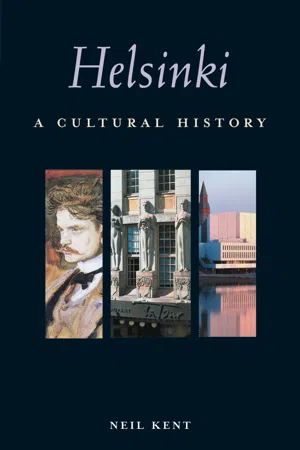
Helsinki is one of the world's most northerly capitals, but it is by no means a city frozen in northern wastes. Situated along the southern shore of the Gulf of Finland, magnificent lakes and forests reach into Helsinki's urban heart, a rare event in today's world of suburban sprawl. The city's natural beauty, emphasized by parks and islands, is matched by an extraordinary cultural richness, the result of fruitful foreign influences and home-grown creativity. The Finnish capital offers a spectacular display of architecture and design: from the neoclassical magnificence imposed by a Russian Czar to the modernist chic of Nordic functionalism. Neil Kent explores the history and culture of the Daughter of the Baltic, a small fishing village that became a powerhouse of design and technology. Tracing its dramatic past of conflict and conflagration, he explores the evolution of a national, and urban, identity through architecture, art and writing. Through such differing cultural phenomena as saunas, railway stations and tango, he explains why Helsinki is a distinctive mix of tradition and innovation. âą The city of architects and designers: Engel, Czar Alexander I and the creation of an imperial metropolis; Alvar Aaalto and the birth of the modern; functionalism and high-tech innovation. âą The city of music and the arts: Sibelius, the national composer; conductors and performers; art galleries and installations; National Romanticism and the Nordic aesthetic. âą The city of hospitality: Art Nouveau hotels and cafes; sauna culture; famous visitors and refugees: Lenin and Hitler; multicultural Helsinki and a history of migration.
Frequently asked questions
Yes, you can cancel anytime from the Subscription tab in your account settings on the Perlego website. Your subscription will stay active until the end of your current billing period. Learn how to cancel your subscription.
No, books cannot be downloaded as external files, such as PDFs, for use outside of Perlego. However, you can download books within the Perlego app for offline reading on mobile or tablet. Learn more here.
Perlego offers two plans: Essential and Complete
Essential is ideal for learners and professionals who enjoy exploring a wide range of subjects. Access the Essential Library with 800,000+ trusted titles and best-sellers across business, personal growth, and the humanities. Includes unlimited reading time and Standard Read Aloud voice.
Complete: Perfect for advanced learners and researchers needing full, unrestricted access. Unlock 1.4M+ books across hundreds of subjects, including academic and specialized titles. The Complete Plan also includes advanced features like Premium Read Aloud and Research Assistant.
Both plans are available with monthly, semester, or annual billing cycles.
We are an online textbook subscription service, where you can get access to an entire online library for less than the price of a single book per month. With over 1 million books across 1000+ topics, weâve got you covered! Learn more here.
Look out for the read-aloud symbol on your next book to see if you can listen to it. The read-aloud tool reads text aloud for you, highlighting the text as it is being read. You can pause it, speed it up and slow it down. Learn more here.
Yes! You can use the Perlego app on both iOS or Android devices to read anytime, anywhere â even offline. Perfect for commutes or when youâre on the go. Please note we cannot support devices running on iOS 13 and Android 7 or earlier. Learn more about using the app.
Yes, you can access Helsinki by Neil Kent in PDF and/or ePUB format, as well as other popular books in Personal Development & European History. We have over one million books available in our catalogue for you to explore.
The name of Helsinki signifies that from its first founding its importance was as a commercial center, since the first half of the word denotes a mercantile base, and the latter the location of a stream or rapids. It was precisely to encourage such mercantile activity and to make Helsinki a rival to Reval (now Tallinn) that the Swedish king Gustaf Vasa obliged merchants from Turku, Ulvila, Pori, Rauma, Tammisaari and Porvoo to settle at the mouth of the Vantaa River. As a result, the parish of Helsinge, as it was then known, became the most affluent of the province of Uusimaa, with around 3,000 inhabitants in 1551.
Unfortunately, the king injured the goose that laid the golden egg, even if he did not quite kill it. After he visited the newly founded town in 1555 he permitted the merchants forcibly brought to Helsinki to return to their former homes if they so desired, which many did. The townâs mercantile attractions were sharply diminished. Nonetheless, it still contained about 500 inhabitants in 1571, small for a continental European town, but still making it Finlandâs fifth largest urban settlement.
One of Helsinkiâs richest merchants and shipping magnates of the late sixteenth century was Hans van Sanden, a native of the Netherlands who died in the 1590s. His ships plied the seas from between Tallinn and Narva (in what is now Estonia) in the east, and to Gdansk, LĂŒbeck and Amsterdam in the west. He married the daughter of a local family of German descent, Anna JĂ€gerhorn, and began a dynasty of some importance. Today a black granite stone marks the site of his grave, adjacent to where the villageâs first church was built. (This site is not far from the Arabia Factory, where modernist Finnish tableware is produced.)
Early Days
Helsinki continued to grow during the early years of the seventeenth century, even if in economic terms it had failed to thrive as first expected. The Swedish government issued a decree on October 12, 1639, ordering the settlement to move further south to a coastal point near present-day SörnĂ€inen. The old settled area around the Old Town, Helsinge Rapids, was then abandoned. But not long after, Governor General Per Brahe chose Vironniemi by Kruununhaka as a location, a move further facilitated by the donation of land there by Swedenâs Queen Christina in 1643.
Built on a grid-like layout, the town reflected the Baroque ideals of regularity so admired throughout Europe at this time. Twenty streets were focused round a central square and adjacent harbor, the whole of which was divided into four equal quarters. By 1670 a few streets adjacent to the churchyard were paved with stone, an indication of the wealth of some merchants who contributed to their construction and a rare luxury in Finnish towns at that time. Most were unpaved, as was usual throughout the Nordic and Russian world.
It was also around this time that the first private two-story residence was built on the corner of Senate Square, where Suurkatu meets Koulukatu and today the Council of State building stands. It was owned by the magistrate and ship owner Torsten Bergman (1661-1711), who had also served as a political representative in Stockholm in 1697. With chambers surmounted by vaulted ceilings, shop and kitchens, it was typical of large Baltic residences of the period. Unfortunately, it was destroyed during the Great Northern War in the early eighteenth century, with the other buildings, great and small, of the little town.
Baltic Port
Even if places like the ancient city of HĂ€meenlinna and its hinterland continued to prefer Turku in the west or Porvoo in the east as their partners, Helsinki finally, if slowly, began to establish its trading credentials. Today Helenankatu, Katariinankatu and Sofiankatu still form a central part of the heart of the city, just as they did when the rich merchants of the seventeenth century held political sway on the town council, even if the center of gravity of Helsinki has shifted to the southwest.
In those days wood was one of the most important commodities. The north of Germany was the main importer of Finnish wood, but Holland and England were also clients. These two seafaring nations were also keen to acquire tar, important for shipbuilding, stored on the island of Tervasaari. Tar soon became the cityâs most important export in the seventeenth century, though some iron and furs were also exported. Since Helsinki was a fishing port, albeit seasonal, the export of fish was also significant. Large quantities went to Stockholm, along with butter and other foodstuffs.
In return, a whole range of staples and luxury goods arrived. Salt was a necessity, essential for the preservation of food, while functional household items like nails, glass, crockery and cutlery were also needed. So, too, were fabrics and not least luxuries like wine, beer and the newly fashionable tobacco. Even hemp and jute, necessary for sails, were brought in small quantities by ship to Helsinki, the sails then shipped as far as the Mediterranean. Sometimes goods traveled even further afield. In 1789 the American brig Bilbao arrived in Helsinki and departed with a hull full of local products.
Wars may have devastated Helsinki during these times, but even during the periods of greatest disruption, as in the Great Northern War, trade continued. After the Russians succeeded in taking Helsinki, significant numbers of Russian merchants followed in the wake of Peter the Greatâs soldiers, carrying on a thriving trade. Then, as now, trade and money knew no political boundaries.
Shipping played a major role in the economic life of Helsinki, even before the city became Finlandâs capital. Then, as later, sea captains carried out a lively private trade, selling some of the goods they carried on their ships directly to the public at prices significantly lower than those in shops.
The merchant Johan Sederholm (1722-1805), active in political relations between Finland and Stockholm, amassed a considerable fortune in shipping, some of which he used to establish other enterprises, including a tile factory, at Herttoniemi and a glass works at Sipoo. A portion of his wealth went to construct his town mansion, the Sederholm House on Aleksanterinkatu 18, completed in 1757. It is the oldest stone house still in existence in the city and is open to the public as a museum, with exhibitions relating to life in the eighteenth and nineteenth centuries, having been acquired by the City of Helsinki in 1949. It was probably designed by Samuel Berner, otherwise famous for the old Ulrika Eleonora Church, named after the Swedish queen of the time. So rich did Sederholm become that he even became a moneylender to the French monarchy.
In the nineteenth century, shipping remained a major industry; over forty percent of the capitalâs merchants were involved in 1813, and because of this maritime focus Alexander I established a college of navigation. Families like the Sederholms and Heidenstrauchs remained active in shipping, and J. H. Heidenstrauch was so successful that he commissioned the building of a three-story residence, adorned by an Ionic colonnade based on that of a Parisian townhouse, which was completed in 1820. Unfortunately, if the Sederholms continued to flourish, the family fortune of the Heidenstrauchs collapsed, and their place was taken by others with greater business acumen. The mansion was duly sold to the government, to be renovated as an imperial palace in 1837. Six years later it was again renovated by Carl Alexander Engel, Carl Ludvig Engelâs son, and is today the Presidential Palace.
The Hietalahti Shipyard produced its first ship in 1868, one of a series that seemed limitless in number. Then, in the 1880s, the Finnish Steam Ship Company initiated its lines, which by the advent of the First World War included 26 different destinations all over the world. In 1926 a regular shipping service from Helsinki to South America commenced, followed ten years later by one to North America. Not surprisingly, ancillary industries were also prominent. Already, in the late eighteenth century Helsinki could boast a sawmill, two shipyards and a sailcloth factory.
Trade and Industry
The backbone of Finnish industry was, of course, manual labor, but this was very poorly paid, especially after Finland was ceded to Russia. In 1819 a manual laborer could expect to earn less than one rouble per day. For entrepreneurs, on the other hand, there was much money to be made.
Feodor Kiseleff, the founder of a sugar dynasty, acquired his refinery in 1812 and made an immense success of the venture. Kiseleff House, completed in 1818 on a corner of Senate Square by Unioninkatu 27, had originally been built in 1772-8 as another residence for Johan Sederholm. The sugar baron had the three-storied edifice, crowned by a mansard roof, extensively remodeled by his relation, the architect Konstantin Kiseleff. The tarred boarding that had clad it was removed, while the windows were enlarged and those on the piano nobile adorned by wooden balustrades. The roof was reinforced with black sheet metal, and the façade painted yellow, in harmony with the other buildings abutting Senate Square.
The refinery moved from its site on Senate Square in 1823 to a new location by Töölö Bay. There Engel designed and built the factory that from 1837 to 1858 was the only sugar refinery in Finland. Kiseleff, a philanthropic figure typical of many entrepreneurs of this period, used some of the proceeds to establish a university grant-giving foundation, which still supports students to this day.
As for Kiseleff House, it was later acquired in 1879 by the great merchant Georg S. Stockmann (1825-1906), a native of LĂŒbeck and founder of the eponymous department store. He had initially made a considerable profit by importing cotton to Helsinki directly from New Orleans while also supplying Christmas fare to British engineers setting up factories in Tampere. With a keen eye for the latest innovations, he also became an early stockist of the bicycle, which soon became one of the cityâs most important means of transport. Reflecting his mercantile spirit, a shopping mall was appended in 1911-12, under the architectural supervision of Lars Sonck, with an entrance on Sofiankatu covered over by large rectangular skylights. It was linked on this side to the department store itself, then situated near Helsinki University on the Senate Square. Today Sonckâs building houses a branch of the City Museum, and adjacent is the so-called open-air street museum, literally a museum of Helsinki streets.
In 1930 Stockmann moved to its present site, opposite the Swedish Theatre, where a new German-inspired building, designed by Sigurd Frosterus, was constructed, a vast edifice of eight stories. Kiseleff House than became headquarters of the Police Department
until in 1985 it once again was given over to commercial use as a department store. Stockmannâs employee Julius Tallberg (1857-1921) also became a major figure in the business world of Helsinki. Awarded the title of commercial counselor, he established a building supplies company and filled in the area around Ruoholahti in 1889, among other developmental projects.
Stockmann was not, of course, the only department store to thrive in Helsinki. Sokos Department Store, designed by Erkki Huttunen, opened its doors in 1952. A five-story building at Mannerheimintie 9, it incorporates a hotel and two restaurants into its physical fabric of strong horizontal lines, the top three floors of receding in pyramid-like fashion to create an illusion of added height.
As the English mineralogist Edward Daniel Clarke, who visited Helsinki in 1799, wrote:
The foreign commerce, as well as that of the south of Finland , is, exclusively with Spain , to which country it conveys deal planks, and brings back salt; the return with this article being considered of great importance. Helsingfors , like Ă bo and Louisa (Lovisa), is renowned for its deal planks; some of which we found to be twelve feet in length and two inches in thickness, perfectly fair, and very free from knots.
The Esplanade, both North and South, was first planned as an elegant residential area for government officials and merchants, but by the second quarter of the nineteenth century the North Esplanade was a street of functional, hardly elegant, mercantile activity. There was an outdoor butcher opposite the corner of Mikonkatu and, in the vicinity, a tannery owned by a Mr. Kropp. Today the North Esplanade is Helsinkiâs most exclusive shopping street, and Mercury House stands on the spot of the long-disappeared butcher.
Even Suomenlinna, the fortress in the harbor of Helsinki, had its merchants, who included Russian traders, many of whom worked as victualers and shopkeepers. By 1820 about one-third of all merchants in the capital were Russian, but by the middle of the century this percentage had declined as Finns themselves became increasingly active in commerce. Even then, many Russians continued to be engaged in trading and industry on a more humble level. Most of the trade in glass on the streets of Helsinki at the turn of the twentieth century, for instance, was in Russian hands.
Trade was no means restricted only to the middle or lower classes. The Finnish nobility, for all its grand airs, was rarely averse to making a good deal. Some were quite willing even to offer up their private city residences if the price were right. Anders Ramsayâs father, a leading member of the Senate, let his to the celebrated Admiral Lazarev, but came to regret it no less than many others in his position today do. As his son recounted: âupon our return in the autumn the place needed repairs that almost exceeded the cost of the rent. The parquet floors were torn by the young peopleâs skating practice, the wallpaper was stained with oil where the icons of the saints had been, the furniture was badly damaged and the table linen had been used as dusters.â
Markets
Despite the rise of industry and trade, traditional marketplaces remained important in Helsinki, which had long enjoyed a number of thriving markets. One, the Baltic herring market, had already been established as far back as 1743, and most continued well into the nineteenth and twentieth centuries.
By the end of the Napoleonic Wars the principal market for food was Senate Square, but in 1818 it moved to the aptly named Market Square or Kauppatori (Salutorget), adjacent to the Esplanade by the harbor. This location enjoyed the major advantage that it enabled fishermen to sell their produce directly from their vessels. Only in 1889 did the Food Market Hall or Kauppahalli, built by the noted architect Gustaf Nyström, provide an enclosed facility for Helsinkiâs shoppers. Situated at EtelĂ€ranta, its brick neo-Renaissance exterior clads a largely iron and steel structure, its central area flanked by two side wings.
Mrs. Ethel Tweedie, a British visitor, noted in the late 1890s:
The market is a feature in Finland, and in a measure takes the place of shops in other countries. For instance, wagons containing butcherâs meat stand in rows, beside numerous carts full of fish, while fruit and flowers, cakes and bread-stuffs in trucks abound. Indeed, so fully are these markets supplied, it seems almost unnecessary to have any shops at allâŠ
It was to the peasant women who worked there that the principal charm of the market was to be traced. They were attired in pink cotton blouses, with brightly colored bodices, sitting beneath their âqueer old cotton umbrellas, the most fashionable shade for which appears to be bright blue!â
Many of Helsinkiâs old markets like Narinkka, the precinct in which Russian and Jewish stalls were to be found until 1929, have now disappeared, but others such as Hietalahti continue to thrive, its frequent flea markets attracting visitors from Sweden, Russia and beyond.
Industrialization
Industrialization in Helsinki was a slow process, but by 1850 there were 27 factories, albeit traditional âcraftâ establishments where industrial technology had made few inroads. Henrik Borgströmâs tobacco factory, for one, had been established in 1834, initially employing over fifty people, a number which expanded rapidly in the following years. There were also five furniture factories, and four mirror manufacturers supplied the needs of Helsinkiâs growing middle classes. For them, no commodity was less important than the piano, provided after 1835 by Erik Granholmâs factory. Between then and 1852 it produced over two hundred pianos of various sizes and types. There were also an almost countless number of tailoring establishments and even one manufacturer of scent. One factory produced playing cards, to the dissatisfaction of some more moralizing churchmen.
One significant boost to this rising industry was the abolition of the guild system in 1868. Then eleven years later total freedom of trade was permitted, further encouraging industrial growth. Even more significant, however, was the arrival of the railway. The first line opened on March 17, 1862, linking Helsinki to HÀmeenlinna. Then, with far greater political, economic and social significance, a line opened, linking Helsinki, by way of RiihimÀki, to St. Petersburg in 1870. Both passengers and goods could thus reach the Russian imperial capital in only a few hours.
The new railway station, which was built on piles on what had been swampy ground by Kluuvi, was a splendid affair, which even had its own imperial waiting room. It also faced a prominent new square, around which imposing edifices, both public and private, made their appearance a...
Table of contents
Cover
Helsinki
Series
Title Page
Copyright
Contents
Forword
Acknowledgments
Linguistic Note
Introduction
Chapter One: Commercial Helsinki: From Herrings to High-Tech
Chapter Two: Imperial Helsinki The Czar, the Architect and the New City
Chapter Three: Military Helsinki: War and Warriors
Chapter Four: Ethnic Helsinki: Language, Identity and Community
Chapter Five: God and Helsinki: Churches, Faiths and Religious Diversity
Chapter Six: Helsinki and Nature: Weather, Sports and Public Health
Chapter Seven: Helsinki and Romanticism: Myth, Epic and Architecture
Chapter Eight: Helsinki and Modernity: Urban Growth, Architecture and Design
Chapter Nine: Intellectual Helsinki: Science and Learning
Chapter Ten: Helsinki and Hospitality: Hotels, Drinking and Saunas
Chapter Eleven: Helsinki and the Visual Arts: Museums, Galleries and Artists
Chapter Twelve: Helsinki and the Performing Arts:Music, Opera and Ballet