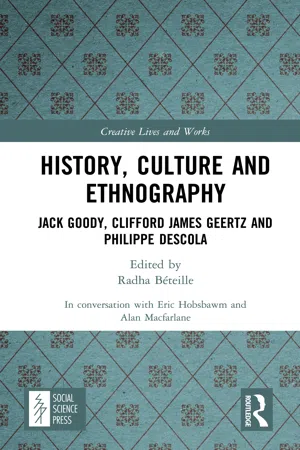
History, Culture and Ethnography: Jack Goody, Clifford Geertz and Philippe Descola is a collection of interviews that is being published as a book for the first time. These interviews have been conducted by one of England's leading social anthropologists and historians, Professor Alan Macfarlane.
Filmed over a period of several years, the three conversations in this volume are part of the series Creative Lives and Works. These transcriptions form a part of a larger set of interviews that cut across various disciplines, from the social sciences and the sciences to the performing and visual arts. The current volume is on three of the world's most eminent social and cultural anthropologists.
These conversations focus primarily on fieldwork experience in Ghana, Indonesia and Amazonia and how new dimensions and interpretations were added to the discipline of sociology and social anthropology. While Jack Goody and Clifford Geertz gave a new turn and depth to the disciple through their experiences in West Africa and Indonesia, Philippe Descola, who belongs to the succeeding generation of anthropologists, added human-nature interactions into the mix.
This book talks about both overcoming and understanding the importance of taking into account linguistic, historical, economic and cultural elements in the study of these societies through engaging conversations and occasional anecdotes. Immensely riveting as conversations, this collection gives one a flavour of the many different societies and cultures in far-flung reaches of the world encompassing several continents, often with no knowledge of each other's existence, and a taste of how expansive the discipline of sociology and social anthropology are.
The book will be of enormous value not just to those interested in the fields of Sociology, Social Anthropology and Ethnography, but also those with an interest in History, Philosophy, Comparative Religion and Cultural Studies.
Please note: This title is co-published with Social Science Press, New Delhi. Taylor & Francis does not sell or distribute the Hardback in India, Pakistan, Nepal, Bhutan, Bangladesh and Sri Lanka.
Some people have influenced me through the force of their ideas, some through the force of their personality. The distinguished Cambridge anthropologist, Professor Jack Goody has combined these. He has undoubtedly been the strongest influence on my career as an anthropologist.
When I applied for my first teaching job in the Department of Social Anthropology, in 1974, the post until lately held by Jack’s former wife Esther, he not only encouraged me to apply, but clearly backed me strongly for the post.
For the rest of his tenure as Professor (to 1983) Jack was always a wonderful mentor and friend. A few examples will suffice.
Whenever we needed equipment for our various computer projects, he supported the application. On one occasion I remember him pulling out his own cheque book and paying for a piece of equipment and muttering that he would somehow find some money later. It was this ‘can do’ attitude which I appreciated so much. He was always optimistic, believing that anything was possible.
Jack himself was always intrigued by new technologies and was among the very first to recognize the value of computers and video. For instance, his indexing of the large offprint collection in the department, his computer version of the west African Bagre myths, his purchase of the Human Relations Area Files, all showed this interest. As did the very early recordings he organized of off-air television programmes which gave the Department the basis for its excellent video library. Or again his early realization that we should video-tape sessions with senior, retiring or retired anthropologists. He did this with Meyer Fortes, Audrey Richards and M.N. Srinivas.
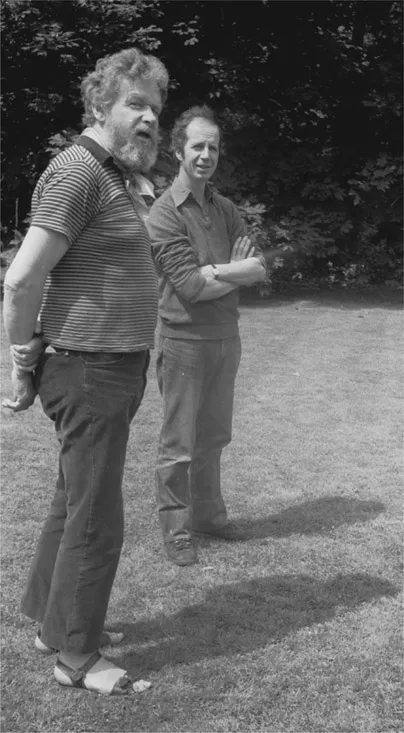
Jack Goody and Alan Macfarlane at Jack’s retirement party in 1984. Photograph courtesy Alan Macfarlane.
His enthusiasm and energy meant that not only did he build up a large department in a short time, but early acquired through grants, and then the University, a technician post. These technicians have been invaluable for many projects in the Department.
***
Jack’s drive and political skills made the Department of Social Anthropology a really exciting place to be from 1975 to 1983. He prevented feuding and stopped the Department from narrowing down to selected specialisms. He encouraged all forms of anthropology and in all areas of the world. Cambridge became the main exporter of good graduates to teach in European universities.
One of the many things I learnt from Jack was how to approach local academic politics. Watching Jack at work through a long day of teaching and administration was an education in itself. He was occasionally over aggressive, took up lost causes, and fought unnecessary battles. But on the whole his immense energy and deep cunning (he reminded me of a bear, apparently clumsy, but lethal and quick thinking) and many ties of friendship and reciprocal networks made him a formidable operator.
Observing and talking to Jack gave me many practical hints. Don’t waste too much time on lectures; make them spontaneous and rough rather than too polished. Don’t waste time going up to London during term. Don’t waste time on formality – a quick note on the back of an envelope will usually do the trick. Don’t be seduced by the idea of American think-tanks. If one has ideas they will come out in any setting and teaching is an encouragement to creativity. Don’t waste time on administration, but try to achieve the maximum amount with the minimal effort. Be courteous and encouraging to assistant staff, secretaries and others, and make them feel valued.
Through Jack I learnt how the University and Department worked, which has since stood me in great stead. I could not have had a better guide to the extraordinary complexity of Cambridge.
Intellectually Jack’s written work and conversations with him had an enormously enlivening effect. Part of his breadth of vision arose from the fact that he was interested in and encouraged interdisciplinary work with many disciplines. He had read English as an undergraduate, but fortunately for me a particular interest was in history and its relationship to anthropology. So we discussed themes and overlaps, in particular in relation to the history of European kinship and marriage, about which we were both writing in those years. Much of his work was set in a long historical time frame, often covering thousands of years. He was practising an early form of global history and maintaining the honourable tradition in anthropology of A.L. Kroeber in looking at long sweeps of civilizations.
Another stimulation was Jack’s interest in technology and material life. Not only was he interested in the practicalities of computers and machines, but he again maintained an earlier (and somewhat unfashionable) anthropological tradition in being interested in material technologies. Thus he wrote books and articles exploring technologies of production, destruction and communication and their effects. This was all the more suggestive because it was broadly comparative, always coming back to the basic contrast which informed his work, that is the difference between the post-Neolithic civilizations of Eurasia, and the pre-Neolithic technologies of sub-Saharan Africa.
So a whole set of areas of our interests overlapped, demography, kinship, communication and technology. And the idea of speculating at a broadly historical and comparative level, taking India, China, Europe and Africa all as grist to the mill, was a constant inspiration. Listening to Jack at seminars, talking to him and reading his stream of works was a constant source of new ideas and themes to pursue. He was constantly suggesting new links, expanding the borders of what anthropology might be. And this was based on a large library and much travel and experience.
***
Jack was enormously productive. By the time he retired, he had published seven single-authored books, and several co-authored and edited ones and many articles. In the thirty years since his retirement he published another sixteen, many of them very long. This set me a target, something to exceed in friendly competition.
In particular I was interested in how he managed to write so much, always based on meticulous reading and research, and to bring together so many diverse ideas. I picked up various hints.
Jack seemed to be working in parallel on half a dozen books or articles at once. If one became bogged down, he switched to another. Furthermore, he was always observing and writing, on journeys, in meetings, even in the shortest period. The blight of busy people is that they have only small bits of time and are tempted to put off producing something worthwhile because of distractions or feeling that they will be interrupted. This did not affect Jack. Great self-discipline and concentration as well as enormous energy and curiosity lay behind this. One aid to his creativity was that he wrote as if he was making a mosaic. At first he would write a few scraps of ideas on a sheet of paper and have it typed. Then he would add in a few more sentences. So a book would be built up as if it were cross-word or jigsaw puzzle.
Another key was moving every two or three years to a fresh subject. He did not, like so many of his colleagues, become stale. This made for great creativity and a freeing of the mind in order to make connections. The fact that Jack was constantly exploring new subjects, and then darting back to old ones, always with the backdrop of deep fieldwork in West Africa and a constant low-key ethnography wherever he went, made his writing very rich. One learnt alongside him and new worlds were opened up.
Whereas Jack’s lecturing and speaking style was sometimes awkward, pausing in the middle of sentences, going back, long ‘oh’ and ‘ah’ pauses (it seemed to me that his speech could not keep up with the lightning speed of his mind) his writing is very clear and easy to follow and in some of his books very good indeed.
He wrote fast and in an almost unreadable hand, using a memory stuffed with information and following his swift and connecting intuitions to bring together ideas from disparate fields. The result are books of great energy and insight.
There are those who have felt that he wrote too much, too fast, and that some of the work is not easy to read because there has been too little attention to the final polishing. There are others who feel that his project to find deep similarities between East and West is flawed because he did not sufficiently distinguish between Renaissance and renaissance, Capitalism and capitalism, Industrialization and industrialization, Science and science, Enlightenment and enlightenment.
Yet there can be no doubt that in a period of what he described as The Expansive Moment (1995), when a small group of anthropologists contributed more to our understanding of the world than many larger disciplines, he was one of the great figures.
***
There was a certain core to all his work which gives it consistency and unity. This is the question of why Eur-Asia had developed through the Neolithic and post-Neolithic revolutions of many kinds, while Africa had not done so (a theme he had early encountered in Gordon Childe’s work). His flexibility arose out of the fact that he did not become constrained by a particular academic fashion. Jack was a materialist, yet not a Marxist, interested in myth and communication, but not a structuralist. He was no faddist and because of his interests in his later years he was more famous perhaps in France than in England. Likewise, his reputation was as great in neighbouring disciplines, particularly history and literary studies, as it was in social anthropology.
One way to approach the very large corpus of his writing is to see it under four main themes. One is the area of kinship and marriage. He wrote seven books in this field, including Death, Property and the Ancestors (1962), Production and Reproduction (1976) and The European Family (2000). Kinship is the toughest and most technical part of anthropology and one where the discipline has contributed most profoundly. Goody’s work on descent, inheritance, bridewealth and dowry, incest and adultery, is a signal achievement.
A second theme was orality, writing and representation, covered in further books; among them are The Logic of Writing and the Organization of Society (1986), The Domestication of the SavageMind (1977) and The Interface Between the Written and the Oral (1987). His work in transcribing and editing The Myth of the Bagre (1972), was ground-breaking. He was one of the major figures in this field.
A third theme was material culture and technology on which he published half a dozen books, including Technology, Tradition and the State in Africa (1971), Cooking, Cuisine and Class (1982), Food and Love (1998) and his last book, written in his nineties, Metals, Culture and Capitalism (2012). Goody opened up an area which is often overlooked by social scientists, namely the intersection of material and cultural worlds.
A fourth theme was an attempt to balance what he considered to be the Eurocentric vision concerning the differences between western Europe and Asia. There were another six books including The East in the West (1996), Islam in Europe (2004), The Theft of History (2006) and The Eurasian Miracle (2010). In an age when global history is expanding fast, the breadth of Goody’s knowledge, rooted in both history and anthropology, with a deep understanding of African and Islamic civilizations, and a keen interest in India and the Far East, made a major contribution to the attack on Euro-centric bias and arrogance of western triumphalism in the Cold War years.
***
I cannot end without noting that he was enormously kind and supportive to many of those he encountered, from children to elderly dons. He would put his hand on your shoulder and draw you into his world, and you knew you could depend on him in any contingency. He was a warm and rounded human being and always exciting to be with.
Jack Goody was a big man in every sense. He was finally knighted, as he should have been earlier. Perhaps he had to wait because there was an ‘Again the Government’, contrarian, streak in him which annoyed some in the Establishment, a characteristic he shared with Edward Evans-Pritchard.
Jack was an excellent ethnographer, a wide ranging and innovative thinker, and bridged the difficult years when anthropology was changing fast from the late colonial period into post-modernity with style and wit.
I have met many fascinating people in my fifty years in Oxford, London and...
Table of contents
Cover Page
Half Title
Title Page
Copyright Page
Contents Page
Transcriber’s Note Page
Introduction Page
PART I
PART II
PART III
Appendix: Biographical Information
Trusted by 375,005 students
Access to over 1.5 million titles for a fair monthly price.
Study more efficiently using our study tools.
Frequently asked questions
Yes, you can cancel anytime from the Subscription tab in your account settings on the Perlego website. Your subscription will stay active until the end of your current billing period. Learn how to cancel your subscription
No, books cannot be downloaded as external files, such as PDFs, for use outside of Perlego. However, you can download books within the Perlego app for offline reading on mobile or tablet. Learn how to download books offline
We are an online textbook subscription service, where you can get access to an entire online library for less than the price of a single book per month. With over 1.5 million books across 990+ topics, we’ve got you covered! Learn about our mission
Look out for the read-aloud symbol on your next book to see if you can listen to it. The read-aloud tool reads text aloud for you, highlighting the text as it is being read. You can pause it, speed it up and slow it down. Learn more about Read Aloud
Yes! You can use the Perlego app on both iOS and Android devices to read anytime, anywhere — even offline. Perfect for commutes or when you’re on the go. Please note we cannot support devices running on iOS 13 and Android 7 or earlier. Learn more about using the app
Yes, you can access History, Culture and Ethnography by Alan Macfarlane,Eric Hobsbawm in PDF and/or ePUB format, as well as other popular books in Social Sciences & Anthropology. We have over 1.5 million books available in our catalogue for you to explore.