Gender, Homicide, and the Politics of Responsibility
eBook - ePub

Gender, Homicide, and the Politics of Responsibility

Fatal Relationships

  1. 154 pages
  2. English
  3. ePUB (mobile friendly)
  4. Available on iOS & Android
eBook - ePub

Gender, Homicide, and the Politics of Responsibility

Fatal Relationships

About this book

Gender, Homicide, and the Politics of Responsibility explores the competing and contradictory understandings of violence against women and men's responsibility. It situates these within the personal and political intersections of neoliberal and 'postfeminist' imperatives of individualisation, choice, and empowerment.

As violence against women has become a national and international policy priority, feminist concerns about violence against women, and men's responsibility, have entered the mainstream only to be articulated in politically contradictory ways. This book explores themes of responsibility for violence, and the social and legal consequences that men and women uniquely or differently encounter. By drawing on high-profile cases of homicide, an extensive literature on feminist perspectives on violence, and compelling focus group discussions, the book examines the politicised claims regarding the 'responsibility' of men and women as both victims and offenders in intimate relationships. Deploying a range of interdisciplinary approaches, it utilises a blend of cultural theory and psychosocial analysis to offer an account of the infiltration of postfeminist and neoliberal sensibilities of individualism and responsibilisation in the social, legal, and interpersonal imaginary. The book makes contributions to several fields, such as the current public policy initiatives to hold men accountable for violence against women; understanding public attitudes to violence against women; and contextualising the challenges faced by a number of feminist reforms that seek to address these issues.

An accessible and compelling read, Gender, Homicide, and the Politics of Responsibility will appeal to students and scholars of criminology, sociology, gender studies and those interested in understanding the debates surrounding violence against women, violence by women, and the social construction of responsibility and responsibilisation.

Frequently asked questions

Yes, you can cancel anytime from the Subscription tab in your account settings on the Perlego website. Your subscription will stay active until the end of your current billing period. Learn how to cancel your subscription.
No, books cannot be downloaded as external files, such as PDFs, for use outside of Perlego. However, you can download books within the Perlego app for offline reading on mobile or tablet. Learn more here.
Perlego offers two plans: Essential and Complete
  • Essential is ideal for learners and professionals who enjoy exploring a wide range of subjects. Access the Essential Library with 800,000+ trusted titles and best-sellers across business, personal growth, and the humanities. Includes unlimited reading time and Standard Read Aloud voice.
  • Complete: Perfect for advanced learners and researchers needing full, unrestricted access. Unlock 1.4M+ books across hundreds of subjects, including academic and specialized titles. The Complete Plan also includes advanced features like Premium Read Aloud and Research Assistant.
Both plans are available with monthly, semester, or annual billing cycles.
We are an online textbook subscription service, where you can get access to an entire online library for less than the price of a single book per month. With over 1 million books across 1000+ topics, we’ve got you covered! Learn more here.
Look out for the read-aloud symbol on your next book to see if you can listen to it. The read-aloud tool reads text aloud for you, highlighting the text as it is being read. You can pause it, speed it up and slow it down. Learn more here.
Yes! You can use the Perlego app on both iOS or Android devices to read anytime, anywhere — even offline. Perfect for commutes or when you’re on the go.
Please note we cannot support devices running on iOS 13 and Android 7 or earlier. Learn more about using the app.
Yes, you can access Gender, Homicide, and the Politics of Responsibility by Ashlee Gore in PDF and/or ePUB format, as well as other popular books in Scienze sociali & Criminologia. We have over one million books available in our catalogue for you to explore.

Information

Publisher
Routledge
Year
2021
Print ISBN
9780367647100
eBook ISBN
9781000470857
Edition
1
Subtopic
Criminologia

1 Feminism, postfeminism, and the politics of responsibility

DOI: 10.4324/9781003125907-2

Introduction

Men and women’s lethal violence is historically, motivationally, and situationally distinct, yet blame and responsibility for this violence is unevenly spread. Men’s responsibility for violence against women has historically been minimised through the deflection of blame onto women, while the responsibility for managing the risks of victimisation is disproportionately borne by women (Dasgupta, 2001). In the realm of homicide, this has been reflected in legal and popular debates and reform efforts to ensure that responsibility, as apportioned by law, reflects the gendered nature of lethal violence between intimate partners (Stubbs, 2016). This has meant confronting the dual challenge of preventing jealous and controlling men who kill from deflecting the blame for killing their female intimate partners, while on the other hand ensuring that women’s resort to violence is adequately contextualised with their history of victimisation. For this purpose, responsibility is explored as synonymous with accountability – this may involve being held to account by a legal standard (criminal responsibility) or being held to be in breach of a moral standard (moral responsibility) (Lacey, 2001). While the former has attracted most attention in the context of homicide, both are important in terms of understanding how responsibility for lethal violence is constructed (Fitz-Gibbon & Walklate, 2016), and neither operate in a social vacuum.
This chapter considers the various ways that ideas about responsibility have manifested in relation to feminist concerns and the context in which this repositioning of blame occurs. It begins by tracing the origins of the criminal law’s conception of responsibility in liberal political theory and the longstanding feminist critiques of liberal legalism. The traditional liberal account of responsibility as located within abstract individual agency is juxtaposed against feminist perspectives which locate both gendered violence and responses to gendered violence within the social and political context of gender inequality and men’s abuse of power. While influential, these accounts have not been without conflict, with debates tending to crystallise around the social and collective responsibility of men for violence against women, and the blurred boundaries between women’s victimisation and criminalisation. The chapter canvasses many of the unresolved tensions in these accounts, including the problematic erasure of women’s agency, and the responsibilisation of men as a collective, as well as the contrasting tendencies to rationalise men’s violence through narratives of ‘masculinity in crisis’.
It is clear that feminism has radically contested, and in some ways changed, discourses about violence. However, the effect of this has been uneven, and feminist dialogue has not wholly displaced or resolved those longstanding attributions of blame. The final section of this chapter situates these competing perspectives within the context of a ‘postfeminism’. The term postfeminism came to prominence in the 1990s as a way of making sense of paradoxes and contradictions in the representation of feminism and women. In Angela McRobbie’s (2009) famous interpretation, feminism was simultaneously ‘taken into account’ yet ‘repudiated’ in contradictory ways. Following Gill (2007), this chapter considers postfeminism as a ‘sensibility’ which encapsulates a circulating set of ideas, images, and meanings which coalesce around several repetitive features, such as choice, empowerment, and autonomy. This sensibility consists of an evident erasure of feminist politics from the popular, even as aspects of feminism seem to be incorporated within that culture (Tasker & Negra, 2007). For Gill (2007), this transition is distinctive because it is a response to feminism that is characterised by an ‘entanglement’ of feminist and anti-feminist discourses. Thus, Gill’s notion of a ‘postfeminist sensibility’ seeks to capture a complex and ambivalent set of discourses that serve to blur the feminist/anti-feminist distinction in current cultural representation (Gill, 2007; Tasker & Negra, 2007; Walby, 1997). Further situating these ongoing debates in the context of ‘postfeminism’ offers a framework to articulate how contemporary manifestations of responsibility take up aspects of feminist thought in contradictory ways.

Responsibility, reasonableness, and the legal subject

Most accounts of responsibility share philosophical foundations located within the tradition of political liberalism and notions of human agency, voluntariness, and criminal liability that emerged in Europe in the philosophies of the Enlightenment (see Russell, 1996). Liberal political theory has at its starting point an ontology – a theory of ‘being’ or personhood (Devlin, 1994). This ontology assumes a rational, free-choosing, autonomous individual who exists prior to and independent of society and others. In other words, liberalism takes as its premise an individualised conception of personhood and self and upon this foundation constructs a political and legal philosophy of individual responsibility (Devlin, 1994).
The law’s understanding of responsibility follows from this conception of the person and human agency. This is most obvious in modern legal discourse, where the idea of criminal responsibility is grounded in liberal political assumptions concerning the nature of individuals who can and should be held responsible. Following the 19th century reform movement, partly motivated by liberal humanism and partly by the goal of more effective deterrence, 20th century criminal law reform has been shaped by greater concern with ensuring that only those who voluntarily and intentionally, or at least recklessly, commit wrongful acts are held to be criminally responsible (Bibbings & Nicolson, 2013). The criminal law is therefore underpinned by ideas of the self-determining moral agent, equipped with distinctive cognitive and volitional capacities of understanding and self-control, and universal personhood (Lacey, 2001):
[It] accords individuals the status of autonomous moral agents who, because they have axiomatic freedom of choice, can fairly be held accountable and punishable for the rational choices … they make. … [I]nformed voluntary choices of action are both necessary and sufficient to justify blame and punishment.
(Dennis, 1997, p. 213)
The core argument is that the force of the criminal law should only be imposed on those who can be said to be responsible for their actions, a task which is determined with reference to objective standards. In the criminal law context, an objective standard refers to a standard that is relatively fixed and independent of the agent, in contrast with a standard that varies with the perceptions, qualities, and capacities of the accused (Moran, 2003). For instance, as Justice Wilson’s famous statement from Hill describes it:
The objective standard … may be said to exist in order to ensure that … there is no fluctuating standard of self-control against which accused are measured. The governing principles are those of equality and individual responsibility, so that all persons are held to the same standard notwithstanding their distinctive personality traits and varying capacities to achieve the standard.
(R v Hill, 1986)
The objective standard, by creating a fixed normative benchmark independent from the actual normative capacities of individuals, supposedly ensures equality under the law by precluding individuals from invoking their own divergent values. Indeed, this is central to the rule of law and to its conception of equality (Moran, 2003). The actions of individuals are therefore weighed against an idealised ‘reasonable’ person as an objective legal standard. For well over a century, the reasonable person has been a central figure in the landscape of the law, and for assessing responsibility in criminal contexts. However, in reality, attributions of blame and responsibility under this standard have been troublingly uneven. For example, feminist legal scholar Nicola Lacey suggests that these objective standards based in individual capacity, agency, rationality, and reasonableness were regimes of truth in which women were incompletely accommodated. Indeed, one of the most pervasive features of criminal responsibility is the gendered nature of attributions of responsibility and criminalisation (see Heidensohn, 1968, 1985; Naffine, 1989; Smart, 1979, 1995). Assumptions about rationality, capacity, and agency or their absence are strongly overlaid with gender norms and assumptions. While the paradigmatic liberal legal subject is a socially decontextualised individual who is “theoretically genderless” (Grear, 2011, p. 44), feminist scholars have compellingly demonstrated the inherent masculinity of this subject. Symbolically speaking, western philosophy has systematically drawn on a binary construction in which the characteristics of liberal personhood – rationality, autonomy, agency, capacity – are associated with masculinity (see for example, Naffine, 2002). The feminine has therefore constituted the binary opposite, existing in a symbiotic hierarchy of the devalued feminine, and the opposite of rational, autonomous, and capable (Naffine, 2002, pp. 81, 87). Women, as man’s ‘Other’, were conversely perceived to lack agency, being controlled by their bodies, passions, and emotions (Olsen, 1990). The ‘reasonable man’ of law has been identified by feminist scholars as modelled on a “white educated affluent male” (Naffine, 1990, pp. 100–101). For well over a century, this gendered understanding of reasonableness was openly announced in the law’s conception of the ‘reasonable man’. An example is AP Herbert’s 1935 infamous opening in the judgment in Fardell v Potts, a fictional case where the court is faced with the puzzle of applying the reasonable man standard to a woman. After noting that among the many authorities there is “no single mention of a reasonable woman”, he concludes “legally at least there is no reasonable woman” (Moran, 2003).
The rise of legal conceptions of individual responsibility founded in agency, rationality, and capacity therefore coincided with an increasingly medicalised view of female irresponsibility. Women were understood as less rational, feebler minded, less autonomous, less fully citizen than men, which had implications for constructions of women’s deviance and criminal responsibility (Lacey, 2008). As Lacey (2008) has observed in her historical analysis of women’s criminal responsibility, in social circumstances in which women’s agentic capacities were called into doubt, criminal law struggled to place women as ‘reasonable persons’ (see also Allen, 1998). Attributions of responsibility to women therefore tended to oscillate between an assumption of non-responsibility reflected in pathologisation discourses, or an extra-punitive ‘double deviance’ stemming from a breach of the criminal law and a breach of femininity. However, each of these responsibility forms were marked by women’s ‘particularity and specificity’ rather than the generality and universalism often legally ascribed to men’s criminal responsibility. As such, women’s criminal responsibility was always constructed as ‘atypical’ (see Loughnan, 2018). On the other hand, the classical liberal male subject, as the universal rational subject, can be imbued with rationality even when he engages in violent conduct.
Conceptions of responsibility based in liberal ideas of agency, rationality, and reasonableness have also worked against women as victims, often responsibilising them for their own abuse. For example, using domestic abuse as an illustration, Naffine (199...
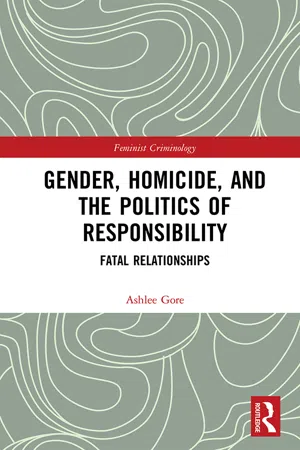
Table of contents

  1. Cover
  2. Endorsements
  3. Half Title
  4. Series Page
  5. Title Page
  6. Copyright Page
  7. Dedication
  8. Table of Contents
  9. Acknowledgements
  10. Introduction
  11. 1. Feminism, postfeminism, and the politics of responsibility
  12. 2. Lethal relationships and legal ambiguities
  13. 3. Beyond the law: Analysing postfeminism, emotion, and affect in public responses to lethal violence
  14. 4. Debating men's responsibility for violence
  15. 5. Women's victimisation and violence: The effects of female individualisation
  16. 6. Postfeminism, men's rights, and responsibility
  17. Conclusion
  18. Index