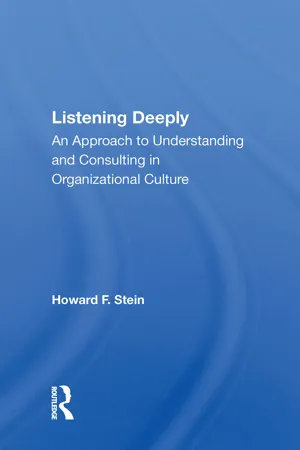
eBook - ePub
Listening Deeply
An Approach To Understanding And Consulting In Organizational Culture
- 288 pages
- English
- ePUB (mobile friendly)
- Available on iOS & Android
eBook - ePub
Listening Deeply
An Approach To Understanding And Consulting In Organizational Culture
About this book
So much in our society is based on the importance of doing, achieving, striving, intervening, and producing. In contrast, Listening Deeply attempts to re-establish listening and attentiveness toward others as the key to consulting with organizations. Professor Howard Stein uses his training in anthropology and psychology to shed light on organizational relationships and tensions. He shows how a consultant can safely allow emotionally charged issues to emerge so that healing can begin. Using brief and extended case examples from his own consulting practice, Stein illustrates his approach of creating a safe holding environment, in which members of an organization can express difficult emotions and learn to understand themselves and their colleagues better. He encourages consultants to use the self creatively and constructively to look beyond the obvious in interpreting messages from group members. Sometimes it is only through the consultants own emotional response that the root of the organizations problem becomes clear. Stein provides concrete examples that show the consultant how to listen for underlying themes and thoughtfully analyze both the text and subtext of an organizations culture. Through his cases, Stein demonstrates how the consultant can go beyond conventional problem-solving to promote healing, growth, and, ultimately, a better working environment.
Information
1 Key Concepts
DOI: 10.4324/9780429034190-2
In this chapter, I identify key concepts that serve as road maps and guideposts for the chapters that follow. These key concepts emerged inductively over the years from consultations. I did not know or apply them beforehand. Organizational work taught me what tools I needed. I first discuss the importance of understanding group dynamics in work sites. I describe how the self of the observer-consultant provides crucial data about groups. I then discuss the roles of metaphors, leadership, and the triad of change-loss-grief in regulating the life of organizations. I begin to raise and answer such questions as, What is a group? Why should we pay attention to group process in work sites? What does it feel like to be a member of a group? What is an organization? What is its culture and that culture's consequences for decision-making, productivity, profit, and morale? How does a consultant know what to pay attention to during the course of a consultation?
Understanding Groups
Psychoanalytic scholars and consultants have contributed much to our understanding of organizations. Perhaps their most important—and difficult to accept—discovery is that workplace groups are governed largely by psychological processes outside the awareness of their own members and that these processes affect major policy development as well as minor decision-making. Furthermore, in diverse areas such as the study of leadership (Levinson et al. 1962), self and organizational identity (Diamond 1984, 1988; Diamond and Allcorn 1985, 1986), evil in organizations (Alford 1990), bureaucratic structure (Baum 1987), and the metaphor of management (Zaleznick 1989), psychoanalytic investigations and consultants repeatedly find that organizational members imagine and act as if their group is a distinct entity that somehow possesses a life of its own.
In describing ethnic, national, or organizational cultures, outside interpreter and insider alike can easily slip into reifications and speak as if a group is a self-standing entity, a living organism rather than an association of individual people. Although in one sense reification distorts reality, in another sense it performs mental functions for group members. Warren Shapiro (1989), for example, shows how reification of peoples social group serves the purpose of denying death. People everywhere perceive and characterize their group or society as an immortal, ontological, if not supernaturally created entity.
While studying how peoples in Europe and the United States reify society, Lloyd deMause and Henry Ebel developed the concept of group fantasy (deMause 1982; deMause and Ebel 1977). It refers to the fact that people perceive, define, identify, and experience themselves as members of a group who constitute some kind of "us." They do so actively and to a large extent unconsciously. The process of constructing and "sharing" a sense of we-ness does not exist apart from constantly imagining an otherness. It is, in short, a never ending hammering out and shaping of group contents. A group fantasy consists of what it feels like to be a member of a group at a particular time. Through the oscillation of projection and introjection (and identification), one reincorporates into the self an image of the group as the outer social skin of the self, the protective outpost or border for security operations. The group self-image becomes an idealized object, the representation of which is then taken back into the self.
Yet groups do not really exist apart from the people—and their motivations—who constitute and "belong to" them (e.g., La Barre 1972; Bion 1959). There exists no such thing as a "group mind" or group entity beyond the individual feelings and perceptions of the people who constitute the group. It is people who believe in and negotiate a sense of we-ness and who create and experience the very group they describe as possessing a separate existence beyond themselves. For purposes of defense against anxiety, motives and character may be ascribed to, projected upon, or externalized upon the group. All organizations and cultures are created and sustained by those who in turn experience themselves as belonging to these groups and who are loyal to "them" (Berger and Luckmann 1966).
Implicitly building on Klein's (1946) concept of projective identification as regulating both internal and interpersonal environments, Yijö Alanen (1990: 8) refers at the individual level to
those defensive functions through which the individual tries to protect himself against anxiety caused by internal or external threats by using or exploiting other persons and/or fantasies about them. A successful warding-off of anxiety will then depend upon whether the other person behaves in the way he is expected to do, or whether at least such a fantasy can be maintained. At the world community level this conception is very relevant to a better understanding of the deeper causes of the so-called enemy stereotypes, projectively tinged apprehensions of the "other part," giving at the same time an acceptable and guilt-relieved motive for one's own aggressive feelings and actions directed at it. This also includes the psychological paradox that a feared and—rightly—condemned aggressive intervention of the other part may also be experienced as an unconsciously welcome event, just because it gives additional evidence in support of the "correctness" of our prejudiced stereotype of that other part.
In families, we not infrequently also see actions exercised by one member to provoke the other member to behave in ways corresponding to the safeguarded conceptions of the first member. These kinds of provocations play their part in international politics as well, and may have contributed to the outbreaks of many wars.
In groups, mental operations differ from those of dyads or of the individual. There is greater proneness to regression; to the eruption of primary process, irrational thinking; and to action governed by it (cf. Alford 1988: 579). The larger the group is, the deeper is the regressive potential; the greater are the depersonalization, dehumanization, and abstraction of adversaries and the diminution of reality testing; and the more unfettered is the dominion of fantasy. Organizational culture, like ethnic and religious cultures, rests upon deeply personal, conflictual, and emotion-laden foundations, most of which drive people unconsciously.
Wilfred R. Bion (1959) describes groups as organized around three types of unconscious basic assumptions: (1) dependency upon a leader or upon the group as an entity (the sense that the Ieader[s] will sustain the group by nurturing and protecting it or that the group itself is a mother-child unit); (2) fight/flight aggression (heightened vigilance, a sense of imminent danger, readiness to attack or to withdraw, heightened aggressive impulses); and (3) creation of a group savior through "pairing" (the group hopes for rebirth via a redeemer who is a product of the fantasized pairing of two group members or of outside parent figures). Bion (pp. 159-160) addresses the relationship between intellectual activity and group fantasies:
The individual, conforming with the behavior imposed by participation in the basic-assumption group, feels as if his intellectual capacity were being reduced. The belief that this really is so is reinforced because the individual tends to ignore all intellectual activity that does not fit in with the basic assumption. In fact I do not in the least believe that there is a reduction of intellectual ability in the group, nor yet that "great decisions in the realm of thought and momentous discoveries and solutions of problems are possible to an individual working in solitude" (McDougall 1920); although the belief that this is so is commonly expressed in the group discussion, and all sorts of plans are elaborated for circumventing the supposedly pernicious influences of the emotions of the group. Indeed I give interpretations because I believe that intellectual activity of a high order is possible in a group together with an awareness (and not an evasion) of the emotions of the basic-assumptions groups. If group therapy is found to have a value, I believe it will be in the conscious experiencing of the group activity of this kind.
In Group Psychology and the Analysis of the Ego, Freud ([1921] 1955b) argues that groups are formed and perpetuated by bonds of identification based on father-son conflict and its resolution. Bion (1959) proposes that this facet of group psychology rests developmentally upon even earlier mother-infant relationships and infantile defenses against massive anxiety. Alan Dundes (1980, 1984) notes similarly that the plausibility of a depthpsychology interpretation lies in the very cultural material—the folklore, slips of the tongue (parapraxes), metaphors, myths, and taboos—of people themselves.
The method of listening deeply discussed here has been especially influenced by the clinical and theoretical work of such object-relations psychoanalysts and psychiatrists as Harold F. Searles, M.D. (1975), Vamik D. Volkan, M.D. (1981), L. Bryce Boyer, M.D. (1983, 1989), Arnold H. Modell, M.D. (1984), James S. Grotstein, M.D. (1981), Thomas H. Ogden, M.D. (1989), Otto F. Kernberg, M.D. (1976), and Wilfred B. Bion, M.D. (1963). What resonates most strongly with my work in organizational groups is how earliest developmental issues of boundaries, continuity, sensation, rhythm, integrity, and cohesion of the body are the foundations upon which organizational group identities are built and destroyed.
In The Meeting: Gatherings in Organizations and Communities, Helen Schwartzman (1989) distinguishes between formal decision-making and the ebb and flow of meetings in which decisions take place. Our culture has widely shared categories, such as decisions, decision-making, outcomes, outcome measures, mission statements, goals, and objectives, according to which the official or formal work of groups is assessed. Schwartzman looks behind bureaucratic language, explicit genres, and official group self-representations to explore the eventfulness of meetings themselves for those who participate in them. Decisions become only one of the many elements of the meeting and not necessarily the most significant one for those participating. The meaning that meetings hold for their participants often diverges widely from the formal agenda and espoused meaning. Decision-making occurs outside the boundaries of what we officially and formally define and recognize as decision-making.
Despite the common belief that decision-making in organizations is governed by realism and rationality, unconsciously motivated hidden agendas affect group thinking, interaction, and action. There are often informal, if not formal, prohibitions against acknowledging certain ideas or feelings in groups—power, membership, leadership, insidership, outsidership. Participants enforce a group fantasy of ignorance that sustains the illusion that the group is really only about decision-making. Group members can unwittingly play out issues of insiderness/outsiderness and conflicts over power via some formal topic (budget, curriculum, production quotas) that embodies what cannot be spoken. Similarly participants can rally around a tightly bounded agenda to divert attention from, and even avoid, an emotionally toxic subject such as what it feels like to be a member of the group or meeting at that moment.
Unless these unconscious agendas are given their due and addressed in group meetings, they will contaminate, if not sabotage, official roles and tasks; distort reality; and perpetuate conflict even if for a while they artificially boost morale. To the degree that unconscious agendas fail to be brought to conscious awareness for greater access and control in work groups, organizations will fail to mature and evolve. They will instead continue to repeat old patterns, often called mistakes. Conversely as groups acquire better insight into these powerful underlying factors, they will increase their ability to be liberated from the pull of the past and to explore genuinely new alternatives.
Although this book is not social psychology or sociology per se, neither is it their adversary. The psychoanalytically informed approach taken in this book complements and helps complete the analyses of groups, organizations, and work offered by social psychologists and sociologists (for example, Erikson and Wallas 1990; Lindsmith and Strauss 1968; Argyris 1990). Decision making processes, consensus, conformity, the construction and use of group norms, the nature of leadership, task and process roles, group cohesiveness, power and status, and the relationship between individual and group decision making are all topics long addressed in these fields—fields now integral to schools of business and management training. What a psychodynamically oriented approach strives to do is add yet another dimension to an understanding of these processes, that of the unconscious and its relation to the conscious.
Let me briefly illustrate this by drawing from a classic experiment performed by Solomon Asch (1952) on how individuals in groups often conform themselves to their social environments as a means of conflict resolution. Richard S. Lazarus (1961: 18) summarizing Asch's work, writes:
Asch (1952) has performed a fascinating experiment on the effects of social pressure on perceptual judgments. The subject in his experiment was required to match a visually presented series of lines with comparison lines of different lengths. In the same room with him were other persons who the subject thought were also being tested but who, in reality, were allied with the experimenter and said what they had been rehearsed to say when they were asked publicly to make their judgments. A large portion of the time they gave incorrect answers so that the actual subject often found himself a minority of one. Even though the correct answers were quite obvious, tremendous social pressure was exerted on the subject to modify his judgment in favor of the group.
As Asch (1952, pp. 4-5) wrote, "There was a marked movement toward the majority. One third of all the estimates in the critical groups were errors identical with or in the direction of the distorted estimates of the majority. The significance of this finding becomes clear in the light of the virtual absence of errors in the control group, the members of which recorded their estimates in writing.". . .
In response to this situation, the subjects conformed to the pressure of the group about 30 per cent of the time. In fact, some subjects, when questioned later, seemed to be entirely unaware that they had responded to this pressure, believing that they actually perceived the lines in the same way as the majority.
Asch's experiment parallels Irving Janis's (1982) later studies of "groupthink," except that in Asch's, conformity occurred with a leaderless group rather than in a group rallying around a leader, A person obliterates his or her distinctiveness in the service of fitting in. Reality distortion and abrogation of personal judgment are two consequences and casualties of this subdy coerced conformism. Organizational groups of all kinds lose in reality testing and creativity what they gain in consensus. Groups can be wrong but insist that they are right. People will change what they "know" and perceive in order to belong. Concepts such as separation anxiety, identification with the aggressor, and dependency wishes help us understand why people in organizations often behave as Asch discovered in his experiment four decades ago. Furthermore, these concepts direct the consultant to largely out-of-awareness dynamics that influence perception and judgment in decision-making.
A number of authors have discussed unconscious influences in what we today call the industrial psychology or management psychology of work groups (Stein and Fox 1985). Nevertheless, the literature remains sparse and continues to be identified as clinical, which makes it seem exceptional, unusual, and exotic rather than mundane. The small-group research of Janis illustrates the promise of depth psychology in understanding group life. Janis studied decision-making in the circle around President John F. Kennedy to understand how the calamitous Bay of Pigs invasion of Cuba was conceived. Janis (1982) also studied corporate policy-making processes and coined the Orwellian term groupthink. Janis (1971: 43, 44) describes groupthink as
a mode of thinking that persons engage in when concurrence-seeking becomes so dominant in a cohesive group that it tends to override realistic appraisal of alternative courses of action. . . . The term refers to a deterioration in mental efficiency, reality testing and moral judgments as a result of group pressures. . . . Groupthink involves nondeliberate suppression of critical thoughts as a result of internalization of the group's norms.
In groupthink, the participants' goal of group cohesiveness through unanimity...
Table of contents
- Cover page
- Half Title page
- Title Page
- Copyright Page
- Dedication page
- Contents page
- Foreword page
- Preface page
- Acknowledgments page
- Introduction
- 1 Key Concepts
- 2 Understanding Groups
- 3 Use of the Self
- 4 Metaphors
- 5 Leadership
- 6 Organizational Change, Loss, and Grief
- Conclusion
- Appendix: Definitions of Terms
- References
- About the Book and Author
- Index
Trusted by 375,005 students
Access to over 1.5 million titles for a fair monthly price.
Study more efficiently using our study tools.
Frequently asked questions
Yes, you can cancel anytime from the Subscription tab in your account settings on the Perlego website. Your subscription will stay active until the end of your current billing period. Learn how to cancel your subscription
No, books cannot be downloaded as external files, such as PDFs, for use outside of Perlego. However, you can download books within the Perlego app for offline reading on mobile or tablet. Learn how to download books offline
We are an online textbook subscription service, where you can get access to an entire online library for less than the price of a single book per month. With over 1.5 million books across 990+ topics, we’ve got you covered! Learn about our mission
Look out for the read-aloud symbol on your next book to see if you can listen to it. The read-aloud tool reads text aloud for you, highlighting the text as it is being read. You can pause it, speed it up and slow it down. Learn more about Read Aloud
Yes! You can use the Perlego app on both iOS and Android devices to read anytime, anywhere — even offline. Perfect for commutes or when you’re on the go.
Please note we cannot support devices running on iOS 13 and Android 7 or earlier. Learn more about using the app
Please note we cannot support devices running on iOS 13 and Android 7 or earlier. Learn more about using the app
Yes, you can access Listening Deeply by Howard F Stein in PDF and/or ePUB format, as well as other popular books in Psychology & History & Theory in Psychology. We have over 1.5 million books available in our catalogue for you to explore.