- 256 pages
- English
- ePUB (mobile friendly)
- Available on iOS & Android
eBook - ePub
About this book
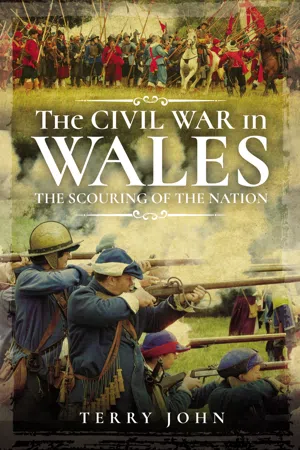
The Civil Wars of the seventeenth century had a devastating effect upon Wales and the Marches, stripping the country of its human resources and ruining whole communities. This book explores the years of conflict between 1642 and 1649, detailing the campaigns, sieges and battles which took place in every corner of the country, presenting information from a wide variety of sources to paint a wide-ranging picture of the nation at a significant turning point in its history.
Information
Subtopic
British HistoryIndex
HistoryChapter 1
Wales, Land and People
On 13 July 1652, John Taylor, an eccentric and much-travelled character known as ‘The Water Poet’, set off on a journey from London to Wales and back. He recorded his experiences in a book entitled A Short Relation of a Long Journey, which was written partly in verse and partly in prose. During his wanderings, he visited Flint Castle, which he described as almost buried in its own rubble, remarking that, ‘surely war hath made it miserable’. He found Aberystwyth to be in an even worse state, its castle blown up and its houses ‘transformed into confused heaps of unnecessary rubbidge.’1
Taylor was witnessing the devastation that resulted from almost ten years of civil war. In common with many areas of Britain, Wales had been torn apart, its towns ruined, its fields despoiled and the blood of its people spilt. It would take decades for many communities to recover.
The damage to the infrastructure of Wales seems to have been matched by a slump in population growth. In 1642, at the beginning of the Civil Wars, the people of Wales have been estimated to number about 356,000, a steady increase from the supposed total of 329,000 in 1621.2 By 1670, over a similar period of thirty years, it had barely reached 376,000, though some of this may admittedly be due to a series of poor harvests in the 1620s and an outbreak of plague in the 1630s. In 1623 Sir John Gwynn of Gwydir in Caernarfonshire found himself £3,000 in debt due to a shortfall in his income from rents and he was worried that his tenants were unable to pay as the cost of bread corn had risen so much ‘that a number do die in the country from hunger…the rest have the impression of hunger in their faces exceeding the memory of any man living’.3 It is worth noting however, that some years earlier, he had been fined for oppressing his tenants in Dolwyddelan and Llysfaen, so it is to be hoped that he now did something to help the hungry.
Most people lived in scattered rural communities. There were no very populous towns. The two largest centres of population were Wrexham, with about 2,500 inhabitants, whilst in South Wales, Carmarthen could boast between 1,500 and 2,000 people.4 In the years before the Civil Wars, only about ten per cent of the population lived in urban settings and even the rural settlements tended to cluster in the more fertile lands. In the north, the Vale of Clwyd and Flintshire contained the best farmland, and in the south the most fertile land lay in the Vale of Glamorgan, areas of the Gower and most of Pembrokeshire.5
Much of Wales consisted of unproductive moorlands and mountain ranges, with shallower soils where the wetter climate made the growing of crops problematic. Farms and villages were sparsely scattered and were huddled against the more sheltered slopes and hollows. Sheep had been grazed in these areas for generations and during the medieval period, several of the larger Welsh abbeys had grazed their flocks on the upland plateaus during the summer months.
Industries
The woollen industry was important to many Welsh counties. At the end of the sixteenth century, George Owen, a Pembrokeshire landowner, recorded a ‘great quantity yearly sold’ from his area of northern Pembrokeshire through ‘Cardigan market to North Wales men’ who also sold their own wool to Oswestry and Shrewsbury.6 The southern part of Pembrokeshire traded to Bristol, Barnstaple and Somerset. In mid-Wales, the flocks provided material for the wool industry at Presteigne and the markets at Knighton and Ludlow.
It was not unusual in the spring and summer months to see the drovers’ roads crowded with cattle, sheep and even geese being driven eastwards towards the Midland towns, Bristol and even London. From South Wales, cattle were shipped out from coastal ports along the coast to harbours in the West Country and to Bristol. This movement of livestock was not all one way. Every year herds of cattle were sent into Wales to summer in the countryside, and there was a steady reciprocal trade in fruit, corn and other kinds of merchandise.7
A high percentage of the Welsh population was employed in industries that were linked to agriculture. Spinning, weaving, cloth making and tanning were carried on as cottage industries as well as in many towns and villages, though George Owen lamented the fact that in Pembrokeshire the wool there was ‘unwrought’, but was sold in a raw state to other countries. Dairy produce was much in demand, so much so that Glamorgan became one of Wales’ biggest butter and cheese making regions. Oats, wheat, barley and rye were grown in the fertile lands of the north and south.
The majority of Welsh landowners were eager to exploit the resources that lay beneath their fields. Lead and copper were mined and smelted, with stone and lime being quarried in a number of locations. Sir Thomas Myddleton of Chirk Castle developed an ironworks on his estate, whilst allowing a speculator named Thomas Bushell to mine lead on the family’s lands in Cardiganshire.8 Coal had been extracted for centuries from the coalfields of the south and north east. Opencast mining is recorded as taking place in Pembrokeshire from the fourteenth century, if not before. Coal and culm – a mixture of clay and coal pressed into balls of fuel that burned slowly – were being exported from Tenby to Ireland in regular shipments during the latter half of the sixteenth century.
Woodlands and forests provided timber for pit props and house- and shipbuilding. Neath was regarded as the best place for shipbuilding in Wales9, though it was possible to find it taking place in harbours and creeks almost anywhere along the coastline. In some cases, the vessels were built on the beaches and a construction site might lie dormant for months until a new ship was needed to replace one that had been wrecked or was no longer seaworthy.
A surprising number of the gentry were involved in some way in sea trade, either by buying shares in a ship, or by financing a voyage. Wealthy merchants also invested in ships as partners or combined their roles as traders with that of captaining a trading vessel. The ports along the South Wales coast had developed close links with Bristol and a number of merchants from Glamorganshire, Carmarthenshire and Pembrokeshire had warehouses in Bristol, mostly in an area of the docks known as the Welsh Quay. Some were willing to send their wives off on voyages to Bristol in order to settle debts or conduct business there, whilst others sent their sons and even their daughters to be apprenticed to a craft or trade.10
Chester, because it was linked to the sea by the River Dee, became a major trading centre for Wales and the Marches. Prosperous, of strategic importance, encircled by its medieval walls, much of its wealth was derived from the wool trade, with fleeces being brought in from North Wales. Welsh cattle also supplied the raw materials for the city’s leather workers, tanners, glovers, saddlers and shoemakers. The city had been sending out ships and cargoes to destinations in France, Iberia and Ireland for many centuries. There were, however, concerns that the wealth of the city was threatened by the silting up of the Dee estuary, which during the mid-sixteenth century, had necessitated the building of a new quay nearer to the outlet with the Irish Sea.11
Three other cities close to the borders with Wales also relied upon Welsh produce to fuel their industries. Shrewsbury became a major centre of the woollen industry, with its merchants buying Welsh cloth that had been woven and treated in fulling mills but was otherwise in an unfinished state. The resulting friezes and plain cloth were sent regularly by road to markets further east, including London.
Wool from the Marches also found its way to Hereford, where it was woven and fulled. This involved cleaning and thickening it by pounding it in a mixture of water and clay and then stretching it on frames known as tenters, to which it was attached by tenterhooks, to dry before making it into clothing. Gloucester also had a flourishing woollen industry and, as at Hereford, the leatherworkers fashioned animal hides into hats, gloves, leather bottles and saddles.
All four of these cities, to a greater or lesser extent, would shape the course of the Civil War in Wales and the Marches.
Society
Across Wales the most eminent positions in society were held by members of the aristocratic and gentry classes. Some great peers, members of the Stuart court, held lands in Wales, but few of them dwelt permanently in their Welsh houses. In North Wales and the borders, the dominant figures, amongst others, were the Myddleton family of Chirk Castle, and the Salusbury family of Lleweni.
The most influential figures in South Wales were Henry Somerset, fifth Earl and later first Marquis of Worcester, whose magnificent castle at Raglan dominated the landscape, and Richard Vaughan, second Earl of Carbery at Golden Grove in Carmarthenshire. Both were to play leading parts in the Royalist war effort in South Wales, with Lord Worcester’s vast wealth and unshakable loyalty to Charles I fuelling the Crown’s campaign across Glamorganshire, Monmouthshire and the southern Marches.
Another leading nobleman was Robert Devereux, third Earl of Essex. The son of Robert, the second earl who had been the favourite of Queen Elizabeth I in her elder years, Essex held a number of manors in Wales, including the former episcopal palace of Lamphey, near Pembroke. Many gentry families such as the Powells, Meyricks and Cunys in Pembrokeshire and the Gwynnes and Lewises in Radnorshire, had been drawn into the orbit of the second earl. After his execution in 1601, they had transferred their loyalties to his son. Another group which was to follow Essex’s lead when he declared for Parliament at the outbreak of the war were the Gunters, who may originally have hailed from the Brecon area and who in 1642 were renting Lamphey Palace from the earl.
Gentry families such as those mentioned here provided Wales with its Members of Parliament, Justices of the Peace and County Sheriffs, whilst younger sons entered the church or the legal profession. As the ruling class within Wales, they were conscious that within their ranks there existed careful gradations of precedence. First in eminence were the knights and, after the creation of the position in 1611, the baronets. Then came the squires and after them the gentlemen.
All derived their position and influence from services carried out for, and privileges granted by, various sovereigns. Some gentry families could trace their lineage back through countless generations to the time of the early Welsh princes, whilst others rooted their ancestry in the conquering Norman lords. Others combined a descent from both sides.
The Welsh gentry were not as wealthy as their English counterparts. Their riches came from land ownership and whilst some lived handsomely on an annual income of £1,000 or more, others existed quite well on at least £300 per annum. There were those who managed more frugally on amounts of less than £100, but this did not necessarily affect their status as gentry, as it was their pedigree and their ownership of land that buoyed them up.
Certain standards were expected of the gentry, whatever their financial situation. In 1626, William Vaughan, the uncle of Richard Vaughan, second Earl of Carbery, produced a work entitled The Golden Grove, in which he set out ‘the means to discern a gentleman’. Foremost amongst the necessary qualities were that ‘he must be affable and courteous in speech, and behaviour’. A true gentleman must also be ‘endowed with mercy to forgive the trespasses of his friends and servants.’ Charity to the poor and hospitality to their fellows should be combined with kindness to servants and an adventurous heart to fight for just causes. ‘These be the properties of a gentleman, which whosoever lacketh deserveth but the title of a clown or of a country boor.’12
A gentleman should also be a patron of the arts, supporting scholars, musicians and poets, perhaps even writing himself, as Sir James Perrot of Carew did in 1630. His book, Meditations on the Lord’s Prayer, proved to be an influential and respected religious text. This was only one of a number of publications he produced during his lifetime.
Some Welsh gentlemen created private libraries of books. The collections of Sir John Price of Brecon and Sir Edward Stradling of St Donat’s were to be envied, whilst one landowner, William Maurice of Cefnybraich in Denbighshire built a three-story addition to his house to hold all his books.13 In the Vale of Clwyd, Glamorgan and Pembrokeshire there existed scholarly groups which met regularly to exchange ideas and manuscripts.14
However cultured they might be, members of the gentry were also proud of their status, touchy over their dignity and rights, and were prepared to take out legal actions against anyone who threatened their titles to land and property. There were long-held grudges against other families and barely concealed resentments over religion. Indeed, it was said that in Monmouthshire few quarrels arose that did not develop out of a difference between Catholicism and Protestantism.15
Another prosperous group, almost indistinguishable from the minor gentry, consisted of yeoman farmers. They occupied freehold lands which they worked for themselves, selling corn and other produce in the markets and could count on an income of up to forty shillings a year. Some diversified into trades, owning smithies and running alehouses and bakeries, even investing in maritime trading ventures. The wealthiest amongst them were ready to loan money, livestock, and crops to their less fortunate neighbours. Their dwellings were often stone-built and surprisingly comfortable, furnished with items of furniture such as chairs, tables, beds with mattresses, wooden chests for storage, candlesticks and other household utensils.
Yeoman farmers could often trace their lineage back through many generations, especially where their families had occupied the same lands for a century or more. It was not unknown for a member of a well-respected and prosperous yeoman family to marry into the lower ranks of the gentry.
There were grades within the yeoman class and some freehold families worked much smaller acreages and were much more likely to slip into poverty following a series of bad harvests or the death or illness of the principal breadwinner. This was also true of the husbandman class, a group of tenant farmers who, if fortune favoured them, might work their way upwards to a reasonable level of prosperity, but who were much more likely to feel the harsh effects of misfortune.
The majority of the rural population worked on the land. They paid cash rents to the gentry for the tenancies of a few acres of land each and, in addition, carried out a range of services for their landlords. These services often dated back to the medieval period and might include the gathering in of the lord’s crops, the repair and maintenance of the manorial mill or fishpond. The homes of the poorest among them were bare of the furnishings of the yeoman class and there were few household goods except wooden bowls and platters and a few sticks of furniture. They lived in houses that were little better than hovels with no windows and earthen floors, upon which the inhabitants slept on heaps of straw. These dwellings, once left empty, quickly collapsed back into the earth from which they had been made.
Welsh was the everyday language of most people, though English dominated in south Pembrokeshire and in some areas of Glamorgan and Monmouthshire. The Reverend John Edwards of Tredunnock, writing in the aftermath of the Civil War, noted that Welsh was not widespread in his home v...
Table of contents
- Cover
- Title
- Copyright
- Contents
- Acknowledgements
- Abbreviations
- Chapter 1 Wales, Land and People
- Chapter 2 1642
- Chapter 3 1643
- Chapter 4 1644
- Chapter 5 1645
- Chapter 6 1646
- Chapter 7 1647–49
- Chapter 8 After the War
- Bibliography
- Endnotes
- Plate section
Trusted by 375,005 students
Access to over 1.5 million titles for a fair monthly price.
Study more efficiently using our study tools.
Frequently asked questions
Yes, you can cancel anytime from the Subscription tab in your account settings on the Perlego website. Your subscription will stay active until the end of your current billing period. Learn how to cancel your subscription
No, books cannot be downloaded as external files, such as PDFs, for use outside of Perlego. However, you can download books within the Perlego app for offline reading on mobile or tablet. Learn how to download books offline
Perlego offers two plans: Essential and Complete
- Essential is ideal for learners and professionals who enjoy exploring a wide range of subjects. Access the Essential Library with 800,000+ trusted titles and best-sellers across business, personal growth, and the humanities. Includes unlimited reading time and Standard Read Aloud voice.
- Complete: Perfect for advanced learners and researchers needing full, unrestricted access. Unlock 1.5M+ books across hundreds of subjects, including academic and specialized titles. The Complete Plan also includes advanced features like Premium Read Aloud and Research Assistant.
We are an online textbook subscription service, where you can get access to an entire online library for less than the price of a single book per month. With over 1.5 million books across 990+ topics, we’ve got you covered! Learn about our mission
Look out for the read-aloud symbol on your next book to see if you can listen to it. The read-aloud tool reads text aloud for you, highlighting the text as it is being read. You can pause it, speed it up and slow it down. Learn more about Read Aloud
Yes! You can use the Perlego app on both iOS and Android devices to read anytime, anywhere — even offline. Perfect for commutes or when you’re on the go.
Please note we cannot support devices running on iOS 13 and Android 7 or earlier. Learn more about using the app
Please note we cannot support devices running on iOS 13 and Android 7 or earlier. Learn more about using the app
Yes, you can access The Civil War in Wales by Terry John in PDF and/or ePUB format, as well as other popular books in History & British History. We have over 1.5 million books available in our catalogue for you to explore.