A Royal Air Force veteran of the Falklands Conflict presents a comprehensive, myth-busting study of the air campaign.
In the spring of 1982, Argentina and the UK engaged in tense combat over control of the Falkland Islands. The ten weeks of fighting are often portrayed with a decidedly one-sided narrative: either heroic Argentine pilots relentlessly pressing home their attacks, or the Sea Harrier force utterly dominating its Argentine enemies. In
Air Power in the Falklands Conflict, RAF veteran John Shields presents a detailed and even-handed analysis of the Falkland Islands air war.
As an RAF officer, John Shields spent two and a half years in the Falklands as an air defense navigator. Using recently released primary source material, Shields looks at the air campaign at the operational level. He develops a considered view of what should have occurred, and contrasts it with what actually happened. In so doing, John Shields has produced a comprehensive account of the air campaign that has demolished many of the enduring myths of this Cold War conflict.
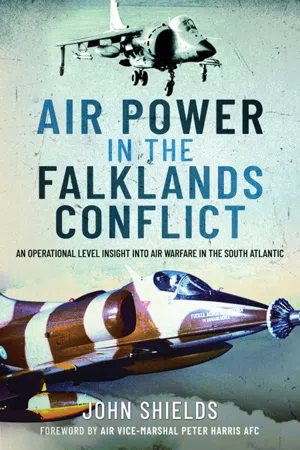
eBook - ePub
Air Power in the Falklands Conflict
An Operational Level Insight into Air Warfare in the South Atlantic
- 376 pages
- English
- ePUB (mobile friendly)
- Available on iOS & Android
eBook - ePub
Air Power in the Falklands Conflict
An Operational Level Insight into Air Warfare in the South Atlantic
About this book
Information
Subtopic
20th Century HistoryIndex
HistoryChapter 1
Introduction
‘One captured A4 [Skyhawk] pilot admitted to being turned back three times by Sea Harriers before eventually penetrating the AOA [Amphibious Operating Area] and getting shot down on his 4th sortie.’
Lieutenant Commander Nigel Ward Commanding Officer 801 Naval Air Squadron.1
Ward used the above example in his official post-Falklands Conflict report to highlight the Sea Harrier’s dominance throughout the campaign.2 Although Ward did not name the pilot nor the cause of his demise, the only Argentine fast jet pilot to be captured during the Conflict was Teniente Ricardo Lucero, an A-4C Skyhawk pilot from Grupo 4 de Caza. On 25 May 1982, Lucero was indeed shot down by British forces during his fourth mission.3 However, Lucero was successfully engaged not by a Sea Harrier but by a combination of land and maritime-based anti-aircraft weapons as he approached the British beachhead at San Carlos.4 While he recovered from his injuries in the British field hospital at Ajax Bay, Lucero spoke to a British journalist via an interpreter. Ian Bruce, the Glasgow Herald correspondent, reported that Lucero said, ‘I was shot down in my fourth attempt to attack your beachhead … three previous attempts were aborted when your Harriers intercepted us over the sea.’5 Research from a variety of British and Argentine sources confirmed that Lucero failed to drop any weapons during his first three missions on 1, 9, and 24 May, respectively. However, the aborted missions were due to an inability to find targets, poor weather, and, despite avoiding a Sea Harrier combat air patrol, the weight of ground fire.6 Consequently, and contrary to Ward’s assertion, not one of Lucero’s missions failed due to Sea Harrier intervention. Was this incident unique, or was it indicative of a much broader issue where success was falsely attributed to the Sea Harrier to enhance its reputation?
In addition to the perceived Sea Harrier dominance during the air campaign, both protagonists have generated several other air power-related myths. As a result, there remains confusion surrounding the air power lessons of the operation. Indeed, many of the perceived lessons now appear to be beyond reproach. However, the steady release and access to new primary source material create an opportunity to review and challenge many of the enduring and entrenched views regarding the Conflict.
However, authors must consider the utility and benefit of further research into the Conflict. Sir Michael Howard disparaged the quality of the historiography of late twentieth century conflicts. In particular, Howard suggested that the military history of the Gulf and Falklands War reaching the public domain was akin to ‘scrapings from barrel bottoms.’7 Howard’s statement is a damning, if harsh, indictment. In addition to the issue of quality, Williamson Murray warned that not everyone embraces the benefits of military history:
‘Throughout history, leaders and institutions have repeatedly manifested an almost willful ignorance of the past.’8
For example, in the early twentieth century, Admiral Sir Jackie Fisher suggested that ‘every condition of the past is altered.’9 Fisher’s dismissal of military history as a learning mechanism was reinforced two decades later by Montgomery, who suggested ‘those who think that because they have read a little military history, everyone else is an ignoramus.’10 Arguably, these legacy views are redundant as the history of warfare is now a core part of professional military education for the modern officer cadre. However, the contemporary position faces challenges. Citing Vietnam, Panama, and Iraq as examples, Murray claims that ‘few current civilian and military leaders seem willing to indulge in systematic reflection about the past.’11 Consequently, to avoid perpetually failing to learn from the mistakes of previous campaigns, there is an enduring utility in the study of military history. Nevertheless, military history acolytes must be wary of how to use their reflections. Michael Howard warned that one of the characteristics of military history ‘is its parochialism. It was all too often written to create and embellish a national myth, and to promote deeds of derring-do among the young.’12 Therefore, and perpetuated by ambivalence, enduring myths, and a desire to maintain reputations, there is an apparent reluctance to challenge the established narrative.
To offer something better than ‘scrapings from barrel bottoms,’ this book has adopted a revisionist approach. Consequently, the book will demonstrate that the established positions from both participants are an eclectic mix of tales that are overly optimistic, partially correct, or misleading. As a result, this book will demonstrate that the operational outcome was a function of Argentine failings rather than British successes. However, several common deficiencies impacted both sides during the prosecution of their respective air campaigns, such as ineffective air command and control. To assess the campaign from an Argentine perspective, the campaign has three distinct phases that reflect the changing British campaign priorities. A similar approach is then adopted to view the British prosecution of the Argentine operational centre of gravity. The book proposes three research questions to assess the air campaign. First, the book reviews the Falklands Conflict operational centres of gravity, both from a British and Argentine perspective. Second, the book analyses the effectiveness of Argentine and British air power in attacking and defending the stipulated operational centres of gravity. Lastly, the book examines the factors affecting the prosecution of both the Argentine and British air campaigns and reviews how these impacted the existing myths of Operation Corporate – the name given to the Falklands Conflict by British military planners.
The Established Position
On 27 May, John Nott, the British Secretary of State for Defence, informed his fellow Cabinet colleagues that ‘British air defences, both the Harriers and the missiles, were performing with great effectiveness.’13 Nott’s statement following the successful completion of Operation Sutton, the amphibious assault at San Carlos, sets the tone and direction for what would become one of the enduring legacies of the Conflict. Buoyed by the recent success of the amphibious assault, Nott, perhaps unwittingly, exaggerated the utility of British air defence capabilities during the crucial phase of the Falklands Conflict. Reinforcing his point, conceivably, to offset the recent loss of the Type 42 destroyer, HMS Coventry, and the supply ship MV Atlantic Conveyor, Nott also suggested that over fifty Argentine combat aircraft were shot down by British forces.14 Although the total figure is accurate, the cause of their demise is more complicated. Eleven aircraft, including non-combat aircraft, were destroyed during the Special Air Service raid on Pebble Island. Airfield attacks at Stanley and Goose Green, as well as strafing missions, account for the remaining losses.15 In contrast, his assessment at the Cabinet meeting two days previously was more subdued, but arguably more accurate, and reflected the extensive usage rather than the utility of the deployed British air defence capabilities. Nott told the Cabinet that ‘the Sea Harrier and the Rapier surface-to-air missile had proved effective in combat, and the Sea Harrier had shown a remarkably high rate of operational readiness.’16 There is no doubt that the Sea Harrier and Rapier played an important role in the British campaign. Still, there appears to be a level of ambiguity regarding their actual performance and decisive contribution to the campaign outcome. However, the British were not the only participants to benefit from campaign-related myths.
From an Argentine perspective, they also received flattering praise for their performance, particularly during the battle for San Carlos. Aided and abetted by the first narratives of the Conflict, both sides quickly perpetuated the lore that the Argentine pilots were worthy and competent opponents who, if it were not for bad luck, had the potential to defeat the British. Although ultimately defeated in battle, at the end of the campaign, military analysts rightly considered Argentine air power to be the primus inter pares of the Argentine military components. During Operation Sutton, the Argentine air arms’ intervention ensured a lasting reputation, both nationally and globally, as a credible force. The post-Conflict situation was a significant change from their position during the planning stages of Operation Azul/Rosario, the Argentine operation to invade the Falkland Islands when the Fuerza Aérea Argentina were excluded from initial campaign planning by its army and naval counterparts.17 However, some commentators considered Argentine pilots to be ‘capable and well trained’ as well as ‘professional and proficient.’18 Others suggested that the pilots were merely ‘the cream of Argentine polo-playing aristocracy, and had nerve, honour and the traditional macho image to maintain to the full.’19 Nevertheless, the robustness of Argentine air power has now become the established norm. However, was this perception truthful or merely a polite but inaccurate platitude to mollify a defeated foe? Alternatively, did the positive reflection on the Argentine pilots obscure the real deficits in the other components of their military capability, which, when combined, demonstrated the true capability of Argentine air power?20 Ultimately, was Argentine air power effective and efficient in its ability to deliver the required effects against the British deployed force?
Some commentators suggest that the Conflict is already extensively documented.21 Therefore, what benefit does this book add to the extensive library of Falklands air war narratives? This proposition will suggest that one critical area of research is missing. The vast majority of the Falklands Conflict narratives focus on the tactical level outputs of the campaign rather than reviewing the joint and operational level outcomes – the ability of each side to strike the decisive blow against their opponent and achieve a military victory. The Gulf War Air Power Survey’s authors articulated the outputs and outcomes concept in their seminal analysis of Operation Desert Storm. They contended that campaign outcomes, or effects achieved, should be the measure of success, rather than merely reporting their outputs, such as the number of sorties flown, the number of targets attacked, or bombs dropped.22 Therefore, this book aims to understand the linkages between force structure, outputs, and outcomes during the Falklands Conflict. By conducting this form of analysis, this narrative addresses the veracity of many of the Conflict’s myths. For example, and as suggested by Admiral Sir ‘Sandy’ Woodward, the British Carrier Battle Group Commander during the Conflict, did the introduction of the AIM-9L Sidewinder air-to-air missile tip the balance of the air war in favour of the Sea Harriers?23 Or, as posited by Cordesman and Wagner, were the Argentine unexploded bombs a significant burden to British maritime operations?24 Also, was the perception that the Argentines diverted their Mirage IIIs from the Falklands operation in order to defend Buenos Aires from potential Vulcan raids correct? A claim which subsequently infuriated ‘Sharkey’ Ward.25
The myths have a consequence. They become the established position and beyond reproach. A point reiterated by Woodward, ‘in the years since, opinions and assessments have been considerably refined, and some “facts” have been cast in stone when they should have been cast on the rubbish tip.’26 However, Woodward was himself guilty of generating one of the key myths of the campaign that would also become the origin for this book.
The Centre of Gravity Argument
The genesis of this book surrounds the debate of ...
Table of contents
- Cover
- Title
- Copyright
- Contents
- List of Tables
- List of Figures
- Acknowledgements
- Foreword
- Chapter 1 Introduction
- Chapter 2 Methodology
- Chapter 3 Air Power prior to Operation Sutton – Bautismo de Fuego!
- Chapter 4 Air Power during Operation Sutton: Muerte Negra or Los Moscardones?
- Chapter 5 Air Power Post-Operation Sutton – Stanley or Bust!
- Chapter 6 Defending the British Operational Centres of Gravity – Sea Harrier: The Decisive Factor?
- Chapter 7 Prosecuting the Argentine Operational Centre of Gravity – The British Fascination with Stanley Airport
- Chapter 8 The Operational Level Lessons of the Falklands Air Campaign
- Chapter 9 Conclusion
- Annex A Argentine Combat Air Sorties Flown During the Falklands Conflict
- Annex B British Combat Air Sorties Flown During the Falklands Conflict
- Annex C Argentine Attack Missions on 1 May
- Annex D Argentine Control of the Air Missions on 1 May
- Annex E Argentine Air Power Prior to Operation Sutton: 2–19 May
- Annex F Argentine Air Power During Operation Sutton: 21 May
- Annex G Argentine Air Power during Operation Sutton: 20–26 May
- Annex H Argentine Air Power Post-Operation Sutton: 27 May–14 June
- Annex I The Reduction in Argentine Combat Air Capability during the Falklands Conflict
- Annex J Sea Harrier/AIM-9L Sidewinder Employment During Operation Corporate
- Annex K Employment of British Attack Weapons during Operation Corporate
- Bibliography
- Endnotes
- Plates Section
Trusted by 375,005 students
Access to over 1.5 million titles for a fair monthly price.
Study more efficiently using our study tools.
Frequently asked questions
Yes, you can cancel anytime from the Subscription tab in your account settings on the Perlego website. Your subscription will stay active until the end of your current billing period. Learn how to cancel your subscription
No, books cannot be downloaded as external files, such as PDFs, for use outside of Perlego. However, you can download books within the Perlego app for offline reading on mobile or tablet. Learn how to download books offline
Perlego offers two plans: Essential and Complete
- Essential is ideal for learners and professionals who enjoy exploring a wide range of subjects. Access the Essential Library with 800,000+ trusted titles and best-sellers across business, personal growth, and the humanities. Includes unlimited reading time and Standard Read Aloud voice.
- Complete: Perfect for advanced learners and researchers needing full, unrestricted access. Unlock 1.5M+ books across hundreds of subjects, including academic and specialized titles. The Complete Plan also includes advanced features like Premium Read Aloud and Research Assistant.
We are an online textbook subscription service, where you can get access to an entire online library for less than the price of a single book per month. With over 1.5 million books across 990+ topics, we’ve got you covered! Learn about our mission
Look out for the read-aloud symbol on your next book to see if you can listen to it. The read-aloud tool reads text aloud for you, highlighting the text as it is being read. You can pause it, speed it up and slow it down. Learn more about Read Aloud
Yes! You can use the Perlego app on both iOS and Android devices to read anytime, anywhere — even offline. Perfect for commutes or when you’re on the go.
Please note we cannot support devices running on iOS 13 and Android 7 or earlier. Learn more about using the app
Please note we cannot support devices running on iOS 13 and Android 7 or earlier. Learn more about using the app
Yes, you can access Air Power in the Falklands Conflict by John Shields in PDF and/or ePUB format, as well as other popular books in History & 20th Century History. We have over 1.5 million books available in our catalogue for you to explore.