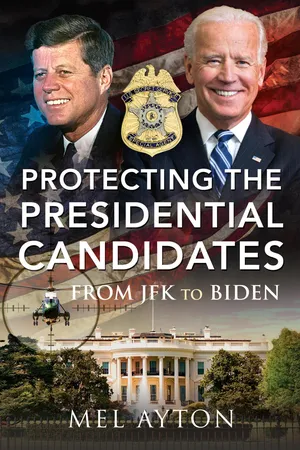
- 312 pages
- English
- ePUB (mobile friendly)
- Available on iOS & Android
eBook - ePub
About this book
Protecting the Presidential Candidates is the first book of its kind to examine how presidents and presidential candidates were protected during the presidential election cycles – from JFK to Biden. It is also the first book of its kind to tell the story of the role of state troopers and private bodyguards in protecting presidential candidates. Protection for candidates changed and evolved from the free-wheeling style of the 1950s and early 1960s, which afforded presidential candidates little or no protection, to the growth of bodyguard personnel, increased intelligence facilities and state of the art technology employed today to keep the candidates safe. Presidential candidates relish connecting with the public and it has given greater visibility to the bodyguards who are willing to place themselves between a presidential candidate and a would-be attacker. In the milieu in which the Secret Service operates, bodyguards have witnessed the terrors of election campaigns when presidential candidates have waded into crowds to shake hands with their supporters, rode in open-top cars, and made sudden but risky changes to their schedules – oblivious to the fact that in every campaign there have been people stalking candidates with ill intent. Many stories revealed in Protecting the Presidential Candidates have remained largely hidden from the public; some buried in newspaper archives and others in oral histories, presidential libraries or official government documents. The author draws on numerous sources, including FBI files, presidential biographies, vice presidential biographies, civilian bodyguard memoirs, Secret Service agent memoirs, White House staff memoirs and more so that these stories can now be told. The book also allows readers to gain an insight into the personal as well as professional relationships between the candidate and the bodyguards who protected them. Some candidates were so trusting of their bodyguards they embraced them as part of an 'inner circle' of advisers. Bodyguards have also witnessed embarrassing moments in a candidate's campaign and how intrusive they have been at the most delicate of moments. "The president's day is your day," one agent said. "Nobody sees the president the way an agent does."
Information
Subtopic
Military & Maritime HistoryIndex
HistoryChapter 1
The Torture Trail
‘The candidate is a race horse and his staff are trying to enter them in every race around.’
‘The best time to listen to a politician is when he’s on a stump on a street corner in the rain late at night when he’s exhausted. Then he doesn’t lie.’
‘I saw their strengths and weaknesses as each wrestled with life-and-death decisions.’
By 1960 the major political parties had discarded the old system of having party elders choose which candidate should be the nominee. Since that time the more democratic presidential primary process became the only viable route to the presidency – the exception being the nomination of 1968 Democrat Hubert H. Humphrey who eschewed the primary system relying on his influence with party bosses.
Presidential campaigns are a contest for control of power in the most powerful nation on earth. The contest of personalities and policies takes place in a war of ideas with sharp turning points along the way as candidates succumb to electoral approval or disapproval.
And campaigns have stretched out for a prohibitive length. The number of primaries has expanded exponentially since the early 1960s. Political journalist Robert Scheer called the primary process, ‘…[a] numbing effect of a modern mass media-observed campaign that requires such a high-wire act – balancing fundraising with integrity, superficial sloganeering with profound commitment, and homogenizing the entire unwieldy package into a marketable commodity – that in the end, the candidate is transformed into a caricature who has difficulty in remembering from whence he came’.1
Even those men and women who saw politics as an honourable way to serve their country ended up damaged by the pursuit. Words like ‘exhausted’, ‘tortured’ and ‘crushing’ were often used by the candidates to explain the gruelling process of fighting primary after primary to persuade the electorate they could appeal to a diverse nation and had what it takes to be president. It became a mind-numbing cross-country obstacle course. Accordingly, many politicians judged to be competent and popular have been deterred from trying.
The pressures can make or break a candidate. When 1972 front-runner Edmund Muskie was attacked by a New Hampshire newspaper he responded with a speech to an outdoor crowd and became emotional to the point of being on the verge of tears. Calm unravelled under stress. It made voters question the emotional stability required from a potential president. When George Romney ran for president in 1968 he made the mistake of telling voters he had been ‘brainwashed’ about Vietnam. The 1972 presidential candidate George McGovern was so exhausted by the time he arrived at the Democrats’ Miami Beach convention he made the disastrous mistake of selecting as his running mate Thomas Eagleton, a man who had undergone electro-shock treatment for depression. The 77-year-old Joe Biden became so exhausted in running for president in 2020 it often left him sounding incoherent during television interviews and campaign speeches. In fact, so many candidates suffered from health problems brought on by campaigning they had to conceal these from the public.
The primary system has tempted literally hundreds of politicians to run for president because of federal subsidies. This type of politician runs not because he or she believes they could be successful but instead are offered an opportunity to raise their profile for other reasons like running for re-election as a governor, Senator or Congressman. Consequently, there have been many candidates who should not have received Secret Service protection including one notable Congressman, John G. Schmitz, a member of the extremist John Birch Society. According to one agent, ‘He used to sit back there [in the limousine] smoking a stogie and just grooving on the idea that he had his own private police force.… I’d just shake my head and think, what a waste of taxpayer’s money.’2
Other presidential candidates who never had a chance of winning the presidency were Georgia Governor Lester Maddox, a right-wing racist, and Shirley Chisholm, a black Congresswoman. In 1976, Maddox was the presidential candidate of the far-right American Independence Party. His candidacy disappeared almost without trace. Nonetheless, he received Secret Service protection for two weeks and glorified in the fact that he was protected by a federal agency. Chisholm entered the Democratic contest primarily to prove it was possible for a woman and an African American to run for president. She was under no illusions she could possibly win.
Not only is the primary system a marathon that punishes winners and losers alike, it also greatly increases the candidate’s exposure to assassination from nationwide extremist groups and individuals who believe it is their God-given right to intervene in the electoral system and eliminate anyone they perceive as antagonistic to their cause. The effect campaigning had on the bodyguards was equally debilitating. Throughout the history of election campaigns agents frequently couldn’t remember which town or city they were in and experienced the same exhaustion suffered by the candidates.
The bodyguards who formed the close protective detail around the presidential candidates included Secret Service agents (in the case of the president or vice president running for re-election it’s the Presidential Protective Detail (PPD) and the Vice-Presidential Protective Detail (VPPD)), local police officers, state troopers and private citizens. They had unique access to the personal lives of the people they protected. Nobody except the candidate’s wife was in such daily intimate proximity to the presidential aspirant and they often became privy to private and intimate conversations in limousines and hotel rooms and on golf courses and jogging trails.
Many bodyguards formed a close bond and friendship with their protectees. As one former bodyguard said, ‘During these [private] moments [when no press was present] they weren’t politicians, they were just regular people, who, after spending the vast majority of their waking hours in a fishbowl for all to observe and critique, were now off the clock. The human side could be refreshing to see.’3
Bodyguards have also witnessed embarrassing moments in a candidate’s campaign with the realisation of how intrusive they have been at the most delicate of moments. The candidate may even forget a bodyguard is in the room, something that Dennis McCarthy recalled when he was guarding President Nixon. McCarthy once saw Nixon crying as the Watergate Scandal began to plague his presidency. State trooper bodyguards conspired with Arkansas Governor Clinton to hide amorous encounters from his wife when he campaigned for the presidency.
When Clinton became president his Secret Service bodyguards faced challenges to the discrete nature of their mission when an independent prosecutor ordered them to reveal confidential knowledge of the president’s relationship with White House intern Monica Lewinsky. ‘The president’s day is your day,’ former agent Marty Vencker said, ‘nobody sees the president the way an agent does. The Secretary of State gets maybe half an hour with him. We were there all the time. And we saw the guy when his head was hanging the lowest.’4 Bodyguards also witnessed affairs and marital discord and other behaviours because they became so part of their inner circle the protectee thought nothing about it.
Bodyguards also observed up close the rash behaviour of candidates when they campaigned. LBJ’s recklessness in plunging into crowds during the 1964 presidential election was emulated in 1968 by presidential candidates Eugene McCarthy, Robert Kennedy and Richard Nixon. Robert Kennedy and Eugene McCarthy eschewed the offer of police bodyguard protection. Both candidates did not want to alienate anti-war youth and African American and Hispanic crowds who were believed to hold an animus towards local police departments and national law-enforcement agencies. The exception was candidate George Wallace who adhered to the security protocols laid down by his state troopers. However, when he ran for president in 1972, he let down his guard, left his bulletproof dais and was shot as he shook hands with his supporters.
Secret Service Chief U.E. Baughman said Richard Nixon was ‘an assassin’s delight’ especially during election campaigns. Baughman said that Nixon came near to being killed on ‘several occasions’ for his wanton disregard for his safety, often climbing on the roof of his limousine to wave to the crowds of anti-war demonstrators. On one occasion his valet drove him out of his San Clemente, California, Western White House without informing his Secret Service detail. Nixon was in the back seat covered in a blanket; he had simply wanted to go a local restaurant without his bodyguards. However, reporters had spotted him and informed the Secret Service who soon caught up with him.
There were few occasions when Secret Service agents were caught off guard by the behaviour of Gerald Ford, Jimmy Carter, Ronald Reagan, George H.W. Bush, George W. Bush and Barack Obama while they were campaigning. But they were seriously challenged by Bill Clinton and Donald Trump. Clinton’s womanising caused problems with the state troopers who protected him during the initial phase of his 1992 candidacy. When Clinton was given Secret Service protection his agents faced the same problem. They were concerned at the way he was cavalier with regard to his safety and his reputation. When Donald Trump campaigned in 2016 and 2020 agents were faced with protecting a president who plunged into crowds and attracted vitriol not seen since the anti-war demonstrations during the Nixon years.
* * *
Whenever reports appear in the media about a politician’s ‘bodyguards’, it is generally assumed that presidents, vice presidents and presidential candidates are all guarded by the US Secret Service. However, before presidential candidates qualify for Secret Service protection they are usually guarded by state troopers, state public safety officers or Capitol police officers, or they make private arrangements such as hiring private security guards. The Secret Service also has the ability to call in federal law-enforcement officers from other agencies to assist in protective duties, including airport baggage screeners from the Transportation Security Administration, DEA agents and immigration enforcement officers.
Presidential candidates are not given official protection until they have proved their worth in the primary election campaigns which run for the first six months of a presidential election year. Until then candidates must make their own security arrangements. Following the assassination of Senator Robert F. Kennedy in 1968, nearly all presidential candidates were given protection. An additional 150 agents were assigned for the job and borrowed from other Treasury Department agents – the Bureau of Alcohol, Firearms and Tobacco, the Customs Service and the formerly titled Bureau of Narcotics.
A criterion for protecting candidates has changed since 1968, however. The Secret Service protects only ‘major’ presidential candidates, or by executive order, and only those who request coverage. The Secretary of Homeland Security determines which presidential candidates are considered major after consultation with an advisory committee that includes the Speaker of the US House of Representatives; the House Minority Whip; the Senate Majority and Minority Leaders; and an additional member chosen by the committee itself. While protection for the president and vice president is mandatory, others can decline it if they choose. Once they are accepted, the Secretary of Homeland Security consults with the advisory committee and one additional member selected by the other members of the committee (usually from the Secret Service) and determines if a candidate is eligible for Secret Service protection.
If the candidate is eligible, they are notified of the committee’s decision and asked if they would like protection. Specifically, presidential candidates become eligible for Secret Service protection, according to the Congressional Research Service, if they:
• Are publicly declared candidates.
• Are actively campaigning nationally and are contesting at least ten state primaries.
• Are pursuing the nomination of a qualified party, one whose presidential candidate received at least 10 per cent of the popular vote in the prior election.
• Are qualified for public matching funds of at least $100,000 and have raised at least $10 million in additional contributions.
• Have received by 1 April of the election year an average of 5 per cent in individual candidate preferences in the most recent national opinion polls by ABC, CBS, NBC and CNN, or have received at least 10 per cent of the votes cast for all candidates in two same-day or consecutive primaries or caucuses.
• Presidential and vice-presidential nominees and their spouses are to receive Secret Service protection within 120 days of a general presidential election. In modern history, however, major candidates receive Secret Service protection well before that time, usually early in the primary campaigns in the late winter and early spring.
• Major candidates are those that have considerable prominence among the public and have raised substantial money for their presidential campaigns.
Once the protection is authorised, it would be unusual for a candidate to then decline it.
Additionally, once a candidate has fulfilled the requirements to apply for Secret Service protection they may still retain their own private bodyguard detail. Most candidates for president begin their candidacy protected by local police agencies and private security firms before they are recognised as ‘front-runners’. The 2016 presidential candidate Donald Trump, for example, had his own team of private bodyguards when he began his campaign. They continued to protect the candidate long after he was given Secret Service protection.
Unless a candidate is an incumbent and therefore already being protected, the Secret Service is not often present for early primary contests like Iowa and New Hampshire. By law, candidates are only required protection within 120 days of the general election. That means July of an election year is when the Secret Service usually begins guarding those candidates who have been successful in the primary election campaigns.
Presidential candidates can also get Secret Service protection if there appears to be a credible threat and protection can start earlier if warranted, such as Barack Obama who got his Secret Service detail in May 2007 after receiving numerous death threats. It was more than a year before he won the 2008 Democratic nomination. The 2016 candidate Ben Carson’s political director G. Michael Brown said the candidate received threats that developed into serious safety concerns by the late summer of 2015. Secret Service protection for Carson began sometime around late October/early November 2015. Hillary Clinton already received protection before she ever entered the race due to her status as former First Lady. Other notable presidential candidates with early protection include Ted Kennedy in 1979, 411 days before Election Day, Jesse Jackson in 1987, 351 days before Electi...
Table of contents
- Cover
- Title
- Copyright
- Dedication
- Contents
- Preface
- Acknowledgements
- 1. The Torture Trail
- 2. Camelot’s Sentinels
- 3. Lyndon Johnson’s Secret Servants
- 4. The Hubert H. Humphrey Assassination Plots
- 5. The Stalking of Robert Kennedy
- 6. Guarding Governor Reagan
- 7. Searchlight and Pathfinder
- 8. Beating Nixon
- 9. The Populist
- 10. Jimmy Who?
- 11. The Last Brother
- 12. Jesse Jackson’s Perilous Campaigns
- 13. The Front-Runners, 1984–2004
- 14. Father and Son
- 15. The Comeback Kid
- 16. Evergreen
- 17. Obama’s Challengers
- 18. Protecting Trump and Biden
- Notes
- Bibliography
- Plates
Trusted by 375,005 students
Access to over 1.5 million titles for a fair monthly price.
Study more efficiently using our study tools.
Frequently asked questions
Yes, you can cancel anytime from the Subscription tab in your account settings on the Perlego website. Your subscription will stay active until the end of your current billing period. Learn how to cancel your subscription
No, books cannot be downloaded as external files, such as PDFs, for use outside of Perlego. However, you can download books within the Perlego app for offline reading on mobile or tablet. Learn how to download books offline
Perlego offers two plans: Essential and Complete
- Essential is ideal for learners and professionals who enjoy exploring a wide range of subjects. Access the Essential Library with 800,000+ trusted titles and best-sellers across business, personal growth, and the humanities. Includes unlimited reading time and Standard Read Aloud voice.
- Complete: Perfect for advanced learners and researchers needing full, unrestricted access. Unlock 1.5M+ books across hundreds of subjects, including academic and specialized titles. The Complete Plan also includes advanced features like Premium Read Aloud and Research Assistant.
We are an online textbook subscription service, where you can get access to an entire online library for less than the price of a single book per month. With over 1.5 million books across 990+ topics, we’ve got you covered! Learn about our mission
Look out for the read-aloud symbol on your next book to see if you can listen to it. The read-aloud tool reads text aloud for you, highlighting the text as it is being read. You can pause it, speed it up and slow it down. Learn more about Read Aloud
Yes! You can use the Perlego app on both iOS and Android devices to read anytime, anywhere — even offline. Perfect for commutes or when you’re on the go.
Please note we cannot support devices running on iOS 13 and Android 7 or earlier. Learn more about using the app
Please note we cannot support devices running on iOS 13 and Android 7 or earlier. Learn more about using the app
Yes, you can access Protecting the Presidential Candidates by Mel Ayton in PDF and/or ePUB format, as well as other popular books in History & Military & Maritime History. We have over 1.5 million books available in our catalogue for you to explore.