This in-depth study of the greatest samurai battle in history explores its momentous significance as well as the epic combat itself.
Finally unified under Toyotomi Hideyoshi, Japan quickly fractured once again after his death in 1598. The warlord Tokugawa Ieyasu mounted a fearsome opposition to Hideyoshi's loyal followers. As the country divided into two great armies, East and West, each side scrambled to take control of strategically vital highways and castles. These sieges culminated in the decisive Battle of Sekigahara.
Fought on October 21st, 1600, the battle lasted just six hours, but saw the deaths of an estimated 30,000 samurai, the destruction of a numerous noble families, and the creation of the Tokugawa Shogunate that would rule Japan for the next 260 years. The loyalist forces, despite their superior numbers and excellent battle formations, were defeated.
In his exploration of the battle, Chris Glenn reveals the developments that led up to the outbreak of war and the characters involved. He details how the battle itself unfolded, and the aftermath. The weapons and armor of the time are also fully explained, along with little known customs of the samurai and their warfare.
eBook - ePub
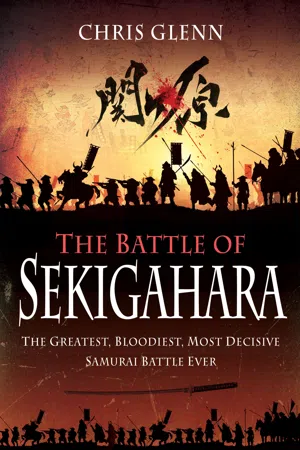
The Battle of Sekigahara
The Greatest, Bloodiest, Most Decisive Samurai Battle Ever
- 248 pages
- English
- ePUB (mobile friendly)
- Available on iOS & Android
eBook - ePub
About this book
Information
Subtopic
Japanese HistoryIndex
HistoryChapter 1
The Roads East and West
Even before the Edo period (1603–1868) there were five major arterial routes linking the old capital, Kyoto, and Edo (now Tokyo). People, merchandise, communications and culture traversed these highways mostly by foot, stopping at the government-designated post towns and checkpoints along the way. Each of these post towns featured special inns, Honjin, Waki-honjin and Hatagoya. These establishments provided lodging, places for meals and rest and stables for horses too. Hatagoya were for the use of common folk, merchants, craftsmen, pilgrims and lower-ranked samurai. The Honjin and Waki-honjin were reserved for the highest-ranked samurai, the nobility and the daimyo.
The two most vital of these highways were the Tokaido and the Nakasendo. The Nakasendo, or Central Mountain Route, was built in 702. Connecting Kyoto and Edo, it was also known as the Kiso-kaido as it followed the route of the mighty Kiso River for much of its length. The road featured sixty-nine post towns along its 542km length. The Tokaido or Eastern Sea Route was the name given to the highway between Edo and Kyoto that traversed the Pacific Ocean side of Japan’s coast, with fifty-three stations on its 514km.
The two roads came closest together about 20km west of Gifu, where the only real pass between the Suzuka mountain range spreading to the south and the Imasu mountains to the north neatly separated east and west Japan. These mountain ranges, with Mount Ibuki to the north-west and Mount Nangu to the east, formed the Sekigahara basin, some 2km by 2km in area.
Near here, a side-track from the Tokaido branched off to join the Nakasendo. The importance of these two vital arteries as military objectives cannot be overestimated. Whoever had control of these major thoroughfares and particularly at the gateway between east and west Japan had control of the country.
At this stage the Western army held a number of castles along the Nakasendo. As well as Ishida Mitsunari’s fiefdom of Sawayama Castle, they now held the strategically-important Ogaki Castle, which lay just south of the Nakasendo. East of Ogaki stood Gifu Castle, overlooking the central route from high on Mount Kinkazan and Inuyama Castle a little further east along the Kiso River. Between Gifu and Inuyama lay Takehana, a small hilltop castle, more akin to a stockade than a fortress.
Further along the Nakasendo and some distance to the north, in what is now Nagano Prefecture, sat Ueda Castle, home of the Sanada clan, former vassals to the military genius and warlord Takeda Shingen. It was a humble castle, built in 1583, but well designed and strongly constructed. This was proven first in 1583 when the castle withstood an attack by a numerically superior Tokugawa force under Ieyasu. Moreover, it was the fortitude of the samurai within the fortress that saw that attack and another similar siege in 1600 repelled by the Sanada. Despite being such a distance from the battlefield of Sekigahara, events at Ueda Castle would almost destroy the plans of the Tokugawa.
The Eastern forces held most of the Tokaido from Ieyasu’s base castle in Edo all the way to Kiyosu Castle north-west of modern-day Nagoya City. Behind the Western lines, Otsu Castle overlooking the southern shores of Lake Biwa was held by secret Eastern allies, as was Fushimi Castle south of Kyoto.
Ishida Mitsunari had originally planned for the battle between his Western forces and the Eastern forces led by Ieyasu to take place near the Kiso River, on what was the border between Mino and Owari Provinces (now Gifu and Aichi Prefectures), with the Uesugi entering the stage from the north, while his own army attacked from the west. Had this plan come to fruition, Ieyasu would have most likely been surrounded and possibly defeated.
Mitsunari advanced eastwards from Osaka to his own fief of Sawayama, north to the Sekigahara pass and then east again towards Ogaki Castle, which was under the command of Ito Morikage. On 6 August, his army of 6,700 passed through Sekigahara, but continued on to Tarui where they stopped for a few days. From there they continued to Ogaki, arriving on 10 August and made the castle the base for the Western army. Ogaki lay just south of the Nakasendo and thus was a strategically-important fortress.
From Ogaki, Mitsunari sent word to the keeper of Kiyosu Castle, a stronghold of equally strategic importance, to capitulate or face attack. Kiyosu was commanded by Fukushima Masanori and while he was with Ieyasu in the Kanto region, his trusted vassal Osaki Gemba was installed as caretaker. Gemba, also known as ‘Oni’ or ‘Devil Gemba’ thanks to his ferocity and willingness to fight on the battlefield, steadfastly refused and in defiance sent word to his master who, along with other allies, hurried back to prevent Mitsunari from taking the castle.
The nation was abuzz as warriors of all ranks rushed to take their positions, East or West, and be ready for the oncoming storm. Mitsunari was joined at Ogaki by key allies, including Ukita Hideie, Konishi Yukinaga, Shimazu Yoshihiro, Shima Sakon and Gamo Bitchu amongst others and as the number of Western troops began to swell, the small castle and surrounding areas were soon brimming with armoured soldiers.
Mitsunari Moves First
Ishida Mitsunari had been shocked at the number of his former allies defecting to the Eastern side. In an effort to prevent any more withdrawals he devised a plan to keep the various daimyo ‘loyal’. He would take hostage the families of those he feared would turn and among the first families taken in Osaka was that of Lord Hosokawa Tadaoki, a daimyo with lands just outside of Kyoto worth about 230,000 koku.
Hosokawa Tadaoki and his father Fujitaka (or Yusai as he was known since having taken religious vows upon the death of Oda Nobunaga) had been much-valued retainers of Oda Nobunaga and at their lord’s urging, Tadaoki had married the daughter of Nobunaga’s most senior retainer, Akechi Mitsuhide. The lady in question was a famed beauty with intelligence to match and the marriage had been organised by Nobunaga so that ties between his close vassals might be further strengthened. When Akechi Mitsuhide turned against Nobunaga, he had first sought assistance from Hosokawa Tadaoki, who, disgusted at the actions of his father-in-law, steadfastly refused. It also caused a rift between the couple as she was torn between loyalty to both her husband and father and so for her safety, Tadaoki sent her into exile for two years.
Later, upon the intervention of Hideyoshi, husband and wife were reconciled, but relations remained partially strained, as during her exile she had converted to Christianity against his wishes, taking the name Gracia. According to the records of the Portuguese and Italian missionaries she was to associate with, Tadaoki was a jealous man and rarely allowed her to make contact with the world outside their high-walled mansion.
In fact, it had been her husband who had inadvertently introduced her to the religion. He had heard about this foreign faith from a friend, Takayama Ukon, during a tea ceremony. Tadaoki later passed on what he had heard to his wife. She was impressed with what she heard and duly sought out the foreign religion. Ukon would fall from grace with Hideyoshi – and later be expelled from Japan by Ieyasu for his Christian beliefs – and would die in exile in Manila in 1615. Hosokawa Tadaoki never felt anything for the religion himself, but thought a great deal of his wife and refused to allow her to become a follower of Christianity. At one stage, it is said the volatile lord had even taken a dagger to his wife’s throat, threatening to take her life unless she renounced her new-found faith. She refused but he still refrained from killing her.1
When the arresting authorities sent by Ishida Mitsunari forced their way into the Hosokawa mansion in search of potential hostages on 25 August 1600, the clan’s loyal retainer, Ogasawara Shosai, approached his then 37-year-old mistress and informed her of her husband’s orders that they were all to die before submitting to Mitsunari’s troops. It is often incorrectly believed that Gracia then committed suicide, but being a follower of the Christian faith would have prevented her from doing so. This much is recorded in the still-existing ‘Chronicles of the Hosokawa Family’, a clan diary of sorts that explains that with her consent, Ogasawara Shosai drove a spear through her body, before setting fire to the mansion and disembowelling himself. Gracia’s body was consumed in the flames. Tadaoki later gave her a Christian funeral at which he cried.
Despite their religious and political differences, Hosokawa Tadaoki truly loved his wife. When he died 45 years later at the age of 83, he had his tomb built next to hers at the Taisho-ji Temple in Kumamoto City, Kyushu. Another grave dedicated to the couple can be found in the Daitoku-ji Temple in Kyoto and features a stone lantern used by the great tea master Sen no Rikyu as a gravestone. Tadaoki lived his final years alone, never remarrying.
The Hosokawa family chronicles mention the defiance shown by both Tadaoki and Gracia against capitulating to Ishida Mitsunari’s samurai and also records that the matter seems to have surprised and angered the samurai community. The backlash proved another setback for Mitsunari, turning many potential allies away. Realising his mistake, he then ordered his men to simply surround the mansions of the other Tokugawa generals, including Ikeda Terumasa, Kato Kiyomasa2 and Kuroda Nagamasa,3 rather than try to arrest the occupants. Mitsunari then attempted to recover the ground he had through propaganda. Five days later he prepared a letter of impeachment, a list of thirteen grievances against Tokugawa Ieyasu in the hopes of spurring other daimyo into once again backing him against Ieyasu in battle. He distributed this list, dated the 17th day of the 7th month (30 August) 1600, amongst the daimyo.
Mitsunari’s principal grievance focused on Ieyasu moving into the late Hideyoshi’s residence at Fushimi, something he saw as a blatant usurping of the power promised to Hideyoshi’s heir, Hideyori. Many of the other complaints concerned Ieyasu’s being in direct contravention of laws instigated by Hideyoshi. Ieyasu’s arranged marriages between his and strategically-important families and his building of and then residing in a small tower keep within the Nishi-no-maru grounds of Osaka Castle, despite a ban on all castle building and maintenance, received particular criticism. Ieyasu was also accused of purporting to have told ‘lies’ regarding his actions to younger members of the council and daimyo and making strategic promises of land and titles without the consent of the Council of Regents in an effort to gain followers.
Further scrutiny fell upon his combative behaviour, his conflict with Uesugi Kagekatsu and his taking of Maeda Toshinaga’s mother as a hostage. However, perhaps most telling was that Mitsunari also accused him of usurping too much political power. Ieyasu, the letter explained, had taken it upon himself to allow the daimyo who had fought in Korea to return to their fiefs for ‘purposes of rest’ without consulting the other regents, before suggesting that Ishida Mitsunari and Maeda Toshinaga (both of whom had also made attempts on the life of Ieyasu) resign their positions as bugyo that Hideyoshi had appointed them to, as those, according to Ieyasu, were no longer required now that the Taiko was no more.
Ieyasu then began to face criticism from other lords too, many of whom also demanded he resign his position. Natsuka Masaie, Mashita Nagamori and Maeda Gen’i were among those writing damning letters about the Tokugawa leader and sending them to other daimyo. Neither paying attention to the accusations, nor answering directly to these lords, caused further rifts between Ieyasu and the other regents.
Thus the country was immediately divided into East and West and both sides began preparations for the war that was by now inevitable. It was not a case of if, but when and where it would happen.
Hostilities Commence – The Fushimi Assault
Meanwhile, having been entrusted by Ieyasu with Fushimi Castle on the southern outskirts of Kyoto, Torii Mototada prepared to face the onslaught of the Western-allied daimyo. Fushimi Castle had been built by Toyotomi Hideyoshi as a southern defence for the capital and as a place for his retirement. It was elegant both inside and out, lavishly decorated with lacquer-work, gold and works of art by the leading artisans of the day. It was an exceptionally strong and well-planned castle, consisting of the central keep surrounded and protected by five smaller baileys, the Nishi-maru, the San-no-maru, the Matsu-maru, Nagoya-maru and the Jibushoyu-maru.
Sixty-one-year-old Torii Mototada was the daimyo of Yahagi, Shimosa, with a revenue of 40,000 koku. Although a little older than Tokugawa Ieyasu, they had long been close friends. Both had been born in Okazaki and as children they had been sent together as hostages to the Imagawa, during which Torii served as Ieyasu’s page. On the night of 25 July Ieyasu visited Fushimi Castle and spent the night talking with Torii. This was to be the last time the two friends would spend together.
Aware of Fushimi Castle’s importance, Ieyasu warned Torii of the imminent attack. Torii understood his role in the contest for the nation and that fighting to save the castle would be futile. Fushimi Castle could not withstand an assault from the combined Western forces and so he suggested Ieyasu reduce the number of troops so that he would have more men with which to fight in the field. Torii and the castle were to be sacrificed in the effort to destroy Ishida Mitsunari. For that reason alone it would have been an emotional parting between the two comrades.
Prior to hostilities breaking out, Shimazu Yoshihiro, a loyal and skilled former general of Toyotomi Hideyoshi and Kobayakawa Hideaki, Hideyoshi’s nephew, had contacted Ieyasu and offered to assist in the defence of Fushimi. In Shimazu Yoshihiro’s case, he had actually met with Ieyasu and confirmed verbally that he would help, but in the heat of the moment, no papers had been drawn up or signed. Ieyasu had headed north to battle the Uesugi, while the Shimazu headed south to prepare. Without this contractual proof, Torii had not trusted either of these men, especially as Shimazu Yoshihiro had such a small army of around only 200 at the time with him. Both the Shimazu and Kobayakawa would soon show their true colours by joining the enemy in the assault against Fushimi.
The expected attack came on 27 August 1600, when Fushimi was besieged by the armies of the Shimazu, Kobayakawa and the Ukita. Ten days of fierce fighting took place around the castle before Mitsunari himself arrived on 6 September to drive on the assault. Also among the attackers was Nabeshima Katsushige. He had been sent by his father with the intention of allying himself with the Tokugawa in the fight against Uesugi Kagekatsu. He arrived at Fushimi after hostilities had begun and decided somewhat strangely to join the attack on the fortress instead of defending it. After the fall of Fushimi Castle, Nabeshima Katsushige took part in the attack on Matsusaka Castle in Ise before being recalled to Kyushu for a berating by his ...
Table of contents
- Cover
- Title
- Copyright
- Contents
- List of Illustrations
- List of Maps
- Acknowledgements
- Preface
- Introduction
- Chapter 1: The Roads East and West
- Chapter 2: The Flight from Ogaki
- Chapter 3: The Battle
- Chapter 4: Aftermath
- Epilogue: Shogun!
- Sekigahara Timeline
- Sekigahara: Who’s Who
- Glossary
- Select Bibliography
- Plates section
Trusted by 375,005 students
Access to over 1.5 million titles for a fair monthly price.
Study more efficiently using our study tools.
Frequently asked questions
Yes, you can cancel anytime from the Subscription tab in your account settings on the Perlego website. Your subscription will stay active until the end of your current billing period. Learn how to cancel your subscription
No, books cannot be downloaded as external files, such as PDFs, for use outside of Perlego. However, you can download books within the Perlego app for offline reading on mobile or tablet. Learn how to download books offline
Perlego offers two plans: Essential and Complete
- Essential is ideal for learners and professionals who enjoy exploring a wide range of subjects. Access the Essential Library with 800,000+ trusted titles and best-sellers across business, personal growth, and the humanities. Includes unlimited reading time and Standard Read Aloud voice.
- Complete: Perfect for advanced learners and researchers needing full, unrestricted access. Unlock 1.5M+ books across hundreds of subjects, including academic and specialized titles. The Complete Plan also includes advanced features like Premium Read Aloud and Research Assistant.
We are an online textbook subscription service, where you can get access to an entire online library for less than the price of a single book per month. With over 1.5 million books across 990+ topics, we’ve got you covered! Learn about our mission
Look out for the read-aloud symbol on your next book to see if you can listen to it. The read-aloud tool reads text aloud for you, highlighting the text as it is being read. You can pause it, speed it up and slow it down. Learn more about Read Aloud
Yes! You can use the Perlego app on both iOS and Android devices to read anytime, anywhere — even offline. Perfect for commutes or when you’re on the go.
Please note we cannot support devices running on iOS 13 and Android 7 or earlier. Learn more about using the app
Please note we cannot support devices running on iOS 13 and Android 7 or earlier. Learn more about using the app
Yes, you can access The Battle of Sekigahara by Chris Glenn in PDF and/or ePUB format, as well as other popular books in History & Japanese History. We have over 1.5 million books available in our catalogue for you to explore.