About ten years after the first edition comes this second edition of Monte Carlo Techniques in Radiation Therapy: Introduction, Source Modelling, and Patient Dose Calculations, thoroughly updated and extended with the latest topics, edited by Frank Verhaegen and Joao Seco. This book aims to provide a brief introduction to the history and basics of Monte Carlo simulation, but again has a strong focus on applications in radiotherapy. Since the first edition, Monte Carlo simulation has found many new applications, which are included in detail.
The applications sections in this book cover the following:
Modelling transport of photons, electrons, protons, and ions
Modelling radiation sources for external beam radiotherapy
Modelling radiation sources for brachytherapy
Design of radiation sources
Modelling dynamic beam delivery
Patient dose calculations in external beam radiotherapy
Patient dose calculations in brachytherapy
Use of artificial intelligence in Monte Carlo simulations
This book is intended for both students and professionals, both novice and experienced, in medical radiotherapy physics. It combines overviews of development, methods, and references to facilitate Monte Carlo studies.
Comparison between Monte Carlo and Numerical Quadrature
Acknowledgment
References
It is still an unending source of surprise for me to see how a few scribbles on a blackboard or on a sheet of paper could change the course of human affairs.
Stan Ulam
Founder of the modern Monte Carlo method, in his 1991 autobiography (1991)
1.1 Motivating Monte Carlo
Generally speaking, the Monte Carlo method provides a numerical solution to a problem that can be described as a temporal evolution (“translation/reflection/mutation”) of objects (“quantum particles” [photons, electrons, neutrons, protons, charged nuclei, atoms, and molecules], in the case of medical physics) interacting with other objects based upon object–object interaction relationships (“cross sections”). Mimicking nature, the rules of interaction are processed randomly and repeatedly, until numerical results converge usefully to estimated means, moments, and their variances. Monte Carlo represents an attempt to model nature through a direct simulation of the essential dynamics of the system in question. In this sense, the Monte Carlo method is, in principle, simple in its approach—a solution to a macroscopic system through simulation of its microscopic interactions and therein is the advantage of this method. All interactions are microscopic in nature. The geometry of the environment, so critical in the development of macroscopic solutions, plays little role except to define the local environment of objects interacting at a given place at a given time.
The scientific method is dependent on the observation (measurement) and hypothesis (theory) to explain nature. The conduit between these two is facilitated by a myriad of mathematical, computational, and simulation techniques. The Monte Carlo method exploits all of them. Monte Carlo is often seen as a “competitor” to other methods of macroscopic calculation, which we will call the deterministic and/or analytic methods. Although the proponents of either method sometimes approach a level of fanaticism in their debates, a practitioner of science should first ask, “What do I want to accomplish?” followed by “What is the most efficient way to do it?,” and then, “What serves science the best?” Sometimes the correct answer will be “Deterministic,” and other times it will be “Monte Carlo.” The most successful scientist will avail himself or herself of more than one method of approach.
There are, however, two inescapable realities. The first is that macroscopic theory, particularly transport theory, provides deep insight and allows one to develop sophisticated intuition as to how macroscopic particle fields can be expected to behave. Monte Carlo cannot compete very well with this. In discovering the properties of macroscopic field behavior, Monte Carlo practitioners operate very much like experimentalists. Without theory to provide guidance, discovery is made via trial and error, guided perhaps, by some brilliant intuition.
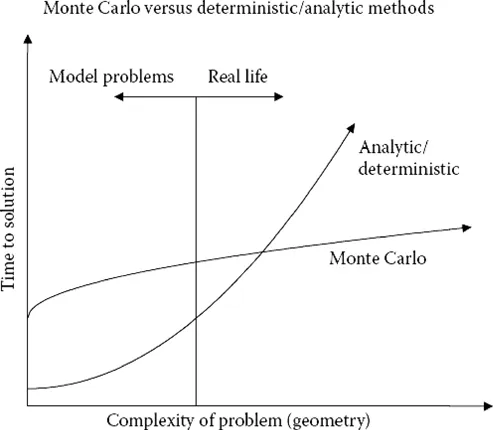
However, complexity is measured, and when it comes to developing an understanding of a physical problem, Monte Carlo techniques become, at some point, the most advantageous. A proof is given, in the appendix of this chapter, that the Monte Carlo method is more advantageous in the evolution of five and higher dimensional systems. The dimensionality is just one measure of a problem’s “complexity.” The problems in radiotherapy target practice (RTP) and dosimetry are typically of dimension 6.ε or 7.ε. That is, particles move in Cartesian space, with position , that varies continuously, except at particle inception or expiration. They move with momentum, , that varies both discretely and continuously. The dimension of time is usually ignored for static problems, though it cannot be for nonlinear problems, where a particle’s evolution can be affected by the presence of other particles in the simulation. (The “space-charge” effect is a good example of this.) Finally, the ε is a discrete dimension that can encompass different particle species, as well as intrinsic spin.
This trade-off, between complexity and time to solution, is expressed in Figure 1.1.
FIGURE1.1 Time to solution using Monte Carlo versus deterministic/analytic approaches.
Although the name “Monte Carlo method” was coined in 1947, at th...
Table of contents
Cover
Half Title
Title Page
Copyright Page
Dedication
Table of Contents
Preface to the First Edition
Preface to the Second Edition
Editors
Contributors
Part I Introduction
Part II Source Modelling
Part III Patient Dose Calculation
Index
Trusted by 375,005 students
Access to over 1.5 million titles for a fair monthly price.
Study more efficiently using our study tools.
Frequently asked questions
Yes, you can cancel anytime from the Subscription tab in your account settings on the Perlego website. Your subscription will stay active until the end of your current billing period. Learn how to cancel your subscription
No, books cannot be downloaded as external files, such as PDFs, for use outside of Perlego. However, you can download books within the Perlego app for offline reading on mobile or tablet. Learn how to download books offline
Perlego offers two plans: Essential and Complete
Essential is ideal for learners and professionals who enjoy exploring a wide range of subjects. Access the Essential Library with 800,000+ trusted titles and best-sellers across business, personal growth, and the humanities. Includes unlimited reading time and Standard Read Aloud voice.
Complete: Perfect for advanced learners and researchers needing full, unrestricted access. Unlock 1.5M+ books across hundreds of subjects, including academic and specialized titles. The Complete Plan also includes advanced features like Premium Read Aloud and Research Assistant.
Both plans are available with monthly, semester, or annual billing cycles.
We are an online textbook subscription service, where you can get access to an entire online library for less than the price of a single book per month. With over 1.5 million books across 990+ topics, we’ve got you covered! Learn about our mission
Look out for the read-aloud symbol on your next book to see if you can listen to it. The read-aloud tool reads text aloud for you, highlighting the text as it is being read. You can pause it, speed it up and slow it down. Learn more about Read Aloud
Yes! You can use the Perlego app on both iOS and Android devices to read anytime, anywhere — even offline. Perfect for commutes or when you’re on the go. Please note we cannot support devices running on iOS 13 and Android 7 or earlier. Learn more about using the app
Yes, you can access Monte Carlo Techniques in Radiation Therapy by Frank Verhaegen, Joao Seco, Frank Verhaegen,Joao Seco in PDF and/or ePUB format, as well as other popular books in Medicine & Oncology. We have over 1.5 million books available in our catalogue for you to explore.