In the Middle Ages the household was such a fundamental part of the social structure that the post-1350 era has been termed 'the Age of the Household.' Academic studies have generally focused on the grand, itinerant households of the wealthy aristocracy, illuminating the lifestyles and pastimes of this elite class. Using the household accounts of Alice de Bryene, a widowed gentlewoman, together with bailiffs' and stewards' reports from her home in Suffolk and other estates further afield, this richly detailed study paints a vivid portrait of the lives of ordinary people in the medieval countryside, of festivals and feast days, marriage and monuments, family loyalties and betrayals, life and death, the rhythms of the working day and year, and the changing scene in the wider world beyond the household.
[Originally published in 1999 by Sutton Publishing Limited (UK) and Routledge Kegan Paul (USA) as Medieval Gentlewoman: Life in a Widow's Household in the Later Middle Ages by ffiona Swabey.]
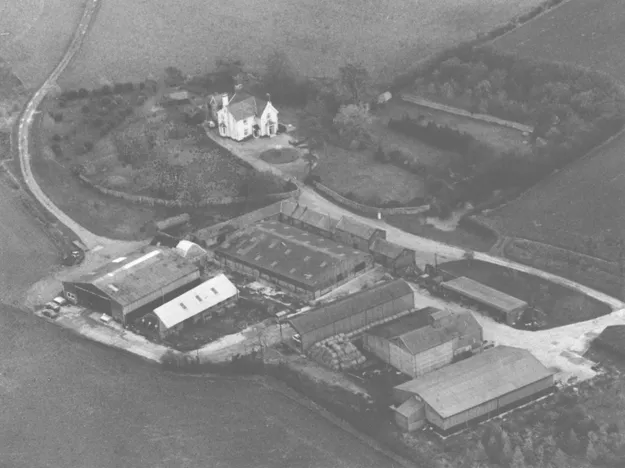
Imagine it is mid-morning on Friday 7 October 1412. Make your way to the small village of Acton a few miles north of Sudbury in Suffolk. Coming from the south the first visible landmark you will see on the horizon is the bell tower of the church. A few minutes from there across the fields is Acton Hall. Quite probably you will be met near some sort of gatehouse or bridge for the house is protected by a moat. Once across you will find a large manor house with a thatched roof, with numerous chambers, a chapel, great hall, kitchen wing, washhouse, brewhouse and bakehouse. Close by is a windmill and a small stream flowing through the gardens near the kitchen where there is a well. There are swans and heron on the moat, pigeons flying around the dovecot and geese, poultry and partridges in the yard. Various farm buildings, barns, animal pens and stables are situated close by.1
Here in the hall of Alice de Bryene’s manor house you may be surprised by a bustle of activity. The tables have already been laid with freshly laundered cloths, and silver goblets, salt cellars and spoons will soon be brought in and put at the appropriate places. In the kitchens final preparations are being made for elaborate sauces of herbs, spices and dried fruit which will accompany the fish dishes, but no meat will be served for dinner today, since Fridays, like Wednesdays and Saturdays, are fish not flesh days in Alice’s household. There is a selection of salt fish and stock fish – that is dried cod – from the household stores, as well as the oysters, smoked herrings, merlings and haddocks that were purchased earlier in the day. Apart from the customary wine and ale to drink there is also the daily bread some freshly baked that morning, mostly white but a few brown loaves as well.
Outside some boys are holding the horses of those other visitors who arrived just before you, while another boy has gone to fetch sufficient fodder for all ten that will be stabled there. Wooden planks provide walkways across those areas of the yard which are muddy. Most of the guests have already assembled in the hall and are awaiting their hostess. While we cannot see exactly how the company is dressed, we do know that Dame Alice is a little over fifty and has been widowed for twenty-six years. Once she has arrived everyone will be invited to take their places at table and offered water in which to wash their hands, before grace is said and dinner may begin.
FIGURE1.1 Aerial view of Acton Manor, Suffolk: the curved wall on the left may indicate the site of the original moat; courtesy of David Johnston.
Forty-four meals were served at Acton that day, eight breakfasts, twenty-three for dinner – the main meal usually taken before noon – and thirteen for supper. Apart from a few members of her household, Alice de Bryene entertained her half-brother Sir Richard Waldegrave with two of his household and Agnes Rokewode, a close relative, with her son. Also present were the rector of Withersfield, who was a houseguest, and four local labourers with their mates who were variously employed on the farm and in the manor house – carting, looking after the cattle, laying tiles, thatching, mending the great oven and doing carpentry. Finally there were two friars from the nearby town of Sudbury who also brought a household member with them. The friars had been guests the day before and may have spent the night there.2
Many of these details come from Alice de Bryene’s Household Book, the daily record book kept by her steward. It covers the accounting year from Michaelmas (29 September) 1412 to Michaelmas 1413. During this period Alice served over sixteen and a half thousand meals at Acton, an average of forty-five meals a day, though daily totals could vary greatly. A fragment of another daily account dating from 29 March to 30 April 1412 has also survived. It is very similar in content to the other account and only ten people are named in it who are not mentioned in the later annual one.
Friday 7 October was not an unusual day, for we can read a similar story throughout the year. But we should not presume that Dame Alice was a merry widow with an insatiable appetite for company, indulging in a perpetual round of entertainment. She was simply playing her part, fulfilling the traditional role of ‘Lord’ of the manor. The hospitality of the household – providing meals for neighbours, friends, workers and occasional strangers – was an essential and fundamental part of medieval social behaviour. For kings, bishops, lords and ladies the household was also a political power-base and hospitality was not merely a domestic affair. It was a means of dispensing patronage and reminding neighbours of the social hierarchy. More than that one might see a reinforcement of community bonding in the ritual breaking of bread together. Most important perhaps and in a very practical manner sharing a meal was one of the few ways that people could actually sit down together, gossip, do business, exchange views and discuss joint ventures, concerns, obligations and responsibilities. If breakfast meetings and business lunches are anathema to some people today, Alice and her contemporaries would have recognized them as an essential factor of daily life.
Sometimes, as at the New Year’s feast, more than 300 people came to dine at Acton; at other times only three were invited to join Alice and those of her household who were present on that particular day. Some of her guests were eminent men whose wives and children visited as well. About three times a week the bailiffs of one of her adjacent manors came to eat, as did the maidservants and various estate workers. In addition, there were also about 50 clerical and religious visitors, many of whom came several times during the year, hundreds of workers throughout August to help with the harvest (on one day alone 60 were provided with food), visits from more than a hundred assorted named casual labourers and a 120 other unnamed guests.
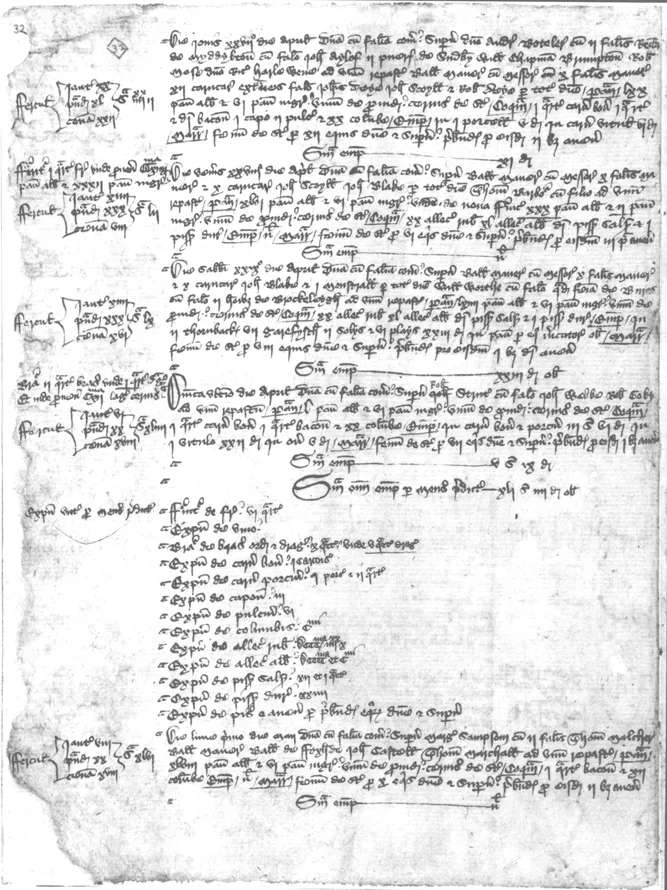
Each daily entry in the Household Book is prefaced with the number of meals served and the date. This is followed by a list of guests, many of whom are named, while others are described by their occupations or from where they came. A pantry account follows with the number of loaves delivered to the table. Note is made that wine and ale were served though no quantity was specified, indicating that there was a separate butterlaria account for these items. Next, there are details of meat and fish sent from the kitchens originating from the manor’s storehouse, followed by the daily purchases, when made, which supplemented these provisions. Provender supplied to the horses in the stables and the total sum of purchases complete each entry. Figures are also given of the household brewing and baking which took place at least once a week. An aggregate total of purchases and food consumed is noted at the end of each month.
FIGURE1.2 Page from Dame Alice’s household accounts showing the total cash expenditure of 41s 4½d for the month of April 1413, followed by a list of victuals used from stock (PRO, C47/4/8b); courtesy the National Archives.
Household accounts are a rich source of information from which we can learn much about the social, domestic, religious and economic lives and relationships of the medieval community, information that cannot be easily gleaned from recorded activities in the public world of government, church affairs and warfare. Every lay or ecclesiastical householder of a large establishment kept such accounts in the Middle Ages. Their primary purpose was to record daily expenditure of victuals by the steward or official in charge who had the overall responsibility for the management of the household. Keeping such accounts enabled the householder to detect mismanagement and budget for the future. They also served as a deterrent against theft and carelessness, a perennial problem that had been recognized a century before.3
These accounts were also essential because such households were like small hotels with numerous staff catering for a wide variety of needs relating not only to the provision and service of meals, which was often an elaborate ritual, but also musicians to provide entertainment and clergy to sing masses and say prayers. There were young men to accompany their masters and mistresses on journeys, run errands and take messages, and scribes and clerks to deal with correspondence and records connected with the management of the estates and other business matters. Men were employed to look after the horses and traction animals, and other servants engaged to help with the daily maintenance of the living quarters, such as cleaning windows and floors and keeping the fires, candles and rushlights lit. A few close companions of the householder might also be resident, and occasionally there would be staff to take care of the young and the elderly.
Among approximately 500 household accounts that have survived there is great diversity, for in some not only is the purchase of food itemized but details given of clothes, cloth, wax, wine, spices and jewellery bought, though often these were specified separately in a wardrobe account. Then there might be cash, corn and stock accounts, records of alms and gifts given, money spent on correspondence, travelling and supplying liveries. Separate accounts were sometimes drawn up for the expenses of maintaining children. Diet accounts – the word originates from per dietas, day rather than food – comprise the largest group of which those of Elizabeth de Burgh, Lady of Clare, are among the most extensive. These run from 1325 to 1360 and include day journals, chamber, wardrobe, chapel and household accounts, as well as those of her goldsmiths and brewers and her travelling expenses.4
The Acton diet accounts are much more modest, reflecting a smaller and less formal household. There are also some extant stewards’ reports from which we may estimate the size, composition and consumption of the de Bryene household. With these – the three receivers’ reports and the numerous bailiffs’ accounts relating to the estates – it has been possible to identify many of those who visited Acton in 1412–13. Taken together, this information illustrates the special place households had in the later Middle Ages, for they were not only like little kingdoms but simultaneously both private homes and public institutions – the nerve centres from which estates were managed, patronage dispensed and social networks maintained. Above all the household was an essential part of the fabric of society in which the life of the local community was contained.
The structure and functions of such households began to change in the later Middle Ages, reflecting development in agrarian practices and social aspirations. Previously few large households had a fixed geographical location, for it was common for estate owners to move with most of their staff from manor to manor, travelling with beds, silver and even, on occasion, with windows. Overseeing farms, which were often scattered over many parts of the country as a result of the accumulation of property through marriage, and living off the produce of these various manors, were fundamental features of landownership. A skeleton staff would be left at the main residence while the rest of the household was on the move. But the fall in population after the plague epidemics made it difficult for landowners to find cheap or bonded labour to farm all their estates in return for small plots of land, and those estates that could not be managed directly were increasingly rented out for cash. People were becoming more settled and sedentary, and for a woman on her own of Alice’s age, such an itinerant lifestyle may not have been particularly appealing or necessary.
Where a household was headed by a married couple, separate accounts were sometimes kept. These might be described as the inner and outer households, the inner account generally taken to be that relating to the main residence which usually meant that it was run by the lady, and the outer or foreign household, a smaller group which would go travelling with the husband. A noblewoman such as Anne Neville, Duchess of Buckingham, might have both a great and an itinerant household of her own even when she was married.5 In the case of a widow in sole control of her estates, all these functions could be combined as a self-contained unit based in one place. What is then noticeable is the executive and administrative capacity of such women, their apparent autonomy, initiative and high-status in the community and the significant influence they were able to wield as the head of a household.
Medieval household accounts were usually written in Latin. The word used for household was familia now related...
Table of contents
Cover
Half Title
Title Page
Copyright Page
Dedication
Table of Contents
List of figures
Acknowledgements
Notes
List of abbreviations
Preface
Introduction
1 The medieval household
2 Marriage and the family
3 Estate management
4 The gentle lifestyle
5 Men at the table
6 Women at the table
7 The wider world
8 Considerations for the afterlife
Epilogue
Appendices
Bibliography
Index
Trusted by 375,005 students
Access to over 1.5 million titles for a fair monthly price.
Study more efficiently using our study tools.
Frequently asked questions
Yes, you can cancel anytime from the Subscription tab in your account settings on the Perlego website. Your subscription will stay active until the end of your current billing period. Learn how to cancel your subscription
No, books cannot be downloaded as external files, such as PDFs, for use outside of Perlego. However, you can download books within the Perlego app for offline reading on mobile or tablet. Learn how to download books offline
We are an online textbook subscription service, where you can get access to an entire online library for less than the price of a single book per month. With over 1.5 million books across 990+ topics, we’ve got you covered! Learn about our mission
Look out for the read-aloud symbol on your next book to see if you can listen to it. The read-aloud tool reads text aloud for you, highlighting the text as it is being read. You can pause it, speed it up and slow it down. Learn more about Read Aloud
Yes! You can use the Perlego app on both iOS and Android devices to read anytime, anywhere — even offline. Perfect for commutes or when you’re on the go. Please note we cannot support devices running on iOS 13 and Android 7 or earlier. Learn more about using the app
Yes, you can access Life in a Medieval Gentry Household by ffiona von Westhoven Perigrinor in PDF and/or ePUB format, as well as other popular books in History & British History. We have over 1.5 million books available in our catalogue for you to explore.