Thinking Like a Mathematician focuses on high-interest, career-related topics in the elementary curriculum related to mathematics. Students will explore interdisciplinary content, foster creativity, and develop higher order thinking skills with activities aligned to relevant content area standards. Students will engage in exploration activities, complete mathematical challenges, and then apply what they have learned by making real-world connections. Thinking Like a Mathematician reflects key emphases of curricula from the Center for Gifted Education at William & Mary, including the development of process skills in various content areas and the enhancement of discipline-specific thinking and habits of mind through hands-on activities.
Grade 3
eBook - ePub
Thinking Like a Mathematician
Lessons That Develop Habits of Mind and Thinking Skills for Young Mathematicians in Grade 3
- 152 pages
- English
- ePUB (mobile friendly)
- Available on iOS & Android
eBook - ePub
Thinking Like a Mathematician
Lessons That Develop Habits of Mind and Thinking Skills for Young Mathematicians in Grade 3
About this book
Information
UNIT 1 SYSTEMS OF COUNTING
DOI: 10.4324/9781003239079-1
RATIONALE
This unit shows students different ways of counting. Students will learn that the base-10 numbering system is not always used. The binary system will be introduced, and students will learn that computers use the binary system. This will solidify students’ understanding of place value and how the number system works. This unit will also introduce basic computer concepts to students.
PLAN
In Lesson 1.1, students will explore the base-10 numbering system. Students will also explore other base numbering systems. In Lesson 1.2, students will apply different numbering systems to write binary code. In Lesson 1.3, students will discover different ways of counting around the world as they develop and present a project.
LESSON 1.1 EXPLORE DIFFERENT COUNTING SYSTEMS
DOI: 10.4324/9781003239079-2
RESOURCES AND MATERIALS
- Lesson 1.1 Base-4 Counting
- Three stackable cups with the numerals 0, 1,2, and 3 written around each cup lip (per group; see Figure 1 for reference)
- Student math notebooks
ESTIMATED TIME
40-45 minutes
OBJECTIVES
In this lesson, students will:
- discover a pattern from a base-4 numbering system,
- understand the differences between numbering systems, and
- compare and contrast the base-10 numbering system with a base-4 numbering system.
PRIOR KNOWLEDGE
Students will need a basic understanding of a base-10 number system. They should also understand place value and how to add and subtract three-digit numbers.
INSTRUCTIONAL SEQUENCE
Anticipatory Set (5-10 minutes): Have students discuss the following in pairs: Explain how our number system works. When you count, is there a pattern? What is the pattern? What would happen if there were no numerals after the numeral 3? How would that kind of counting work?
Activity (30 minutes):
- Divide students into groups of 2-3. Each group should receive three cups. Distribute Lesson 1.1 Base-4 Counting.
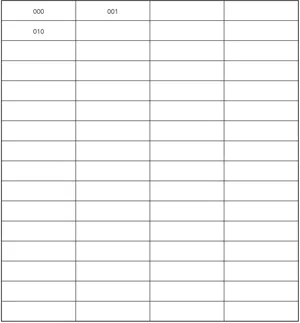
- Have students stack the cups and turn them sideways so the numerals are showing (see Figure 1). Students should start with the number 000. Explain that (moving from left to right) cup 1 represents the hundreds digit, cup 2 represents the tens digit, and cup 3 represents the ones digit. Students will be turning the cups to find a pattern and recording their numbers on Lesson 1.1 Base-4 Counting.
- Have students turn the ones digit (cup 3) to 1 and record the number shown: 001. They should then turn the ones digit again, and write the corresponding numbers until they reach the number 003.
- Once students reach the number 003, have them turn the ones digit back to 0,and then turn the tens digit (cup 2) to 1. They should write down the number: 010.
- Students should continue the pattern until they have reached 333.
- Explain that this number system is called a base-4 number system (consisting of four numerals: 0,1,2,3).
- Lead a whole-group discussion about patterns of numbers.

Figure 1. Stackable cups for base-4 counting.
Exit Ticket (5 minutes): Have students respond to the following in their math notebooks: How would our numbering system change if there were no numeral zero? What if there were only the numerals 0 and 1?
EXTENSION ACTIVITY
Have students add and subtract the following numbers in base 4, using carrying and borrowing rules. Students may also create their own addition and substraction problems.
- 110 + 011
- 223 + 121
- 323 - 122
- 301 -223
ASSESSMENT OBSERVATIONS
- Students should discuss patterns in the base-4 numbering system.
- Students should be using the correct counting process with their cups: After students reach 003, they should reset cup 3 to the digit 0 and turn cup 2 to the digit 1.
- Students should discuss place value similarities and numeral differences.
NAME:________________________________________________DATE:________
LESSON 1.1
Base-4 Counting
Directions: Fill in the chart with the base-4 digits as you count the numbers. Then answerthe questions on the next page.
NAME:________________________________________________DATE:________
- Write the patterns you see in the new number system.
- How is this counting system similarto the way we count numbers? Explain.
- How is this counting system different from the way we count numbers? Explain.
- What happens when you get to the highest possible ones digit?
- What happens when you get to the highest possible tens digit?
LESSON 1.2 APPLY BINARY COUNTING
DOI: 10.4324/9781003239079-3
RESOURCES AND MATERIALS
- Lesson 1.2 Robot Maze
- Lesson 1.2 Writing in Binary Code
- Student math notebooks
- Coins (one per student)
ESTIMATED TIME
60-65 minutes
OBJECTIVES
In this lesson, students will:
- create a written block code to guide a robot through a maze,
- learn how binary code is formed, and
- crea...
Table of contents
- Cover Page
- Half Title Page
- Title Page
- Copyright Page
- Table of Contents Page
- Introduction
- Introductory Lesson: What Is a Mathematician?
- Unit 1: Systems of Counting
- Unit 2: Order of Operations
- Unit 3: Patterns
- Unit 4: Time and Measurement
- Unit 5: Graphing, Data, and Charts in Algebra
- Unit 6: Geometry
- Unit 7: Data Analysis and Statistics
- Final Project: Designing a Garden
- Answer Key
- About the Authors
Trusted by 375,005 students
Access to over 1.5 million titles for a fair monthly price.
Study more efficiently using our study tools.
Frequently asked questions
Yes, you can cancel anytime from the Subscription tab in your account settings on the Perlego website. Your subscription will stay active until the end of your current billing period. Learn how to cancel your subscription
No, books cannot be downloaded as external files, such as PDFs, for use outside of Perlego. However, you can download books within the Perlego app for offline reading on mobile or tablet. Learn how to download books offline
Perlego offers two plans: Essential and Complete
- Essential is ideal for learners and professionals who enjoy exploring a wide range of subjects. Access the Essential Library with 800,000+ trusted titles and best-sellers across business, personal growth, and the humanities. Includes unlimited reading time and Standard Read Aloud voice.
- Complete: Perfect for advanced learners and researchers needing full, unrestricted access. Unlock 1.5M+ books across hundreds of subjects, including academic and specialized titles. The Complete Plan also includes advanced features like Premium Read Aloud and Research Assistant.
We are an online textbook subscription service, where you can get access to an entire online library for less than the price of a single book per month. With over 1.5 million books across 990+ topics, we’ve got you covered! Learn about our mission
Look out for the read-aloud symbol on your next book to see if you can listen to it. The read-aloud tool reads text aloud for you, highlighting the text as it is being read. You can pause it, speed it up and slow it down. Learn more about Read Aloud
Yes! You can use the Perlego app on both iOS and Android devices to read anytime, anywhere — even offline. Perfect for commutes or when you’re on the go.
Please note we cannot support devices running on iOS 13 and Android 7 or earlier. Learn more about using the app
Please note we cannot support devices running on iOS 13 and Android 7 or earlier. Learn more about using the app
Yes, you can access Thinking Like a Mathematician by Mary-Lyons Walk Hanks,Jennifer K. Lampert,Katherine Plum in PDF and/or ePUB format, as well as other popular books in Education & Education Teaching Methods. We have over 1.5 million books available in our catalogue for you to explore.