Concerned with vital issues of ecclesiology within Australian Anglicanism, this book is both darling and controversial. It confronts the 'undiscussable' and in doing so brings together people who write from various contexts within the Church. Its diversity of style and attitude reflects the living richness and complexity of Australian Anglicanism today and also the problems and challenges. The book, in four parts, sets out the issues of methodology, looks at influences of the Australian Anglican inheritance, examines aspects of the institutional life of the Church, and, finally, focuses on the social and political contexts within which ecclesiology is shaped and created. This book is an 'essay', a conversation and a listening between theologians and, consequently, does not attempt to present a unified ecclesiology. As with the Christian community from which it stems, it seeks to engage with its divine-'wonderful and confessedly'-origins.
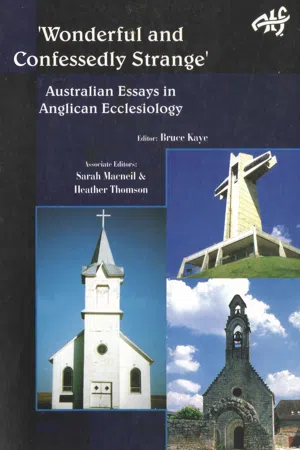
- 425 pages
- English
- ePUB (mobile friendly)
- Available on iOS & Android
eBook - ePub
About this book
Trusted by 375,005 students
Access to over 1.5 million titles for a fair monthly price.
Study more efficiently using our study tools.
Information
Topic
Theologie & ReligionSubtopic
KirchengeschichtePart One: Setting The Scene
Introduction
Introduction
This book attempts to do something which is at once controversial and daring. It is controversial because it attempts to deal with some of the ‘undiscussable’ issues of ecclesiology in Australian Anglicanism. Such is the nature of the diversity, to use a generously euphemistic term, in Australian Anglicanism, that the underlying issues of ecclesiology are often kept in the background of the political arguments that are the bread and butter of ecclesiastical life. We seek here to bring some of those ecclesiological issues into the foreground. The project is daring in that it has brought together people who write out of very different contexts within the Anglican Church of Australia, and who are naturally influenced by those contexts. Having done that, it has sought to encourage a conversation on vital issues to do with ecclesiology for Australian Anglicans.
The project is also daring in the sense that it seeks to engage with the divine origins of the Christian community. In an age when the political dynamics and public disputes within the church appear to many to be little different from the power politics of government or of business corporations, it is reasonably daring to suggest that this community has something to do with a God of Grace, with a suffering and serving Christ. Yet that is the claim of the essays in this book. The Christian church has long been described as a pilgrim community made up of people whose citizenship is in heaven; a community of resident aliens. It is not surprising that this vocation appeared to the ancient writer Diognetus to be ‘wonderful and confessedly strange’. We have taken this phrase for our title in order to draw attention to the divine character of the vocation of the church.
The difference between this project and those of the General Synod Doctrine Commissions in recent years has been that this project has not been set within the politics of a Commission and it has encompassed general issues of ecclesiology, rather than specific matters which were the subject of intense political debate in the church. The project involved several meetings of the authors and continuing contact between them, though mostly through the editors. The diversity in attitude and style is very marked and this in itself reflects something of the character of Australian Anglicanism. It points to the significant challenge of listening to others, especially as they seek to pursue their Christian vocation within a context of significant diversity. It also points to the peculiar and pressing difficulty of understanding and engagement with difference that Australian Anglican theologians have to struggle with. This book thus does not present a coherent unified ecclesiology. Rather it points to the mixture, one might even say the fruit cake, that is the result of two centuries of cooking; not to strain too many images!
These kinds of considerations have influenced the shape of the book. It begins with a ‘Setting of the Scene’, which seeks to introduce issues of methodology in ecclesiology conducted in this Australian context and also the historical context in which the Anglican tradition has existed. The subsequent sections reflect different ways into the subject. Part II looks at aspects of the inheritance with which the present generation must work. Part III looks at aspects of the life of the church which cross boundaries of time or framework. Part IV looks at various contexts within which ecclesiology is shaped and created.
This book is an ‘essay’, what German theologians might call an Untersuchung, an attempt. The chapters are also essays in this sense. They are attempts, trials, testings of where the church is, that is to say, where God is bringing into existence and life a people who will be witnesses to Christ the crucified king.
1
Foundations And Methods In Ecclesiology
Bruce Kaye
From the very earliest times Christians believed that Jesus of Nazareth was also and at the same time the Son of God incarnate. Their belonging to this Jesus Christ committed them to live according to a heavenly vocation in the earthly circumstances in which they believed God had placed them. The early Christians’ struggle to understand how Jesus was both human and divine was also at the same time a struggle reflected in their own lives as a group of people. Paul encouraged the Philippians, who lived in a Roman garrison town, to think of their circumstances in terms of a heavenly citizenship. Jesus told his disciples that they were to set their hearts on a treasure in heaven.
The point is well made in the second century letter of Diognetus. He was concerned to show that the Christian faith appealed to all throughout the known world and therefore it underlined a continuity across cultural and social differences. The continuity was provided between believers through a common heavenly citizenship:
For the distinction between Christians and other men is neither in country nor language nor customs. For they do not dwell in cities in some place of their own, nor do they use any strange variety of dialect, nor practice an extraordinary kind of life . . . while living in Greek and barbarian cities, according as each obtained his lot, and following local customs, both in clothing and food and in the rest of life, they show forth the wonderful and confessedly strange character of the constitution of their own citizenship. (V,1)1
This shared vocation constitutes them as Christians and together with the character of their lives marks out the heavenly kingdom to which they belong.
Just as Christians have sought to understand the nature of their faith so also that search has been a quest to understand the nature of the group or community which together they are becoming. As a consequence ecclesiology has been an implicit part of the Christian conversation from the beginning. This has been so especially at times of significant social and cultural change and at times when Christians have found themselves in contact with each other across different cultural divides.
Not surprisingly the engagement of the early church writers in the key theological questions of Christology and the doctrine of the Trinity was accompanied by attempts to make sense of the nature and foundations of the community which increasingly came to be called church. Institutional arrangements developed such as a canon of scripture, sacraments, an ordered ministry, and also patterns of authority and power began to be visible amongst the Christians. Groups such as Gnostics and Montanists emerged and sharpened the perceptions of other Christians on issues of authority, scripture and community order. This early period in Christianity also highlighted the question of how a Christian conversation on these issues might properly be conducted: according to what criteria and in the light of what authority? How could it be a conversation which encountered the changing social circumstances of Christians and at the same time was faithful to the word of God in Jesus Christ and the reality of the Holy Spirit in the Christian gospel?2
These questions did not go away with Constantine’s deal with the bishops and the recognition of Christianity as the official religion of the Roman Empire, indeed they only multiplied and became more intense and more difficult. Undoubtedly Constantine’s was a political act born of a recognition that the widely spread and astonishingly numerous Christians offered the best hope of providing the unity which his empire required and that the bishops appeared to be the significant leaders in this religion.3 Nonetheless his decision introduced into the life of the Christian community new and alien versions of authority, power and institutionality which sharply challenged the heavenly vision of the Christians’ vocation.
These changes have echoed down through the history of the Christian church. The revolutionary creation of Christian Europe in the time of Gregory the Great and its division and dispersion in the seventh century were moments of similar magnitude.4 The shattering of the world of Gregory the Great by the reforms of Gregory VII, which created a separate and overarching identity for a clerical vision of the church, laid the groundwork for the political divisions in Western Europe which in turn formed the social and political shape of the sixteenth century Reformation.5 All of this meant that Western Christianity was driven into a different image of its coherence than had prevailed under the Constantinian model or the later Carolingian version of a universal Christian Empire.
The early modern emergence of nation states and the attempt by Christians to live out their heavenly vocation in such differentiated social and political contexts meant again the Christians had to adjust their image of how they were as a group to testify to their true identity as people of God. The pluralism of the modem period in Western Christianity has provided the base challenge for Christians. The ecumenical movement and the consolidation of the centralised concept of the Roman papacy are but two of the more prominent responses to this challenge.6 The Anglican form of this story has had some characteristic markers of its own; an early experience of nationalism and encounters with domestic and exported imperialisms. The current crisis in worldwide Anglicanism is but the consequence of the desiderata of this story and its exportation as part of the colonial phase of the English and American imperial experiences. All these moments have to do with Christians in their interrelations dealing with complexity and coherence, change and faithfulness.
But this story only raises more questions. The history of Christianity has clearly shown that this particular form of faith with its heavenly dimension and earthly engagement has produced a number of clear discrete traditions of faith. These traditions are exemplified in groupings or communities of Christians who align themselves with the tradition which provides the overarching framework for their practice of the faith. Not only so, it is also clear that these traditions change over time in terms of their precise form and structure. Each encompasses the challenges of continuity and change which can be seen on the broader canvas in Christianity generally. Some change more obviously than others. Some have change more prominent in their self-understanding; others give prominence to continuity. Thus Lutherans speak of the church as always reforming while being constant and Roman Catholics use the rhetoric of consistency while changing. Discrete traditions and change inevitably raise both the coherent vision of the heavenly character of the Christian vocation and also of the contingency of the life of the Christian and the pilgrimage of the Christian groups. That in turn draws attention to the contingent character not just of the Christian life but of the institutional arrangements by which the different traditions sustain their life of faith and witness to their vocation.7
It is in this context that we should understand the preoccupation of writings on ecclesiology with both the empirical reality of the church and the so-called theological ideal of the church. Michael Ramsey’s influential Anglican treatment of this subject illustrates the interdependence of the empirical and the ideational. ‘Michael Ramsey wished to recall both Evangelicals dismissive of church order, and legalistic Catholics to a truly catholic awareness of the continuity and interdependence of the Gospel and church order’.8 Ramsey sought to sustain an argument that catholic order, by which he meant episcopacy in an apostolic succession, arose from the character of the gospel which he found to be focussed in the death and resurrection of Christ. This is a different argument from that of Charles Gore who wished to argue that the same catholic order was a consequence of the institution by Jesus of an organic community, the church, and this particular order. Despite the confidence of Gore, Ramsey’s argument is less vulnerable to the criticisms of historical investigation about such an institution and the emergence of this order of ministry and at the same time is a more substantial theologi...
Table of contents
- Cover
- Title Page
- Copyright
- Contents
- Preface
- Part One: Setting The Scene
- Part Two: Inheritance
- Part Three: Bridging
- Part Four: Context
- Contributors
- Author Index
Frequently asked questions
Yes, you can cancel anytime from the Subscription tab in your account settings on the Perlego website. Your subscription will stay active until the end of your current billing period. Learn how to cancel your subscription
No, books cannot be downloaded as external files, such as PDFs, for use outside of Perlego. However, you can download books within the Perlego app for offline reading on mobile or tablet. Learn how to download books offline
Perlego offers two plans: Essential and Complete
- Essential is ideal for learners and professionals who enjoy exploring a wide range of subjects. Access the Essential Library with 800,000+ trusted titles and best-sellers across business, personal growth, and the humanities. Includes unlimited reading time and Standard Read Aloud voice.
- Complete: Perfect for advanced learners and researchers needing full, unrestricted access. Unlock 1.5M+ books across hundreds of subjects, including academic and specialized titles. The Complete Plan also includes advanced features like Premium Read Aloud and Research Assistant.
We are an online textbook subscription service, where you can get access to an entire online library for less than the price of a single book per month. With over 1.5 million books across 990+ topics, we’ve got you covered! Learn about our mission
Look out for the read-aloud symbol on your next book to see if you can listen to it. The read-aloud tool reads text aloud for you, highlighting the text as it is being read. You can pause it, speed it up and slow it down. Learn more about Read Aloud
Yes! You can use the Perlego app on both iOS and Android devices to read anytime, anywhere — even offline. Perfect for commutes or when you’re on the go.
Please note we cannot support devices running on iOS 13 and Android 7 or earlier. Learn more about using the app
Please note we cannot support devices running on iOS 13 and Android 7 or earlier. Learn more about using the app
Yes, you can access Wonderful and Confessedly Strange by Bruce Kaye in PDF and/or ePUB format, as well as other popular books in Theologie & Religion & Kirchengeschichte. We have over 1.5 million books available in our catalogue for you to explore.