The Luther@500 anniversary may be behind us, but Luther stands ahead of us in many ways. The essays in this volume by an international group of scholars begin with a contextual discussion of Luther's definitive contribution to the Wittenberg Reformation and its significance for us today. New light is shed on old issues across a range of topics. But these essays do not stay in the past. Many also engage critically with contemporary issues in Luther interpretation and a few boldly trace the trajectory of Luther's reformational theology into the future. 'Just as the four hundredth anniversary of Luther's Ninety-Five Theses in 1917 signalled a renaissance in Lutheran theology, so too the quincentenary in 2017 galvanised a global celebration of his legacy. This book, which gathers together the insights of a stellar cohort of Australian and international scholars, bears testimony to the ongoing vitality of Luther's thought. It ought, and will, become an invaluable resource for future Luther studies.' Mark R. Lindsay, Professor of Historical Theology and Deputy Dean, Trinity College Theological School (University of Divinity), Melbourne 'The rich fare of this volume extends from deep and finely focused studies of specific aspects of Martin Luther's thought, through his historical and ecumenical reception, to the challenges of interpreting what he has to say to twenty-first century issues and hearers. Fourteen authors from three continents bring readers into conversation with the reformer's insights and stimulate their own engagement with his theology.' Robert Kolb, Professor Emeritus of Systematic Theology, Concordia Seminary, Saint Louis (USA) 'A valuable collection showing the ample figure of Martin Luther, who re-framed Christian instruction from its centre while aiming to guide many spiritually to a life anchored in God's word, freed from burdens, and intent on the neighbour's good. Major gains in recent Luther interpretation are present: on the theology of the cross, on God's performative word engendering faith and on Luther's mature doctrine of creation displaying the range of God's gratuitous giving. We hear as well how other Reformation communities see Luther and how recent Pauline studies pose questions about his impact.' Jared Wicks, S.J., Professor Emeritus, Pontifical Gregorian University, Rome
eBook - ePub
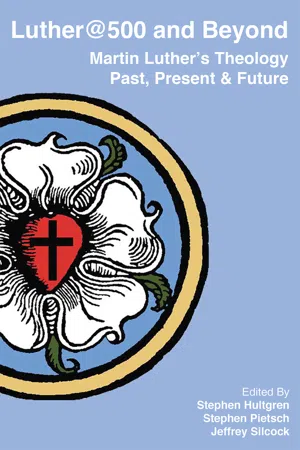
Luther@500 and Beyond
Martin Luther's Theology Past, Present and Future
- 314 pages
- English
- ePUB (mobile friendly)
- Available on iOS & Android
eBook - ePub
Luther@500 and Beyond
Martin Luther's Theology Past, Present and Future
About this book
Trusted by 375,005 students
Access to over 1.5 million titles for a fair monthly price.
Study more efficiently using our study tools.
Information
Topic
Theology & ReligionSubtopic
Christian TheologyA New Look at the Theology of the Cross: What It Meant for Luther and Its Significance for Us Today
Introduction
The theology of the cross (theologia crucis) is one of the most popular of Luther’s teachings. Outside the Lutheran tradition, it is usually understood as nothing more than a restatement of the atonement, as developed by Paul, whose mission it was to preach nothing else except Jesus Christ, and him crucified (1 Cor 2). But in Lutheran theology, the cross has a deeper meaning, for it is precisely in God’s act of self-revelation culminating in the cross that God conceals himself most deeply in a way that reason will never understand. This, as we will see, is the paradoxical heart of Luther’s theology of the cross. Although we cannot discuss it here, this theology provides an important approach to the problem of suffering. It also enables us to see how God is at work in a hidden way in the church and its ministry, despite its apparent weakness, public ridicule, and in recent decades rapid shrinkage.
However, several prominent Luther scholars question if this reading of Luther’s theology of the cross is in fact historically accurate. These scholars argue that, far from being central to his theology, the theologia crucis, as Luther develops it in 1518, virtually disappears from his thought by 1520. In this paper, I will explore whether there is a truth to this claim and if so, what these scholars mean by Luther’s theology of the cross and how their understanding of it relates to that of the standard interpretation that prevails in much of Luther scholarship today. As we will see, another matter that plays into this discussion is the question of whether Luther’s theological breakthrough should be dated early (1513–15) or late (1518–19).1
The paper falls into four main sections. After a short introduction, I will begin by discussing the standard interpretation of the theology of the cross that sees it as central to Luther’s mature reformational theology. In the second section, I will present the alternative view that the theologia crucis is not a central feature of his reformational theology at all, but belongs rather to his early pre-reformational theology, culminating in the Heidelberg Disputation. This will be followed by a third, longer section that critically assesses these two views to determine which is better supported by the texts and whether they can be brought into some sort of relationship to each other. The final section will consider the significance of the theology of the cross for today.
It is a curious fact that the term ‘theology of the cross’ (theologia crucis) or ‘theologian of the cross’ (theologus crucis) seems to occur in only six texts in the Luther corpus. Four of them were written in the early spring of 1518, namely, the Heidelberg Disputation2 (this has the most explicit and well-known of the references), Luther’s Asterisks and Eck’s Obelisks3 (the English title of an untranslated Latin work), the Lectures on Hebrews,4 and The Explanations to the 95 Theses (Resolutiones).5 The fifth occurs in the Operationes in Psalmos (Luther’s second series of lectures on the Psalms, 1519–21) in 1519. This comes less than a year later and follows closely the emphasis Luther makes in the other four texts, even if it has some different accents. The sixth text, which has recently been identified, comes from 1532/33, some fifteen years after Heidelberg. The key question here, as we will see, is whether this text, although it uses the term ‘theology of the cross’, still fits the pattern of the other five from 1518–19. The fact that all of the texts that use the term come from Luther’s early period, except for the last one mentioned, is an important datum for those who argue that the theology of the cross, as Luther understands it in 1518, does not belong to his mature, reformational theology.
1. Standard Interpretation of the Theology of the Cross
The standard view of Luther’s theologia crucis is based on the interpretation of scholars like Paul Althaus,6 Walther von Loewenich,7 Gerhard Ebeling,8 and Alister McGrath,9 among others. Not all writers agree with each other in every aspect of their Luther interpretation, but they all agree that the theology of the cross belongs to his mature theology and not simply to one stage of his theological development.10
The main features of the theology of the cross, according to this view, can be summed up under five key themes.11 (1) The theologia crucis is a theology of revelation and is aimed specifically at scholastic theology that puts great store by reason. Rather than seeking God where he has revealed himself in the death of his Son on Calvary, it attempts to know God by way of philosophical speculation based on natural law. (2) God’s revelation is paradoxical, contrary to human reason. When he reveals himself, he also conceals himself—so deeply in fact that he can only be apprehended with the eyes of faith. Like Moses, who was denied a vision of God’s glory (Exod 33:23), we too cannot see God’s face but only his back (posteriora Dei). We cannot know God as he is in himself, but only as he is hidden in his revelation. (3) Again, like Moses, we are denied a direct knowledge of God. Instead, we see God in faith revealed in the cross, the posteriora Dei revealed in the humility and shame of Calvary. The things that we can see are the very things that human wisdom regards as the opposite of deity, such as weakness, foolishness, and humility. To those without faith, this revelation is concealed. God’s presence in the cross of Christ cannot be empirically verified by human reason. However, those who have faith know that concealed in the humility and shame of the cross are the power and glory of God. His strength is revealed in apparent weakness, his wisdom in apparent folly, and his mercy in apparent wrath. (4) The theology of the cross stresses that God is known especially through suffering and the cross—both Christ’s and the Christian’s. (5) The theologia crucis rejects not only the rationalist’s attempt to know God through reason but also the moralist’s attempt to reach God through obedience to the law.12 For as Luther says in the Heidelberg Disputation, ‘true theology and recognition of God are to be found [only] in Christ crucified’.13
A brief elaboration of some of these themes, on the basis of standard works, should be sufficient since this understanding of the theologia crucis is already well known to most people who are familiar with the basics of Luther’s theology.14 The theology of the cross in 1518 does not simply highlight Christ’s death on Calvary nor does it just explicate the doctrine of the atonement, but it specifically refers to that type of theology which stands in stark contrast to the theology of glory. These are not simply two different, but equally valid, ways of doing theology, but they are more like two different religions; one is true, the other false.15
Theologians of the cross see God differently from the theologians of glory. As we saw above, Moses, who was denied a vision of God’s face (that is, God’s glory) exemplifies the theologians of the cross, who can only see God from behind, in a hidden way. The theologians of glory, on the other hand, are typified by the scholastics of Luther’s day who tried to reach God through philosophy, that is, reason and speculation.
God’s revelation is contrary to human reason and defies logic. According to unregenerate human reason, God is omnipotent, transcendent, and detached from this world. The theology of the cross, on the other hand, takes its stand on scripture and through faith confesses that God reveals himself by concealing himself in the opposite of what reason would expect. So, in Jesus Christ, the almighty God becomes a helpless infant born in a manger;16 he comes not as a king but as a servant. He dies the death of a criminal on a Roman cross—yes, paradoxically, God dies. But to unbelievers, his death is only the death of another crazy messianic pretender who was betrayed by his own people to the Roman authorities and whose cross is only one of thousands that dotted the Judean hillside. Yet faith points to this blood-streaked and God-forsaken man on the gallows and confesses, with the soldier under the cross, ‘Truly, this man was the Son of God’ (Mark 15:39). In all of this, faith sees in the cross divine power hidden under human weakness,17 glory concealed behind ignominy and shame, divine wisdom hidden behind the folly of the cross, as the apostle emphatically describes it in 1 Cor 1:18–31, which is Paul’s statement of the theology of the cross. But according to the theologia crucis, the revelation of God is not only hidden but paradoxical. God acts in a way that defies all our expectations based on natural religion, reason, and philosophy. In fact, according to the theology of the cross, God is absconditus sub contrario (hidden under his opposite).18
This leads to profound Anfechtung19 in the Christian life, which is another hallmark of the theologia crucis. Christians who through the law feel only God’s accusation and wrath because of sin are called to turn away from the voice of the law and to put their trust in that other word that God speaks, the word of gospel,20 which declares and bestows the forgiveness of sins. The Anfechtung arises when Satan uses the law to create doubt in the mind of Christians who have been absolved—‘Did God really say that? What gives you the right to think you are forgiven? Do you think God turns a blind eye to sin?’ With words like these, the evil one attacks the conscience and tries to get the believer to doubt God’s word of grace. According to the theologia crucis, the Christian life is stamped by spiritual attack in which Christians are called to turn away from the God of wrath and to find refuge in the God of mercy; in faith, they are to appeal to God against God, just as Christ did on Calvary, in his great hour of temptation, when he was forsaken by God the Father (Matt 27:46).21
The theology of the cross has implications for all facets of Christian doctrine and life: God’s omnipotence is hidden under the weakness of his crucified Son, his glory under the shame and disgrace of the cross, victory under defeat, the holiness of Christians under their continuing sinfulness (simul iustus et peccator), the wisdom and power of God under the apparent foolishness and weakness of his word, which looks and sounds all too ordinary in a church which, to the natural eye, looks anything like the glorious saints of the new creation. The cross stands for God’s hidden and paradoxical revelation, which can only be seen with the eyes of faith.
Within a year of his Heidelberg Disputation, Luther says, in his later lectures on the Psalms, ‘The cross of Christ is t...
Table of contents
- Cover
- Copyright
- Title Page
- Table of Contents
- Preface
- Abbreviations
- Martin Luther’s Ninety-Five Theses—Reconstructing a Disputation Which Never Took Place Theodor Dieter
- A Clarifying Moment? The Continuing Significance of the Leipzig Disputation Mark Thompson
- Our Martin: Catholic Sympathisers of Martin Luther Yesterday, Today and Tomorrow Franz Posset
- A New Look at the Theology of the Cross: What It Meant for Luther and Its Significance for Us Today Jeffrey Silcock
- On Weariness of Life: Luther’s Letter to Jonas von Stockhausen as Pastoral Care for the Suicidal Stephen Pietsch
- Luther on the Sharing of the Attributes James Arne Nestingen
- Luther’s Theology of Giving and the Gift Risto Saarinen
- Luther’s Bible Prefaces and Their Contemporary Significance Maurice Schild
- Luther beyond Lutheranism: The Reception of Luther’s Theology and Life by Non-Lutherans Peter Matheson
- Faith into Context: Luther’s Small Catechism as a Cross-Cultural Mission Resource Andrew Pfeiffer
- Luther as Educator: His Vision of Teaching and Learning and Its Significance Today Thomas Kothmann
- Communion with Christ and All Saints: Reclaiming Luther’s Early Eucharistic Theology Dean Zweck
- Luther for the Future Kirsi Stjerna
- Luther Ahead: Remarks on and Proposals for Luther Research and Luther Reception Oswald Bayer Translated by Jeffrey Silcock
- List of Contributors
Frequently asked questions
Yes, you can cancel anytime from the Subscription tab in your account settings on the Perlego website. Your subscription will stay active until the end of your current billing period. Learn how to cancel your subscription
No, books cannot be downloaded as external files, such as PDFs, for use outside of Perlego. However, you can download books within the Perlego app for offline reading on mobile or tablet. Learn how to download books offline
Perlego offers two plans: Essential and Complete
- Essential is ideal for learners and professionals who enjoy exploring a wide range of subjects. Access the Essential Library with 800,000+ trusted titles and best-sellers across business, personal growth, and the humanities. Includes unlimited reading time and Standard Read Aloud voice.
- Complete: Perfect for advanced learners and researchers needing full, unrestricted access. Unlock 1.5M+ books across hundreds of subjects, including academic and specialized titles. The Complete Plan also includes advanced features like Premium Read Aloud and Research Assistant.
We are an online textbook subscription service, where you can get access to an entire online library for less than the price of a single book per month. With over 1.5 million books across 990+ topics, we’ve got you covered! Learn about our mission
Look out for the read-aloud symbol on your next book to see if you can listen to it. The read-aloud tool reads text aloud for you, highlighting the text as it is being read. You can pause it, speed it up and slow it down. Learn more about Read Aloud
Yes! You can use the Perlego app on both iOS and Android devices to read anytime, anywhere — even offline. Perfect for commutes or when you’re on the go.
Please note we cannot support devices running on iOS 13 and Android 7 or earlier. Learn more about using the app
Please note we cannot support devices running on iOS 13 and Android 7 or earlier. Learn more about using the app
Yes, you can access Luther@500 and Beyond by Stephen Hultgren, Stephen Pietsch & Jeffrey Silcock in PDF and/or ePUB format, as well as other popular books in Theology & Religion & Christian Theology. We have over 1.5 million books available in our catalogue for you to explore.