Taking as its theme 'beauty from ashes' the beautiful image from Isaiah 61: 3, All the Beautiful Things: Finding Truth, Beauty and Goodness in a Fractured Church is written at a time when the Catholic Church and its people are reeling from years of scandal. This book asks questions throughout and attempts to answer them based on the author's lived experience; but it also engages a wide range of conversation partners. These answers are the result of interviews, surveys and conversations with people who love the Church, but seek reform and renewal. It is a 'cri de coeur', a cry of the heart to try to reclaim what has been lost. It is a taking up of a cross and walking on a journey paved with all manner of challenge. In the end, the author's hope is to help others to rediscover the truth, beauty and goodness that still exist within Catholicism. Like many who long for a more accountable church, Beth Doherty faces the question of whether to stay or go. The book does not minimise the failures of the Church, but is a call to action. Sandie Cornish, Australian Catholic Social Justice Council At a time when it is difficult to have hope in the Catholic Church, this book responds by listening to real people who want it to return with authenticity to the message of Jesus. (Bishop) Pat Power, Emeritus Auxiliary Bishop of Canberra and Goulburn. Beth Doherty's book reflects her wide reading and is enlivened by experience with Catholic organisations overseas and in Australia. Andrew Hamilton SJ, Editorial Consultant, Jesuit Communications. Beth Doherty's experiences will strike a chord with many Catholics who feel hurt, but can't shake from their feet the dust of the institution that has led them to Jesus. Margaret Hebblethwaite, Theologian, Journalist and Founder of Santa Maria Education Fund A Church that evolves over centuries develops accretions that need painful revisiting. The author calls for a deep renewal. A worthy read! Maria Casey RSJ, Canon Law Consultant and Postulator for the Cause of St Mary of the Cross MacKillop.
eBook - ePub
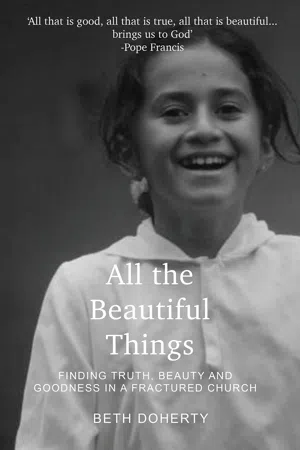
All the Beautiful Things
Finding Truth, Beauty and Goodness in a Fractured Church
- 145 pages
- English
- ePUB (mobile friendly)
- Available on iOS & Android
eBook - ePub
About this book
Trusted by 375,005 students
Access to over 1.5 million titles for a fair monthly price.
Study more efficiently using our study tools.
Information
Topic
Theology & ReligionSubtopic
Christian ChurchChapter One
Beauty from Ashes
‘The beauty of the Catholic Church is that it has a sacramental structure that can hold its own with the best out of any tradition. It has a mystical system and content that can hold its own with the best out of Tibet . . . it’s an amazing tradition, but I think you need to be critical.’1
There are few passages of scripture that more aptly describe the story of Christianity than Isaiah 61:3:
To provide for those who mourn in Zion—
to give them a garland instead of ashes,
the oil of gladness instead of mourning,
the mantle of praise instead of a faint spirit.
They will be called oaks of righteousness,
the planting of the Lord, to display his glory.
A garland instead of ashes . . . The oil of gladness . . . A mantle of praise.
The story, that is the story of Christianity, and of life itself is still being written on our hearts.
For those who cling on to belief, however haphazardly, there lives the possibility that from suffering and sadness, from the ashes of destruction, can come great beauty.
Beauty from ashes is about redemption. It’s about a cross. It’s about gathering together threads, grains, broken glass, shreds, fragments and dust, and transforming them.
It is about building up something new from the ruins of our lives. It is about the transformative power of God’s liberating love to make beautiful things out of brokenness.
It’s about an apparently illegitimate child born in a stable, surrounded by oxen and sheep, a humble saviour born into poverty and turmoil.
‘I saw the angel in the marble’, said the great Renaissance sculptor and painter Michelangelo, ‘and I carved until I set him free.’
November, 2017.
The gentle scent of flowers, incense and candles, an odour pregnant with meaning, greets me as I enter the side door of the cathedral.
I bless myself, kissing my hand quickly after making the sign of the cross, a gesture I learned in Latin America and that reminds me of a faith that has carried me from before I was born.
There is a lot of propaganda in this church. As the mother church of the archdiocese, it’s only natural that it would, at times, become a repository for the good, the bad and the crazy.
There are magazines and leaflets, there are Catholic newspapers from around the country, miraculous medals with printed instructions on how to pray the rosary, and flyers espousing different interest groups’ positions on the latest political battles.
Some of the material is comforting, beautifully designed and crafted with exquisite prose, written objectively and thoughtfully. Some of it is less so, provoking a range of emotions, some of them rage, division and exclusion.
And so it is with this faith.
The Catholic Church is nothing if not an institution that invites and gives a home to all the paradoxes of life.
People’s opinions, cultures, preferences and political leanings, economic status, race and language, all somehow fit and co-exist under this banner we call Catholicism.
Indeed, how is it that Catholicism manages to maintain a fragile unity, even across every nation and tribe?
On this day, I am struck by the smells that greet me. I notice them, because they remind me of that unusual mix of incense and roses and of candles just extinguished.
The smell is beautiful, it’s the scent of prayer.
It causes me to wonder why it is, at age thirty-six, when most of my peers have chosen to leave, or simply put aside, this tradition, that I still find solace, beauty and truth in my Catholicism.
Sometimes, I think the reason I am still here is because of some misguided sense of obligation.
Week in, week out, I still attend.
It’s not always the same parish mind you. I’m itinerant like many of my generation.
One week will be in a cathedral complete with ornate vestments, and choral sounds coming from the choir loft; the following week could be in a suburban church with colourful banners on the wall and dove-shaped cut-outs made by primary school children preparing for the sacraments.
This means that my experience of parish as a connecting community is limited, and this isn’t always helpful.
My wondering about Catholicism’s enduring pull for me led me to wonder what others thought.
So, I set out to survey some people using social media.
My questions included: Why do you go to mass? (if at all), and what do you find beautiful about Catholicism in this time and place?
Have the scandals in the Church affected your feelings about your own faith?
I asked people to give honest opinions about their experiences of parish and the sacraments, their thoughts on church teaching, and on the place of women in leadership.
I asked them not to hide from the things they find difficult, particularly in the light of recent scandals.
The questions were deliberately varied, and the responses reflected a wide array of opinions and backgrounds.
One thing I found almost unanimously was a hunger for change.
Very few were happy with the status quo.
Many were bewildered, concerned, angry, and thirsting, hungering for reform. Some had been working at the fringes of the Church for years.
Some had given up hope.
The percentage who felt that the tradition should, for the most part, stay as it is was less than two per cent.
One particularly insightful response came from a member of my immediate family, my brother, Dr Bernard Doherty. He is a historian, a revert to the Catholic faith after a brief stint in the Greek Orthodox church and has many years of education across a wide range of Protestant faculties. He wrote:
Despite its many flaws the Catholic Church maintains the fullest and most compelling expression of the Christian faith. Catholicism embodies a direct historical and enduring sacramental link back to the early Christian tradition and while developing organically has continued to proclaim that inheritance.
While other Christians are no less Christian, I have found by rich experience of the diversity of other Christian traditions that only Catholicism has drawn to itself the sufficient cumulative spiritual resources to fully express that in a holistic way in the face of unbelief . . .
Catholicism is as cultural as it is religious, in a way that is far more inextricable than most other Christian creeds. It is woven into the warp and woof of life in a way far more difficult to untangle than other forms of Christianity. One rarely encounters someone who says they’re a lapsed Baptist, for instance, implying that they still maintain, if only tentatively, some vestiges of self-identification with that tradition. In contrast, one frequently meets ‘lapsed Catholics’ who, while often embittered toward the Church, cannot bring themselves to entirely disown their inheritance.
Another thoughtful response was the following:
The tradition. Knowing that hundreds of thousands of people before me have participated in the exact same thing; knowing that, at the same time, there are Catholic masses being held all throughout the world in various languages and countries; knowing that, because the tradition has been alive for so long, I can find countless pieces of evidence and writing supporting it and maybe even questioning it to make it stronger. All these things are beautiful to me.
Others had similar things to say, expressed in a variety of ways. Some were quick responses, dashed off between feeding young children, others were the considered views of academics, tradespeople, teachers, journalists, lawyers, priests and religious; others were midnight rants over a glass of wine, and others again were casual interviews over tea or something stronger.
The Church is where I am sustained in my commitment to Christ and his mission. It has transformed my life and has been the force that powers any good that I do. At its best it is a place of beauty and truth.
Before I started writing this book, I had been thinking about beauty a lot.
The first time I heard the quote ‘the world will be saved by beauty’ was while reading Kate Hennessy’s biography of the famed twentieth century servant of God (and Kate’s grandmother), Dorothy Day.
The quote comes originally from the pen of Dostoevsky in the novel The Idiot. The main character of this novel is Prince Myshkin, depicted as a Christ-figure:
Out of the mouth of this idiot comes a clearer vision of beauty and reality than those around him, his clarity heightened even in the midst of his sickness.2
Pope John Paul II quoted the same line from Dostoevsky in his Letter to Artists, under the heading ‘The saving power of beauty’. He wrote:
People of today and tomorrow need this enthusiasm [of wonder] if they are to meet and master the crucial challenges which stand before us. Thanks to this enthusiasm, humanity, every time it loses its way, will be able to lift itself up and set out again on the right path. In this sense it has been said with profound insight that ‘beauty will save the world’.3
So, where do we find beauty, saving beauty? Can beauty save the Church, or will ugliness, brokenness and evil triumph?
Purveyors of beauty—artists, craftspeople, designers, architects, musicians, actors, media, marketing and advertising professionals—have us convinced of a plethora of ways we might find beauty, depending on the time, fashions and cultural influencers.
But could it be that baptism with holy water in the name of the carpenter from Nazareth, that weekly or even daily nourishment from his body and blood might be the beauty we seek?
Could it be that the smells of incense accompanied by a grand processional and a blessing, or an anointing with oil, may be the healing balm our hungry, broken souls need?
Might it be that pondering the words of scripture in our hearts might give us a living encounter with Christ?
Might it be that in serving bread to the poor and questioning the structures that keep them in poverty we will be brought face to face with Christ, as Mother Teresa put it, in the ‘distressing disguise of the poor’?
Could it be that these things form together into something quite beautiful in which we might find our deepest longings met?
Belonging is a crucial part of this question. None of the above is possible without community. As one survey respondent wrote when asked about why they remain in the Church:
Because the Church holds a...
Table of contents
- Cover
- Title Page
- Copyright
- Table of Contents
- 1. Beauty from Ashes
- 2. Of Saints and Sinners
- 3. The Gift of the Sacraments
- 4. The Name of God Is Mercy
- 5. Women Who Follow Jesus
- 6. Education in the Catholic Tradition
- 7. The Parish Community
- 8. Celebrating Christmas and Easter
- 9. Worshipping in Spirit and Truth
- 10. Let Justice Roll Down
- 11. Rebuilding, Renewal, Reform
- 12. Jesus, Yesterday, Today and Tomorrow
- 13. Epilogue
- 14. References
Frequently asked questions
Yes, you can cancel anytime from the Subscription tab in your account settings on the Perlego website. Your subscription will stay active until the end of your current billing period. Learn how to cancel your subscription
No, books cannot be downloaded as external files, such as PDFs, for use outside of Perlego. However, you can download books within the Perlego app for offline reading on mobile or tablet. Learn how to download books offline
Perlego offers two plans: Essential and Complete
- Essential is ideal for learners and professionals who enjoy exploring a wide range of subjects. Access the Essential Library with 800,000+ trusted titles and best-sellers across business, personal growth, and the humanities. Includes unlimited reading time and Standard Read Aloud voice.
- Complete: Perfect for advanced learners and researchers needing full, unrestricted access. Unlock 1.5M+ books across hundreds of subjects, including academic and specialized titles. The Complete Plan also includes advanced features like Premium Read Aloud and Research Assistant.
We are an online textbook subscription service, where you can get access to an entire online library for less than the price of a single book per month. With over 1.5 million books across 990+ topics, we’ve got you covered! Learn about our mission
Look out for the read-aloud symbol on your next book to see if you can listen to it. The read-aloud tool reads text aloud for you, highlighting the text as it is being read. You can pause it, speed it up and slow it down. Learn more about Read Aloud
Yes! You can use the Perlego app on both iOS and Android devices to read anytime, anywhere — even offline. Perfect for commutes or when you’re on the go.
Please note we cannot support devices running on iOS 13 and Android 7 or earlier. Learn more about using the app
Please note we cannot support devices running on iOS 13 and Android 7 or earlier. Learn more about using the app
Yes, you can access All the Beautiful Things by Beth Doherty in PDF and/or ePUB format, as well as other popular books in Theology & Religion & Christian Church. We have over 1.5 million books available in our catalogue for you to explore.