![]()
CHAPTER ONE
‘THE FLAG THAT FLOATS OVER US’
PATRIOTISM AND SOUTH AFRICA
Under normal circumstances, Dunedin residents being roused from their beds by the tolling of the town hall bell and the piercing shriek of steam whistles would be cause for general alarm. However, the circumstances surrounding this cacophony on 18 May 1900 were anything but normal. If further proof was required, the sight of Robert Chisholm, the mayor of the southern New Zealand city, repeatedly discharging his shotgun into the chilly morning air provided it. As lights appeared in windows across the city the noise increased with the addition of school bells, fire bells, explosions, and rockets arcing across the pre-dawn sky. In response, Dunedin’s citizens spilled onto the streets, enthusiastically striking anything capable of producing a sound, from gongs to empty kerosene tins.1
The cause of these uncharacteristic displays was neither invasion nor emergency. It was confirmation that after a 217-day siege the British Army had finally liberated ‘dusty, dirty, dilapidated Mafeking’—a remote and ordinarily insignificant way station of British imperialism in southern Africa.2 A New Zealander who had been in the town during the siege described Mafeking as ‘only a small place (about the size of Patea)’, but for most its size was immaterial.3 What Mafeking had come to represent was far more important, and the celebrations in Dunedin mirrored similar rapturous scenes across the British Empire. The relief of this nondescript town thousands of miles from New Zealand shores had been eagerly anticipated. When the news finally arrived, it unleashed a tumult of patriotism.
To an anxious New Zealand public, the prolonged siege of Mafeking by Boer military forces had seemed interminable. As weeks turned into months, newspapers closely followed the town’s fortunes, with hopes of a British breakthrough dashed as rumours of the town’s imminent relief came to nothing. Admittedly, the lifting of the sieges of the two other South African towns invested by the Boers—Kimberley and Ladysmith—had also resulted in feverish public outpourings. Nonetheless, by the time the first imperial troops trotted into Mafeking the town had become a symbol of British resolve in the face of adversity. That it was besieged in the first place was undoubtedly a British reverse, but the empire had been spared a morale-sapping capitulation. Even if holding out longer came largely at the expense of Mafeking’s starving black African population, the refusal of the town’s commanding officer, Colonel Robert Baden-Powell, to surrender was seen as an exemplar of British determination and pluck.
As the sieges showed, the war’s initial progress had hardly been encouraging. While New Zealanders familiar with Boer tenacity had initially expressed reservations, once hostilities broke out in October 1899 the general expectation was for a swift British victory. With the overwhelming might of British arms brought to bear on the numerically smaller Boer forces, Britain would surely prevail. Three months prior to the declaration of war, the Feilding Star optimistically predicted that within a week of war’s outbreak all of Transvaal would be part of the British Empire: ‘England would crush the Transvaal as a giant would crush a worm.’4
But it soon became clear that Boer leaders had no intention of meekly accepting peace on imperial terms. Seizing the initiative, they took advantage of Britain’s lack of preparedness. Before vessels carrying reinforcements could dock at Cape Town and Durban, disgorge their khaki cargoes and turn the tables in Britain’s favour, the Boers hoped to use force to lever political advantage. For the British, the enemy’s resolve proved as disturbing as it was unpalatable. There were no decisive victories cast in the mould of Lord Kitchener’s 1898 rout of Mahdist forces at Omdurman in Sudan. Instead, in the initial stages of the war the British public was forced to subsist on a diet of humiliating defeats and inconclusive victories. At the battles of Magersfontein, Stormberg and Colenso in December 1899, British troops were repulsed with heavy losses. Rather than accept battle on British terms, the Boers engaged the enemy from concealed defensive positions. Their kommandos used their mobility and superior knowledge of the terrain to inflict British casualties and withdraw when their positions became untenable.
Shortly before the war, the New Zealand premier, Richard John Seddon, addressed the House of Representatives. Seddon claimed it was well known what New Zealand was prepared to do ‘to maintain the good old British flag’ should necessity arise.5 He also spoke of wiping out the stains of the military defeats the British had sustained at the hands of the Boers at Majuba Hill and Bronkhorstspruit during the First Anglo-Boer War.6 There was a widespread belief that the British had unfinished business in South Africa. In time for Christmas 1899, the British children’s annual Chatterbox was sold in New Zealand bookstores.7 It featured an account of the ‘inglorious’ fight at Majuba that also spoke of ‘wiping out the stain of that defeat’.8 A reporter who visited a Dunedin school classroom in December 1899 said that all the children in the class raised their hands when asked about Majuba.9
The New Zealand governor, Lord Ranfurly, echoed Seddon’s views, telling Wanganui Collegiate School students that Majuba Hill and the death of General Charles Gordon at the Mahdist siege of Khartoum were stains on Great Britain’s reputation.10 However, by the early months of 1900 the overarching desire to avoid further costly defeats meant that if the British public could not have another Omdurman in southern Africa, they at least wished to be spared the ignominy of another humiliating Khartoum at Mafeking. Mayor Chisholm informed the Dunedin crowd that the relief of Mafeking was the best news they had received since the war began.11
In the preceding days the excitement had been palpable as British forces edged closer to Mafeking. The MHR for the City of Auckland electorate, George Fowlds, suggested that regardless of the hour when news of the relief was received guns in the city’s forts should be fired.12 Having first sought Lord Ranfurly’s permission, Seddon instructed Lieutenant-Colonel Arthur Penton, the Commandant of Forces, to have ‘royal salutes’ at the ready.13 The long-awaited news finally reached Wakapuaka Cable Station on the Nelson coast at two in the morning on 18 May and was transmitted to the Otago Daily Times’ Dunedin offices. Despite the hour, the newspaper notified Chisholm who decided that although the news was not official the city should be informed at 6 a.m. by the tolling of the town hall bell. The newspaper portrayed the lifting of the siege as much more than simply a strategic reverse for a Boer enemy forced into retreat; ‘Mafeking Relieved!’ screamed the oversized headline.14
Across the empire, Baden-Powell became the ‘Hero of Mafeking’. He may not have delivered a decisive victory, and a New Zealand churchman questioned the morality of his tactics, but at least he had prevented another demoralising defeat and restored British military pride following the earlier embarrassments.15 In stark contrast to press portrayals of Baden-Powell, the Otago Daily Times characterised the besiegers as the ‘refuse of the Boer army, together with the scum of Europe’ and claimed General J. P. Snyman, the Boer commander, ‘and his devilish crew’ had ‘put the very savages to shame by their campaign of systematised savagery’.16
After Chisholm’s declaration of a half-holiday, normal business in Dunedin ground almost to a standstill. Following the delivery of patriotic speeches marking the occasion, both the stock exchanges suspended trading, with many of their members retiring to the Otago Club.17 Work ceased at Port Chalmers, where vessels were decorated with flags and bunting, and Hillside Railway Workshops staff downed tools and readied their parade banners.
As the news spread, schools joined the festivities, with Arthur Street schoolboys ringing the school bell continuously for two hours. After erecting an image of Baden-Powell featuring the words ‘British pluck for ever’, the children joined the throng gathering in the city. At Union Street School, President Kruger was burned in effigy, after which the school’s cadets fired a volley of blank cartridges. Noting Baden-Powell’s loyalty, the headmaster of High Street School advised his children to follow the officer’s example and remain loyal to their teachers, their school, their empire and their queen. By early afternoon, parade participants had gathered in marshalling areas in the crowded Octagon. The procession represented a cross-section of Dunedin’s citizens, including bands, Volunteer and cadet corps, football clubs, city councillors, students, nurses, timber workers, jockeys, railway employees, butchers, paper mill workers, Fuller’s Vaudeville Company and ‘two niggers in a gig’.18
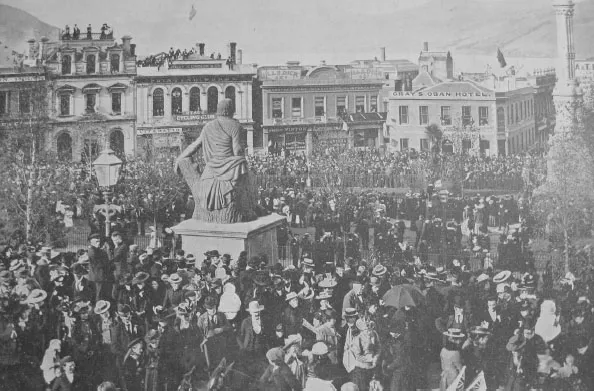
Press photographs captured the scale of the celebrations.19 Amid the sea of humanity in the Octagon, boys climbed light standards to secure a better vantage point. Others occupied the second storey of Gray’s Oban Hotel or peered from the windows of Mills, Dick and Co. Printery above the Edinburgh Dining Rooms. Still more packed the windows of the Otago Cycling Club, while men viewing the spectacle from the roof of Jolly, Connor and Company Printing Works dangled their legs precariously over the edge.
A crowd throngs the Dunedin Octagon in May 1900 following receipt of news of t...