THE HOMECOMING
As the bedraggled warrior crested the hill outside Mizpah, he could see the thin trail of smoke streaking down the sky toward his beloved home. They must be cooking dinner now, he thought. He had doubted that he would see this place again. Thankfully, the god to whom he had prayed had proven faithful to their bargain. Enemies had fallen by the warrior’s hand, and he had felt a strange strength coursing through him. It was the only explanation for how his band of ruffians had sacked those twenty towns. I guess some gods can be trusted, he thought; I must remember this one. The victory had been a sign that the warrior must keep his promise. This was the reason he was squinting at the trail of smoke that led down toward the open doorway of his house.
Who was that standing there? He knew before he asked the question. The asking was a weak attempt at denial—an effort to delay the images that flooded his imagination: the altar and the blood. Every father knows his child from a distance. There is something unmistakable in the gait and posture—a mark of Cain now terribly inverted.
Through tears, the warrior saw her racing toward him, dancing, ecstatic, her curls bouncing. She looked like her mother. In one hand she held a tambourine, and with the other she girded up her garments so to speed her coming. She cried with joy as she embraced him. And he wished for all the world that he had died in battle.
Father Jephthah
It is an offense that Jephthah has the gall to appear alongside the likes of Abraham in faith’s “hall of fame” (Heb 11). But we cannot understand one man without the other. Jephthah is what happens if Abraham stops listening upon Moriah. He is Abraham with wires crossed. Jephthah is a cautionary tale of what happens when zealous devotion coincides with frightful theological ignorance.1 In our day, Jephthah is jihad. He is the faith healer who turns down medicine for his sick child. He is the militant fringe of the religious Right (or Left). Or more likely, in an age of biblical illiteracy, Jephthah is the church at large.
Born (most likely) to a Hebrew father, Jephthah should have learned the Mosaic prohibitions against human sacrifice. But the period of judges was not a time of much inductive Bible study within Israel’s history. Not much Deuteronomy, we may guess, was recited around the table in Jephthah’s broken home, much less fastened to the doorposts. His mother was a prostitute. His brothers drove him out to live among the pagans. His father did not stop them. How much, then, could Jephthah have known of Yahweh living with the bandits in the land of Tob? He returned, years later, because his kin needed “muscle” to defeat their enemies. And after haggling, they were willing to make him leader in exchange for his unique skill set (Judg 11:8-10). Jephthah had a knack for bargaining. And like some other sons of prostitutes, he turned youthful scorn into a frightful male aggression. Such was Jephthah’s “gift.”
But even tough guys say Hail Marys in a pinch. So when Jephthah sought the help of Israel’s God before his mercenary fighting, he did it in the only way he knew: he bargained like a pagan. He haggled with God just as he had with his brothers:
If you give the Ammonites into my hands, whatever comes out of the door of my house to meet me when I return in triumph from the Ammonites will be the LORD’s, and I will sacrifice it as a burnt offering. (Judg 11:30-31)
Apparently, he never expected that his little girl would be the one to greet him. What was he hoping for? A slave? A goat? Regardless, if there was one thing he had learned in Tobite Sunday school, it was that warrior-gods hate nothing more than those who renege on promises. Jephthah was a man of his word. And besides, if he broke his vow, would his brothers still keep theirs? It would set a precedent. And Jephthah did not have that much faith. So the book of Judges ends his tale with a sad postscript: “He did to her as he had vowed. And she was a virgin” (Judg 11:39).
Between Mizpah and Moriah
What does Jephthah have to do with Abraham? According to the Torah, what Jephthah did in slaughtering his child was “detestable” (e.g., Deut 12:31; 18:9-10). It was abominable and ignorant. He is a cautionary tale. Yet Hebrews lists him as a man of faith.2 After all, Abraham too was willing to sacrifice his child out of obedience to God. So how exactly are the two men different?
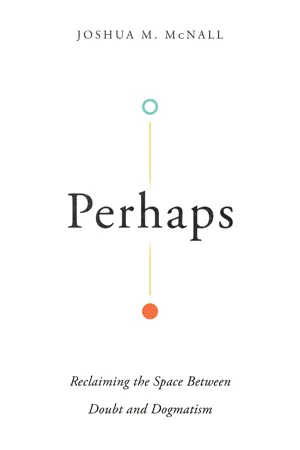
The most obvious answer is that God actually commanded Abraham to kill his child while Jephthah only thought this action was required. The trouble for Jephthah was that he had misunderstood Yahweh; the trouble for Abraham was that he understood perfectly. Yet, a further difference is that Abraham had more time and opportunity to get to know this God of promises and high demands. While neither man had (much) access to the Torah to provide an anti-Molech memory verse, Abraham had experienced a longer history with Yahweh. And Abraham remained open to a last-minute course correction.3 Alongside these differences, however, I will now move to a point that is often missed: Abraham had learned how to say perhaps.
In Genesis 22, we are presented with the Aqedah—a Hebrew word that refers to the “binding” of Isaac upon an altar of burnt offering. Like the later narrative of Jephthah, this tale seems ghastly to modern readers. What kind of deity demands a child’s murder, regardless of an eventual reprieve? The late atheist Christopher Hitchens implied (perhaps rightly) that if the story were to happen today, we would chalk it up to schizophrenia, or worse: “All three monotheisms . . . praise Abraham for being willing to hear voices and then to take his son Isaac for a long and gloomy walk. And then the caprice by which his murderous hand is finally stayed is written down as divine mercy.”4
Despite the force of Hitchens’s claim, there are certain points that he gets wrong. In the Bible, they are not voices heard by Abraham but a voice (singular)—and its accent belongs to the same promise-keeping, womb-reviving God that Abraham had come to know as powerful and trustworthy. Abraham, we might say, had a history with this voice. So when the angel halts the hand of sacrifice, the point is not capriciousness (“See how nice I am, old man!? I didn’t make you do it!”) but a “severe mercy.”5 The test is God wringing the incipient idolatry from Abraham’s heart for the good of future generations. Despite its horror, the trial is teaching him to value the Giver over even his most precious gifts.6
But these points hardly trim the Aqedah of its rough edges. The tale resists our taming—and especially when we place ourselves in Abraham’s position. Generations of readers have wondered what went through the old man’s mind as he ascended Mount Moriah. In most cases, the attempts to psychologize such ancient persons yield dubious results.7 “The past is a foreign country,” says the adage. “They do things differently there.”
Genesis 22 is also rather sparse for conversation. There are clues to Abraham’s thoughts, but only that. With Moriah looming in the distance, the old man tells the servants that both he and the boy will return after having worshiped (Gen 22:5). And in response to Isaac’s question regarding their lack of animal accompaniment, Abraham assures him, “God himself will provide the lamb for the burnt offering” (Gen 22:8). Are these words polite deceptions or prophetic hope? Either way, it is Isaac wriggling on the altar just one verse later. What did Abraham expect to happen next?
Only the book of Hebrews tells us. In Hebrews 11, just prior to the awkward nod to Jephthah, the inspired author gives a window into Abraham’s inner world. “By faith,” it says, he was willing to kill Isaac. Yet he did not do so in despair. According to the text, the patriarch held fast to Yahweh’s prior promise that “it is through Isaac that your offspring will be reckoned” (Heb 11:18; cf. Gen 21:12). How could this be? The unnamed author offers this interpretation:
By faith . . . Abraham reckoned that God could even raise the dead, and so in a manner of speaking he did receive Isaac back from death. (Heb 11:17, 19, emphasis added)8
In the NIV translation, Abraham “reasoned” (logisamenos) to this bold conclusion. Yet in other English versions, the word is less certain and cerebral. We are told that he merely “considered” that the Lord was able to raise Isaac from the dead (ESV, NASB, and NRSV). Regardless of translation, my claim is that Abraham’s logisamenos—his ability to “consider” a strange possibility—serves as a model for what this book proposes. The logisamenos points to his ability to say perhaps.