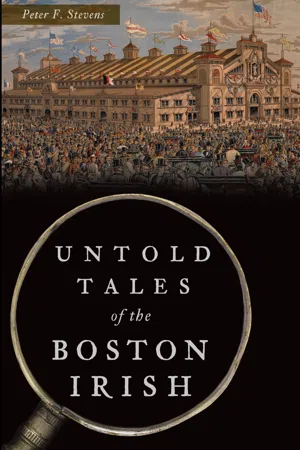
- 192 pages
- English
- ePUB (mobile friendly)
- Available on iOS & Android
eBook - ePub
Untold Tales of the Boston Irish
About this book
When it comes to the Boston Irish, names such as Bulger and Curley have long shaped the local turf. But most people are probably unaware of some of the most amazing and forgotten Irish men and women who helped mold this city. There was Patrick Gilmore, America's first famed bandleader. Louis Sullivan was the "Father of the Skyscraper." Other colorful characters included Patsy Donovan, the man who discovered Babe Ruth, and Ann "Goody" Glover, whose horrifying ordeal launched the Salem Witch Trials. Although each played a noteworthy role in his or her era, all have been unjustly forgotten. Local author Peter Stevens uncovers the missing pieces of the Irish experience in Boston.
Information
Topic
StoriaPart I
JUSTICE DENIED
1
“THOU SHALT NOT SUFFER A WITCH TO LIVE”
Ann “Goody” Glover
At Our Lady of Victories Church (currently closed), perched on Isabella Street in Boston, is a plaque testifying to a dark day in the annals of the Boston Irish. The memorial marks the saga of Ann “Goody” Glover, an elderly Irishwoman who was hanged on November 16, 1688, as a witch near the site of the future Catholic shrine. As the tablet notes, she is considered by many to be a Catholic martyr in Massachusetts, executed because of the Puritans’ fear and hatred of “Papists.” The Irishwoman’s trial and death served as a chilling portent of the Salem witch trials some four years later.
The traditional yet murky details of Goody Glover’s story are as follows.
On November 16, 1688, jeers erupted from hundreds of throats. An ox-drawn cart flanked by sentries creaked to a stop in the shadow of a huge elm tree. A gaunt woman, staggering from the weight of the chains that tore her wrists and ankles, stepped from the cart. Her guards shoved her beneath a noose dangling from the elm.
A jowly man clad in a long black robe and a high, wide-brimmed hat held up his hand for silence. The throng’s din ebbed, no right-minded Puritan wishing to suffer the ire of Superior Court Clerk Dr. Benjamin Bullivant.
A few feet from the tree, a chained woman clutching a cat sobbed. Her mother, Ann “Goody” Glover, was about to die at the end of a rope. Goody Glover’s only crimes were her Catholicism and her Irish brogue. In Puritan Boston, they were reason enough to hang.
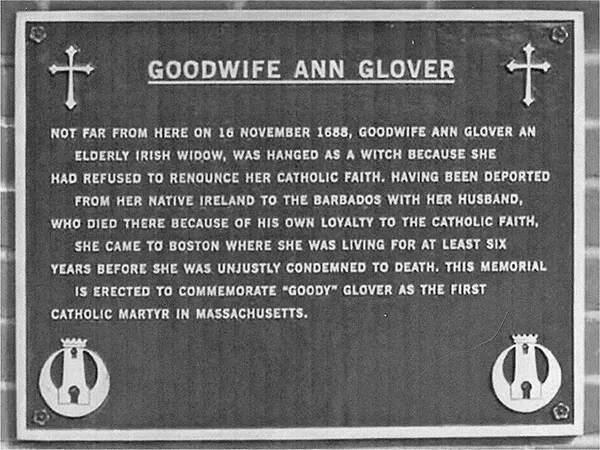
Memorial plaque at Our Lady of Victories Church, in Boston, for Ann “Goody” Glover, tried, convicted and hanged for witchcraft in 1688. Photo by Peter F. Stevens.
Goody Glover and her daughter, Mary, had arrived in the Massachusetts Bay Colony as refugees of the religious wars ravaging Ireland. In court, Ann Glover said that she and her husband had been sent from Ireland as slaves to Barbados during Oliver Cromwell’s brutal campaign in Ireland. Glover stated that while in Barbados her husband was “scored [whipped] to death, and did not give up his religion, which same I hold to.”
In Boston, as a “bondswoman,” or indentured servant, Mary Glover, Ann’s daughter, toiled as a washerwoman for “a sober and pious Puritan mason, John Goodwin.” One of Goodwin’s children, thirteen-year-old Martha, accused the Irish servant of stealing linen sheets. Neither of the Glovers reportedly spoke much English, but Ann Glover confronted Martha Goodwin, allegedly unleashing a stream of “barbarous Irish” and “very bad language” in defense of her daughter.
Shortly afterward, John Goodwin rushed to Cotton Mather, the Puritan cleric and leader, and charged that Goody Glover, “a scandalous Irish Papist,” had driven the Goodwin children into “odd fits.” Mather immediately suspected Glover of witchcraft.
Constables seized the Irishwoman from her rude cottage, clapped her in irons and flung her into a squalid cell in Boston Gaol, whose three-foot-thick brick and stone walls rose on Prison Lane.
From July to early November 1688, she languished on the fetid straw atop her cell’s floor. Two Puritans—Robert Calef and Rebecca Nurse—brought her food and clothing when the jailers allowed. Calef later wrote a scathing attack against Cotton Mather for his persecution of Glover and other alleged witches. Rebecca Nurse, convicted of witchcraft, would hang in Salem in 1692.
Goody Glover’s trial began in the second week of November 1688 and degenerated into one of the cruelest farces in American legal history. Forced to defend herself in Gaelic, which none of her accusers understood but which several court-appointed officials “translated,” she faced a range of charges: flying in and out of chimneys, striking children deaf and dumb, casting “hellish spells” and practicing “black magic.” One of the most serious charges was “Satanic idolatry”—she had been seen kneeling in front of a tiny statue of the Blessed Virgin. In a chilling prelude to the Salem witch trials, Glover’s chief accusers were children.
The ministers, officials and “skilled physicians” denounced Glover as “a vile Papist hag.” A judge wrote: “Upon her trial, the Papist did in Irish confess to herself guilt. The Papist defended herself unskillfully in her foreign gibberish and admitted her witchcraft.”
When asked whether she was a Papist and when shown “an idol [statue of a saint] that was diabolic,” she said, “I die a Catholic.” The Puritans would contend that she admitted to tormenting the children by striking small rag dolls that were produced during the trial. When she took up one of these dolls in court, one of the afflicted children was seized with fits. In reality, though, Glover failed to comprehend the questions hurled at her.
Her accusers also claimed that the night after her trial, Glover’s jailers heard her “explaining to the devil that she had confessed everything because he had deserted her.” Upon examination by court-appointed physicians, Glover acknowledged her Roman Catholicism and recited the Lord’s Prayer “very readily.” She was sentenced to “be swung off into eternity.”
According to one onlooker, “a great concourse of people came to see the Papist hag hang on the morn of November 16 [1688].…The hag’s cat, the witch’s familiar, was present, fearsome to some. They would to destroy the cat, but Mr. Calef would not allow it.” The final chapter of Goody Glover’s harsh, tormented life unfolded, her fate terrible testimony to the simmering paranoia that would soon engulf New England and would begin the infamous Salem witch trials of the 1690s.
Her noose affixed around her neck, Ann Glover predicted that her death would not erase the children’s “fits,” as she had cast no spells. Moments later, the noose pulled tight.
The “Great Elm” no longer stands to remind passersby of the torturous path of the Irish in Boston and the sad fate of Ann “Goody” Glover.
Glover’s trial and execution are incontrovertible historical facts. Scholar Liam Hogan, however, contends that she was not an “Irish slave,” that she was never in Barbados and that her Catholicism was not the driving factor of her fate in Puritan Boston. His research into the foggy (at best) historical record does raise debate on the first two points. Still, his belief that it was solely Puritan terror about witchcraft and not at all about Glover’s religion that sealed her death belies one incontrovertible fact: Cotton Mather’s Boston was a hostile spot for Irish Catholics.
2
THE ST. PATRICK’S DAY MURDERS OF 1845
Homicide on a Holy Day
On the Hanover, Massachusetts, Historical Society’s July 2000 calendar, an old photo showing a house and shed and bearing the inscription “Three Irishmen Shot Here by Seth Perry in 1845” was featured. What had started as a St. Patrick’s Day celebration for three Irishmen working for the Old Colony Railroad to build a track from Boston to Plymouth ended in an explosion of violence.
In the early afternoon of March 17, 1845, the trio of Irish laborers—James Stapleton, Patrick Stapleton and Pierce Dowlan (Dolan)—strode with other workers from a jobsite near Hanson to a “noted groggery” in Hanover. The Irishmen’s plan was to celebrate their “old sod’s” patron saint on his holy day.
Neighbors loathed the “shanty,” run by fifty-two-year-old local Seth Perry; he had been arrested and jailed several times for serving liquor without a license. After a few rounds, Patrick Stapleton and Pierce Dowlan started to argue with a man named Enos Bates, Perry’s cousin. Words fueled by liquor escalated to blows between Stapleton and Bates, and soon, the brawl ended up outside the shanty. Suddenly, a musket pealed. Stapleton toppled dead to the ground, Seth Perry standing nearby with the smoking weapon—and reloading.
Most of the Irish railroad workers scattered in every direction, but not James Stapleton and Dowlan. James lunged at Perry. For a second time, the musket belched flame and smoke. The ball tore into James Stapleton’s chest and killed him instantly. As Dowlan started to run, Perry, with another musket close by, picked it up, leveled it and fired. Dowlan must have turned. The round slammed into his face, shattering his jaw. He would survive the grievous wound.
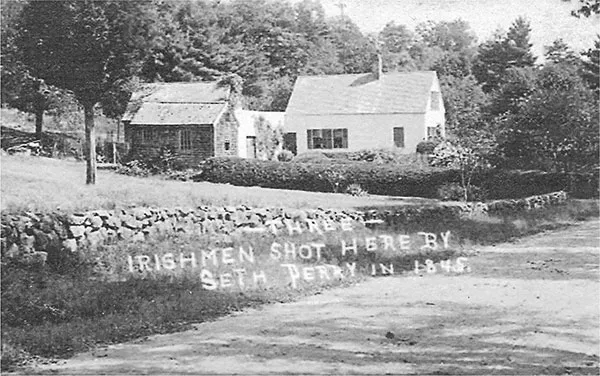
Site where two Irish laborers were murdered by Perry on St. Patrick’s Day in 1845. Courtesy of Hanover, Massachusetts Historical Society.
Later that night, a mob of temperance zealots likely motivated by their hatred of alcohol rather than any sympathy for the two dead Irishmen and their wounded companion destroyed the shanty and were about to burn down Perry’s house when constables stopped them. Because St. Mary’s, in Quincy, Massachusetts, was the sole Catholic church between Boston and Hanover at the time, the brothers Stapleton were buried in unmarked paupers’ graves in the church’s graveyard.
Seth Perry was indicted by a Plymouth County grand jury on April 14, 1845, charged with two counts of murder and one count of assault with intent to kill. He languished in a cell without bail as both the “prosecution and defense petitioned the court to try Perry for the murders of Patrick and James Stapleton together, but the court denied their request, and ordered that Perry be tried first for the murder of Patrick.”
Few Irish immigrants believed Perry would be convicted. The disdain that many New Englanders heaped on the “ragged Irish” of the era was rife with brutal stereotypes of “drunken Paddies.” Nativist newspapers and magazines were clotted with other ethnic caricatures of “Paddy and Bridget.”
On June 17, 1845, Perry stood trial in front of a twelve-man jury. It was truly a jury of his peers, as not one Irishman was among them. The verdict came two days later. Perry was found guilty of manslaughter only in the death of Patrick Stapleton. Historian John Gallagher notes: “The district attorney dismissed the charge of murder in the death of James Stapleton when Perry agreed to plead guilty to manslaughter. The prosecutor chose not to pursue the charge of assault with intent to murder Pierce Dowlan.”
If Perry had cut down two “native New Englanders” and wounded a third, he might well have been hanged. Still, given the unbridled contempt so many Yankees harbored toward the Irish, the verdict must have surprised many locals. As Mr. Gallagher noted in his letter to this author, Thomas O’Connor, in The Boston Irish: A Political History, writes that the Irish of the era were viewed by Yankee Protestants as “little more than ‘wild bison’ ready to leap over the fences that usually restrained the ‘civilized domestic cattle.’”
“Wild bison” notwithstanding, Perry’s sentence was ten years for killing Patrick Stapleton and three years for the murder of James Stapleton. From June 28, 1845, until his release in 1858, Perry was incarcerated in the grim stone and brick Charlestown State Prison. He went back to Hanover, where he died on November 25, 1874. No one knows the exact spot where he was buried, the murderer sharing the same fate in death as the two Irishmen he had slain.
At 1359 Broadway in Hanover, the house that Seth Perry’s groggery flanked remains. The combination of brogues and too much St. Patrick’s Day revelry ignited something murderous in Seth Perry, something so dark that even his Yankee neighbors could not ignore one savage fact: he had gunned down two men and wounded a third. Irish though those men were, and even though Yankee prosecutors and a Yankee jury could not bring themselves to convict Perry of outright murder, they held him to some account, even in a day of antipathy toward the Irish.
HISTORIAN AND RETIRED BOSTON Police superintendent John Gallagher, the author of Rum, A Tailor’s Goose and a Soap Box: Three Murderous Affairs in the History of Hanover, Massachusetts, provided several key details.
3
“HIS DUTY WAS DONE TO THE LAST”
Officer John T. Lynch
For God’s sake, keep him away and don’t let him shoot me again!” shouted Patrolman John T. Lynch at Officer John P. Doyle. Doyle had rushed across icy, snow-cloaked Arch Street to the corner of Summer and Kingston Streets as three shots pealed through the chill evening air of January 16, 1908.
Lynch’s muscular, six-foot, two-inch frame pinned another man to the ground. In the man’s right hand was a smoking. 38-caliber revolver. “I saw Lynch on top of a man, holding the hand that grasped the revolver, and turning it away from him,” Doyle later said to reporters.
A crowd had begun to gather.
As Lynch rolled off the gunman, Doyle pounced on him and pushed the revolver farther away from him. Twenty-three-year-old John Lynch lay crumpled and writhing in the snow from a bullet that, according to the later police report, “had entered the right side of the officer above the liver and entered into the vitals.” Despite the grievous wound, Lynch had refused to let the shooter escape.
While grappling to control the thrashing suspect, Doyle shouted at onlookers to summon an ambulance and a police wagon from the Court Street Station. All he could do until help arrived was to ur...
Table of contents
- Front Cover
- Title Page
- Copyright
- Contents
- Acknowledgements
- Part I: Justice Denied
- Part II: Of Brush, Chisel and Baton
- Part III: Around the Diamond and the Track
- Part IV: Boyos, a Ballot Buster and a Breakfast TradiDItIOn Shattered
- Part V: Tales of the Sea
- Part VI: Church and State
- Part VII: A Paper, a Poetess, a Playboy and a Pulitzer
- Part VIII: Rebels, Patriots and Reprobates
- Part IX: Changing the Landscape
- Part X: Captains of Commerce
- Bibliography
- About the Author
Trusted by 375,005 students
Access to over 1.5 million titles for a fair monthly price.
Study more efficiently using our study tools.
Frequently asked questions
Yes, you can cancel anytime from the Subscription tab in your account settings on the Perlego website. Your subscription will stay active until the end of your current billing period. Learn how to cancel your subscription
No, books cannot be downloaded as external files, such as PDFs, for use outside of Perlego. However, you can download books within the Perlego app for offline reading on mobile or tablet. Learn how to download books offline
Perlego offers two plans: Essential and Complete
- Essential is ideal for learners and professionals who enjoy exploring a wide range of subjects. Access the Essential Library with 800,000+ trusted titles and best-sellers across business, personal growth, and the humanities. Includes unlimited reading time and Standard Read Aloud voice.
- Complete: Perfect for advanced learners and researchers needing full, unrestricted access. Unlock 1.5M+ books across hundreds of subjects, including academic and specialized titles. The Complete Plan also includes advanced features like Premium Read Aloud and Research Assistant.
We are an online textbook subscription service, where you can get access to an entire online library for less than the price of a single book per month. With over 1.5 million books across 990+ topics, we’ve got you covered! Learn about our mission
Look out for the read-aloud symbol on your next book to see if you can listen to it. The read-aloud tool reads text aloud for you, highlighting the text as it is being read. You can pause it, speed it up and slow it down. Learn more about Read Aloud
Yes! You can use the Perlego app on both iOS and Android devices to read anytime, anywhere — even offline. Perfect for commutes or when you’re on the go.
Please note we cannot support devices running on iOS 13 and Android 7 or earlier. Learn more about using the app
Please note we cannot support devices running on iOS 13 and Android 7 or earlier. Learn more about using the app
Yes, you can access Untold Tales of the Boston Irish by Peter F. Stevens in PDF and/or ePUB format, as well as other popular books in Storia & Biografie nell'ambito delle scienze sociali. We have over 1.5 million books available in our catalogue for you to explore.