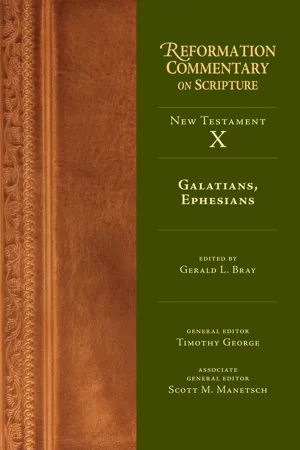
The gospel of justification by faith alone was discovered afresh by the Reformers in the epistolary turrets of the New Testament: the letters to the Galatians and the Ephesians. At the epicenter of the exegetical revolution that rocked the Reformation era was Paul's letter to the Galatians. There Luther, Calvin, Bullinger and scores of others perceived the true gospel of Paul enlightening a situation parallel to their own times--the encroachment of false teachers and apostates upon the true teaching of salvation by grace through faith.In Ephesians, the Reformers gravitated to what they understood to be the summit of Paul's vision of salvation in Christ. Finding its source, beyond time, in the electing love of God, the Reformers disseminated the letter?s message of temporal hope for Christians living under the duress of persecution.For the Reformers, these epistles were living, capsule versions of Paul's letter to the Romans, briefs on the theological vision of the celebrated apostle. Probed and expounded in the commentaries and sermons found in this volume, these letters became the very breath in the lungs of the Reformation movements.The range of comment on Galatians and Ephesians here spans Latin, German, French, Dutch and English authors from a variety of streams within the Protestant movement. Especially helpful in this volume is Gerald Bray's editorial presentation of the development of tensions among the Reformers.The epistles of Galatians and Ephesians open up a treasure house of ancient wisdom, allowing these faithful Reformation witnesses to speak with eloquence and intellectual acumen to the church today.
- 446 pages
- English
- ePUB (mobile friendly)
- Available on iOS & Android
eBook - ePub
About this book
Information
Topic
Theology & ReligionSubtopic
Biblical CommentaryGALATIANS
PREFACE
OVERVIEW: Paul wrote this letter to churches in Galatia that he had founded but that had subsequently been led astray by false apostles who preached that Gentiles had to accept circumcision and the law of Moses as part of the gospel. Adding these requirements detracted from the work of Christ, who offers believers justification by faith in him, without regard to what they have done. The Galatians were a Celtic people distantly related to the Germans, which gives their situation a special interest for modern Germans, but more importantly, the danger of teaching that people must work to become righteous is ever- present and must be combated just as much today as it was by Paul.
THE FOOLISHNESS OF THE GALATIANS. DESIDERIUS ERASMUS: Although the Galatians were Greeks, they were originally descended from Frenchmen, and as Saint Jerome says, resembled them in their stupidity.1 . . . Saint Paul also in this present epistle reproves them by calling them anoetous, that is to say, witless or foolish. He adjusts his teaching to suit their capacities and reproves them more vehemently and sharply than he does in his other epistles . . . checking them rather than teaching them, to the intent that those who could not be brought to a better mind might at least be called home again by his authority and put right. In this epistle Paul is concerned about the same matter that he discusses everywhere else. He wants to call people from the bondage of Moses’ law to the grace of the gospel, which is also the subject of his epistle to the Romans, because both churches had fallen into the same error. PARAPHRASES.
THE GALATIANS MUST BE BROUGHT BACK TO THE GOSPEL. MARTIN LUTHER: Although the Galatians had been taught sound faith by the apostle, that is, to trust in Jesus Christ alone and not in their own righteousness or in that of the law, they were turned away from this by false apostles who taught them to put their trust in works of legalistic righteousness. They were easily deceived by those people, who used the name and reputation of the apostles falsely. . . . As Peter explained in Acts 15:7-11, the apostles had permitted these practices because they were harmless to those who put their trust in Jesus Christ for their salvation. To those who believe in Christ, external ceremonies are neither here nor there. Paul was so determined to bring the Galatians back to this understanding that he took no account of the rank of Peter or the other apostles. He even boasted with a kind of holy pride that he received nothing from them—on the contrary, they had approved of him. He made no concession to the opinion of other apostles because he saw that the truth of the gospel was being compromised, and he thought it far better that both he and the other apostles should lose their reputation than that the gospel should be made null and void. FIRST LECTURES ON GALATIANS.
THE TEACHING OF THE FALSE APOSTLES MUST BE DEFEATED. WILLIAM TYNDALE: As you read [in Acts 15], certain men came from Jerusalem to Antioch and vexed the disciples there, affirming that they could not be saved except they were circumcised. Even so after Paul had converted the Galatians and coupled them to Christ, to trust in him only for remission of sin and hope of grace and salvation, and was departed, there came false apostles to them (as to the Corinthians and to all places where Paul had preached) and that in the name of Peter, James and John, whom they called the apostles, and preached circumcision and the keeping of the law, to be saved by, and diminished Paul’s authority. To the confounding of those, Paul magnifies his office and apostleship in the two first chapters and makes himself equal to the high apostles, and he concludes that everyone must be justified without deserving, without works and without help of the law, but alone by Christ. And in the third and fourth, he proves the same with Scripture examples and similitudes and shows that the law is cause of more sin and brings the curse of God on us and justifies us not; but that justifying comes by grace promised us of God through the deserving of Christ, by whom (if we believe) we are justified without help of the works of the law. And in the fifth and sixth he exhorts unto the works of love that follow faith and justifying. So in all his epistle he observes this order. First he preaches the damnation of the law, then the justifying of faith and thirdly the works of love. For on that condition that we love and work is the mercy given us. NEW TESTAMENT PREFACE TO GALATIANS.
THERE ARE TWO KINDS OF RIGHTEOUSNESS. MARTIN LUTHER: I can hardly believe that when I delivered these lectures on Galatians I was as long-winded as this book shows I was. But I recognize that the thoughts set down here by the diligence of my coworkers are really mine and that most if not all of them were actually spoken by me. In my heart only one doctrine rules—faith in Christ. From it, through it and to it all my thinking about theology flows and returns day and night, yet I am aware that I have grasped no more than the first fruits and fragments of such infinite wisdom. My teaching is that there is a clear distinction between two kinds of righteousness, the active and the passive, so that morality must not be confused with faith, works must not take the place of grace and secular society must not prevail over religion. Both kinds of righteousness are necessary, but each of them has its limits. Christian righteousness applies to the new person and the righteousness of the law applies to the old person, who is born of flesh and blood. The old person bears an oppressive burden and cannot enjoy the freedom of the Spirit until he has put on the new person in Christ, but that does not happen fully in this life. . . . We must learn to distinguish these two types of righteousness so that we shall know how far we ought to obey the law. In a Christian the law should rule only over the flesh and not over the conscience. Give the law its due, but do not let it exceed its jurisdiction. SECOND LECTURES ON GALATIANS.
THE FALSE APOSTLES MIXED THE LAW WITH THE GOSPEL. HEINRICH BULLINGER: There was a particularly nasty type of person who wandered around the churches that the apostles had founded—the ancients called them Nazaraeans. They were originally a branch of the Pharisees and were essentially Jews, even if they called themselves Christians. Because they had not yet had the benefit of Christ’s grace, they mixed the law with the gospel and argued that nobody can be saved by Christ unless he is also circumcised and keeps the law of Moses. In ancient times this epistle of Paul’s enjoyed the highest authority and respect in all the churches, and it is not easy to convey just how great its value and usefulness is. To put it simply, the greatest mysteries of our faith are expounded in it, and with considerable skill. It is short, but even in that brevity you will find an amazing wealth if you examine it carefully. Paul speaks out in this epistle as he does nowhere else, but its very sharpness makes it more compelling than any of his other letters. COMMENTARY ON PAUL’S EPISTLES.
GOD IS THE GOD OF GENTILES AS WELL AS JEWS. ERASMUS SARCERIUS: This epistle to the Galatians is polemical in nature because in it Paul is upbraiding the Galatians for having so easily turned away from the true doctrine of the gospel and fallen into the works of the law, which they were preaching as necessary for justification. But when Paul starts teaching about true righteousness, which is found in Christ Jesus without regard to the law or to works, the tone changes and the epistle becomes more didactic in nature. In the first part of the epistle he calls the Galatians back from the error of justification by works into which they had fallen because of the teaching of false apostles who had visited them after his departure. In the second part he teaches what the difference is between the righteousness that comes from faith and the righteousness that comes from works. In the epistle to the Romans, Paul’s main argument is that God is the God not only of the Jews but also of the Gentiles. In order to prove this he brings in all kinds of considerations, and to make things as clear as possible he adopts the technique of starting with an explanation of righteousness by faith, to which the Gentiles have been called by grace. He then describes the righteousness that comes by the law, under which the Jews had struggled until Christ came teaching justification by faith, without reference to works. In this epistle, Paul does exactly the same thing. The false apostles had led the people astray by preaching circumcision and the works of the law, insisting that they were nec...
Table of contents
- Cover
- Title Page
- Contents
- Abbreviations
- General introduction
- A Guide to Using This Commentary
- Introduction to Galatians & Ephesians
- Commentary on Galatians
- Commentary on Ephesians
- Appendix - Early Anabaptist Use of Galatians and Ephesians
- Map of the Reformation
- Timeline of the Reformation
- Biographical Sketches of Reformation-Era Figures
- Bibliography
- Author Index
- Subject Index
- Scripture Index
- Notes
- Praise for the Reformation Commentary on Scripture
- About the Author
- More Titles from InterVarsity Press
- Copyright Page
Trusted by 375,005 students
Access to over 1.5 million titles for a fair monthly price.
Study more efficiently using our study tools.
Frequently asked questions
Yes, you can cancel anytime from the Subscription tab in your account settings on the Perlego website. Your subscription will stay active until the end of your current billing period. Learn how to cancel your subscription
No, books cannot be downloaded as external files, such as PDFs, for use outside of Perlego. However, you can download books within the Perlego app for offline reading on mobile or tablet. Learn how to download books offline
Perlego offers two plans: Essential and Complete
- Essential is ideal for learners and professionals who enjoy exploring a wide range of subjects. Access the Essential Library with 800,000+ trusted titles and best-sellers across business, personal growth, and the humanities. Includes unlimited reading time and Standard Read Aloud voice.
- Complete: Perfect for advanced learners and researchers needing full, unrestricted access. Unlock 1.5M+ books across hundreds of subjects, including academic and specialized titles. The Complete Plan also includes advanced features like Premium Read Aloud and Research Assistant.
We are an online textbook subscription service, where you can get access to an entire online library for less than the price of a single book per month. With over 1.5 million books across 990+ topics, we’ve got you covered! Learn about our mission
Look out for the read-aloud symbol on your next book to see if you can listen to it. The read-aloud tool reads text aloud for you, highlighting the text as it is being read. You can pause it, speed it up and slow it down. Learn more about Read Aloud
Yes! You can use the Perlego app on both iOS and Android devices to read anytime, anywhere — even offline. Perfect for commutes or when you’re on the go.
Please note we cannot support devices running on iOS 13 and Android 7 or earlier. Learn more about using the app
Please note we cannot support devices running on iOS 13 and Android 7 or earlier. Learn more about using the app
Yes, you can access Galatians, Ephesians by Gerald L. Bray, Gerald L. Bray,Gerald Bray in PDF and/or ePUB format, as well as other popular books in Theology & Religion & Biblical Commentary. We have over 1.5 million books available in our catalogue for you to explore.