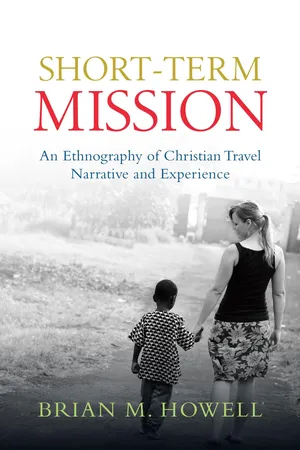
Over the past few decades, short-term mission trips have exploded in popularity. With easy access to affordable air travel, millions of American Christians have journeyed internationally for ministry, service and evangelism. Short-term trips are praised for involving many in global mission but also critiqued for their limitations.Despite the diversity of destinations, certain universal commonalities emerge in how mission trip participants describe their experiences: "My eyes were opened to the world's needs." "They ministered to us more than we ministered to them." "It changed my life."Anthropologist Brian Howell explores the narrative shape of short-term mission (STM). Drawing on the anthropology of tourism and pilgrimage, he shows how STM combines these elements with Christian purposes of mission to create its own distinct narrative. He provides a careful historical survey of the development of STM and then offers an in-depth ethnographic study of a particular mission trip to theDominican Republic. He explores how participants remember and interpret their experiences, and he unpacks the implications for how North American churches understand mission, grapple with poverty and relate to the larger global church.A groundbreaking book for all who want to understand how and why American Christians undertake short-term mission.
eBook - ePub
Short-Term Mission
An Ethnography of Christian Travel Narrative and Experience
- 256 pages
- English
- ePUB (mobile friendly)
- Available on iOS & Android
eBook - ePub
About this book
Information
Topic
Theology & ReligionSubtopic
Christian MinistryPart One
Introducing Narratives
1
“It Changed My Life”
Short-Term Mission and Christian Narratives of Travel

My first exposure to short-term mission came through my participation in such a trip as a high school junior in 1986. Our church had recently purchased a comfortable, fifteen-passenger van, and my youth leader and her husband were anxious to put it to work. After a busy year of fund-raising, our Methodist youth group set out to drive from our town in Washington State to the California-Mexico border town of San Ysidro, where we would work with a Christian children’s ministry called Los Niños.
We stopped at Disneyland and Torrey Pines State Beach on our way down, bonding through youthful hijinks and close proximity. I can’t recall that we had much in the way of preparation as to the cultural and historical context of our destination, a theological rationale for the trip or even a framework through which to understand our travels as part of our faith. Perhaps my former youth group leader would disagree, and we were offered more in the way of preparation than sank into my high school mind. What I can remember is that as a sixteen-year-old, the trip posed some challenges for me.
I clearly recall an evening when I joined a group of North American missionaries and the Mexican teen residents of a Catholic boys’ home on an overnight camping trip to the beach somewhere between Ensenada and Tijuana. For much of the trip, I hung around with the other teenage boys, strolling up and down the beach. I spoke virtually no Spanish. Our “conversation” consisted of greetings and vague references to chicas. Eventually we ended up sitting with some bilingual chicas who were on a four-hour shore visit from their Los Angeles-based cruise ship. As a good Methodist boy from a small town in rural Washington, watching my Mexican compatriots interact with the girls, displaying their confident sexuality and vastly more mature self-assurance, I was intimidated and intrigued, but mostly confused. What in the world was I, a bumpkin from Walla Walla, Washington, doing on a “mission” to these guys?
Later in that trip, I had some time to talk with one of the adult chaperones, a man who was spending a year in ministry prior to entering the Catholic priesthood. A twenty-something Asian American who had grown up in the United States, he seemed to be someone who might provide some context, perspective or purpose to my trip. From my vantage point, I could not see what good I was doing, unable to communicate with the Mexican teens, feeling utterly disconnected from their experiences, lost in the midst of cultural, social and even spiritual dislocation. I have vague memories of him encouraging me to consider my own growth or to learn from the people around me. I doubt he answered all my questions, and I was likely unable to understand everything he was saying, but I recall it made me feel better at the time.
Approximately one year later, I did find a way to articulate at least part of the experience. I attached a photograph of me giving a piggyback ride to an adorable five-year-old Mexican boy, taken during a morning spent at a different children’s home in Tijuana, to an application to Vassar College with a description of how meaningful the whole experience had been to me. For the purpose of self-representation, I assimilated my time with the littlest Mexicans into a narrative of service, personal growth and Christian virtue. The confusing, even disturbing, experience with my vastly more experienced and sophisticated peers on the Mexican beach faded into a less salient part of the adventure.
Today, such travels have become regular features in college applications, particularly for Christian colleges.[1] Unlike me, with my halting efforts to find a narrative for my experience, the Christian college students I have taught for the past ten years seem ready to tell the story of their travel and articulate its effects in their lives. They frame their trips as significant—even life-altering—experiences, largely in regard to personal spiritual and emotional growth, and often related through one or two significant relationships, divine revelations or meaningful encounters.
In these retellings, there are often moments of epiphany, if not conversion, in which realizations of unity across cultures, gratitude for a relatively affluent life and self-discovery punctuate a week or ten days of manual labor, sacrifice and service in an unfamiliar cultural context. Those who traveled in middle or high school came to my college classes with well-developed narratives of growth and change, although not without misgivings. They seemed to have received clearer and far more involved preparation and structure for their trips than I ever did.
In particular, as I have interacted with these students over the years, I have been struck by how regularized the language used to describe these experiences has become. The question I began to ask myself was how the narratives of STM had come to take up such a predictable and seemingly powerful form in contemporary Christianity. How was it that students traveling to such diverse places as the Czech Republic, Mexico, Brazil and Kenya all returned with such similar experiences? What was the relationship between these narratives and the experiences themselves? Were students responding to the reality of their encounters, or were the narratives shaping their memories toward a common version of STM? It is toward answering these questions that I have undertaken this study.
Why Study Short-Term Mission?
For those unfamiliar with STM, it can most simply be described as short travel experiences for Christian purposes such as charity, service or evangelism, although such a definition probably obscures as much as it clarifies (see chapter two for a definitional understanding of STM, including a brief discussion of the distinction between mission and missions). At least within evangelical Christian circles, short-term missions have come to encompass everything from groups of high school students presenting the gospel through mime on the streets of Rome to major construction projects in the aftermath of the Haitian earthquake undertaken by teams of engineers and contractors.
But given recent statistics on the millions of U.S. Americans who have participated in STM travels, as well as the millions more who are exposed by encountering these teams in their own travels or hearing about their trips, I suspect that many of those picking up this book already have a mental image of STM.[2] My goal in this study, like much of anthropology, is to create some ethnographic distance for those who have been close to this phenomenon as participants, supporters or members of communities engaging in such travel, while bringing those at a distance—anthropologists, sociologists or other with little personal connection to the phenomenon—into the cultural world of STM. To do this, I focus in particular on the language—the narratives—of travel that STM participants create and use in making sense of the STM travel experience.
The stories I heard from individuals were quite diverse in many ways; some had powerfully transformative experiences, some had disappointments, some returned critical of what they did, and others were deeply in love with (or deeply disgusted by) the places and people they had encountered. But the similarities of phrases, expectations, disappointments or emotions were striking. From vastly different experiences, students were talking about their experiences within a common narrative framework of STM that helped them to think about these diverse experiences as a single sort of thing, a type of travel they could all understand.
One definition of culture I have always appreciated is Anthony F. C. Wallace’s (1970), in which he rejected the idea of culture as the reproduction of uniformity and instead considered it “the organization of diversity.” It seemed that the evangelicals among whom I lived had found a guiding narrative—a metanarrative—by which they could organize the diversity of their own motives, experiences and interests. My questions were what that organizing narrative was, where it came from and how it became so influential among those traveling.[3]
To answer my questions, I needed to see how this overarching narrative was produced, consumed and experienced throughout an STM experience. I developed an ethnographic research project to explore the dynamics of narrative and experience at work. As I studied the narratives and experiences of STM travelers firsthand and through presentations in print and PowerPoint, I found a common understandings of what the trip was, or was supposed to be.
Most called these trips “life-changing” and “eye-opening,” radically transforming the ways the travelers “saw the world.” For many it was the first time “really seeing” for themselves the conditions of poverty and inequality in the world, evoking deep emotions, including sorrow, anger and compassion, in many of those who traveled. Narratives of connection and relationship—particularly with other Christians—were powerful positive experiences in which North American Christians, some of whom had never been outside the United States, “discovered” that “we’re all the same” and “we are one in Christ,” despite linguistic, cultural and economic differences.
In many ways, STM narratives resonated with, or reinforced, central theological commitments of Christian unity and the importance of service or sacrifice. The disappointments people expressed were often with their inability to see or experience these very things. I recall one of my students telling me that in her first STM trip, in which her group of high school youth traveled to Mexico, she felt as if the team was not needed. She told me she regretted the money and effort spent on the trip, because she felt the time serving did not make much of a difference. She contrasted this to a later trip she took to Africa (she did not name the country), in which she felt that the local people valued the presence of the team and that she was able to make “a real difference.”
As I have spoken with people, particularly other Christians, about these narratives, I have found a great deal of familiarity with these themes, even among those who have not gone on STM trips themselves. Many can quote particular common phrases, almost verbatim, from testimonies I have heard in presentations and interviews I have conducted. These clichés are not simply familiar ways of expressing common experiences, however; they are culturally particular ways of framing those experiences. Anthropologists studying everything from race (Hill 2008), to gender (Schiffrin 1996), to tourism (E. M. Bruner 2005), to nationalism (Mattingly et al. 2002) have pointed out how familiar cultural narratives (or discourses) not only express experience but also shape it. Many setting out on their first STM trip already carry an arsenal of narrative structures through which they can interpret their trip.
This book is the product of my research, which draws together narratives from public presentations such as chapels and worship services, personal conversations and a two-year ethnographic experience with a particular STM team at a nondenominational congregation I refer to as Central Wheaton Church, or CWC. This 1,500-plus-member church has made STM trips a regular part of its missions program for more than twenty-five years.[4] STM travels, like other forms of travel, are cultural moments created through historical processes and institutions. Although it shares aspects of tourism and pilgrimage, STM can’t be reduced to another version of either of these. Guided by theological commitments and embedded in a wider social context, STM is a type of travel unto itself in which particular guiding narratives shape the experiences of participants.
Although my study draws on the experiences of an evangelical congregation, STM is not exclusively an evangelical phenomenon. Orthodox, Catholic and mainline Christians, as well as Jews, Unitarian Universalists and other religious groups have expressions of short-term mission, often looking very similar to the evangelical versions described here (see Hefferan, Adkins and Occhipinti 2009; Wuthnow 2009; McAdoo and Principe 2010). Nancy Ammerman (2005, p. 143) has noted that virtually every religious group in the United States—conservative Protestants, Orthodox, Catholic, Seventh-Day Adventist, mainline Protestants, LDS, Jehovah’s Witness, Jewish congregations—have increased the number of “direct connections” with missionaries through short-term trips. Similarly, in his comprehensive study of the ways religious congregations in the United States have engaged globalization, Robert Wuthnow (2009, p. 169) notes that while “evangelical churches are the most likely to sponsor mission trips . . . nearly half of mainline Protestants say their congregations do as well, compared with one-third of Catholics and members of historically black denominations.”[5] No doubt, the practices and discourses of STM reflect the different theological and institutional contexts of these groups. Even among conservative Protestants and evangelicals, different congregations have idiosyncratic means of talking about these sorts of travels. What I believe is generalizable from the case of CWC is the process of narrative formation that occurs through the institutional and cultural practices that surround STM travels. Only when we see the cultural dynamics of these trips can we think about what, if anything, we might do in changing or reforming STM experiences.
The question of changing these trips in focus or practice is controversial, of course. For many who participate in these travels, significant change may seem unnecessary. Yet even some of the most ardent proponents of STM have written of the need for care and self-reflection (Morgan and Easterling 2008; Harris 2002). My purpose here is to provide the theoretical framework for understanding the ways we come to frame these trips culturally; my hope is that this will aid those who want these trips to accomplish the highest ideals of social and spiritual transformation, often said to be the trips’ reason for existing (e.g., Anthony 1994; Peterson, Aeschliman and Sneed 2003).
In the case at hand, I demonstrate how a narrative of mission, emerging within the specific context of a congregation, reflects a history and social context, while providing the means for travelers to make sense of their experiences. At the same time, while this narrative provides a means to understanding, it also makes some sorts of understanding more difficult. I argue that in the case of this group, a personalistic missionary narrative serves a positive function to link these travels to a theological and spiritual understanding that the travelers and their supporters recognize and affirm, while obscuring aspects of the very things many of my team members wanted to understand: poverty, inequality and cultural difference.
By framing the encounter as primarily interpersonal, a service to “the poor,” as well as having a theological motive of “sharing the gospel,” the guiding narratives through which our team experienced these travels made it more difficult to see the structural, historical and cultural forces at work. As I explain in chapter two, narratives generally play a central role in Christian experiences of faith and life, but scholars have not always attended to the social life of these narratives—how they are created or recreated in the practices of faith.[6] For STM travelers, the narrative has cultural resonance that is both pragmatic and inspirational, enabling them to connect their trips and identity to a larger and longer theological narrative that is powerful and meaningful, though not always in ways that travelers and organizers seek.
Naming the experience of STM as a product of narrative does not mean I take these trips as only a product of narrative with no reality outside language.[7] In exploring the creation, reproduction and use of narrative in experience, though, I ask how these narratives reflect cultural context, practical action, theological commitments and history: how do they work in tandem with the experiences in the trip itself to shape the experience and rearticulation of the travel experience? Like all discourses, this language and practice is contested at many points, but the stories STM travelers tell of faith and mission are not simply reflections of an unmediated encounter in the “mission field,” springing up from the countryside of Bermuda, slums in Mexico, megacities in China or chapels in Ghana. STM travels are cultural events embedded in historic, linguistic and institutional contexts through which we come to anticipate and, in some ways, construct our travel experiences before anyone gets on a plane.
Short-Term Mission as a Scholarly Subject
Although those U.S. Americans who regularly participate in a Christian community of some sort are likely familiar with the concept and practice of STM, nonreligious people, including the majority of my fellow anthropologists, may be less aware of the phenomenon. As frequent travelers, many anthropologists have seen groups in the airport wearing matching T-shirts, preparing to board an international flight. They may have encountered a team surrounded by bags of medical supplies, or building materials being loaded onto buses in a Latin American capital. Even those who do not travel frequently or have not encountered these groups personally may have seen reports of the phenomenon in the media.[8] Major news outlets, such as the New York Times and the Wall Street Journal, have published articles about STM, including stories about Southern California megachurch pastor Rick Warren’s plans for thousands of short-term volunteers to focus their benevolence on Rwanda in an effort to lift the nation out of poverty and expand the reach of Christianity (Kristof 2002). Partly depending on the perspective of the reader, these sorts of accounts inspire positive views of the phenomenon—medical personnel, dentists or skilled trade workers bringing their time and expertise to impoverished communities—or largely (even wholly) negative images: triumphalist Christians bumbling through vulnerable and remote communities engaged in neocolonialist projects of proselytism. Whatever the view or however it has been garnered, few of us have ever come to understand this phenomenon through scholarly literature, as relatively little research yet exists.[9]
Anthropologists and other social scientists who do study these groups often begin somewhat by chance. They encounter these groups in their field sites, where few North Americans are typically found, apart from the occasional Peace Corps volunteer. One anthropologist became intrigued when she came across a group of U.S. businesspeople teaching management and entrepreneurship in the small Baptist church in her rural Haitian field site. Another was drawn into translating for a group working among those speaking a minority Mayan language in the highlands of Guatemala. She later wrote a paper about her experience, but her initial motivation to assist the group was to minimize the potential damage she feared this wealthy, culturally naïve team of North American evangelicals might do in the small village where she worked. As I have presented on this phenomenon at professional meetings, many colleagues have approached me with their own stories of encountering STM teams around the world, oc...
Table of contents
- Cover
- Title Page
- Copyright
- Contents
- Preface and Acknowledgments
- Part One: Introducing Narratives
- Part Two: The History of a Narrative
- Part Three: Traveling Narratives
- Part Four: The Future of the Narrative
- Notes
- Notes on Transcription
- Index
- References
- About the Author
- Endorsements
Trusted by 375,005 students
Access to over 1.5 million titles for a fair monthly price.
Study more efficiently using our study tools.
Frequently asked questions
Yes, you can cancel anytime from the Subscription tab in your account settings on the Perlego website. Your subscription will stay active until the end of your current billing period. Learn how to cancel your subscription
No, books cannot be downloaded as external files, such as PDFs, for use outside of Perlego. However, you can download books within the Perlego app for offline reading on mobile or tablet. Learn how to download books offline
Perlego offers two plans: Essential and Complete
- Essential is ideal for learners and professionals who enjoy exploring a wide range of subjects. Access the Essential Library with 800,000+ trusted titles and best-sellers across business, personal growth, and the humanities. Includes unlimited reading time and Standard Read Aloud voice.
- Complete: Perfect for advanced learners and researchers needing full, unrestricted access. Unlock 1.5M+ books across hundreds of subjects, including academic and specialized titles. The Complete Plan also includes advanced features like Premium Read Aloud and Research Assistant.
We are an online textbook subscription service, where you can get access to an entire online library for less than the price of a single book per month. With over 1.5 million books across 990+ topics, we’ve got you covered! Learn about our mission
Look out for the read-aloud symbol on your next book to see if you can listen to it. The read-aloud tool reads text aloud for you, highlighting the text as it is being read. You can pause it, speed it up and slow it down. Learn more about Read Aloud
Yes! You can use the Perlego app on both iOS and Android devices to read anytime, anywhere — even offline. Perfect for commutes or when you’re on the go.
Please note we cannot support devices running on iOS 13 and Android 7 or earlier. Learn more about using the app
Please note we cannot support devices running on iOS 13 and Android 7 or earlier. Learn more about using the app
Yes, you can access Short-Term Mission by Brian M. Howell in PDF and/or ePUB format, as well as other popular books in Theology & Religion & Christian Ministry. We have over 1.5 million books available in our catalogue for you to explore.