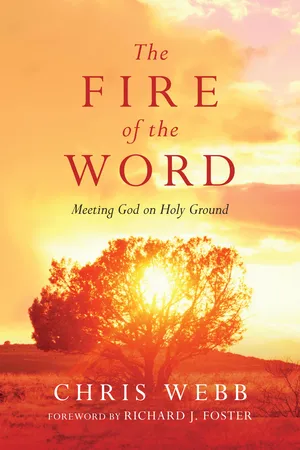
The Bible has the astounding power to transform lives. The stories of people like Francis of Assisi, Antony of Egypt, Augustine of Hippo, Martin Luther and Martin Luther King Jr. vividly demonstrate this. Why aren't more of us transformed by Scripture today?Too often we study biblical texts without believing that God truly inhabits this book. Scripture seeks to capture our minds, not merely educate them. In these pages Chris Webb explains that we can transform our Christian life by reading as lovers rather than as theorists. This is possible by coming to the text prayerfully, expectantly, in humility and empty-handed. When we open the Bible, it does not say to us, "Listen: God is there!" Instead, the voice of the Spirit whispers through each line, "Look: I am here."Reading the Bible this way can reconfigure the habits of your heart, refresh your imagination and memory, reshape and redeem your emotions, realign your reality individually and communally for kingdom life, and take us beyond the Bible into a renewed way of life.Here is the work of today--which is also the work of the whole of life--to open your heart afresh to the living Word of God.
- 199 pages
- English
- ePUB (mobile friendly)
- Available on iOS & Android
eBook - ePub
About this book
Information
Print ISBN
9780830835638
Topic
Theology & Religion1
Hear His Voice

It’s just a little before six in the morning and the alarm on my cell phone is ringing. It’s winter, and the air in the room is cold and sharp; I grab a warm sweater as I stumble out of the bedroom and head down the stairs. The house is quiet, the family asleep; I’m reminded of some words of the sixteenth-century Spanish poet and mystic John of the Cross: “One dark night, fired with love’s urgent longings—ah the sheer grace!—I went out unseen, my house being now all stilled.” On this dark morning, my home silent around me, I’m heading into the gloomy basement, flashlight in hand, fired by those same urgent longings. It’s time to pray.
Some while back I converted a corner of our basement into a makeshift chapel. It’s a simple and rather inelegant affair: lengths of blue cloth, bought at a thrift store and pinned to the exposed rafters, form the walls, and three old rugs cover the concrete floor. A couple of yard-sale armchairs and an old bookcase provide the meager furnishings, and under the single window is a prayer desk I picked up years ago from a redundant chapel in England. On the windowsill sits a battered electric lamp, a candleholder and a wood-mounted print of the San Damiano cross before which Francis of Assisi used to pray. This is my Jerusalem, my temple: the holy ground where I encounter the presence of God.
It seemed cold upstairs, but the air down here is frigid. Shivering a little, I kneel at the prayer desk, light the candle and open my prayer book and Bible. Making the sign of the cross on my lips, I recite the traditional opening words of the liturgy: “O Lord, open thou our lips, and our mouth shall shew forth thy praise.” Then, as Christians throughout the centuries have done (especially in monastic and liturgical communities), I begin the day’s prayer by softly chanting Psalm 95, the great invitation to worship: “O come, let us sing unto the Lord, let us heartily rejoice in the strength of our salvation” (v. 1). And as the psalm unfolds, I absorb the poet’s encouragement to sing, to rejoice, to celebrate God and his creation, to recognize his care for us.
Buried in the heart of this psalm comes a challenge: “Today if ye will hear his voice, harden not your hearts.” Here is the work of today—which is also the work of the whole of life. I’m called daily to open my heart afresh to the living Word of God. I know I need this reminder but, to tell the truth, I’m daunted by the possibility that God might actually speak. I feel like an Israelite at the foot of Mount Sinai, overwhelmed by the swirling clouds at the mountain’s summit, the bursts of thunder and the flashes of fiery lightning. How can I bear to hear God’s voice, let alone listen to it, interpret it, comprehend it? “You speak to us,” Moses was told, “and we will listen; but do not let God speak to us, or we will die” (Ex 20:19). Wouldn’t hearing the voice of God be something like seeing his face: an experience so great, so consuming, that our mortal frame would be unable to contain it?
So it’s with caution that, in my prayers, I approach the reading of Scripture itself. The contemporary Coptic saint Matta el-
Meskeen understood this well when he wrote: “There are those who always fast to read the Gospel. There are those who, when they read the Gospel alone, always kneel. There are those who always read it with weeping and tears.” The candlelight flickers as I turn the pages, and my heart trembles a little too. What will I hear? How will I be called, how changed? Will I be comforted or inspired? Or is it today that my life will be turned inside out? It has happened before—to others and to me.
Meskeen understood this well when he wrote: “There are those who always fast to read the Gospel. There are those who, when they read the Gospel alone, always kneel. There are those who always read it with weeping and tears.” The candlelight flickers as I turn the pages, and my heart trembles a little too. What will I hear? How will I be called, how changed? Will I be comforted or inspired? Or is it today that my life will be turned inside out? It has happened before—to others and to me.
Life-Changing Words
On another cold winter morning—in February of 1208—a young man named Francesco Bernardone came into a small Umbrian church to hear the mass being celebrated for the feast of Saint Matthias. For three years Francesco had been living as a hermit in the Spoleto Valley under the direction of a community of Benedictine monks. The son of a wealthy cloth merchant, he had become estranged from his family and many friends because of the eccentric fervor with which he seemed to be seeking God’s will for his life—emptying his father’s warehouse to provide for the poor, caring for outcast lepers by washing and redressing their wounds, and begging from house to house as he raised money to rebuild local churches.
As the mass ended and the little church began to empty, Francesco approached the priest. He quietly explained that hadn’t understood the Gospel reading (which would have been in Latin); would the priest kindly read through it again? The cleric obliged, taking Francesco through the passage from the tenth chapter of Matthew’s Gospel line by line. He translated Jesus’ words about the apostles traveling from place to place curing the sick, raising the dead and ministering to lepers (that last part must have caught Francesco’s attention). Jesus told them to journey without money or baggage, and to trust in faith that God would provide through those among whom they went. Above all, they were to proclaim the heart of the Gospel message: “The kingdom of heaven has come near!”
As he listened to the priest’s explanation, Francesco’s heart began to race; he could sense the calling of the Spirit on his own life. “This is what I want!” he cried. “This is what I seek! This is what I desire with all my heart!” From that moment on his course was set: Francesco would become a wandering preacher, an itinerant proclaimer of the kingdom. He would travel in poverty and faith to the furthest reaches of his world, throughout Italy and on to France, Germany, Spain, the Balkans, even to northern Egypt to share the good news of Christ with a Muslim sultan who was facing a great European crusading army. Francesco’s shining example of obedience to the gospel would become legendary, inspiring generations of Christians until the present day. Francesco is known to us as that startling lover of Christ, St. Francis of Assisi.
Scripture not only sparked Francis’s tremendous spirituality, it continued to fuel the burning flame of his passion for Jesus. By 1210 the rapidly growing Franciscan movement had caught the attention of the wider church, and Francis was encouraged to present a community rule to the pope. The text of that rule no longer survives, but it seems almost certain that it was little more than a collection of sayings of Christ from the Gospels. That spirit was reflected in the opening words of a revised rule he composed a decade later, in which he committed himself and his Friars Minor (“Little Brothers”) simply to “follow the teaching and footprints of our Lord Jesus Christ.” Francis had experienced the Bible (especially the Gospels) as a life-changing book and was determined to stay open to its transforming influence.
His experience was far from unique; similar stories could be repeated from every age of the church’s life over the last twenty centuries. Almost a thousand years before Francis, Antony of Egypt was a young farmer and landowner in the Upper Nile region. One Sunday morning as he walked into the traditional Coptic service in his local church, he heard the priest reading from Matthew’s Gospel: “If you wish to be perfect, go, sell your possessions, and give the money to the poor, and you will have treasure in heaven; then come, follow me” (Mt 19:21). The impact was striking and immediate. Antony sold everything and retreated into the Egyptian desert, charting a course which would be followed later by thousands of others who were seeking a deeper and more committed life with God. The Life of Antony, a short biography by the Alexandrian bishop Athanasius, touched the lives of Christians and churches across the Middle East and Europe, and helped lay the foundations of the monastic movement; Antony himself is often known as the “father of monasticism.” And all this grew from that unexpected encounter with the words of Scripture.
A little over fifteen centuries later, in the remote Welsh village of Pontrobert, the young daughter of a local farmer became captivated as she listened to the Calvinistic Methodist preachers whose fiery sermons were lighting up the pulpits of Wales. She soaked herself in the vivid scriptural imagery which permeated their teaching, and began to sew together a patchwork of metaphors, symbols and allegories into one of the most striking collections of hymns and poetry that Welsh culture has ever known. In every line the impact of the Bible on her life and faith is glaringly evident. One of her hymns, Bererin llesg gan rym y stormydd, opens with this verse (in English translation):
Pilgrim, swept by storms and weary,
raise your head, look up and see:
Jesus, Lamb of God, our Savior,
clothed in robes of majesty;
girdled with the gold of loyalty,
round his hem the bells ring clear,
singing grace to every sinner:
Christ, the eternal Yes, is here!
Remarkably, this single verse ranges across almost the whole sweep of Scripture as it references Paul’s experience of being shipwrecked in the Mediterranean (Acts 27:13-44), John the Baptist’s exhortation to “Behold the Lamb of God!” (Jn 1:29 kjv), John the Evangelist’s vision of Jesus on the island of Patmos (Rev 1:13),
the clothing of the Levitical priests (Ex 28:33-35) and the story of the woman reaching for the hem of Jesus’ garment (Mt 9:20-22). Into this are woven theological allusions to the incarnation (Christ’s vestments symbolically reach to the earth) and the atonement. It’s a remarkable synthesis for a young woman who lived and worked on a rural sheep farm and had only a rudimentary education to her credit.
the clothing of the Levitical priests (Ex 28:33-35) and the story of the woman reaching for the hem of Jesus’ garment (Mt 9:20-22). Into this are woven theological allusions to the incarnation (Christ’s vestments symbolically reach to the earth) and the atonement. It’s a remarkable synthesis for a young woman who lived and worked on a rural sheep farm and had only a rudimentary education to her credit.
These poems and hymns, now considered treasures of the Welsh language, might have been lost to us altogether after Ann Griffiths’s tragic death at the age of twenty-nine, had they not been collected by her maid and published in the early nineteenth century by Thomas Charles of Bala, a clergyman living over the mountains in northwest Wales. Around the time of their publication, Charles was also playing a key role in an initiative which would enable countless others to experience the life-changing power of Scripture for themselves. At the turn of the century a young teenager named Mary Jones turned up at Charles’s home, having walked twenty-six miles, barefoot, across the Welsh mountains. She had been saving money for six years and had made her difficult journey with one purpose: to buy a Bible.
Charles was impressed and shaken by her single-minded determination and her passionate hunger for Scripture. A couple of years later he related the story to friends meeting together in London, and lamented the scarcity of affordable Welsh-language
Bibles which could be distributed to those, like Mary, who longed to read Scripture for themselves. The friends decided to create an organization to translate, publish and distribute the Bible as widely as possible—and so the British and Foreign Bible Society was born, the first of the many Bible societies throughout the world, which have made Scripture available and accessible to millions.
Bibles which could be distributed to those, like Mary, who longed to read Scripture for themselves. The friends decided to create an organization to translate, publish and distribute the Bible as widely as possible—and so the British and Foreign Bible Society was born, the first of the many Bible societies throughout the world, which have made Scripture available and accessible to millions.
In our own time we might consider the life of Martin Luther King Jr., a moral and political leader whose speeches and example changed the face of Western society. The catalysts of the civil rights movement are well known: the arrest of Rosa Parks on a Montgomery bus for refusing to give up her seat for a white man, the longing of so many to see integration in the public school system, the desperate circumstances of many black Americans in the southern states—to name just a few. Less often acknowledged, though, is the direct role of the Bible in shaping King’s life and actions. The inspiration for his nonviolent resistance came directly from the message of Jesus (and, of course, from the example of Gandhi, but Gandhi in turn frequently acknowledged his indebtedness to the teachings of Christ). King looked particularly to the Sermon on the Mount, where Jesus spoke of turning the other cheek and loving our enemies. His teaching about “creative suffering” was rooted in his reading of the Passion narratives. And his astonishingly inclusive social vision, expressed so movingly in the legendary “I have a dream” speech, was grounded in the Gospels, where Jesus is continually presented as the friend of all those on the edges of first-century Jewish culture—sinners, tax collectors, women, lepers, outcasts. In every way, King was a man changed and shaped by hearing the voice of God.
All these remarkable figures from the history of the church relived, in one way or another, the formative experience of Moses standing before the burning bush. Most of us are familiar with the story. Moses, having fled Egypt after murdering one of the Egyptian slave drivers, found himself herding sheep in the stark, rocky desert of the Sinai peninsula. Day after day he wandered the trackless wasteland, moving the flock from one watering hole to another; a former prince of Egypt, he had become a forgotten solitary in the wilderness, invisible to the rest of the world—as though already dead.
From time to time small brush fires would spark in the dry, brittle undergrowth, bu...
Table of contents
- Cover
- Copyright
- Foreword
- 1 Hear His Voice
- 2 Learning to Read Again
- 3 Do Not Be Afraid
- 4 The Yearning of God
- 5 My Beloved Speaks
- 6 Reading Like Lovers
- 7 Anatomy of the Soul
- 8 Listen!
- 9 Living in the Gospel
- 10 The Book of Christ
- 11 Sacred Reading
- 12 The Disordered Soul
- 13 A Life Desired
- 14 Beyond the Bible
- 15 Friendship with Jesus
- Epilogue
- Acknowledgments
- Notes
- What is Renovaré?
- About the Author
- Other Books in This Series
- Endorsements
Trusted by 375,005 students
Access to over 1.5 million titles for a fair monthly price.
Study more efficiently using our study tools.
Frequently asked questions
Yes, you can cancel anytime from the Subscription tab in your account settings on the Perlego website. Your subscription will stay active until the end of your current billing period. Learn how to cancel your subscription
No, books cannot be downloaded as external files, such as PDFs, for use outside of Perlego. However, you can download books within the Perlego app for offline reading on mobile or tablet. Learn how to download books offline
Perlego offers two plans: Essential and Complete
- Essential is ideal for learners and professionals who enjoy exploring a wide range of subjects. Access the Essential Library with 800,000+ trusted titles and best-sellers across business, personal growth, and the humanities. Includes unlimited reading time and Standard Read Aloud voice.
- Complete: Perfect for advanced learners and researchers needing full, unrestricted access. Unlock 1.5M+ books across hundreds of subjects, including academic and specialized titles. The Complete Plan also includes advanced features like Premium Read Aloud and Research Assistant.
We are an online textbook subscription service, where you can get access to an entire online library for less than the price of a single book per month. With over 1.5 million books across 990+ topics, we’ve got you covered! Learn about our mission
Look out for the read-aloud symbol on your next book to see if you can listen to it. The read-aloud tool reads text aloud for you, highlighting the text as it is being read. You can pause it, speed it up and slow it down. Learn more about Read Aloud
Yes! You can use the Perlego app on both iOS and Android devices to read anytime, anywhere — even offline. Perfect for commutes or when you’re on the go.
Please note we cannot support devices running on iOS 13 and Android 7 or earlier. Learn more about using the app
Please note we cannot support devices running on iOS 13 and Android 7 or earlier. Learn more about using the app
Yes, you can access The Fire of the Word by Chris Webb in PDF and/or ePUB format. We have over 1.5 million books available in our catalogue for you to explore.