![]()
CHAPTER 1
The Trinity as the Norm for Soteriology
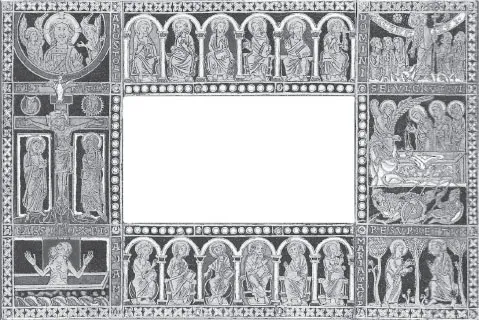
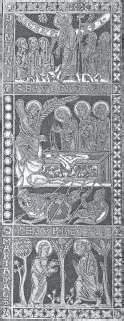
THE CHURCH OF ST. SERVATIUS in Siegburg, Germany, has a treasure room full of medieval art and relics. Among the artifacts is a portable altar crafted around the year 1160 by the workshop of Eilbertus of Cologne. Eilbertus was a master craftsman of Romanesque metalwork and enamel decoration, a sturdy artistic medium that withstands the centuries with minimal fading or decay. The colors remain brilliant after nearly a millennium. But Eilbertus was also a skillful iconographer, whose fluency with the symbolism of Christian art equipped him to construct dense and elaborate visual arguments. Consider the lid of the altar-box, shown here. Ranged in bands along the top and bottom of it are the twelve apostles of the Lord, labeled “apostoli domini.” Running down the right border are three ways of depicting Christ’s victory over death: at the bottom is the post-resurrection appearance to Mary Magdalene in the garden, at the center is the empty tomb (sepulcrum domini) with sleeping soldiers and the three women seeking the Lord among the dead where he is not to be found, and at the top is the ascension, ascensio Christi. The event of the resurrection itself is not directly portrayed, of course, but Eilbertus juxtaposes three images of the resurrection’s consequences: the presence of the Lord with his people, the absence of the Lord from the tomb, and the ascension of the Lord by which he is now both present to us (spiritually) and absent from us (bodily) until his return. If a picture is worth a thousand words, three pictures placed together in significant visual proximity are not increased simply by addition of ideas, but rather by a remarkable multiplication of meaning.
Lid of a portable altar-box, the workshop of Eilbertus of Cologne, ca. 1160
Altar-box lid, detail, right border
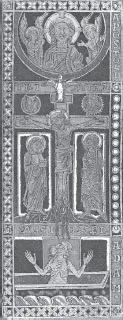
Altar-box lid, detail, left border
But it is the left border that showcases Eilbertus as the iconographic and doctrinal master that he was. In the middle is the crucifixion of Jesus, where the Son of God is flanked by his mother Mary and John the evangelist, as well as by the moon weeping and the sun hiding his face. At the foot of the cross, from the feet of the savior runs the blood of the crucified, and as it runs down the hill of the skull, it crosses a rectilinear panel border in which is inscribed passio Christi, the passion of Christ. The blood runs out of its own frame and into an adjoining visual space, a space in which Adam (clearly labeled Adam, which is Latin for … Adam) is rising from a sepulcher. Adam’s arms are outstretched in a gesture of reception, but they also set up a powerful visual echo of the outstretched arms of Jesus. Adam’s tomb and its lid are arranged perpendicular to each other so that Adam’s body is framed by an understated cruciform shape of the same blue and green colored rectangles as Christ’s. Eilbertus is making another visual argument here: where the two crosses cross, salvation takes place. Because the second Adam bends his head and looks down from his death, the first Adam raises his head and looks up from his. Eilbertus is offering an invitation here: above are the everlasting arms, outstretched but unbent, as linear and straight as panel borders or the beams of the cross, while below the salvation is received with appropriate passivity into the bent arms of the father of the race of humanity. Redemption is accomplished and applied, and at long last an answer is given to God’s first interrogative: “Adam, where are you?”
But even this is not the peak or extent of Eilbertus’s iconographic teaching. For that master stroke we have to look not below the cross but above it. In another pictorial space, framed by both a square and a circle, is God the Father flanked by angels. It doesn’t look much like God the Father. It looks instead exactly like Jesus, right down to the cross inscribed in the halo. Pity the iconographer who has to represent the first person of the Trinity visually. As a general rule, the Father should not be portrayed: even in the churches that use icons in worship, stand-alone images of the Father are marginal, aberrant, noncanonical. Do you portray him as an elderly man with a flowing white beard, as if he were modeled on Moses or even perhaps Zeus? Eilbertus has taken the imperfect but safe route, and depicted the Father christomorphically: since Christ told his disciples “If you have seen me, you have seen the Father,” it stands to reason that if an artist decides to show the Father, he should show him looking like what we have seen in the face of Jesus.
Representing God the Father visually is a problem not even Eilbertus can solve, and even though other options might be worse, this christomorphic Father is nevertheless a rather regrettable solution. But if you avert your eyes from that difficult figure, you will notice the dove of the Holy Spirit ascending from Christ on the cross. The dove imagery is of course not found at the end of the gospels ascending from Golgotha, but rather at the beginning of the gospels, descending at the Jordan, onto the scene of the baptism of Christ. Eilbertus has moved the symbol here to provide a visual cue for something like Hebrews 9:14, where we are told that “Christ … through the eternal Spirit offered himself without blemish to God.” Just as the blood broke the bottom border, the dove breaks this upper border, crossing over from the Son to the Father. The dove also breaks the crucial word, the label that makes sense of it all: trinitas, Trinity.
It’s a little word, but it changes everything. Simply by juxtaposing the death of Christ with a visual evocation of God in heaven, Eilbertus indicates that what happened once upon a time in Jerusalem, a thousand years before Romanesque enamels and two thousand years before the internet, is not simply an occurrence in world history but an event that breaks in from above, or behind, or beyond it, an event in which God has made himself known and taken decisive divine action. But by adding the word Trinity, the artist has turned scribe, and has proclaimed that what we see at the cross is in some manner a revelation of who God is. Here God did not just cause salvation from afar, but caused himself to be known as the Father, Son, and Holy Spirit. And here we cannot press Eilbertus any further, because the diction of enamel and the grammar of metalwork are not precise enough to say what we must go on to say. Eilbertus has reminded us of the essential movement that we must make, has set us on the path that faith seeking understanding must follow: from the history of salvation to the eternal life and unchanging character of God. But it is high time to come to terms with the precise meaning of that movement, and for that task we need not images depicting the truth, but words: first the form of sound doctrine given in the teaching of the apostles, then the interpretive assistance of classical doctrines, and finally the conceptual re-description that characterizes constructive systematic theology in the present. The craft and wisdom of Eilbertus frame the discussion, but we need to have the discussion.
In this chapter, I want to characterize not the doctrine of the Trinity itself but how it functions within systematic theology. The adjective in the phrase “trinitarian theology” is grammatically ambiguous, since it could indicate either a theology that is about the Trinity, or an overall theological system that is shaped and conditioned by the doctrine of the Trinity. The latter sense is what I intend to describe by exploring what the doctrine of the Trinity is for; what follows is an account of the dogmatic function of the doctrine of the Trinity in the overall structure of Christian theology and life. Under the guiding image of Eilbertus, we have already begun the task of considering the events of salvation history against the background of the eternal being of God; the doctrine of the Trinity poses the question of how salvation history is to be correlated with the divine being in itself, or to describe the connection between God and the economy of salvation. As it does this, the doctrine of the Trinity provides five services that promote the health and balance of Christian theology as a whole. First, trinitarian theology summarizes the biblical story. Second, it articulates the content of divine self-revelation by specifying what has been revealed. Third, it orders doctrinal discourse. Fourth, trinitarian theology identifies God by the gospel. And fifth and cumulatively, it informs and norms soteriology.
SUMMARIZING THE BIBLICAL STORY
The easiest angle of approach to the Trinity begins with a straightforward reading of the gospels as rather obviously the story of three special characters: Jesus Christ, the Father who sent him and who is constantly present in his conversation and actions, and then, rather less clearly, the Holy Spirit, who seems simultaneously to precede Christ, accompany Christ, and follow Christ. There are many other characters in the story, but these three stand out as the central agents on whom everything turns. And the actions of these three are concerted, coordinated, and sometimes conjoined so that sometimes they can scarcely be distinguished and at other times they stand in a kind of opposed relation to each other. As for the salvation they bring, it is not three salvations but one complex event happening in three ways, or (as it sometimes seems) one project undertaken by three agents. The epistles, each in their own way, all look back on and explain this threefold story, adding more layers of analysis and insight but not altering the fundamental shape of what happened in the life of Jesus.
We could summarize this threefold shape of the New Testament story in the formula “The Father sends the Son and the Holy Spirit.” And though we can’t take the time to develop it here, we would then have to extend the analysis to include the entire canon, to demonstrate that what happens in the New Testament is a continuation and fulfillment of what happened in the Old. To trace the storyline of Scripture, and especially of the Old Testament, as the God of Israel promising to be with his people in a Son of David who is the Son of God, and to pour out his Holy Spirit on all flesh in a surprising fulfillment of the promise to Abraham, is a task for a comprehensive biblical theology. But it can be undertaken while remaining in the mode of mere description, rather than moving to the more contentious field of systematic construction. In that case, giving a particular kind of interpretive priority to the New Testament because of its position at the end of a process of progressive revelation, the sentence “The Father sends the Son and the Holy Spirit” would be a summary of the entire Bible.
This particular threefold formula is not the only possible summary of the storyline of the Bible. Other themes in salvation history could be highlighted. Even other threefold patterns could be discerned: the triad of exodus, exile, and resurrection suggests itself. The themes of kingdom or covenant could be pushed to the foreground, or even substituted for the schema of Father, Son, and Holy Spirit. Much can be gained from investigations that give prominence to these other themes, but what I am describing here is how to read the salvation history witnessed in Scripture in such a way as to reach the doctrine of the Trinity. The reason we would want to read it that way as Christians is that only the trinitarian reading is actually attempting to read salvation history as the revelation of God’s identity in a way that transcends salvation history; that reads it as showing not only what God does but who God is. The God behind the stories of kingdom or covenant, of exodus, exile, and resurrection, could remain personally undisclosed except insofar as his faithfulness to stand reliably behind his actions suggested something about him. The trinitarian reading of salvation history goes further: it construes the divine oikonomia (God’s wise ordering of salvation history) to be simultaneously an oikonomia of rescue, redemption, and revelation, indeed self-revelation. Salvation history on the trinitarian reading is the locus in which God makes himself known, the theater not only of divine action but also of divine self-communication. A faithful God may stand behind other construals of salvation history, but on the trinitarian reading, God stands not behind but also in his actions, at least in the actions of sending the Son and the Holy Spirit.
There are numerous advantages to beginning in this way. In our age, many Christian readers have trouble seeing the doctrine of the Trinity in Scripture. They see a verse here and a verse there that may help prove the different parts of the doctrine (the deity of Christ, the unity of God, etc.), but they struggle to see the whole package put together in any one place. Granting that the doctrine is not compactly gathered into any one verse (not even Matthew 28:19 or 2 Corinthians 13:13 are quite as complete or as detailed as could be wished), it is quite beneficial to approach the doctrine in a bigger-than-one-verse way.
Follow the whole argument of Galatians 4, for example (in the fullness of time, God sent his Son, and has sent the Spirit of his Son into our hearts crying Abba Father), or 1 Corinthians 2 (in apostolic foolishness we have the mind of Christ, we have the Spirit who searches the deep things of God), or of Ephesians 1 (we are blessed with every spiritual blessing by the Father who chose us before the foundation of the world, gave redemption in the blood of the Beloved son, and sealed us with the Spirit of promise), or of the Gospel of John (the Word became flesh, talked endlessly about the Father who sent him, and then gave the Spirit), and the Trinitarian profile of God’s self-revelation emerges clearly. We have to train our minds to think in bigger sections of Scripture than just a verse here and a verse there; the bigger the better.
To arrive at the biblical doctrine of the Trinity requires three very large mental steps. The first step is simply to read the whole Bible, to achieve some initial mastery of the long, main lines of the one story that is the Christian Bible. An interpreter needs to be able to think back and forth along the canon of Scripture, with figures like Abraham and Moses and David and Cyrus standing in their proper places, and with categories like temple and sonship and holiness lighting up the various books as appropriate. This familiarity and fluency with all the constituent parts is the prerequisite for further steps.
The second step, though, advances beyond canonical mastery by understanding not just the shape of the biblical text but of God’s economy. What is required here is to comprehend the entire Bible as the official, inspired report of the one central thing that God is doing for the world. God has ordered all of these words and events that are recorded in Scripture toward one end. Simply knowing the content of the entire Bible is inadequate, if that content is misinterpreted as a haphazard assemblage of divine stops and starts. These are not disparate Bible stories, but the written witness of the one grand movement in which God disposes all his works and words toward making himself known and present.
The third step is to recognize the economy as a revelation of who God is. This is the largest step of all. Once interpreters have mastered the contents of the Bible, and then understood that it presents to us God’s well-ordered economy, they still need to come to see that God is making himself known to us in that economy. After all, it is theoretically possible for God to do great things in world history without really giving away his character or disclosing his identity in doing so. This final step on the way to the doctrine of the Trinity is the recognition that God behaved as Father, Son, and Spirit in the economy because he was revealing to us who he eternally is, in himself. The joint sending of the Son and the Holy Spirit was not merely another event in a series of divine actions. It...