- 144 pages
- English
- ePUB (mobile friendly)
- Available on iOS & Android
eBook - ePub
About this book
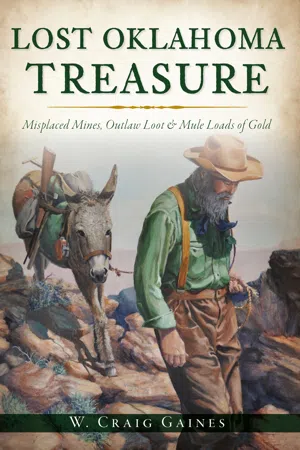
Oklahoma keeps its secrets. Adventurers combing the Wichita Mountains for the legendary Lost Cave with an Iron Door can slake their thirst at Cache Creek or Treasure Lake. Following the tradition of French and Spanish explorers, miners and pioneers stashed their valuable discoveries along the Santa Fe Trail and the California Road. Chief Opothleyahola reportedly buried gold coins that could be worth more than $14 million today, while businessman Dr. John J. Hayes never returned from a Confederate refugee camp to reclaim his hidden fortune. From the unrecovered loot of the James Gang to the fabled funds of the Knights of the Golden Circle, W. Craig Gaines tracks tales of treasure across sixty Oklahoma counties.
Trusted by 375,005 students
Access to over 1.5 million titles for a fair monthly price.
Study more efficiently using our study tools.
Information
Subtopic
North American HistoryIndex
HistoryCHAPTER 1
TREASURES BY COUNTY
ADAIR COUNTY
Farm Cache
A farmer hid his family’s money on his farm near the Illinois River not far from Chewey. He died without telling anyone where it was. When I was young, I searched for it briefly with my first metal detector with the help of a friend whose family was from the area. The old homestead was long gone, and the directions were a bit vague about where the house originally was.
ATOKA COUNTY
Bill Cook’s Lost Loot
See Johnson County.
John C. White Treasure
In the 1920s, rancher John White was rumored to have buried a quart jar full of five-, ten- and twenty-dollar gold coins close to his ranch house near Harmony, east of Atoka. He told W.F. McKown about burying the gold in 1923. White was leasing the ranch from others. White got sick and died in Texas. In 1960, some of John White’s relatives came to the area and looked for their uncle John’s money but did not appear to have found it.
BECKHAM COUNTY
Cavalry Payroll
See Cimarron County.
BLAINE COUNTY
Roman Nose Treasure
In 1874, a miner returning from Montana was said to have buried gold and silver coins in the Roman Nose State Park area near Eagle City. Another version of this tale was that $500,000 in gold coins was hidden during a Comanche raid in a canyon near the Washita River. The site was said to be about eight miles north of Watonga.
Yeager-Black Gang Treasure
A Yeager-Black Gang treasure was supposed to have been hidden near Eagle City. In 1895, outlaw Dick Yeager (also known as Nathanial Ellis “Zip” Wyatt) was killed in August and outlaw Isaac “Ike” Black was killed in in July in different gun fights.
See Major County, “Money in a Cave.”
BRYAN COUNTY
Confederate Gold Chest
There is a local tale that in 1864 or 1865, a Confederate gold shipment traveled along the Blue River. As Union troops approached, the Confederates buried the chest of gold near the Red River. A steer’s head was carved on a tree with one horn pointing up and one horn pointing down. The horn pointing down indicated where the chest was. The gold was supposedly hidden about three miles east of Highway 70 and about three miles east of Durant on Lone Oak Road. It was at the bottom of a hill on the edge of the Blue River.
About 1915, a young boy found the mysterious steer’s head carving on the tree. He dug under the tree. After seeing an old Indian who lived nearby watching him, the young boy ran home. He returned to the site with his father. They discovered that the hole had been deepened by someone.
In the 1930s, the Newman brothers from Durant dug at the site with a steam shovel. Near a quicksand area, the steam shovel was said to have brought up an old rusted chest with the letters “C.S.A.” on it. However, the chest rolled back into the quicksand. Upon resuming digging, they found the quicksand went down ninety feet, which exceeded the depth their steam shovel could dig. The Newman brothers gave up digging for the treasure.
Lost Cannon
Near Fort Washita, several cannons were reportedly buried. Another version of this story was that a cannon was put in a well.

Fort Washita. Oklahoma Historical Society.
Twenty-Seven Mule Loads of Gold
A legend claimed twenty-seven mule loads of gold were hidden in a creek near a large rock during an Indian attack. The site was near the mouth of the Little Wichita.
CADDO COUNTY
Fort Cobb Treasure
Two chests full of gold were said to have been buried near Fort Cobb.
Frank James Treasure
Outlaw Frank James reportedly hid $5,000 in gold and silver coins near a barn on the Billy Royce Farm near Anadarko in the Keechi Hills. He may have recovered it. Other counties with James Gang treasure, both lost and found, are Comanche, Grady, Jefferson, Kay, Le Flore, Mayes, Rogers and Tulsa.
See Comanche County, “James Gang $2 Million Cache and Other Caches.”
Lost Platinum Mine
Prospector A.S. Keown was murdered in 1924 between Anadarko and Fort Cobb with a bullet in his head by an unknown attacker. After he died, it was discovered that he had been selling platinum scrapings to an Oklahoma City jeweler. Some thought the platinum was from a mine that he accessed from his cabin on the George Thomas Ranch about fifteen miles northwest of Meers. This mine was said to be in the Keechi Hills, but he did not own the land. Keown had been working to buy the land or get the mining rights just before he was murdered. The Bat Cave in the area has been mentioned as a possible site with a secret room under water, but this seems unlikely.
Spanish Treasure
A Spanish treasure worth $200,000 in gold coins was rumored to be hidden near Cement.

Fort Cobb. Oklahoma Historical Society.

Frank James. Library of Congress.
CARTER COUNTY
Gold-Stuffed Cannon
Spaniards were said to have stuffed two gold bars and four silver bars into a cannon and hid it near Ardmore on Hickory Creek. In another story, it was Confederates being attacked by Indians who lost their cannon in Hickory Creek. The location of some sort of battle associated with this tale is S/2 Section 25 T5S-R1E.
CHEROKEE COUNTY
Blackface Treasures
In the 1830s, a renegade Black Seminole called Blackface led a gang that looted traders, pack trains and settler wagons. Seminole Indians had been removed from Florida to present Oklahoma by the U.S. Army after the many years of fighting the United States. This story likely was based on some exiled Seminoles who continued to resist in Indian Territory.
Mexican traders traveling from Mexico bound for St. Louis with several mule loads of gold were reportedly ambushed by Blackface’s gang near where the Fort Gibson National Cemetery is located. All the traders were killed. The gold was hidden in a cave by a few gang members. Blackface and his band were all hunted down and killed.
This treasure was forty large gold bars hidden a half-day’s ride from Tahlequah. In the 1920s, a Cherokee man searching for the gold agreed to give an innkeeper half the treasure if the innkeeper would let him stay for a month while he searched for it. Just before the stay was over, the man found the cave and treasure. He took the blindfolded innkeeper to the site. The cave entrance was concealed by rocks. The Cherokee removed the rocks and used a torch to enter the cave. Inside, several large clay jars contained small gold bullion bars. They took only one gold bar and left the cave. The innkeeper was again blindfolded on the way out. The next morning, the Cherokee disappeared, as he had killed someone and the police were after him. The innkeeper searched for the cave and never found it.
Another version of this story was that a man found a treasure in coins about fifteen miles south of Tahlequah near Qualls but covered it up and planned to return later to retrieve it. He got sick and died.
See Latimer County, “Wilburton Outlaw Caches” for another Blackface treasure.

Park Hill/Murrell Mansion. Library of Congress.
Cherokee Silver Mine
A legend indicated that Cherokees hid a silver mine near Park Hill. This story ties into a tale about Uncle Billy Melton, who was with his dog near Park Hill when the dog chased a rabbit into a crevice in a bluff. Getting a stick, Melton tried to get the rabbit out of the crevice. Instead, what was described as a solid chunk of silver came out. Since no mining was allowed in the Cherokee Nation, Melton never did anything about the find. This story came from Reverend Walter A. Duncan, who was Cherokee Chief John Ross’s secretary. I suspect what he found was iron pyrite (which is found in shales or other rocks), or it may have been lead or zinc, which is found in sedimentary rock in northeast Oklahoma in Mississippian age carbonates that outcrop in the area.
Flowers Canyon Treasure
A group of Spaniards may have buried treasure in Flowers Canyon a couple miles northeast of Fort Gibson. Indians had attacked the Spaniards, who left their treasure behind. Dresser Cave, located about four miles northeast of Fort Gibson, is associated with this legend. Dresser Cave is named after a man who moved into the cave in 1913, lived there about four years and disappeared. Dresser Cave is on the south side of the canyon about forty feet above Flowers Creek. It is about fifteen feet wide and six feet in height.
Heirloom Treasure
Before the Civil War, three escaped slaves were said to have fled from Mississippi across Arkansas to the Cherokee Nation. They took some of their master’s gold and heirlooms. Their master and a posse pursued them. Near the Illinois River east or southeast of Tahlequah, the posse caught up with the escaped slaves. One fugitive slave was shot, and the others were captured. They did not have the gold or heirlooms on them. They were believed to have hidden the treasure in a hollow tree near a chimney-shaped rock.
Horseshoe Bend Treasure
In the mid-1800s, some Cherokees supposedly hid gold bars in a couple of earthen churns in a cave in a valley in the Illinois River Horseshoe Bend area. These gold bars could have been from Cherokees who mined gold in the California gold rush. Some Cherokees returned back to the Cherokee Nation with gold.
John N. Riley’s Treasure
Cherokee John N. Riley lived on a farm six miles east of Fort Gibson before the Civil War. Afraid of being robbed, he buried his family’s prized possessions, including their silverware, near his farm. Riley died before he disclosed where the treasure was hidden to his family.
Joseph Henry Clark’s Treasure
Before the Civil War, farmer Joseph Henry Clark lived in the Park Hill area. He was said to have buried somewhere near his farmhouse $5,000 in gold coins from selling slaves and property. In 1865, while traveling on the Fort Gibson Military Road between Park Hill and Fort Gibson, he was ambushed and murdered. One of his descendants, Admiral Joseph James “Joko” Clark, was the first Cherokee to graduate from the U.S. Naval Academy and became a navy admiral. A January 22, 1945 Life magazine article on Admiral Joseph James Clark said the Clark family and neighbors were still looking for Grandpa Clark’s buried treasure.

Illinois River. Oklahoma Historical Society.
Lost Cherokee Nation Treasures
There is a legend that just before the Civil War, the U.S. government paid $50,000 in gold coins to the Cherokee Nation. Four Cherokees were put in charge of the gold, which was placed in two nail kegs. The two kegs were then hidden on Tahlequah Creek. It may have been buried behind the Cherokee capitol building, half a mile south on Tahlequah Creek within sight of the capitol. The Civil War was extremely violent, with many Cherokees dying in combat as well as by illness. At the end of the Civil War, only one of the original four Cherokee trustees who hid the gold survived. The Cherokee trustee gave directions on the treasure’s location to Cherokee council members. In spite of their efforts to recover the treasure, they could not find it.

Cherokee Nation capital Tahlequah. Library of Congress.

Chief John Ross. Oklahoma Historical Society.
The Cherokee capitol building was burned down in 1863 by Confederate Cherokee Colonel Stand Watie and his Confederate Indians. A new capitol was constructed on the site of the old building and now serves as part of the Cherokee Nation’s offices.
Another version of the story was that the kegs were buried near the village of Park Hill, where Chief John Ross and other Cherokee Nation leaders lived. Another related story claimed a wagonload of silver was sent by the Union for Chief John Ross to convince him to support the Union cause. The wagon overturned and was lost in the Illinois River just south of the Barren (Baron) Fork in the spring of 1862.
The truth is that Chief John Ross had from $70,000 to $80,000 of the Cherokee treasury when he was escorted by part of the Union Sixth Kansas Cavalry Regiment from Park Hill on August 3, 1862. The Cherokee Nation treasury was taken to Kansas. Chief John Ross went in exile to Philadelphia and Washington, D.C. It is highly unlikely there is any lost Cherokee Nation treasury gold or silver, but some small caches are possible.
Joe Payne Silver Mine
U.S. deputy marshal Joe Payne lived south of Tahlequah and spent a lot of time tracking down outlaws in Indian Territory. One day, he went hunting in the Cherokee Hills and sat down by a stream, where he took off a boot and shook gravel out of it. Suddenly, he noticed a large vein of silver about three feet wide that went under the stream and exited on the other side. The Cherokee Nation did not allow mining. To hide the vein, he cut down some trees and laid them over the vein. He later returned and dug down into the vein and found it to be at least four feet thick. He never tried to mine the silver and died in 1904. Payne did make a map of how to find the silver vein and gave it to a good friend. His friend did not find the site. Payne’s friend later gave the information to a friend’s brother-in-law, who did not find the site. It is possible this was lead or zinc rather than silver.
Rich Joe Vann Treasure
The richest Cherokee before the Civil War, Joseph “Rich Joe” Vann, was driven out of his Georgia plantation called Diamond Hill at Spring Place, Georgia, during Indian Removal. Rich Joe Vann died in 1844 when his steamboat, the Lucy Walker, blew up during a steamboat race. Vann’s steamboat was named after his favorite racehorse. There is a legend that Rich Joe Vann buried $60,000 in gold before leaving on his last voyage on the Lucy Walker. Vann’s mansion was at the town of Webbers Falls on the Arkansas River. His lands and wealth passed on to his family, including his son, who served both in the Confederate Drew’s Regiment of Cherokee Mounted Rifles and Union Kansas Indian Home Guard. During the Civil War, Webbers Falls was the site of skirmishes in 1863. The Confederate Cherokee Council also held several meetings in Webbers Falls. Union soldiers burned down the Vann Mansion as none of the Vann family reportedly would disclose where Confederate gold was buried nearby.
Robin Bobb’s Treasure
A June 28, 1931 Tulsa World article related the tale of Ro...
Table of contents
- Front Cover
- Title Page
- Copyright
- Contents
- Introduction. Oklahoma Treasure
- 1. Treasures by County
- 2. Wichita Mountains
- 3. Traders and Travelers
- 4. Knights of the Golden Circle
- 5. Outlaws and Their Loot
- 6. The Indian Nations
- 7. Shipwrecks
- Bibliography
- About the Author
Frequently asked questions
Yes, you can cancel anytime from the Subscription tab in your account settings on the Perlego website. Your subscription will stay active until the end of your current billing period. Learn how to cancel your subscription
No, books cannot be downloaded as external files, such as PDFs, for use outside of Perlego. However, you can download books within the Perlego app for offline reading on mobile or tablet. Learn how to download books offline
We are an online textbook subscription service, where you can get access to an entire online library for less than the price of a single book per month. With over 1.5 million books across 990+ topics, we’ve got you covered! Learn about our mission
Look out for the read-aloud symbol on your next book to see if you can listen to it. The read-aloud tool reads text aloud for you, highlighting the text as it is being read. You can pause it, speed it up and slow it down. Learn more about Read Aloud
Yes! You can use the Perlego app on both iOS and Android devices to read anytime, anywhere — even offline. Perfect for commutes or when you’re on the go.
Please note we cannot support devices running on iOS 13 and Android 7 or earlier. Learn more about using the app
Please note we cannot support devices running on iOS 13 and Android 7 or earlier. Learn more about using the app
Yes, you can access Lost Oklahoma Treasure by W. Craig Gaines in PDF and/or ePUB format, as well as other popular books in History & North American History. We have over 1.5 million books available in our catalogue for you to explore.