A global energy war is underway. It is man versus nature, fossil fuel versus clean energy, the haves versus the have-nots, and, fundamentally, an extractive economy versus a regenerative economy. The near-unanimous consensus among climate scientists is that the massive burning of gas, oil, and coal is having a cataclysmic impact on our atmosphere and climate, and depleting earth’s natural resources, including its land, food, fresh water and biodiversity.
These climate and environmental impacts are particularly magnified and debilitating for low-income communities and communities of color that live closest to toxic sites, are disproportionately impacted by high incidences of asthma, cancer and rates of morbidity and mortality, and lack the financial resources to build resilience to climate change.
Energy democracy tenders a response and joins the environmental and climate movements with broader movements for social and economic change. Energy democracy is a way to frame the international struggle of working people, low income communities, and communities of color to take control of energy resources from the energy establishment and use those resources to empower their communities—literally providing energy, economically, and politically. Energy democracy is more important than ever as climate and social justice advocates confront a shocking political reality in the U.S.
This volume brings together racial, cultural, and generational perspectives. This diversity is bound together by a common operating frame: that the global fight to save the planet—to conserve and restore our natural resources to be life-sustaining—must fully engage community residents and must change the larger economy to be sustainable, democratic, and just. The contributors offer their perspectives and approaches to climate and clean energy from rural Mississippi, to the South Bronx, to Californian immigrant and refugee communities, to urban and semi-rural communities in the Northeast. Taken together, the contributions in this book show what an alternative, democratized energy future can look like, and will inspire others to take up the struggle to build the energy democracy movement.
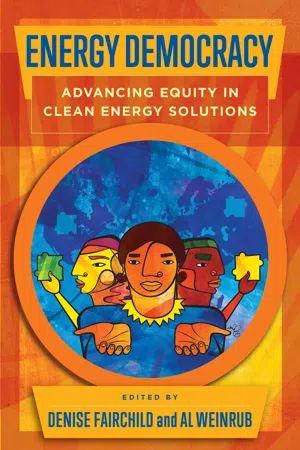
eBook - ePub
Energy Democracy
Advancing Equity in Clean Energy Solutions
- 275 pages
- English
- ePUB (mobile friendly)
- Available on iOS & Android
eBook - ePub
Energy Democracy
Advancing Equity in Clean Energy Solutions
About this book
Information
CHAPTER 1
Introduction
If there is a reason for social movements to exist, it is not to accept dominant values as fixed and unchangeable but to offer other ways to live—to wage and win, a battle of cultural worldviews … laying out a vision that competes directly with the one on harrowing display, … one that resonates with the majority of people on the planet, that … we are not apart from nature but of it.
Naomi Klein, This Changes Everything: Capitalism vs. the Climate
What does it mean to get real about climate change and take back control over our energy resources? What energy alternatives represent real solutions to the economic and environmental crisis confronting our civilization?
While still in its formative stages, energy democracy, a growing current in the clean energy and climate resilience movement, is attempting to address these very questions. Energy democracy is rooted in the long-standing social and environmental justice movements and is a key component of the evolving economic democracy movement. It goes beyond the simplistic “transition to 100% renewables” framework to offer a deeper understanding of the cultural, political, economic, and social dimensions of the climate change problem.
This volume collects the converging perspectives, strategies, and practices of the emerging field of activism that defines energy democracy. It highlights the promising ideas and efforts of U.S.-based energy democracy advocates and practitioners. As opposed to the academic, scientific, and policy perspectives of mainstream environmental professionals, this book gives voice to community-based organizations and leaders active in the climate and clean energy struggle. Their perspectives differ radically from the mainstream environmental community about how to get real about climate change.
The growing energy democracy movement is more important now than ever. Climate and social justice advocates are entering a new, shocking reality. The United States government is abandoning its already weak commitment to reduce greenhouse gas emissions, as represented by the 2015 Paris Climate Agreement. The new federal administration is staffing its cabinet and agencies with operatives of the fossil fuel industry, opening the door to fossil fuel exports and transcontinental oil and gas pipelines, bringing back coal and extreme extraction, and gutting environmental regulations and the federal agencies that oversee them.
Energy democracy addresses these challenges by joining the environmental and climate movement with broader movements for social and economic justice in this country and around the world.
The Energy Imperative
A global energy war is under way. It is being waged on numerous fronts, with distinct battle lines. It’s man versus nature; global North versus global South; fossil fuel versus clean energy; globalization versus local sovereignty; the powerful moneyed class versus low-income and indigenous communities and communities of color (the haves versus the have-nots); and, fundamentally, an extractive economy versus a regenerative economy.
The stakes are high for everyone. The health of the planet and whether humans will survive as a species will be determined by who emerges as the victors of the warring factions. Fortunately, a growing global consensus points to the need to move from a fossil fuel economy to a clean energy economy. The Consensus Project (theconsensusproject.com) reports the near unanimous (97%) consensus among climate scientists that the massive burning of gas, oil, and coal is having cataclysmic and cascading impacts on our atmosphere and climate, depleting Earth’s natural resources, including its land, food, fresh water, and biodiversity. Extreme weather events—the incidence of torrential rains, floods, heat waves, droughts, and hurricanes—resulting from global warming further threaten human settlements, life, and property.
Such climate disruption finally propelled 195 world leaders to sign the 2015 Paris Climate Accord. The Accord is an acknowledgment that the fossil fuel economy is no longer sustainable, that climate change is happening, that it is human-induced, and that a global effort is needed to stem the greenhouse gas pollution that threatens human survival.
Yet despite the urgency of the climate challenge, the fossil fuel sector—concentrated in five supermajors: BP, Chevron, Conoco, ExxonMobil, and Shell—continues to debunk climate change and disdains worldwide concerns about the existential threat of extracting, transporting, and burning increasing amounts of dirtier and harder-to-get fossil fuels.1 The Dakota Access and Keystone North American transcontinental pipelines are but two examples of the continued corporate drive to wreak havoc on our fragile ecosystem, ruining delicate aquifers, sovereign First Nation lands, farm communities, the oceans, and, of course, Earth’s atmosphere. These climate and environmental impacts are particularly magnified and debilitating for low-income communities and communities of color that live closest to toxic sites; are disproportionately impacted by high incidences of asthmas, cancer, and rates of morbidity and mortality; and lack the financial resources to adapt to climate impacts.
The Path Forward: Democratizing Energy
In the face of this threat to survival, the battle lines have been clearly drawn between fossil fuel capitalism (the fossil fuel industry, its Wall Street backers, and its military enforcers) and those working to avert climate disaster.
“We need to view the fossil fuel industry in a new light,” says climate activist Bill McKibben. “It has become a rogue industry, reckless like no other force on Earth. It is Public Enemy Number One to the survival of our planetary civilization.”2
Many different forces are opposing the determined efforts of the fossil fuel industry to continue its program of globalization, extreme energy, and international military hegemony, at everyone else’s (and Earth’s) expense.
This opposition includes the struggles against fossil fuel extraction (the Keep It in the Ground movement), especially opposition to the further development of extreme energy (the Keystone Pipeline, deep ocean drilling, Arctic drilling, tar sands exploitation, hydrofracking, and so forth); opposition to fossil fuel subsidies; opposition to oil wars; regulation of carbon emissions; imposition of carbon taxes; shutting down coal-fired power plants; and other areas of struggle that unite diverse forces in opposition to the “rogue” fossil fuel capitalists.
In essence, this opposition is attempting to wrest control of energy resources from the powerful institutions that are driving humanity to the brink of extinction. The struggle reflects an effort by citizens to exercise more control over energy decisions and to self-determine a sustainable, life-supporting energy future.
While this opposition needs to be deepened and strengthened, there remains an important strategic question: what is the alternative to the fossil fuel energy-based global economic system?
A large number of climate activist organizations in the United States are engaged in efforts to contain the fossil fuel establishment’s increasingly desperate program of extreme energy extraction, climate destabilization, and environmental destruction. Many of these organizations have the goal of reducing greenhouse gas emissions or even transitioning to a decarbonized energy system.
This resistance has awakened many people, politicized them around energy and climate issues, and fueled an increasingly powerful grassroots opposition to the corporate energy agenda. However, these movements are still mainly reactive and have exhibited, for the most part, only a limited vision of an energy alternative.
Many, for example, call simply for a technological fix: for a transition to 100% renewable energy, citing how it is technologically possible to develop sufficient renewable resources. But these calls do not specify who will develop and control that energy, to what end, or to whose benefit. The impetus is to decarbonize the economy, but otherwise leave the basic economic and social system—the institutional framework—intact.
This approach fails to confront the capitalist growth imperative that jeopardizes the world’s ecosystem, or to address the globalized exploitation of human and natural resources that leaves billions of people struggling to survive, or to fully appreciate how climate disruption, gross economic disparities, oppression, and institutionalized racism are inextricably linked.
Naomi Klein, in her book This Changes Everything: Capitalism vs. the Climate, demonstrates that the climate crisis draws into question the institutions and logic that have created our existential predicament. She points out both the necessity and the opportunity of our thinking outside the box, creating truly transformational solutions, if we are to survive.
In this vein, a growing number of climate activists see resistance to the corporate energy agenda as a struggle for social, racial, environmental, and economic justice. These “climate justice” forces see the opposition to fossil fuel capitalism as a key front in a crucial battle to transform our economic system more deeply—an economic system that has used fossil fuel energy as the driver of capital accumulation, ecosystem destruction, and social exploitation. For these activists, the struggle against the extreme fossil fuel agenda is a struggle for system change, for an alternative system. It is a struggle for community health, community resilience, and community empowerment. It is a struggle for social justice and an opportunity for building community.
The struggle is not simply to decarbonize the economic system, but to transform it.
Hence, the question we posed above—the alternative to the fossil fuel energy-based global economic system, is a justice-based (“just”) transition to a new, renewable energy-based, ecologically sound, equitable, life-sustaining economic system that can serve the needs of the world’s peoples.3
And in case it is not obvious, let’s be explicit. The struggle to achieve that kind of alternative is fundamentally a struggle for democracy.
The Energy Democracy Movement
An international labor roundtable4 in October 2012 framed the struggle for a global energy transition as an issue of democracy: “An energy transition can only occur if there is a decisive shift in power toward workers, communities and the public—energy democracy. A transfer of resources, capital and infrastructure from private hands to a democratically controlled public sector will need to occur in order to ensure that a truly sustainable energy system is developed in the decades ahead….”5
In short, energy democracy is a way to frame the international struggle of working people, low-income communities, and communities of color to take control of energy resources from the energy establishment and use those resources to empower their communities—literally (providing energy), economically, and politically. It means bringing energy resources under public or community ownership and/or control, a key aspect of the struggle for climate justice, as described earlier, and an essential step toward building a more just, equitable, sustainable, and resilient economy.
Thus, the energy democracy movement—represented by a growing number of organizations and organizing campaigns worldwide—seeks to replace our current corporate fossil fuel economy with one that puts racial, social, and economic justice at the forefront of the transition to a 100% renewable energy future.
In particular, energy democracy acknowledges the historical and contemporary perspectives and experiences of frontline communities—those most directly impacted by the fossil fuel economy and by the impacts of climate change, as well. This framing prioritizes the needs and concerns of working families, indigenous communities, and communities of color in the struggle to define a new energy future. It seeks comprehensive and effective solutions to the full impact of the fossil fuel economy.
Energy democracy is a critical framework for addressing the economic and racial inequalities that a decarbonized economic system would otherwise continue to perpetuate.
A New Energy Paradigm
The energy democracy movement implies a profound shift in how we think about and relate to energy. Energy is an essential enabler of all human activity—from producing the essentials of life, to transportation, to communication, to the creative arts. We can’t survive without it. In that light, given the existential threat we now face as human beings from the burning of fossil fuels, our relationship to energy must be reevaluated; this involves a paradigm shift of major proportions. The new energy paradigm must address three major aspects of our energy system: its relationship to the environment, to social justice, and to a new economy.
A NEW ENVIRONMENTAL PARADIGM
Energy democracy represents a new environmental paradigm.
Energy democracy emphasizes the core values and related strategies needed to protect Earth’s species. It seeks to find the historical and cultural precedents for making our energy systems life-sustaining, relying on ecological principles from preindustrial, traditional, and land-based societies.
Much is now understood by scientists about the impact of fossil fuel use on the environment. The extraction of these fuels is laying waste to huge tracts of land and ocean due to mountaintop removal, deep-water drilling, tar sands oil production, fracking, and other forms of extreme fossil fuel extraction. The burning of these fuels—increasing concentration of greenhouse gasses in the atmosphere and the acidification of the oceans—is modifying Earth’s climate and altering the biosphere, causing the extinction of an ever-increasing number of species and now putting human populations in jeopardy as well.
This ecosystem destruction is a product of the industrial, fossil fuel economy, which has accelerated mass production and consumption and the accumulation of wealth. But its origins lie in a Western civilization worldview of human beings as masters and exploiters of the natural world for the betterment and progress of human civilization—without regard to the fragile ecosystem needed to maintain life on the planet or the delicate balances required for Earth to susta...
Table of contents
- Cover
- Title Page
- Copyright
- Contents
- Prologue
- 1. Introduction by Denise Fairchild and Al Weinrub
- 2. From Commodification to the Commons: Charting the Pathway for Energy Democracy by Cecilia Martinez
- 3. The Case for a Just Transition by Michelle Mascarenhas-swan
- 4. Energy Democracy through Local Energy Equity by Strela Cervas and Anthony Giancatarino
- 5. Base-building and Leadership Development for Energy Democracy: Apen’s Work in East Bay Asian Immigrant and Refugee Communities by Vivian Yi Huang and Miya Yoshitani
- 6. Organizing for Energy Democracy in Rural Electric Cooperatives by Derrick Johnson and Ashura Lewis
- 7. Conflicting Agendas: Energy Democracy and the Labor Movement by Sean Sweeney
- 8. Democratizing Municipal-scale Power by Al Weinrub
- 9. Community-anchor Strategies for Energy Democracy by Maggie Tishman
- 10. New Economy Energy Cooperatives Bring Power to the People by Lynn Benander, Diego Angarita Horowitz, and Isaac Baker
- 11. Building Power through Community-based Project Development by Anya Schoolman and Ben Delman
- 12. Conclusion: Building an Energy Democracy Movement by Denise Fairchild
- Contributors
- Index
Trusted by 375,005 students
Access to over 1.5 million titles for a fair monthly price.
Study more efficiently using our study tools.
Frequently asked questions
Yes, you can cancel anytime from the Subscription tab in your account settings on the Perlego website. Your subscription will stay active until the end of your current billing period. Learn how to cancel your subscription
No, books cannot be downloaded as external files, such as PDFs, for use outside of Perlego. However, you can download books within the Perlego app for offline reading on mobile or tablet. Learn how to download books offline
Perlego offers two plans: Essential and Complete
- Essential is ideal for learners and professionals who enjoy exploring a wide range of subjects. Access the Essential Library with 800,000+ trusted titles and best-sellers across business, personal growth, and the humanities. Includes unlimited reading time and Standard Read Aloud voice.
- Complete: Perfect for advanced learners and researchers needing full, unrestricted access. Unlock 1.5M+ books across hundreds of subjects, including academic and specialized titles. The Complete Plan also includes advanced features like Premium Read Aloud and Research Assistant.
We are an online textbook subscription service, where you can get access to an entire online library for less than the price of a single book per month. With over 1.5 million books across 990+ topics, we’ve got you covered! Learn about our mission
Look out for the read-aloud symbol on your next book to see if you can listen to it. The read-aloud tool reads text aloud for you, highlighting the text as it is being read. You can pause it, speed it up and slow it down. Learn more about Read Aloud
Yes! You can use the Perlego app on both iOS and Android devices to read anytime, anywhere — even offline. Perfect for commutes or when you’re on the go.
Please note we cannot support devices running on iOS 13 and Android 7 or earlier. Learn more about using the app
Please note we cannot support devices running on iOS 13 and Android 7 or earlier. Learn more about using the app
Yes, you can access Energy Democracy by Denise Fairchild, Al Weinrub, Denise Fairchild,Al Weinrub in PDF and/or ePUB format, as well as other popular books in Biological Sciences & Global Warming & Climate Change. We have over 1.5 million books available in our catalogue for you to explore.