Wildlife Responses to Climate Change
eBook - ePub

Wildlife Responses to Climate Change

North American Case Studies

  1. 350 pages
  2. English
  3. ePUB (mobile friendly)
  4. Available on iOS & Android
eBook - ePub

Wildlife Responses to Climate Change

North American Case Studies

About this book

Wildlife Responses to Climate Change is the culmination of a three-year project to research and study the impacts of global climate change on ecosystems and individual wildlife species in North America. In 1997, the National Wildlife Federation provided fellowships to eight outstanding graduate students to conduct research on global climate change, and engaged leading climate change experts Stephen H. Schneider and Terry L. Root to advise and guide the project. This book presents the results, with chapters describing groundbreaking original research by some of the brightest young scientists in America. The book presents case studies that examine:

  • ways in which local and regional climate variables affect butterfly populations and habitat ranges
  • how variations in ocean temperatures have affected intertidal marine species
  • the potential effect of reduced snow cover on plants in the Rocky Mountains
  • the potential effects of climate change on the distribution of vegetation in the United States
  • how climate change may increase the susceptibility of ecosystems to invasions of non-native species
  • the potential for environmental change to alter interactions between a variety of organisms in whitebark pine communities of the Greater Yellowstone Ecosystem
Also included are two introductory chapters by Schneider and Root that discuss the rationale behind the project and offer an overview of climate change and its implications for wildlife.

Each of the eight case studies provides important information about how biotic systems respond to climatic variables, and how a changing climate may affect biotic systems in the future. They also acknowledge the inherent complexities of problems likely to arise from changes in climate, and demonstrate the types of scientific questions that need to be explored in order to improve our understanding of how climate change and other human disturbances affect wildlife and ecosystems.

Wildlife Responses to Climate Change is an important addition to the body of knowledge critical to scientists, resource managers, and policymakers in understanding and shaping solutions to problems caused by climate change. It provides a useful resource for students and scientists studying the effects of climate change on wildlife and will assist resource managers and other wildlife professionals to better understand factors affecting the species they are striving to conserve.

Trusted by 375,005 students

Access to over 1.5 million titles for a fair monthly price.

Study more efficiently using our study tools.

Information

Publisher
Island Press
Year
2013
Print ISBN
9781559639255
9781559639248
eBook ISBN
9781610911214

CHAPTER 1

Climate Change and Its Effect on Species Range Boundaries: A Case Study of the Sachem Skipper Butterfly, Atalopedes campestris

LISA CROZIER


Atalopedes campestris is a butterfly on the move. While the temperature has been warming in the Pacific Northwest, the typically southern A. campestris has advanced its northern range edge ~700 kilometers in 35 years (Dornfeld 1980, Hinchliff 1994, 1996; pers. obs.). In the warmest decade on record, the 1990s (IPCC 2001), the butterflies established their first known populations in Washington State. In the hottest year of the century, 1998 (NCDC 1999a), A. campestris dispersed another 125 kilometers into new territory (pers. obs.). Is the warm weather responsible for the range expansion? If so, A. campestris may provide a good example of the biological consequences of global warming. Many insects, including pests and disease vectors, are prime candidates to expand their ranges in response to warming, given their sensitivity to temperature, rapid generation times, and high mobility (Walker 1991, Lawton 1995, Sutherst et al. 1995). But constraints on distribution are neither simple, nor fully understood. This species presents an unusual opportunity to study the process of range shift during climate change.
Many recent studies have documented changes in animal distribution or phenology associated with climate change (Grabherr et al. 1994, Barry et al. 1995, Parmesan 1996, Crick et al. 1997, Holbrook et al. 1997, Mantua et al. 1997, Myneni et al. 1997, McCleery and Perrins 1998, Alward et al. 1999, Brown et al. 1999, Parmesan et al. 1999, Post and Stenseth 1999, Sagarin et al. 1999, Thomas and Lennon 1999). However, a gap exists between observations of an association between distributions and various environmental factors, and a mechanistic understanding of what physiological, ecological, and evolutionary processes maintain range edges, especially in animals (Bartholomew 1958, Hoffmann and Parsons 1991). While correlation studies have great value in suggesting multiple hypotheses, experimental tests are necessary to pin down actual range-limiting factors. Understanding the true underlying mechanisms is crucial for predicting the biological outcomes of a changing climate. Unfortunately, in very few cases have hypothesized range-limiting mechanisms actually been tested.
This chapter presents my investigation into what constrains the distribution of the native, northwardly moving Atalopedes campestris. The range expansion occurred during relevant changes in both habitat and temperature, which led to multiple hypotheses regarding the causal mechanism of the range shift. My approach involves three steps: (1) Develop hypotheses of range-limiting factors based on correlation with the range change and the biology of the species. (2) Identify the physiological constraints that could constitute a mechanism by which climate could directly limit the range of Atalopedes campestris. (3) Test hypotheses experimentally with field transplantation to determine whether the proposed mechanism is acting on the current range boundary. This type of case study into the actual mechanisms of range limits in a geographically dynamic species should provide a model from which to make testable predictions about the biological consequences of climate change for a variety of species.

Analyzing Range Shifts: From Global Change to Local Experiments

Anticipating specific biogeographical consequences of climate change requires understanding how species borders depend on climatic conditions. Our current understanding of this relationship is limited by the “scale gap” (Root and Schneider 1995). An average increase in global mean temperature is a landscape-scale prediction based on climate models using 500 × 500 km grids (Schneider 1993). These climate model predictions apply to “the big picture” of a species’ range: large-scale patterns of abundance and distribution. Analyses of distributions at this scale show that combinations of temperature and precipitation criteria are frequently good predictors of species’ ranges (e.g., Pigott 1975, Hengeveld 1985, Caughley et al. 1987, Root 1988, Cammell and Knight 1992). This association suggests that a change in environmental conditions may lead to a corresponding change in species’ ranges.
Unfortunately, large-scale correspondence cannot differentiate essential and coincidental environmental associations. There are a large number of potential environmental variables that may yield spurious associations with species ranges. Many environmental factors are also correlated with each other in today’s climate, obfuscating their relative importance for organisms (Dennis 1993). However, paleontological evidence shows that temperature, precipitation, and seasonality all vary independently during climate change (Brubaker 1988, Overpeck et al. 1992). Climates have existed in the past that do not occur today; thus it is likely that future regimes will differ from today’s. If “no-analog” conditions result, present ranges do not necessarily predict a species’ future distribution. Furthermore, species’ response times to climate change can vary by orders of magnitude, leading to strong transient effects of rapid climate change (Davis 1976, Huntley 1991, Lawton 1995, Huntley et al. 1997). Response times are difficult to predict from static distributions due to the important but stochastic role of long-distance dispersal (Pitelka and Plant Migration Workshop 1997, Clark et al. 1998). Therefore, current large-scale associations alone are insufficient for predicting biogeographical consequences of climate change.
Ecological experiments are designed to identify causal mechanisms underlying broader patterns. For logistical reasons most ecological experiments occur on a relatively small scale, studying a single population or locality, usually for a short period of time (Kareiva and Anderson 1988). Unfortunately, experimental results cannot necessarily be extrapolated to larger scales (Levin 1992, Root and Schneider 1995). There are three potential problems with scaling up. First, larger-scale constraints may not be apparent at a smaller spatial or temporal scale or level of organization. For example, a short-term experiment would be unlikely to detect a range limit set by occasional extreme events, or subtle differences in extinction probability. Second, constraints appearing at a small scale may not be very important at a larger scale. We know, for example, that the key factor limiting population growth in one part of a species’ range may differ from that in another location (e.g., Pollard 1979, Shaw 1981, Dempster 1983, Thrush et al. 2000). Although there is increasing interest in this problem (e.g., Connolly and Roughgarden 1999, Thrush et al. 2000), it is not yet clear how to predict when certain classes of factors will dominate either within a species or across species and thus how small-scale processes may generate large-scale patterns.
Third, all levels of organization from individual, to population, to species, to multiple species—and a corresponding range of spatial and temporal scales—interact to shape a species’ distribution. For example, physiological limits to tolerance of environmental stress certainly exist and correlate broadly with geographic distribution. However, it is not necessarily clear whether this relationship demonstrates a fundamental physiological constraint in the species, or is contingent on population dynamics that inhibit local adaptation. Genetic variation in stress tolerance exists within natural populations (Hoffmann and Parsons 1991), suggesting that species could adapt to different climatic regimes. Intraspecific comparisons of populations from climatically different regions (e.g., Lamb 1977) complemented by many artificial selection experiments demonstrate that physiological tolerance can evolve rapidly (e.g., White et al. 1970, Tucic 1979, Huey and Kingsolver 1989). However, a comparison of the environmental correlates of the ranges of closely related species suggests that these niches tend to be conserved in evolutionary time (Peterson et al. 1999).
We currently know relatively little about range edge populations and how they may differ from central populations (Hoffmann and Parsons 1991, Hoffmann and Blows 1993). Little is known, for example, about the extent to which marginal populations are locally adapted, whether they are more likely to go extinct than equal-sized central populations, or what percentage of edge populations are demographic sinks, dependent on migration from central populations for persistence. There may be trade-offs between stress tolerance and fitness (Mongold et al. 1996, Bradshaw et al. 1998) such that migration from central-range populations opposes local adaptation (Stearns and Sage 1980, Kirkpatrick and Barton 1997). Thus population-level and species-level processes could interact with a physiological process to define a range limit.
One solution to the scaling problem is to alternate between scales interactively (Root 1991, Root and Schneider 1995). For example, an initial comparative analysis may reveal a pattern consistent with a particular hypothesized mechanistic relationship between factors. This hypothesis should then be explicitly tested at a local level to explore its mechanistic basis (e.g., Gilbert 1980, Muth 1980). Once the mechanism is understood, additional experiments in different localities or with different species can be targeted to more efficiently detect that mechanism at a larger scale and to predict under what circumstances it should be most important (e.g., Root 1991).
The approach I present in this chapter fits into this paradigm at the mechanistic level. After presenting some background information on what we already know about the relationship between butterflies and climate, I will focus on the mechanism controlling the leading edge of an advancing range in the sachem skipper. Understanding the direct impact of an environmental gradient in a natural population along the range edge is a first step toward integrating the individual- and population-level dynamics. Studying a population that may already be responding to rapid environmental change will further provide insight into the transient effects of rapid climate change, and hence the population- and species-level phenomenon of range change. Further experiments involving other locations and species will add to the results of this study and build a better bridge across the scale gap.

Butterfly Ranges and Climate

Research at many scales clearly shows that climate is important for butterfly abundance and distribution. The basic association between climate and insect distribution and abundance has been studied for at least 70 years (e.g., Uvarov 1931, Andrewartha and Birch 1954, Birch 1957, Dennis 1993). The challenge now is to focus on experiments that will integrate our mechanistic understanding of individual and population processes with distribution limits and change.
Large-scale patterns in butterfly distribution are generally consistent with the hypothesis that environmental conditions may constrain the northern boundaries of many species’ ranges, although alternative hypotheses have been proposed (see discussion in Dennis 1993). As with many taxa, butterfly species richness characteristically declines along latitudinal and elevational gradients (Scriber 1973, Gieger 1987, Dennis et al. 1991, Sanchez-Rodriguez 1995). Dennis (1993) conducted a multifactorial analysis of species richness within Great Britain based on a systematic 10-km grid database on butterfly abundance (from the Butterfly Monitoring Program, Pollard 1977). Dennis (1993) recorded that butterfly species richness correlates with July temperature (correlation coefficient, r = 0.85), but also with January temperature (r = 0.59), the number of frost-free days (r = 0.58), and precipitation (r =–0.49). This analysis demonstrates a strong correspondence with environmental factors, particularly summer temperature.
If most species’ ranges are constrained by temperature, then during a century of warming the prevailing direction of range shifts should be toward higher latitude and elevation...
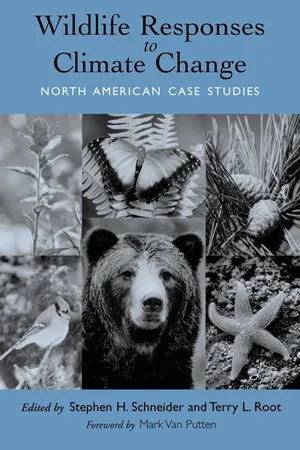
Table of contents

  1. About Island Press
  2. Title Page
  3. Copyright Page
  4. Table of Contents
  5. Foreword
  6. Introduction: The Rationale for the National Wildlife Federation Cohort of Young Scientists Studying Wildlife Responses to Climate Change
  7. Climate Change: Overview and Implications for Wildlife
  8. CHAPTER 1 - Climate Change and Its Effect on Species Range Boundaries: A Case Study of the Sachem Skipper Butterfly, Atalopedes campestris
  9. CHAPTER 2 - Butterflies as Model Systems for Understanding and Predicting Climate Change
  10. CHAPTER 3 - Historical Studies of Species’ Responses to Climate Change: Promise and Pitfalls
  11. CHAPTER 4 - Community Responses to Climate Change: Links between Temperature and Keystone Predation in a Rocky Intertidal System
  12. CHAPTER 5 - Testing Climate Change Predictions with the Subalpine Species Delphinium nuttallianum
  13. CHAPTER 6 - Modeling Potential Impacts of Climate Change on the Spatial Distribution of Vegetation in the United States with a Probabilistic Biogeography Approach
  14. CHAPTER 7 - Climate Change and the Susceptibility of U.S. Ecosystems to Biological Invasions: Two Cases of Expected Range Expansion
  15. CHAPTER 8 - Climate Change, Whitebark Pine, and Grizzly Bears in the Greater Yellowstone Ecosystem
  16. APPENDIX
  17. Conclusion: Climate Change and Wildlife—A Look Ahead
  18. Contributors
  19. Index
  20. Island Press Board of Directors

Frequently asked questions

Yes, you can cancel anytime from the Subscription tab in your account settings on the Perlego website. Your subscription will stay active until the end of your current billing period. Learn how to cancel your subscription
No, books cannot be downloaded as external files, such as PDFs, for use outside of Perlego. However, you can download books within the Perlego app for offline reading on mobile or tablet. Learn how to download books offline
Perlego offers two plans: Essential and Complete
  • Essential is ideal for learners and professionals who enjoy exploring a wide range of subjects. Access the Essential Library with 800,000+ trusted titles and best-sellers across business, personal growth, and the humanities. Includes unlimited reading time and Standard Read Aloud voice.
  • Complete: Perfect for advanced learners and researchers needing full, unrestricted access. Unlock 1.5M+ books across hundreds of subjects, including academic and specialized titles. The Complete Plan also includes advanced features like Premium Read Aloud and Research Assistant.
Both plans are available with monthly, semester, or annual billing cycles.
We are an online textbook subscription service, where you can get access to an entire online library for less than the price of a single book per month. With over 1.5 million books across 990+ topics, we’ve got you covered! Learn about our mission
Look out for the read-aloud symbol on your next book to see if you can listen to it. The read-aloud tool reads text aloud for you, highlighting the text as it is being read. You can pause it, speed it up and slow it down. Learn more about Read Aloud
Yes! You can use the Perlego app on both iOS and Android devices to read anytime, anywhere — even offline. Perfect for commutes or when you’re on the go.
Please note we cannot support devices running on iOS 13 and Android 7 or earlier. Learn more about using the app
Yes, you can access Wildlife Responses to Climate Change by Stephen H. Schneider, Terry Root, Stephen H. Schneider,Terry Root in PDF and/or ePUB format, as well as other popular books in Physical Sciences & Zoology. We have over 1.5 million books available in our catalogue for you to explore.