Some ecosystem management plans established by state and federal agencies have begun to shift their focus away from single-species conservation to a broader goal of protecting a wide range of flora and fauna, including species whose numbers are scarce or about which there is little scientific understanding. To date, these efforts have proved extremely costly and complex to implement. Are there alternative approaches to protecting rare or little-known species that can be more effective and less burdensome than current efforts?
Conservation of Rare or Little-Known Species represents the first comprehensive scientific evaluation of approaches and management options for protecting rare or little-known terrestrial species. The book brings together leading ecologists, biologists, botanists, economists, and sociologists to classify approaches, summarize their theoretical and conceptual foundations, evaluate their efficacy, and review how each has been used.
Contributors consider combinations of species and systems approaches for overall effectiveness in meeting conservation and ecosystem sustainability goals. They discuss the biological, legal, sociological, political, administrative, and economic dimensions by which conservation strategies can be gauged, in an effort to help managers determine which strategy or combination of strategies is most likely to meet their needs. Contributors also discuss practical considerations of implementing various strategies.
Conservation of Rare or Little-Known Species gives land managers access to a diverse literature and provides them with the basic information they need to select approaches that best suit their conservation objectives and ecological context. It is an important new work for anyone involved with developing land management or conservation plans.
eBook - ePub
Conservation of Rare or Little-Known Species
Biological, Social, and Economic Considerations
- 389 pages
- English
- ePUB (mobile friendly)
- Available on iOS & Android
eBook - ePub
Conservation of Rare or Little-Known Species
Biological, Social, and Economic Considerations
About this book
Information
1
Introduction
Conservation and restoration of biological diversity are often-stated objectives of land management. Doubtless, most natural resource managers will say they are achieving those objectives. But how can this be determined? The term “biological diversity” has been given many definitions (see Baydack and Campa 1999 for a listing of 19 alternatives), and most of these emphasize the variety of life and its processes. Much of this variety pertains to various aspects of species—their presence, distribution, occurrence within ecological communities, gene pool diversity, ecological functions, and other parameters—about which we know little, if anything for most species.
What’s in This Book
The authors of this book describe a variety of approaches that move natural resource management toward the goal of achieving biological conservation, particularly species conservation. Natural resource managers usually focus on conservation practices that address only the larger and better-known taxa. This book focuses on the rare or little-known taxa, particularly species.
What is meant by “rare” or “little known”? Figure 1.1 illustrates the set of species the authors are addressing. Consider a large planning area and the assemblage of species that occur there (denoted as set A). Among those species are those that are rare (set B; as described in chap. 3) and those that are little known (set D; as described in chap. 4). One might wish to focus on the set of rare species, which might be at risk due to their small population size and increased vulnerability to disturbance. But one must not ignore the little-known species, because many of these, if we did know more about them, also might prove to be at risk because they are rare or because they are also vulnerable to changes in their environment. Conceptually, it is the combined sets of species B and D that define the group of species we call rare or little known. And perhaps the more vulnerable subset of these species are those that are both rare and little known (species set C; discussed in chap. 5).
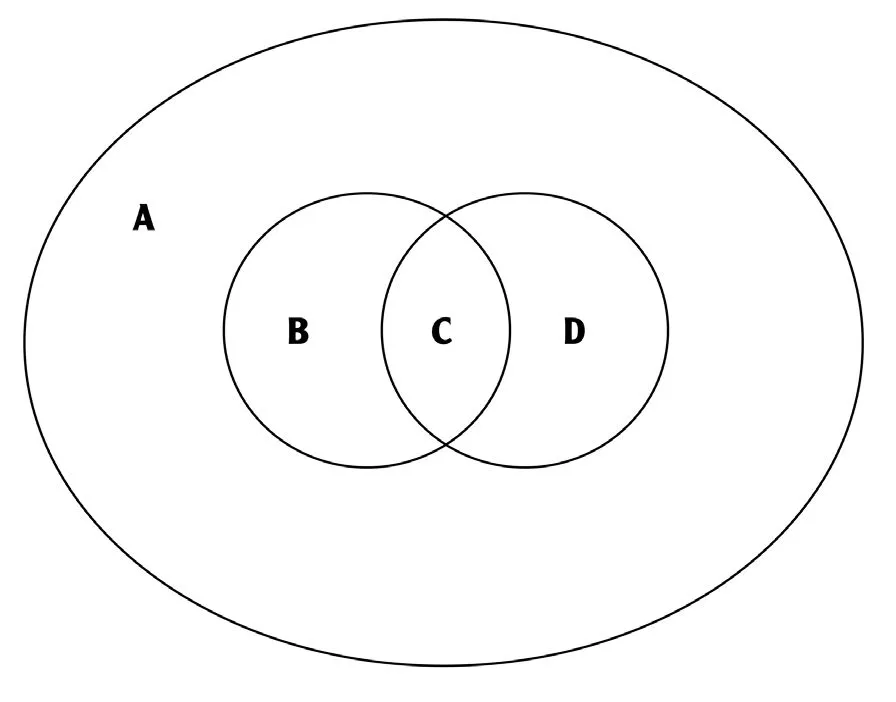
Figure 1.1. The species “universe.” Set A represents all species in a given planning area. Set B represents all species in A that are rare. Set D represents all species in A that are little known. The area of overlap between sets B and D (labeled as C) is the set of species that are both rare and little known. The union of sets B and D is the set of species that are rare or little known.
The authors of this book evaluate how well various conservation approaches provide for rare or little-known species, either directly or indirectly. A few conservation strategies are fairly well aimed at providing for such species, but most focus on other aspects of biological diversity and conserve such species at best opportunistically or incidentally. For these strategies, the bottom line for conserving such species is largely that “it depends” on how the strategies are specified and implemented. The authors discuss the legal, biological, sociological, political, administrative, and economic dimensions by which conservation strategies can be gauged, to help managers determine which strategy or combination of strategies would best meet their goals and objectives. There are no fixed, single, or easy answers.
This book focuses primarily on terrestrial ecosystems and rare or little-known species associated with those systems. However, rarity concepts surely extend to aquatic, riparian, and wetland systems, and the authors provide some examples from these ecosystems when relevant to overall objectives. It is outside the scope of this book, however, to provide detailed discussions of river (fish) and marine issues.
This work was also prompted by the need to provide information on alternative approaches that could complement single-species assessment and management. Taking a strictly species-specific approach has proven difficult and expensive, particularly the collection of basic inventory data (Molina et al. 2006). Alternative ways of managing multiple species, including those rare or little-known, as well as ecological systems under scientifically credible approaches might help complement species-specific approaches currently in use.
How can rare or little-known species be managed effectively? There are many possible approaches to conceptualizing, assessing, managing, and monitoring rare or little-known species. In this book, the authors provide a classification of such approaches, offer a summary of the theoretical and conceptual foundations of each approach, evaluate each approach’s efficacy in conserving rare or little-known species, and review how each has been used in assessments, management plans, and monitoring activities. The goal is to give land managers access to this diverse literature and to provide them with the basic information they need to select those approaches that best suit their conservation objectives and ecological context.
The book suggests an overall procedure by which management approaches can be identified (fig. 1.2). This entails first describing the legal, social, economic, administrative, political, and ecological requirements and considerations for the management question (discussed here and in chap. 2). The next step is to articulate the overall social, economic, and ecological management goals (chap. 2) and then to identify the rare or little-known species to address (chaps. 3, 4, and 5). Then one conducts a risk assessment that identifies key threats to the species and system factors and possible management sideboards (chaps. 6, 7, and 8). From this assessment, one can identify the management approach or combination of approaches that best addresses the specific risk factors (chaps. 6, 7, and 8), and then evaluate the approaches for their social, economic, ecological, and administrative application (chaps. 8, 9, 10, and 11). A final selection of approaches is made (chap. 12), and a program to monitor and evaluate success of meeting the goals is implemented (chaps. 11 and 12). Results of monitoring can be used to revisit the goals, the species selected, the risk assessment, and the set of approaches selected. In the end, our objective is to provide a thorough scientific evaluation of approaches and management options for conserving rare or little-known terrestrial species.

Figure 1.2. Flow chart of the process for selecting and testing alternatives to conservation of rare or little-known species as discussed in this book. A fuller version of this process with explanation of each step is presented in chapter 12.
Why Should Land Managers Care about Conserving Rare or Little-Known Species?
Land managers should be concerned about rare or little-known species for ethical, ecological, and legal reasons.
Rare or Little-Known Species Contribute to Biodiversity
The reasons may mirror the many practical and ethical reasons given for conserving nature itself—preserving potential future sources of drugs and pharmaceuticals, protecting native pollinators of our food plants, “saving all the pieces” to ensure that the system works, acknowledging the “existence value” of other life forms on Earth, and so on. Bolger (2001) pointed out that, although we do not fully understand how biological diversity provides for ecological functions in ecosystems, assuring some level of redundancy in species and their functions, and protecting species that have particularly salient functions (“keystones”), are probably important for maintaining system stability. Until we learn more, Bolger noted, it is prudent to protect all species lest we sacrifice some unknown critical function. This book provides examples of critical functions and the ecological roles of rare or little-known species.
Conservation science is concerned, in part, with anticipating how natural or human-caused disturbance affects the pattern of commonness and rarity among the biota of a given area (Lubchenco et al. 1991; also see chap. 3). The concept of rarity has several definitions in common usage (see chap. 3), but in the lexicon of conservation biology, “rarity” is most simply defined based on the distribution and abundance of a species (Gaston 1994). However, for many taxa we lack basic information on distribution and abundance (Brown and Roughgarden 1990; Flather and Sieg 2000) from which to judge rarity and basic information on life history and ecology. The authors here refer to these species collectively as “little known.” Although it is most certainly true that many little-known species are also rare, there are many examples of little-known species that are likely quite common, such as soil and forest canopy arthropods. As Flather and Sieg discuss in chapter 3, there are different kinds of rarity that may have differing kinds of management implications. Something could be (1) locally common but endemic or highly restricted in spatial distribution, (2) widespread but rare everywhere, (3) a locally rare population of a species that is common elsewhere (i.e., at the edge of the range or an outlying population in a metapopulation, or (4) genetically or behaviorally distinctive.
Rare or Little-Known Species Can Play Key Ecological Roles
Rare or little-known species help provide for productive and diverse ecosystems from which humans can sustainably use renewable natural resources. This is particularly true with native organisms whose roles may be to stave off unwanted invasions by nonnative species; some rare or little-known native organisms provide such ecological services. Rare or little-known species may contribute significantly to the maintenance of ecosystem function (Andrén et al. 1995; Borrvall et al. 2000; Cottingham et al. 2001; Lyons and Schwartz 2001; Lyons et al. 2005), thereby helping to provide the goods and services that humans derive from ecosystems (Chapin et al. 1998).
An example is the set of soil microspiders (“micryphantids” of the family Araneae) that collectively occur in abundance, that consist of many poorly known, undescribed, or possibly rare species, and that are likely important invertebrate predators at a very fine scale. Overall, soil microspiders contribute to the balance of soil food webs and maintenance of nutrient pools, and thus to productivity of soils that in turn provide ecosystem services of growing food crops of commercial interest to people (Mansour and Heimbach 1993). In another example, empirical studies have demonstrated how rare broadleaved plant species can control the abundance of dominant grasses by governing ecosystem processes (Boeken and Shachak 2006). In a review of how biodiversity can affect ecosystem functioning, Hooper et al. (2005) noted in general that even relatively rare species such as keystone predators can strongly influence energy and material flows through an ecosystem.
Likewise, referring to invertebrates, Black (2002, 3) wrote:
Though endangered invertebrates are unlikely to determine the fate of a large ecological system, as a group they may have a large effect. Often, endangered invertebrates are specialists that perform vital ecosystem functions such as pollination or the recycling of nutrients.... Endangered species also may play a linchpin role in small, specialized systems such as caves, oceanic islands, or some pollinator–plant relationships.
... [S]ome endangered species might also provide useful products—such as new defenses against diseases or tools for studying various ecosystem or organismal processes—as well as direct material benefits.
S...
Table of contents
- About Island Press
- Title Page
- Copyright Page
- Table of Contents
- Foreword
- Acknowledgments
- 1 - Introduction
- 2 - Conservation Goals and Objectives
- 3 - Species Rarity: Definition, Causes, and Classification
- 4 - Definitions and Attributes of Little-Known Species
- 5 - Special Considerations for the Science, Conservation, and Management of Rare or Little-Known Species
- 6 - Species-Level Strategies for Conserving Rare or Little-Known Species
- 7 - System-Level Strategies for Conserving Rare or Little-Known Species
- 8 - Effectiveness of Alternative Management Strategies in Meeting Conservation Objectives
- 9 - Social Considerations
- 10 - Economic Considerations
- 11 - Implementation Considerations
- 12 - A Process for Selection and Implementation of Conservation Approaches
- Contributors
- Index
- Island Press Board of Directors
Trusted by 375,005 students
Access to over 1.5 million titles for a fair monthly price.
Study more efficiently using our study tools.
Frequently asked questions
Yes, you can cancel anytime from the Subscription tab in your account settings on the Perlego website. Your subscription will stay active until the end of your current billing period. Learn how to cancel your subscription
No, books cannot be downloaded as external files, such as PDFs, for use outside of Perlego. However, you can download books within the Perlego app for offline reading on mobile or tablet. Learn how to download books offline
Perlego offers two plans: Essential and Complete
- Essential is ideal for learners and professionals who enjoy exploring a wide range of subjects. Access the Essential Library with 800,000+ trusted titles and best-sellers across business, personal growth, and the humanities. Includes unlimited reading time and Standard Read Aloud voice.
- Complete: Perfect for advanced learners and researchers needing full, unrestricted access. Unlock 1.5M+ books across hundreds of subjects, including academic and specialized titles. The Complete Plan also includes advanced features like Premium Read Aloud and Research Assistant.
We are an online textbook subscription service, where you can get access to an entire online library for less than the price of a single book per month. With over 1.5 million books across 990+ topics, we’ve got you covered! Learn about our mission
Look out for the read-aloud symbol on your next book to see if you can listen to it. The read-aloud tool reads text aloud for you, highlighting the text as it is being read. You can pause it, speed it up and slow it down. Learn more about Read Aloud
Yes! You can use the Perlego app on both iOS and Android devices to read anytime, anywhere — even offline. Perfect for commutes or when you’re on the go.
Please note we cannot support devices running on iOS 13 and Android 7 or earlier. Learn more about using the app
Please note we cannot support devices running on iOS 13 and Android 7 or earlier. Learn more about using the app
Yes, you can access Conservation of Rare or Little-Known Species by Martin G. Raphael, Randy Molina, Martin G. Raphael,Randy Molina in PDF and/or ePUB format, as well as other popular books in Biological Sciences & Biology. We have over 1.5 million books available in our catalogue for you to explore.