How can you make a real difference in the world and make a good living at the same time? The ECO Guide to Careers That Make a Difference: Environmental Work for a Sustainable World provides the answer.
Developed by The Environmental Careers Organization (ECO, the creators of the popular Complete Guide to Environmental Careers), this new volume is unlike any careers book you've seen before. Reaching far beyond job titles and resume tips, The ECO Guide immerses you in the strategies and tactics that leading edge professionals are using to tackle pressing problems and create innovative solutions.
To bring you definitive information from the real world of environmental problem-solving, The ECO Guide has engaged some of the nation's most respected experts to explain the issues and describe what's being done about them today. You'll explore: Global climate change with Eileen Claussen, Pew Center for Global Climate Change; Biodiversity loss with Stuart Pimm, Nicholas School for the Environment at Duke University; Green Business with Stuart Hart, Kenan-Flager Business School at University of North Carolina; Ecotourism with Martha Honey, The International Ecotourism Society; Environmental Justice with Robert Bullard, Environmental Justice Center at Clark Atlanta University; Alternative Energy with Seth Dunn, Worldwatch Institute; Water Quality with Sandra Postel, Global Water Policy Project; Green Architecture with William McDonough, McDonough + Partners; and twelve other critical issues.
To demonstrate even more clearly what eco-work feels like on the ground, The ECO Guide offers vivid "Career Snapshots" of selected employers and the professionals that work there. You'll visit government agencies like the USDA Forest Service, nonprofit organizations like Conservation International and Project Wild, and local advocates like Alternatives for Community and Environment. You'll go inside environmental businesses like Wildland Adventures and Stonyfield Farms. And you'll learn from academic institutions like the National Center for Atmospheric Research and the Gund Institute for Ecological Economics.
ECO also identifies and describes forty specific jobs that are representative of environmental career opportunities in the twenty-first century. It provides dozens of the best Internet resources. And most importantly, The ECO Guide offers all of the insight about current trends you expect from ECO, the acknowledged leaders in environmental career information.
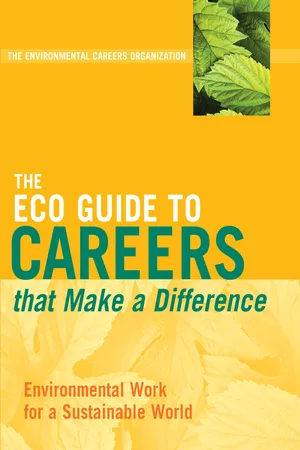
eBook - ePub
The ECO Guide to Careers that Make a Difference
Environmental Work For A Sustainable World
- 320 pages
- English
- ePUB (mobile friendly)
- Available on iOS & Android
eBook - ePub
The ECO Guide to Careers that Make a Difference
Environmental Work For A Sustainable World
About this book
Information
Topic
Personal DevelopmentSubtopic
Business GeneralConversations with the Experts
WORKING THE ISSUES
1. AGRICULTURE AND FOOD SECURITY

Dr. Fred Kirschenmann. Dr. Fred Kirschenmann.
Photo used courtesy
Successful Farming magazine.
A CONVERSATION WITH Fred Kirschenmann
Having spent his life working in the field, literally, as well as on the marketing and sales side of agricultural production, Fred Kirschenmann is keenly aware that modern industrial agricultural practices jeopardize long-term agricultural stability.
He’s hopeful that redesigning of our agricultural system can make us more aware of the “most basic details of our own food production” and also help counter a production system driven mostly by economic forces. “We need to think about where we want to go in the future with agriculture,” Kirschenmann says. “The principles of sustainability must become actualized in ways that will work for farms and farm families.”
Kirschenmann is director of the Leopold Center for Sustainable Agriculture at Iowa State University. He previously managed the 3,500-acre certified organic Kirschenmann Family Farms in North Dakota and was president of Farm Verified Organic, a private organic certification agency. Kirschenmann obtained a Ph.D. in philosophy from the University of Chicago and is the author of numerous articles and book chapters dealing with ethics and agriculture.
What Is the Issue?
As we enter the twenty-first century, modern agriculture stands at a crossroads. We’ve had unprecedented success in increasing the yields of some commodity crops and animal species, largely due to the introduction of hybrid crops and modern technology during the “Green Revolution” in the 1960s. But agriculture is now directly affected by some extraordinary new challenges. These include fossil fuel depletion, environmental degradation, climate change, biodiversity loss, population growth, persistent poverty, and an unprecedented explosion of infectious diseases. Some believe these challenges can be met by developing a new generation of technologies. Others believe that only a new paradigm for food, fiber, and energy production can surmount the challenges ahead.
• Environmental Degradation
Masae Shiyomi and Hiroshi Koizumi argue that two emerging challenges associated with modern agriculture—the depletion of fossil fuels and environmental degradation—will force agriculture to make some dramatic changes in the near future. Modern industrial agriculture is enormously dependent on fossil fuel. We need it to run farm equipment and produce fertilizers and pesticides. But we are currently pumping out of the second half of the oil barrel, making this resource increasingly costly.
At the same time, degradation associated with agriculture is becoming increasingly intolerable, and it is unlikely we can continue ignoring the costs that agricultural wastes impose on others and on the environment. There are now at least fifty hypoxic zones on the planet, which are areas where excess algae growth has robbed coastal waters of enough oxygen to support most marine animals. All of these areas are associated with nutrient pollution from industrial agriculture regions.
At the same time, environmental change is posing new challenges to agriculture. For example, climate change impacts on agriculture are becoming apparent. A recent Iowa State University study projects that the Upper Mississippi River Basin is likely to see precipitation increases of 21 percent by 2050, causing surface runoff increases of up to 51 percent. Such runoff would dramatically increase soil erosion and nutrient pollution.
According to Lester R. Brown, writing in Eco-Economy: Building an Economy for the Earth, some 36 percent of the world’s cropland is already losing topsoil at rates that are undermining productivity. In short, modern agriculture is possible because of abundant, cheap natural resources, like fossil fuels and virgin soils that are now in a state of depletion, and because of natural sinks that absorb wastes, although these sinks are now saturated. Neither can be relied upon to subsidize production systems indefinitely.
Additionally, an unprecedented explosion of infectious diseases, mostly caused by ecological impact, presents further unique challenges because of concentrated animal agriculture systems. According to writer Mark Walters, writing in Orion, “Crammed into factory farms, pigs and poultry live in the equivalent of a Petri dish,” which is an ideal environment for disease.
• Biodiversity Loss and Genetic Uniformity
In the interest of maximizing efficiency, virtually every modern agricultural production system has become specialized to produce just one crop. These specialized systems, called monocultures, significantly decrease biodiversity. By some estimates, traditional agriculture once used 80,000 plant varieties for food production. Today, 80 to 90 percent of the world’s calories are produced from just ten or twenty crops. Animal diversity has been similarly compromised. Increasingly narrow production specifications are to blame and have seriously compromised the gene pool. Ecologist Norman Myers even suggests that wheat could become an endangered species “because of a protracted breeding trend toward genetic uniformity” that has caused wheat to lose “the great bulk of its populations.” Consequently, wild strains and genetic diversity are almost nonexistent.
Unfortunately, U.S. political efforts have not encouraged the maintenance of broad-based genetic seed stocks. The recently debated energy bill, for example, contained provisions supporting greater production of ethanol, a product based on corn, a staple of monoculture farming. This is just one example of government policy that is completely at odds with sound ecological thinking.
• Pest Management
Increasingly, agriculturalists have recognized that managing farms in an industrial manner produces numerous problems. For example, Joe Lewis, pest management specialist with the U.S. Department of Agriculture (USDA), points out that applying pesticides to solve pest problems is not sustainable. This “solution” ignores basic ecological principles and dynamics that cause pest emergence and also leaves systems ripe for resurgence. Since all organisms develop defenses against threats to their existence, we then apply even more lethal pesticides to surviving pests, often resulting in harmful consequences to other organisms. All too often, the solution becomes part of the problem.
At the same time, applying fertilizers to maintain crop yields also masks poor soil management, causing erosion and compromising soil quality. Inevitably, we must then increase fertilizer use as counteraction. Furthermore, concentrating livestock in one place produces excess manure that can’t be economically transported to fields where manure would be a welcome source of fertility. Applying inappropriately high rates in one location and then purchasing synthetic fertilizers in another leads to increased nutrient runoff, which contributes to impaired water systems.
• Economic Costs
The farm sector of agriculture is in crisis even without counting the costs of environmental damage, which are either subsidized by taxpayers or simply never accounted for at all. In fact, if it weren’t for huge government subsidies, most farmers couldn’t afford to pay their bills. Ever since the 1980s government subsidies have comprised a significant portion of net farm income. In 1993, for example, government subsidies accounted for 143 percent of Iowa farmers’ net farm income.
These economic situations have multiple causes, but chief among them is the cost of input-dependent industrial agriculture, market structures that leave farmers without power to negotiate cost-of-production prices, and public policies that favor agribusiness corporations—all issues that significantly impact small farmers. Furthermore, these situations may be among the principal reasons that few farmers have used direct marketing strategies or have transitioned to producing higher-value products such as salad greens or herbs or high-value meat products such as grass-fed organic instead of continuing to produce undifferentiated commodities such as feed corn.
• Bioterrorism
These problems are compounded by potential threats of bioterrorism to food security. According to David Orr, a society fed by a few “mega farms” is much more vulnerable to disruption than a society with many smaller and widely dispersed farms. Farms that rely on long-distance transport must guard supplies carefully, but often the military’s capability to do so is ecologically costly, contributing to more vulnerability. As Orr writes, “In short, no society that relies on distant food, energy, and materials sources or heroic feats of technology can be secured indefinitely.” His observations coincide with Yale sociologist Charles Perrow’s views. Perrow points out that in large, complex, and tightly coupled systems, accidents that generally occur in any system will always become catastrophes because of vulnerability. This is not the case in smaller, dispersed systems.
• Persistent Poverty and Food Insecurity
Now more than ever, the global community is recognizing and demanding that food is a basic human right. Worldwide, we are faced with continued, often dramatic, population growth, mostly in regions beset with poverty. The United Nations estimates that the world’s population will reach 9.3 billion by the year 2050. Most of the additional 3.2 billion people will live in poor rural areas in the developing world. World poverty rates are increasing at 100 million people per decade. Nearly half of the planet’s 6 billion people now live on less than two dollars a day.
Hunger and famine are directly associated with population growth and persistent poverty, although they are caused by many more, enormously complex factors. For example, Barry Berak points out that Africa’s paralyzing debt, sorry infrastructure, depleted soil, meager exports, bad government, and ethnic neglect all contribute to these problems. Simply inventing costly new technologies to increase productivity in the developed world, where overproduction already forces farmers to accept profits well below the cost of production, will not solve this problem. More creative agricultural solutions are needed in order to feed the increasing world population and equitably distribute the world food supply.
How Are Environmental Professionals Approaching the Issue?
A recent National Academy of Sciences report, Frontiers in Agricultural Research: Food, Health, Environment and Communities, recommended that the USDA shift the emphasis of its $2 billion annual research budget from increasing food and fiber production to promoting environmentally sound farming alternatives, higher quality of life in rural communities, better diet and health, increased food safety, and a softer impact of globalization on U.S. farming. This report also suggested that scientists see a need to shift to more ecologically based agricultural approaches. But currently few scientists are trained to address food and farming issues from this perspective, and few farmers have practical knowledge in applying this approach...
Table of contents
- About Island Press
- About The Environmental Careers Organization (ECO)
- THE ENVIRONMENTAL CAREERS ORGANIZATION
- Title Page
- Copyright Page
- Table of Contents
- Preface
- Acknowledgments
- Featured Jobs
- Career Spotlights
- Introduction
- Sector by Sector Snapshot of Environmental Careers Today
- Building Your Environmental Career
- Conversations with the Experts - WORKING THE ISSUES
- Index
- Island Press Board of Directors
Trusted by 375,005 students
Access to over 1.5 million titles for a fair monthly price.
Study more efficiently using our study tools.
Frequently asked questions
Yes, you can cancel anytime from the Subscription tab in your account settings on the Perlego website. Your subscription will stay active until the end of your current billing period. Learn how to cancel your subscription
No, books cannot be downloaded as external files, such as PDFs, for use outside of Perlego. However, you can download books within the Perlego app for offline reading on mobile or tablet. Learn how to download books offline
Perlego offers two plans: Essential and Complete
- Essential is ideal for learners and professionals who enjoy exploring a wide range of subjects. Access the Essential Library with 800,000+ trusted titles and best-sellers across business, personal growth, and the humanities. Includes unlimited reading time and Standard Read Aloud voice.
- Complete: Perfect for advanced learners and researchers needing full, unrestricted access. Unlock 1.5M+ books across hundreds of subjects, including academic and specialized titles. The Complete Plan also includes advanced features like Premium Read Aloud and Research Assistant.
We are an online textbook subscription service, where you can get access to an entire online library for less than the price of a single book per month. With over 1.5 million books across 990+ topics, we’ve got you covered! Learn about our mission
Look out for the read-aloud symbol on your next book to see if you can listen to it. The read-aloud tool reads text aloud for you, highlighting the text as it is being read. You can pause it, speed it up and slow it down. Learn more about Read Aloud
Yes! You can use the Perlego app on both iOS and Android devices to read anytime, anywhere — even offline. Perfect for commutes or when you’re on the go.
Please note we cannot support devices running on iOS 13 and Android 7 or earlier. Learn more about using the app
Please note we cannot support devices running on iOS 13 and Android 7 or earlier. Learn more about using the app
Yes, you can access The ECO Guide to Careers that Make a Difference by Kevin Environmental Careers Organization in PDF and/or ePUB format, as well as other popular books in Personal Development & Business General. We have over 1.5 million books available in our catalogue for you to explore.