Let's get dirty. In childhood, the back yard, the flowerbed, the beach, the mucky place where land slips into puddles, lakes, and streams are infinitely fascinating. It is a mistake to leave that "childish" fascination with mud and dirt behind. The soils of the Earth, whether underneath our feet or pressurized beneath tons of ocean water, hold life in abundance. A handful of garden dirt may harbor more species than the entire aboveground Amazon.
The robotic rovers Spirit and Opportunity made headlines as they scraped their way across the Martian landscape, searching for signs of life. But while our eyes have been turned toward the skies, teeming beneath us and largely unexplored lies what Science magazine recently called the true "final frontier." A growing array of scientists is exploring life in soils and sediments, uncovering a living world literally alien to our own senses--and yet one whose integrity turns out to be crucial to life above ground.
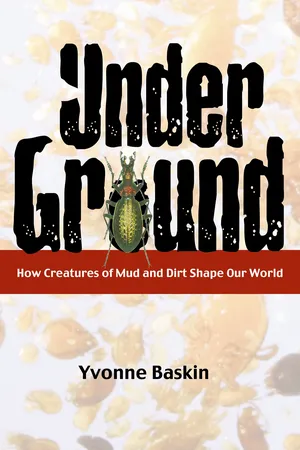
Yvonne Baskin takes the reader from the polar desert of Antarctica to the coastal rain forests of Canada, from the rangelands of Yellowstone National Park to the vanishing wetlands of the Mississippi River basin, from Dutch pastures to English sounds, and beyond. She introduces exotic creatures--from bacteria and fungi to microscopic nematode worms, springtails, and mud shrimp--and shows us what scientists are learning about their contribution to sustaining a green and healthy world above ground. She also explores the alarming ways in which air pollution, trawl fishing, timber cutting, introductions of invasive species, wetland destruction, and the like threaten this underground diversity and how their loss, in turn, affects our own well being.
Two-thirds of the world's biological diversity exists in soils and underwater sediments, and yet most of us remain unaware of these tiny multitudes that run the planet beneath the scenes. In Under Ground, Baskin reveals the startling ways in which that life, whether in our own back yards, in fields and forests, or in the furthest reaches of the Earth, is more numerous, significant, and fascinating than we once imagined.
- 246 pages
- English
- ePUB (mobile friendly)
- Available on iOS & Android
eBook - ePub
About this book
Trusted by 375,005 students
Access to over 1.5 million titles for a fair monthly price.
Study more efficiently using our study tools.
Information
Notes
I. INTRODUCTION: Opening the Black Box
1
Kerr, R. A. 2004. Opportunity tells a salty tale. Science 303: 1957.
2
Merriam-Webster’s Collegiate Dictionary, Eleventh Edition. 2003. Springfield, MA: Merriam-Webster, Inc.
3
Richter, D. D. and D. Markewitz. 1995. How deep is soil? BioScience 45: 600–609. Quote p. 600.
4
Usher, M. B. 1985. Population and community dynamics in the soil ecosystem. In Ecological Interactions on Soil: Plants, Microbes and Animals, ed. A. H. Fitter, 243–265. Oxford: Blackwell Scientific.
5
Brussaard, L. et al. 1997. Biodiversity and ecosystem functioning in soil. Ambio 26: 563–570.
6
Snelgrove, P. R. et al. 1997. The importance of marine sediment biodiversity in ecosystem processes. Ambio 26: 578–583.
7
Wilson, E. O. 1997. The little things that run the world: the importance and conservation of invertebrates. Conservation Biology 1: 344–346.
8
Soil Quality Institute, U.S. Department of Agriculture, Soil Biology Quick Facts, online at http://soils.usda.gov/sqi/soil_quality/soil_biology/index.html.
9
Whitman, W. B., D. C. Coleman, and W. J. Wiebe. 1998. Prokaryotes: the unseen majority. Proceedings of the National Academy of Sciences 95: 6578–6583.
10
Gross, M. 1996. Life on the Edge: Amazing Creatures Thriving in Extreme Environments. Cambridge, MA: Perseus Books.
11
Treonis, A. M., D. H. Wall, and R. A. Virginia. 2000. The use of anhydrobiosis by soil nematodes in the Antarctic Dry Valleys. Functional Ecology 14: 460–467.
12
Smith, M. L., J. N. Bruhn, and J. B. Anderson. 1992. The fungus Armillaria bulbosa is among the largest and oldest living organisms. Nature 356: 428–431.
13
Ferguson, B. A. et al. 2003. Coarse-scale population structure of pathogenic Armillaria species in a mixed-conifer forest in the Blue Mountains of northeast Oregon. Canadian Journal of Forestry Research 33: 612–623.
14
Coleman, D. C. and D. A. Crossley Jr. 1996. Fundamentals of Soil Ecology. San Diego: Academic Press.
15
Wilson, The little things that run the world.
16
Wall, D. H., A. Fitter, and E. A. Paul. In press. Developing new perspectives from advances in soil biodiversity research. In Biological Diversity and Function in Soils, ed. R. D. Bardgett, M. B. Usher, and D. W. Hopkins. Cambridge, U.K.: Cambridge University Press.
17
Daily, G. C. 1995. Restoring value to the world’s degraded lands. Science 269: 350–354.
18
Pimentel, D. et al. 1995. Environmental and economic costs of soil erosion and conservation benefits. Science 267: 1117–1123. But see also Kaiser, J. 2004. Wounding earth’s fragile skin. Science 304: 1616–1618.
19
Wall, D. H., G. Adams, and A. N. Parsons. 2001. Soil biodiversity. In Global Biodiversity in a Changing Environment: Scenarios for the 21st Century, ed. F. S. Chapin III, O. E. Sala, and E. Huber-Sannwald, 47–82. Berlin: Springer-Verlag.
20
For example, the member nations of the Convention on Biological Diversity (CBD) decided at the 6th Conference of the Parties meeting in Nairobi in April 2002 (COP decision VI/5, paragraph 13) “to establish an International Initiative for the Conservation and Sustainable Use of Soil Biodiversity as a cross-cutting initiative within the programme of work on agricultural biodiversity, and invites the Food and Agriculture Organization of the United Nations, and other relevant organizations, to facilitate and coordinate this initiative.” See the CBD Web site at http://www.biodiv.org/default.aspx and the FAO Web site at http://www.fao.org/ag/agl/agll/soilbiod/fao.stm.
21
Baskin, Y. 1997. The Work of Nature: How the Diversity of Life Sustains Us. Washington, D.C.: Island Press; and Baskin, Y. 2002. A Plague of Rats and Rubbervines: The Growing Threat of Species Invasions. Washington, D.C.: Island Press/Shearwater Books.
22
Wall, D. H., ed. 2004. Sustaining Biodiversity and Ecosystem Services in Soils and Sediments. Washington, D.C.: Island Press.
23
Ward, P. D. and D. Brownlee. 2002. The Life and Death of Planet Earth. New York: Times Books.
24
Fortey, R. 1998. Life: A Natural History of the First Four Billion Years of Life on Earth. New York: Alfred A. Knopf. Quote p. 49.
25
Schwartzman, D. W. and T. Volk. 1989. Biotic enhancement of weathering and the habitability of Earth. Nature 340: 457–460.
26
Coleman and Crossley, Fundamentals of Soil Ecology.
27
Pimentel, D. et al. 1993. Soil erosion and agricultural productivity. In World Soil Erosion and Conservation, ed. D. Pimentel, 277–292. Cambridge, UK: Cambridge University Press.
28
Coleman and Crossley, Fundamentals of Soil Ecology.
29
Richter and Markewitz, How deep is soil?
II. Where Nematodes Are Lions
1
I visited Antarctica in the 2003–2004 season as a participant in the National Science Foundation’s Antarctic Artists and Writers Program.
2
For an overview of the Taylor Valley ecosystems, see the six articles in a Special Section on the McMurdo Dry Valleys, BioScience 49 (12), December 1999.
3
Baldwin, J. G., S. A. Nadler, and D. H. Wall. 1999. Nematodes: Pervading the Earth and linking all life. In Nature and Human Society: The Quest for a Sustainable World, ed. P. H. Raven and T. Williams, 176–191. Washington, D.C.: National Academy Press.
4
Barrett, J. E. et al. 2004. Variation in biogeochemistry and soil biodiversity across spatial scales in a polar desert ecosystem. Ecology 85: 3105–3118.
5
Scott, R. F. 1905. The Voyage of the Discovery, Vol. II. London: Macmillan.
6
Dougherty, E. C. and L. G. Harris. 1963. Antarctic Micrometazoa: Fresh-water species in the McMurdo...
Table of contents
- Title Page
- A SHEARWATER BOOK
- Under Ground - How Creatures of Mud and Dirt Shape Our World
- Copyright Page
- Table of Contents
- I - INTRODUCTION
- II - Where Nematodes Are Lions
- III - Of Ferns, Bears, and Slime Molds
- IV - The Power of Ecosystem Engineers
- V - Plowing the Seabed
- VI - Microbes, Muck, and Dead Zones
- VII - Fungi and the Fate of Forests
- VIII - Grazers, Grass, and Microbes
- IX - Restoring Power to the Soil
- Epilogue
- Notes
- Acknowledgments
- Index
Frequently asked questions
Yes, you can cancel anytime from the Subscription tab in your account settings on the Perlego website. Your subscription will stay active until the end of your current billing period. Learn how to cancel your subscription
No, books cannot be downloaded as external files, such as PDFs, for use outside of Perlego. However, you can download books within the Perlego app for offline reading on mobile or tablet. Learn how to download books offline
Perlego offers two plans: Essential and Complete
- Essential is ideal for learners and professionals who enjoy exploring a wide range of subjects. Access the Essential Library with 800,000+ trusted titles and best-sellers across business, personal growth, and the humanities. Includes unlimited reading time and Standard Read Aloud voice.
- Complete: Perfect for advanced learners and researchers needing full, unrestricted access. Unlock 1.5M+ books across hundreds of subjects, including academic and specialized titles. The Complete Plan also includes advanced features like Premium Read Aloud and Research Assistant.
We are an online textbook subscription service, where you can get access to an entire online library for less than the price of a single book per month. With over 1.5 million books across 990+ topics, we’ve got you covered! Learn about our mission
Look out for the read-aloud symbol on your next book to see if you can listen to it. The read-aloud tool reads text aloud for you, highlighting the text as it is being read. You can pause it, speed it up and slow it down. Learn more about Read Aloud
Yes! You can use the Perlego app on both iOS and Android devices to read anytime, anywhere — even offline. Perfect for commutes or when you’re on the go.
Please note we cannot support devices running on iOS 13 and Android 7 or earlier. Learn more about using the app
Please note we cannot support devices running on iOS 13 and Android 7 or earlier. Learn more about using the app
Yes, you can access Under Ground by Yvonne Baskin,Scope in PDF and/or ePUB format, as well as other popular books in Biological Sciences & Biology. We have over 1.5 million books available in our catalogue for you to explore.