The face of the pedestrian safety crisis looks a lot like Ignacio Duarte-Rodriguez. The 77-year old grandfather was struck in a hit-and-run crash while trying to cross a high-speed, six-lane road without crosswalks near his son’s home in Phoenix, Arizona. He was one of the more than 6,000 people killed while walking in America in 2018. In the last ten years, there has been a 50 percent increase in pedestrian deaths.
The tragedy of traffic violence has barely registered with the media and wider culture. Disproportionately the victims are like Duarte-Rodriguez—immigrants, the poor, and people of color. They have largely been blamed and forgotten.
In Right of Way, journalist Angie Schmitt shows us that deaths like Duarte-Rodriguez’s are not unavoidable “accidents.” They don’t happen because of jaywalking or distracted walking. They are predictable, occurring in stark geographic patterns that tell a story about systemic inequality. These deaths are the forgotten faces of an increasingly urgent public-health crisis that we have the tools, but not the will, to solve.
Schmitt examines the possible causes of the increase in pedestrian deaths as well as programs and movements that are beginning to respond to the epidemic. Her investigation unveils why pedestrians are dying—and she demands action. Right of Way is a call to reframe the problem, acknowledge the role of racism and classism in the public response to these deaths, and energize advocacy around road safety. Ultimately, Schmitt argues that we need improvements in infrastructure and changes to policy to save lives.
Right of Way unveils a crisis that is rooted in both inequality and the undeterred reign of the automobile in our cities. It challenges us to imagine and demand safer and more equitable cities, where no one is expendable.
eBook - ePub
Right of Way
Race, Class, and the Silent Epidemic of Pedestrian Deaths in America
- 229 pages
- English
- ePUB (mobile friendly)
- Available on iOS & Android
eBook - ePub
About this book
Information
Chapter 1
The Geography of Risk
Saa’mir Williams was just seven months old when his mother pushed him in a stroller to the corner of Roosevelt Boulevard in Philadelphia the night of July 9, 2013, and paused to look for an opening in traffic.
Saa’mir was a doted-on baby brother, the youngest of four sons to Samara Banks, a twenty-seven-year-old daycare teacher. That night, the whole family was together, waiting at the curb, bound for their apartment across the street in the Feltonville neighborhood. The oldest boy, Saa’yon Griffin, was just five years old.
They were headed home from a party at a relative’s house nearby that Saturday night at the height of summer. It was close to 10 p.m. There had been a water fight at the party, and everyone was tired and happy as they approached the road.
To live near Roosevelt Boulevard, Philadelphia’s most notorious street, is to live in the shadow of a serial killer, however. Every year, an average of twelve people die along Roosevelt’s fifteen-mile-long passage through the city.
Standing on the side of its roaring twelve lanes, it is easy to see why. The boulevard is a jumble of access roads and turn lanes. It stretches about three hundred feet across, about the length of a football field. Roosevelt would take well over one minute for a fit, younger man walking at an average speed to cross. That is a long time to be exposed to traffic traveling near the posted speed limit: 45.1
For Philadelphians living nearby, a high-stakes game of Frogger stands between them and their work or the things they need every day. Roosevelt has every kind of risk factor that makes a street deadly for pedestrians.
As the Banks family made their way home that July 2013 night, two men—Khusen Akhmedov, age twenty-three, and Ahmen Holloman, thirty2—were speeding down Roosevelt, one man driving an Audi and the other a souped-up Honda. The pair had been drag racing for miles, weaving in and out of lanes as fast as 79 miles per hour.
Witnesses would later testify that they heard a loud boom. “They saw stuff in the air,” said Latanya Byrd, Samara Banks’s aunt. “They thought it was debris. They had no idea.”3
When Banks and her sons were struck, the cars were going as fast as 70 miles per hour. The force of the blow was catastrophic. The bodies of Banks, baby Saa’mir, almost-two-year-old Saa’sean, and four-year-old Saa’deem were thrown as far as 210 feet, according to reports.4
Shortly after the crash, Byrd remembers getting a call from a cousin. “I got to the scene and I just seen cars blocking off the road,” she said. “My husband and I couldn’t get through. Me and my daughter just ran toward wherever it was. They would not let us get to her. They covered her up.”5
The boys lived long enough to be transported to the hospital. After that, the family was never allowed to see Samara or her three youngest boys again. Their faces and bodies were too badly disfigured. “To identify them, they just took a picture, maybe a partial of their face,” said Byrd.6
Saa’yon, five years old at the time, was the only survivor. Akhmedov, an ambulance driver, was charged and convicted of third-degree murder and sentenced to seventeen to thirty-four years in prison.7 The sentence—but not the conviction—was overturned on appeal in 2017, however.8
This notorious crash—the near annihilation of a whole family, three of them children under age five—was a galvanizing case in Philadelphia, but it was just the tip of the iceberg in many ways. Roosevelt Boulevard sees about seven hundred total crashes annually. In 2018, it was the site of an astronomical twenty-one deaths—about one in five of the traffic fatalities that occurred within the city of Philadelphia.9
Pedestrian deaths are not random. They happen in geographic clusters, at intersections, and they happen along radiant lines—on thoroughfares like Roosevelt Boulevard.
In the planning industry, these kinds of roads are called suburban arterials: wide, high-speed roads that have a lot of commercial and residential destinations that people want to access on foot or wheelchair. In the United States, a majority of pedestrian fatalities—52 percent—occur on these kinds of roads, according to Smart Growth America.10
In Denver, For another example, 50 percent of all traffic fatalities occur on twenty-seven corridors, or 5 percent of the street network.11 In Albuquerque, the story is much the same, with 64 percent of traffic fatalities occurring on 7 percent of the city’s roads.12 Planners call this kind of cluster a high-crash network. Almost every city has at least one road like Roosevelt.
For example, in Rockford, Illinois, just three roads account for 40 percent of all pedestrian crashes, and one road accounts for almost one-fourth of them.13
Pedestrian deaths, in other words, are a design problem. Certain streets are designed to kill.
“If you map out where those deaths are happening, they’re not for the most part in downtowns or neighborhoods,” said Emiko Atherton, director of the National Complete Streets Coalition. “They’re on these roads that were never intended for people to walk on.”14
After her niece’s death, Latanya Byrd became an advocate for safer streets in Philadelphia. She joined with other Philadelphians who lost family members to car crashes and helped found a group called Families for Safe Streets Greater Philadelphia (FSSGP) to advocate for safety improvements. Together they lobbied for three years in Harrisburg, the state capital, and at home in Philadelphia to add automated speed cameras on Roosevelt. Speed cameras have been shown to reduce fatalities as much as 55 percent in cities like New York15 and might have prevented the racing incident that killed most of Banks’s young family.
After the years-long campaign, including testimony from Byrd in Harrisburg, Families for Safe Streets finally prevailed, winning special permission to install a limited number of speed cameras on Roosevelt Boulevard only. The first ones went live in late 2019.16
Philadelphia has long-term plans for more dramatic changes to Roosevelt, but that street will be tricky and expensive to change because it has so many driveways and lanes. In the meantime, a traffic light with bright lighting was added where Banks and her boys were killed. Philadelphia even renamed the passage “Banks Way.”
“Gaps” in the Infrastructure
The Roosevelt Boulevard of Rockford, Illinois, is called State Street. In 2018, Michael Smith, a graduate student at the University of Illinois, conducted a study to find out why this five-lane federal highway was so deadly. Smith installed cameras along key intersections and recorded pedestrian behavior. He found that many pedestrians were “breaking the rules,” but it turned out that in a lot of locations, that behavior had a rational explanation: the infrastructure was hostile.
State Street serves as an important commercial corridor for the region, but its land use is suburban. Pedestrians have to navigate a collision course of commercial driveways and parking lots to report for their shift, grab a burger, or buy a bag of diapers. Sidewalks are intermittent, beginning and ending at random points. The traffic signals on State Street in the area Smith examined do not even have walk signals. And bus stops were mostly just a pole in the ground.17
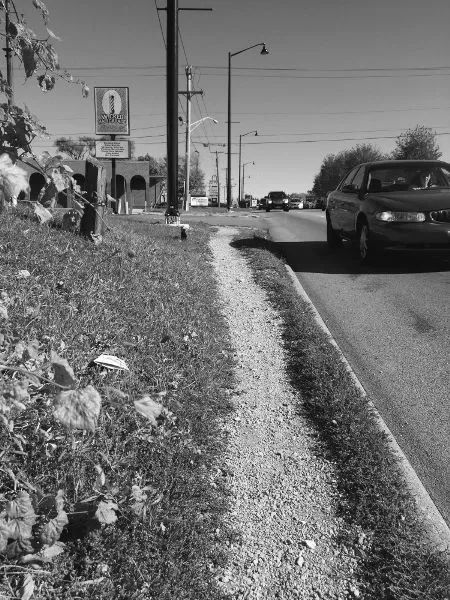
Pedestrians have worn a path in the sidewalk beside State Street, the most dangerous road in Rockford, Illinois. (Photo: Michael Smith)
Smith’s video footage showed that pedestrians were adapting their behavior to the environment. In one video, a man in a wheelchair is seen rolling out to the intersection of Longwood and State. He reaches the curb and then turns around, rolls off into a gas station driveway, and then rolls into the street. For a few moments he rolls right along the curb in the street, mixing with car traffic, before turning the corner and rolling up to the intersection again.
Smith saw wheelchair users perform this same maneuver over and over again. He noted that there is an affordable senior housing complex near the intersection, but there is no curb ramp at the intersection that could accommodate wheelchairs.
Again and again on State Street, Smith found that the infrastructure was failing people who were vulnerable. The situation was similar at bus stops, where pedestrians were put in a dangerous position by the lack of amenities. Rather than stand on the side of the road next to a pole in the grass in the rain or the hot sun without a place to sit, for example, bus riders would wait under an awning of a nearby business. “And then the moment a bus would come, you’d see a mid-block crossing, running across the street,” Smith said in 2018.18 Many bus riders in Rockford rely on buses that come just once an hour, which adds to the pressure to dash across the busy street to avoid missing their connection.
Thanks in part to these conditions, State Street sees only about one hundred pedestrians a day, and the people who walk along the street are not powerful politically. Rather, they are struggling to survive on the margins of a transportation system not designed with them in mind. Some engineers might even argue that such a small number is not worth the trouble of accommodating.
But ignoring the needs of these pedestrians turns out to be very dangerous. “When you take 100 persons a day, 365 days a year you get some statistical likelihood that there’s going to be an accident,” Smith said.19
There is a lot that can be done to repair roads like Roosevelt and State, however.
New York City’s “Boulevard of Death”
Not too long ago, New York City’s Roosevelt Boulevard equivalent—Queens Boulevard—was known locally as the Boulevard of Death. Between 1990 and 2014, 189 people—predominately pedestrians—were killed on this ten-lane raceway through some of the most densely populated, most transit-dependent neighborhoods in the United States.
But in 2014, city officials overhauled the road. They painted the outside lane green and added plastic bollards—a series of evenly spaced posts—creating a protected bike lane. On the curbside, they added a red-painted lane reserved for city buses. The redesign was cheap—according to the New York Times, the cost was just $4 million20—but it was remarkably effective. There was not a single traffic fatality on the road following the redesign until 2018.21
To reduce pedestrian deaths, roads like Queens Boulevard—and State Street and Roosevelt Boulevard—need to be fixed. The kinds of issues Smith documented—the dangerous gaps in the pedestrian infrastructure—need to be resolved, and vehicle speed...
Table of contents
- Cover
- Title Page
- Copyright Page
- Contents
- Author’s Note
- Foreword by Charles T. Brown
- Introduction: Outline of an Epidemic
- Chapter 1: The Geography of Risk
- Chapter 2: The Profile of a Victim
- Chapter 3: Blaming the Victim
- Chapter 4: The Criminalization of Walking
- Chapter 5: Killer Cars
- Chapter 6: The Ideology of Flow
- Chapter 7: A Hard Right Turn
- Chapter 8: Pedestrian Safety on the Technological Frontier
- Chapter 9: The International Context
- Chapter 10: Families for Safe Streets
- Conclusion
- Acknowledgments
- Notes
- About the Author
Trusted by 375,005 students
Access to over 1.5 million titles for a fair monthly price.
Study more efficiently using our study tools.
Frequently asked questions
Yes, you can cancel anytime from the Subscription tab in your account settings on the Perlego website. Your subscription will stay active until the end of your current billing period. Learn how to cancel your subscription
No, books cannot be downloaded as external files, such as PDFs, for use outside of Perlego. However, you can download books within the Perlego app for offline reading on mobile or tablet. Learn how to download books offline
Perlego offers two plans: Essential and Complete
- Essential is ideal for learners and professionals who enjoy exploring a wide range of subjects. Access the Essential Library with 800,000+ trusted titles and best-sellers across business, personal growth, and the humanities. Includes unlimited reading time and Standard Read Aloud voice.
- Complete: Perfect for advanced learners and researchers needing full, unrestricted access. Unlock 1.5M+ books across hundreds of subjects, including academic and specialized titles. The Complete Plan also includes advanced features like Premium Read Aloud and Research Assistant.
We are an online textbook subscription service, where you can get access to an entire online library for less than the price of a single book per month. With over 1.5 million books across 990+ topics, we’ve got you covered! Learn about our mission
Look out for the read-aloud symbol on your next book to see if you can listen to it. The read-aloud tool reads text aloud for you, highlighting the text as it is being read. You can pause it, speed it up and slow it down. Learn more about Read Aloud
Yes! You can use the Perlego app on both iOS and Android devices to read anytime, anywhere — even offline. Perfect for commutes or when you’re on the go.
Please note we cannot support devices running on iOS 13 and Android 7 or earlier. Learn more about using the app
Please note we cannot support devices running on iOS 13 and Android 7 or earlier. Learn more about using the app
Yes, you can access Right of Way by Angie Schmitt in PDF and/or ePUB format, as well as other popular books in Social Sciences & Architecture General. We have over 1.5 million books available in our catalogue for you to explore.