How do we make sense of the world's different religions?In today's globalized society, religion is deeply intertwined with every issue we see on the news. But talking about multiple religions can be contentious. Are different faiths compatible somehow? And how can we know whether one religion is more true than another? In this creative thought experiment, Peter Kreeft invites us to encounter dialogues on the world's great faiths. His characters Thomas Keptic and Bea Lever are students in Professor Fesser's course on world religions, and the three explore the content and distinctive claims of each. Together they probe the plausibility of major religions, from Hinduism and Buddhism to Christianity and Islam. Along the way they explore howreligions might relate to each other and to what extent exclusivism or inclusivism might make sense. Ultimately Kreeft gives us helpful tools for thinking fairly and critically about competing religious beliefs. If the religions are different kinds of music, do they together make harmony or cacophony? Decide for yourself.
eBook - ePub
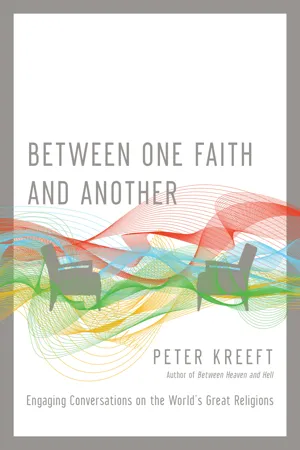
Between One Faith and Another
Engaging Conversations on the World's Great Religions
- 217 pages
- English
- ePUB (mobile friendly)
- Available on iOS & Android
eBook - ePub
About this book
Information
Topic
Theology & ReligionSubtopic
Christian Ministry1
WHAT IS RELIGION?
The Problem of Definition
Bea and Thomas have just come from the first class in Professor Fesser’s course on world religions.
Thomas: | Well, that was a surprise! |
Bea: | To me too, frankly. I think I’m going to drop this course. |
Thomas: | Oh. Apparently your surprise was the opposite of mine. I didn’t think I was going to stay, but now I think I am. I thought the professor would be vague, but he’s not. He made us think. |
Bea: | You think he made us think just because he asked a question we couldn’t answer and then shot down all our answers and left us hanging? |
Thomas: | Yes! That’s exactly what Socrates used to do. And it’s a lot harder than most people think it is. And more valuable. |
Bea: | But it didn’t help us to understand the thing we all came there to understand. |
Thomas: | What thing is that? |
Bea: | The religions of the world. That’s the course title, after all. |
Thomas: | And that’s what the professor talked about. So what’s your complaint? |
Bea: | He proved that we didn’t even know what the word religion meant. So we don’t even know what we mean when we call these things religions. If we can’t even define the most basic term in the course, why bother taking a course in it? It’s ridiculous. Throughout history we keep having arguments about religion, and we fight wars to the death about religion, but we don’t even know what it is, what we’re fighting about! It’s ridiculous. |
Thomas: | I quite agree that that’s ridiculous. So let’s make it less ridiculous. |
Bea: | How? |
Thomas: | Don’t you think we made any progress in doing that today? |
Bea: | In understanding the religions of the world, the thing this course is supposed to be about? No! In understanding what religion means? No! |
Thomas: | Don’t you think it’s progress to understand that we don’t really understand what we thought we did understand? |
Bea: | I understand how that Socratic skepticism may be fun for you. You like to play those games. |
Thomas: | It’s not fun and games. It’s understanding. That’s what you’re paying big tuition bucks to this university for, isn’t it? |
Bea: | You are, maybe. You just love to tear ideas apart, like Socrates, don’t you? |
Thomas: | But the Socratic method isn’t “me versus you.” It’s logic. |
Bea: | Your logic,... |
Table of contents
- Cover
- Title Page
- Contents
- Introduction
- 1 - What is Religion? - The Problem of Definition
- 2 - Primitive Religions - The Sense of the Religious
- 3 - Hinduism - The Claims of Mystical Experience
- 4 - Buddhism - The Logic of Nirvana
- 5 - Zen - The Transformation of Consciousness
- 6 - Confucianism - The Structure of Social Success
- 7 - Taoism - The Power of Nature’s Way
- 8 - Judaism - Human Culture or Divine Revelation?
- 9 - Islam - Is Surrender Fundamentalism or the Heart of Religion?
- 10 - Christianity - The Most Believed (and Most Unbelievable) Claim Ever Made
- 11 - Comparative Religions - Can Contradictories Both Be True?
- Postscript
- Other Books by Peter Kreeft
- Praise for Between One Faith and Another
- About the Author
- More Titles from InterVarsity Press
- Copyright
Trusted by 375,005 students
Access to over 1.5 million titles for a fair monthly price.
Study more efficiently using our study tools.
Frequently asked questions
Yes, you can cancel anytime from the Subscription tab in your account settings on the Perlego website. Your subscription will stay active until the end of your current billing period. Learn how to cancel your subscription
No, books cannot be downloaded as external files, such as PDFs, for use outside of Perlego. However, you can download books within the Perlego app for offline reading on mobile or tablet. Learn how to download books offline
We are an online textbook subscription service, where you can get access to an entire online library for less than the price of a single book per month. With over 1.5 million books across 990+ topics, we’ve got you covered! Learn about our mission
Look out for the read-aloud symbol on your next book to see if you can listen to it. The read-aloud tool reads text aloud for you, highlighting the text as it is being read. You can pause it, speed it up and slow it down. Learn more about Read Aloud
Yes! You can use the Perlego app on both iOS and Android devices to read anytime, anywhere — even offline. Perfect for commutes or when you’re on the go.
Please note we cannot support devices running on iOS 13 and Android 7 or earlier. Learn more about using the app
Please note we cannot support devices running on iOS 13 and Android 7 or earlier. Learn more about using the app
Yes, you can access Between One Faith and Another by Peter Kreeft in PDF and/or ePUB format, as well as other popular books in Theology & Religion & Christian Ministry. We have over 1.5 million books available in our catalogue for you to explore.