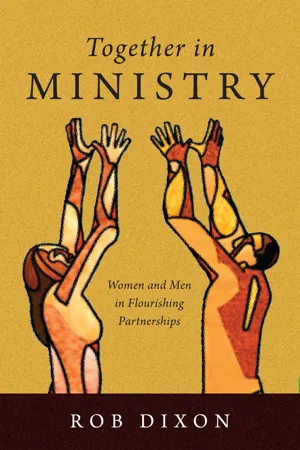
Women and men are designed to work together in fulfilling God's mission on earth. Yet God's original intent for equal partnership has been so distorted that churches and organizations continually struggle to foster healthy mixed-gender ministry collaboration. Is it even possible to return to the Genesis ideal of co-laborers in today's contexts?
Longtime ministry leader Rob Dixon knows it's possible—though it takes intentionality, courage, and wisdom. Based on qualitative field research among ministry practitioners, Together in Ministry offers a prophetic roadmap for individuals and communities as they seek to develop flourishing ministry partnerships for women and men.
Organized around the key domains of inner life, community culture, and intentional practices, this model identifies ten key attributes of partnerships that are both personally satisfying and missionally effective. For each attribute Dixon presents research findings and biblical examples, along with benefits, barriers, and practical next steps. With plenty of real-life stories from ministry leaders and reflection questions in each chapter, Together in Ministry casts a compelling—and encouraging—vision for flourishingpartnerships and equips teams and individuals with next steps for making that vision a reality.
Trusted by 375,005 students
Access to over 1.5 million titles for a fair monthly price.
THE FIRST AIM OF MY DOCTORAL RESEARCH was to determine the best combination of attributes that constitute flourishing mixed-gender ministry partnerships. Following that determination, my goal was to assemble those attributes into a model that individuals and communities could use to build such partnerships in greater measure. Before laying out the Together in Ministry model, some introductory definitions and background regarding the notion of flourishing mixed-gender ministry partnerships are in order.
MINISTRY PARTNERSHIPS
To begin with, my focus is the particular context of Christian ministry. Ministry includes any activity where the good news about Jesus is being proclaimed, either in word or deed. In my case, my research was conducted among individuals on staff with InterVarsity Christian Fellowship/USA. InterVarsity is a seventy-five-year-old evangelical campus ministry based in the United States whose stated purpose is “to establish and advance at colleges and universities witnessing communities of students and faculty who follow Jesus as Savior and Lord: growing in love for God, God’s word, God’s people of every ethnicity and culture, and God’s purposes in the world.” In InterVarsity’s ministry, women and men partner together every day, in a variety of configurations.
My study began with InterVarsity, but since then I have noticed that my findings have relevance and applicability in other ministry contexts as well. As I have presented this content to a wide range of churches and organizations, including Wycliffe, Cru, Missio Nexus, and the Reformed Church in America, I have seen people helped by what I have discovered. It has been gratifying to watch the Together in Ministry model helpfully transcend organizational boundaries and denominational distinctives into a wide range of ministry contexts.
Next, in my research interviews and focus groups, I investigated many different forms of ministry partnerships. In some cases, partnerships were marked by an organizational power dynamic, with one of the partners serving as a supervisor to the other. In other cases, partners were peers, operating either as long-standing coworkers or in short-term arrangements. Some partners worked closely together and others over distance. This research is informed by a diversity of partnership arrangements, thus increasing its relevance to a variety of organizational contexts.
MIXED-GENDER
Next, by the term mixed-gender, I am specifically referring to ministry partnerships between women and men. The conversation around gender is alive right now in many spaces—including within some Christian churches and organizations—but during my research process, I opted to confine myself solely to ministry partnerships between women and men, and therefore Together in Ministry will be similarly restrained.1 I will not, then, have anything specific to say about gender fluidity, transgenderism, or LGBTQ+ issues, though these topics are certainly worthy of further study.2
Instead, I have been curious about what makes ministry partnerships specifically between women and men work well, and Together in Ministry represents my answer to that question. No doubt each reader can bring to mind someone from the opposite gender with whom they work or serve in some sort of ministry context. In fact, it will be useful for readers to read this book with this person, or these people, in view. Better still, mixed-gender ministry partners can read this book together! In Together in Ministry, I aspire to equip individuals and communities to steward these partnerships well.
FLOURISHING
Finally, in Together in Ministry I will join with a growing chorus of writers and thinkers in using the term flourishing to capture the essence of what I hope these mixed-gender partnerships can become. The concept of flourishing is a popular one in many Christian circles. For instance, in his book Strong and Weak, Andy Crouch defines flourishing as being “fully alive.”3 When something is fully alive, it is functioning as it was meant to function. Everything is working as intended, whether we’re talking about a person, a relationship, or a system.
The Hebrew notion of shalom offers a biblical analog to how Crouch, myself, and others are using the term flourishing. When someone or something is experiencing shalom, it is truly flourishing and fully alive. In her book The Very Good Gospel, Lisa Sharon Harper captures the holistic nature of shalom:
Shalom is what the Kingdom of God smells like. It’s what the Kingdom looks like and what Jesus requires of the Kingdom’s citizens. It’s when everyone has enough. It’s when families are healed. It’s when shame is renounced and inner freedom is laid hold of. It’s when human dignity, bestowed by the image of God in all humanity, is cultivated, protected, and served in families, faith communities, and schools and through public policy. Shalom is when the capacity to lead is recognized in every human being and when nations join together to protect the environment.4
What a vivid and compelling picture of shalom and, by extension, of human flourishing.
In the context of my research, mixed-gender ministry partnerships are flourishing when two things are true. First, ministry partners experience a profound sense of personal satisfaction. That is, the partnership is a blessing to each person involved. It is enjoyable, enriching, and life giving. More often than not, both partners go home at the end of the day grateful to be in partnership together.
Second, flourishing mixed-gender ministry partnerships accomplish something. They are not just personally satisfying; they are also missionally effective. In other words, the work produced is better specifically because of the partnership. Plenty of studies attest to the positive impact of diversity on an organization’s bottom line, and flourishing partnerships experience that on a regular basis.5
These two characteristics—personal satisfaction and missional effectiveness—define what flourishing can look like in mixed-gender ministry partnerships.6 When either of these two characteristics are absent or underdeveloped, partnerships won’t be fully alive.
Figure 1.1. Personal satisfaction and missional effectiveness
Figure 1.1 further fills out this idea, using four quadrants to describe what happens as these two dimensions of flourishing increase or decrease. In quadrant one, both personal satisfaction and missional effectiveness are low, and one wonders why the partnership exists at all. After all, no one wants to be a part of a ministry partnership that is relationally dissatisfying and produces little fruit.
Quadrants two and three are better but still incomplete. In quadrant two, partnerships marked by high personal satisfaction but low missional effectiveness make for solid mixed-gender friendships, which are no small thing. As will be noted in chapter seven, life-giving mixed-gender friendships are important. Still, the lack of missional fruit limits such a partnership from being all that it could be in the ministry context.
In quadrant three, where missional effectiveness is high but personal satisfaction is low, lots of things get done but without accompanying personal fulfillment. As with the quadrant two example above, mixed-gender partnerships that expand the mission are still significant. And yet most work relationships marked by this reality will wear down over time. Even productive partnerships can wither without a robust interpersonal foundation.
Quadrant four, then, is the place of true flourishing, the quadrant where mixed-gender partnerships can be fully alive. It is the place of shalom. In quadrant four, personal satisfaction and missional effectiveness come together in a beautiful picture of flourishing mixed-gender ministry partnership.
As will become apparent throughout this book, I have been fortunate to personally experience the reality of flourishing mixed-gender partnerships. I know what quadrant four is like! For many years, I worked together in ministry with my friend Tina. Partnering together with Tina in ministry has been an interpersonal joy for us. Such is the nature of our friendship and working partnership that over the years we have regularly sought out opportunities to work together. On top of that, our partnership extends past the lines of work, as Tina is our family’s official photographer, Tina’s father served as our realtor, we trained for and ran a marathon together, and I officiated at Tina’s wedding to her husband, Adam. In my ministry partnership with Tina, it has been a joy to experience a high degree of personal satisfaction.
At the same time, working together with Tina has repeatedly produced fruitful and effective ministry. Perhaps the best example of that is a seminar we lead that invites college students to explore the Bible’s message of gender equality (see chap. 3). Our par...
Table of contents
Cover
Title Page
Dedication Page
Contents
Foreword by Ruth Haley Barton
Acknowledgments
Introduction: God's Intent for Flourishing Partnerships
1 The Together in Ministry Model
Part 1: Inner Life
Part 2: Community Culture
Part 3: Intentional Practices
Conclusion: Together in Ministry
General Index
Scripture Index
Praise for Together in Ministry
About the Author
More Titles from InterVarsity Press and Missio Alliance
More Titles from InterVarsity Press
Copyright
Frequently asked questions
Yes, you can cancel anytime from the Subscription tab in your account settings on the Perlego website. Your subscription will stay active until the end of your current billing period. Learn how to cancel your subscription
No, books cannot be downloaded as external files, such as PDFs, for use outside of Perlego. However, you can download books within the Perlego app for offline reading on mobile or tablet. Learn how to download books offline
Perlego offers two plans: Essential and Complete
Essential is ideal for learners and professionals who enjoy exploring a wide range of subjects. Access the Essential Library with 800,000+ trusted titles and best-sellers across business, personal growth, and the humanities. Includes unlimited reading time and Standard Read Aloud voice.
Complete: Perfect for advanced learners and researchers needing full, unrestricted access. Unlock 1.5M+ books across hundreds of subjects, including academic and specialized titles. The Complete Plan also includes advanced features like Premium Read Aloud and Research Assistant.
Both plans are available with monthly, semester, or annual billing cycles.
We are an online textbook subscription service, where you can get access to an entire online library for less than the price of a single book per month. With over 1.5 million books across 990+ topics, we’ve got you covered! Learn about our mission
Look out for the read-aloud symbol on your next book to see if you can listen to it. The read-aloud tool reads text aloud for you, highlighting the text as it is being read. You can pause it, speed it up and slow it down. Learn more about Read Aloud
Yes! You can use the Perlego app on both iOS and Android devices to read anytime, anywhere — even offline. Perfect for commutes or when you’re on the go. Please note we cannot support devices running on iOS 13 and Android 7 or earlier. Learn more about using the app
Yes, you can access Together in Ministry by Rob Dixon,Robert Ford Dixon in PDF and/or ePUB format, as well as other popular books in Theology & Religion & Christian Church. We have over 1.5 million books available in our catalogue for you to explore.