This proven best-selling study guide, used in conjunction with PMI's
PMBOK Guide — Sixth Edition and the
Project Management Professional (PMP) Examination Content Outline dated June 2019 and reissued May 2020, presents all the fundamental knowledge, concepts, exercises, and practice exam questions a project manager needs to prepare for and successfully pass the Project Management Professional (PMP) Certification Exam on the first try, while cutting study time in half.
Key Features:
--Covers all subjects addressed on the PMP Exam, including the comprehensive performance domain and cross-cutting knowledge and skills defined within the PMI PMP Examination Content dated June 2019 and reissued May 2020 and the PMI Code of Ethics and Professional Conduct
--Provides free online access to over 1500 practice questions, including hundreds of situational questions, enabling users to perform practice tests by Knowledge Areas and/or simulate actual 200 question exams, and receive feedback on incorrect answers
--Details key topics, concepts, and techniques from PMI recommended readings, eliminating the need for additional resources
eBook - ePub
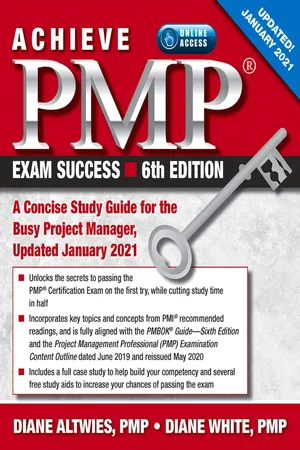
Achieve PMP Exam Success, Updated 6th Edition
A Concise Study Guide for the Busy Project Manager, Updated January 2021
- 512 pages
- English
- ePUB (mobile friendly)
- Available on iOS & Android
eBook - ePub
Achieve PMP Exam Success, Updated 6th Edition
A Concise Study Guide for the Busy Project Manager, Updated January 2021
About this book
Information
CHAPTER 1 | STUDY TIPS & ASSESSMENT EXAM
WHAT IS A PROJECT MANAGEMENT PROFESSIONAL (PMP)?
A PMP is a project management practitioner who:
- Has demonstrated a professional level of project management knowledge and experience by supporting projects using project management tools, techniques, and methodologies
- Has at least 4,500 hours of experience leading and directing projects
- Has completed 35 hours of formal project management training
- Has passed a computer-based exam administered by the Project Management Institute (PMI)
- Is committed to doing what is right and honorable by following the profession’s Code of Ethics and Professional Conduct.
Consult the PMI website (PMI.org) for the most current information.
PMP EXAM SPECIFICS
The exam has the following characteristics:
- It assesses the knowledge and application of globally accepted project management concepts, techniques, and procedures
- It covers the three performance domains detailed in the Project Management Professional (PMP) Examination Content Outline—May 2020
- It covers the ten Knowledge Areas and the five Process Groups as detailed in the A Guide to the Project Management Body of Knowledge (PMBOK® Guide) book
- It contains 180 multiple-choice questions
- It includes 5 questions that are “pre-exam” questions being field-tested by PMI that do not affect your exam score
- You have 230 minutes to complete the exam which includes two 10-minute breaks
- Questions will be a combination of multiple-choice, multiple response, matching, hotspot, and limited fill-in-the-blank
Table 1-1
| Domain | % of Questions on the Exam |
| People | 42% |
| Process | 50% |
| Business Environment | 8% |
PMI has changed from determining the number of questions based on five Performance Domains to three Performance Domains consisting of People, Process, and Business Environment (see Table 1-1).
ROLE DELINEATION STUDY
PMI conducts a role delineation study (RDS) on a periodic basis to answer the question “what skills must project managers have to successfully lead and direct projects?” The results of the study provide the basis for the exam so that it mirrors the practices, methods, and systems of the project management profession. The study validates that the exam is measuring what project management professionals actually do on their jobs.
PERFORMANCE DOMAINS
PMI has simplified the format by defining a hierarchical structure of domain, task, and enabler to make the Examination Content Outline easier to understand and interpret.
- A domain is a high-level Knowledge Area that is essential to the practice of project management.
- A task is the underlying responsibility of the project manager.
- An enabler is an illustrative example of work associated with the task.
Project managers work in a variety of environments and utilize different approaches. The 2021 PMP Exam will have half of the questions related to predictive project management approaches and half related to agile or hybrid approaches.
Domains, Tasks, and Enablers
Bolded items in Table 1-2 (below) are new content added by PMI and highlighted in the PMP® Exam Content Crossover Map. In addition, the team at Core Performance Concepts has added additional cross references to any related Knowledge Areas. This is not an exhaustive association but will help you to focus your studies.


STUDY TIPS
Below is a list of recommended study tips from project managers who have successfully passed the PMP exam. Think about each one and determine which suggestions are the best for your learning style.
- Develop a plan for studying; see page 23 for a sample study plan utilizing the PMBOK® Guide and this study guide
- Follow the plan on a daily or weekly basis; it is important for you to commit to studying
- Plan your study sessions with time limitations
- Study during a time of day when you are most alert
- Vary tasks and topics during lengthy study periods
- Find one special place for studying and use it only for that
- Eliminate distractions
- If daydreaming, walk away
- Take brief breaks (five to ten minutes) after about 50 minutes of study
- Use practice exams
- Your goal should be consistently getting 80% of the questions correct
- Learn the PMBOK® Guide definitions
- Understand the big concepts first
- Review the introductory sections of each of the chapters in this book
- Try to put the concepts in your own words
- Try to apply concepts to your own experiences (remember your experiences may not reflect the PMBOK® Guide approach)
- Read the Project Management Considerations section of each chapter in this book to test your ability to apply concepts in real-world scenarios
- Memorize
- Important people and their contributions to project management
- Formulas
- Processes and their order
- Inputs, tools and techniques, and outputs of each process
- The benefits of each tool and technique
- The data gathering, data analysis, and data representation tools and techniques
- Facilitate memorization by using tools like mnemonics
- Prepare for exam day
- Get a good night’s rest
- Avoid last-minute cramming
- Have a good breakfast
- Leave books at home
- Go with a positive attitude
- Get to the exam site early
EXAM TIPS
The exam tests your knowledge of the PMBOK® Guide by asking you many questions on definitions, inputs, tools and techniques, and outputs, and it has many situational questions that determine how well you apply PMBOK® Guide concepts to real-life situations. Most people can succeed if they follow these simple steps on test day.
- Watch the 15 minute tutorial
- Once the exam begins, take a few minutes to jot down key concepts or formulas that you do not want to...
Table of contents
- Cover
- Title Page
- Copyright
- Contents
- Foreword
- Preface
- Acknowledgments
- Introduction
- Authors’ Information
- Web Added Value
- Chapter 1. Study Tips & Assessment Exam
- Chapter 2. Overview and Environment
- Chapter 3. The Project Manager Role
- Chapter 4. Integration
- Chapter 5. Scope
- Chapter 6. Schedule
- Chapter 7. Cost
- Chapter 8. Quality
- Chapter 9. Resource
- Chapter 10. Communications
- Chapter 11. Risk
- Chapter 12. Procurement
- Chapter 13. Stakeholders
- Chapter 14. Final Exam
- Chapter 15. Appendices
Trusted by 375,005 students
Access to over 1.5 million titles for a fair monthly price.
Study more efficiently using our study tools.
Frequently asked questions
Yes, you can cancel anytime from the Subscription tab in your account settings on the Perlego website. Your subscription will stay active until the end of your current billing period. Learn how to cancel your subscription
No, books cannot be downloaded as external files, such as PDFs, for use outside of Perlego. However, you can download books within the Perlego app for offline reading on mobile or tablet. Learn how to download books offline
We are an online textbook subscription service, where you can get access to an entire online library for less than the price of a single book per month. With over 1.5 million books across 990+ topics, we’ve got you covered! Learn about our mission
Look out for the read-aloud symbol on your next book to see if you can listen to it. The read-aloud tool reads text aloud for you, highlighting the text as it is being read. You can pause it, speed it up and slow it down. Learn more about Read Aloud
Yes! You can use the Perlego app on both iOS and Android devices to read anytime, anywhere — even offline. Perfect for commutes or when you’re on the go.
Please note we cannot support devices running on iOS 13 and Android 7 or earlier. Learn more about using the app
Please note we cannot support devices running on iOS 13 and Android 7 or earlier. Learn more about using the app
Yes, you can access Achieve PMP Exam Success, Updated 6th Edition by Diane Altwies,Diane While in PDF and/or ePUB format, as well as other popular books in Business & Formazione aziendale. We have over 1.5 million books available in our catalogue for you to explore.