This extract from the
Eerdmans Commentary on the Bible provides Scott's introduction to and concise commentary on John. The
Eerdmans Commentary on the Bible presents, in nontechnical language, the best of modern scholarship on each book of the Bible, including the Apocrypha. Reader-friendly commentary complements succinct summaries of each section of the text and will be valuable to scholars, students, and general readers.
Rather than attempt a verse-by-verse analysis, these volumes work from larger sense units, highlighting the place of each passage within the overarching biblical story. Commentators focus on the genre of each text—parable, prophetic oracle, legal code, and so on—interpreting within the historical and literary context.
The volumes also address major issues within each biblical book—including the range of possible interpretations—and refer readers to the best resources for further discussions.
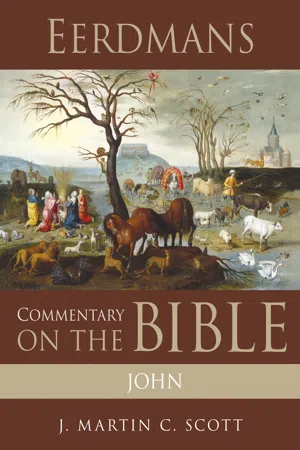
eBook - ePub
Eerdmans Commentary on the Bible: John
- 65 pages
- English
- ePUB (mobile friendly)
- Available on iOS & Android
eBook - ePub
Eerdmans Commentary on the Bible: John
About this book
Information
Topic
Theology & ReligionSubtopic
Biblical CommentaryJohn
J. Martin C. Scott
INTRODUCTION
The Fourth Gospel (= FG) is a work of great literary artistry, full of dramatic irony and poetic beauty. The medium of poetry, with which the Gospel opens (1:1–18), is appropriate to the literary-theological style employed throughout and reflects the principal background on which the Fourth Evangelist (= FE) draws, namely, the writings of the Jewish wisdom tradition.
While the FG undoubtedly alludes to a wide number of works from the Hebrew scriptures (both the prophets and often polemically the Torah), it is the wisdom writings which provide the most important materials for understanding the FE’s use of the term “Logos” and the whole christological reflection which emerges from it in the body of the FG. Knowledge of the picture of Sophia (her Greek name is used to highlight the gender of Wisdom in this commentary) found in the great poetic chapters of Proverbs 1–9, Sirach 24 (also chs. 1, 4, 6, 14, and 15) and throughout Wisdom of Solomon, is fundamental for reading John’s Gospel. Pictured in wisdom literature as the agent of God’s communication of salvation, hope, judgment, and reproach to humanity, she provides a model for understanding the Johannine Jesus’ mission in the world (Scott 1992: 83–173).
The portrayal of God’s wisdom as a woman comes about at its most basic level because of the feminine gender of the Hebrew and Greek words. Yet it is not simply a linguistic accident that the portrayal develops in the way that it does in Israel’s wisdom literature (Scott 1992: 36–82). The whole contrast between Sophia’s call and that of the prostitute who sits at her door to entice men into her parlor (Prov 7:5–27; 9:13–18) depends on powerful sexual imagery. To make a direct equivalence in incarnational terms between the male Jesus and what is decisively a female image of God’s presence in the world is not possible. In choosing Logos, a well-established but masculinegendered synonym for Sophia, the FE is making firm the connection with the tradition while taking seriously the limitations of incarnation.
The importance of this female image of God’s presence in creation, redemption, and judgment as a background for reading the story of Jesus at the start of the third millennium is highlighted by the history of interpretation of the FG. Far from letting “John Be John” (Dunn 1983), the Logos of John’s Prologue was used as a significant building block for patriarchal Christology by many early church writers. The interpretation of the Logos in terms of Greek philosophical speculation, largely ignoring its primary roots in Sophia tradition, fast became the norm. It is clear, not least from the writings of Philo, the Alexandrian Jewish philosopher, that the words “Logos” and “Sophia” were quite interchangeable by the time of writing of the FG. In using the term “Logos,” which acknowledges the maleness of the human Jesus, the FG still leaves open the full range of meaning of the word “Sophia.”
In the Johannine Jesus we may see the fullness of God revealed, in both masculine and feminine dimensions, albeit within the limitations of incarnation in terms of human sexuality. As Elizabeth Johnson puts it: “The gender particularity of Jesus does not reveal that God must be imaged exclusively as male. In Jesus Christ we encounter the mystery of God who is neither male nor female, but who as source of both and Creator in the divine image can in turn be imaged as either” (Johnson 1985: 280).
Whether the FE intended to convey all the gender subtleties of the Sophia background (it is at least possible that it is intentional), this commentary adopts a narrative approach to reading the text as it stands. Little time is spent on weighing up historical matters which can be followed up in other literature on the FG (cf. Brown 1997: 362–82). We have no certain access to either the historical author or her/his audience, even if there are strong pointers to a community in crisis being addressed throughout. What may be attempted, however, is a reading of the Gospel from the viewpoint of an “ideal [or “implied”] reader,” whom the text itself constructs. This hypothetical “reader” is required for the narrative to make sense, or be heard coherently (cf. Powell 1993). In endeavoring to enable the modern reader to hear the FG from such an ideal reader’s perspective this commentary places emphasis on the pointers to the emergent theological meaning which the developing narrative contains.
John often uses “intertextual echo” as a means of alerting the “implied reader” to a variety of subtle connections. This takes the form of a word, a phrase, or an idea which evokes particular counterparts either internal to the Gospel (e.g., the use of “feet” in 12:1–8 evoking the later “footwashing” account), or externally in the literature of wider Jewish tradition (e.g., the opening words of the Gospel evoking Gen 1:1). Many of these echoes are crucial for understanding the christological picture which the FE paints, particularly in terms of the relationship to Sophia. Since she represented the immanence of God’s wise presence in its fullest appeal to Israel, Jesus, Sophia incarnate, comes in similar manner to the whole of humanity.
Another important literary-theological technique which the FG employs is irony. This takes a variety of forms throughout the Gospel, sometimes overt, sometimes covert (cf. Duke 1985: 7–27), but always pressing and inviting the reader to see beyond the surface responses of Johannine characters to the twists of meaning which often turn interpretation on its head. One such twist which this commentary attempts to read in a novel way is the use of the term “Jews.” Jesus, who is clearly a Jew, often speaks of “Jews” as though he were not one. For the most part this has been interpreted as part of the struggle of the Johannine community with its separation from its roots in Judaism (cf. Stibbe 1994: 107–31). Such a reading has never, however, done justice to the full spectrum of use of the term in the FG, so we will instead attempt to read it as an ironic reference to the struggle of the Johannine community with other Christian groups evidenced in the polemic of the later Johannine epistles (see the comment on 1:19).
Another ironic element of the FG’s presentation is the way in which discipleship is portrayed. Far from the Synoptic picture of a central band of men who demonstrate in positive and negative manner the traits of true discipleship, it is the women of the FG who serve in a paradigmatic role (cf. Scott 1994). Given the overwhelmingly overt male language of the FG (Father-Son) and indeed the maleness of Jesus, the subtlety of Sophia’s influence may perhaps be glanced in this role reversal. Certainly it provides an important alternative perspective to other NT and later ecclesiological viewpoints in this third millennium.
COMMENTARY
John 1:1–18
In the beginning the FE employed poetry to draw together the disparate themes which now find their theological focus in the Gospel’s portrayal of Jesus as the Christ, the Son of God. The primary themes of the FG are laid before the reader in these verses. The genius of the FE lies in the ability to make these opening words not only point forward to the content of the Gospel but also hark back to so much that has gone before.
Many attempts have been made to reconstruct an “original” hymn lying behind this introduction to the FG. Most commentators define four stanzas, which are interrupted by the comments on John the Baptist (= JBap), though the content of the stanzas differs in the various analyses (Dunn 1989: 240). There is general agreement on the scope of the first two stanzas (1:1–2, 3–5). Brown gives good grammatical and literary reasons for seeing the next stanza as comprising vv. 10–12b, with a fourth made up from vv. 14 and 16 (Brown 1966: 1–18, 21–23). While we shall not attempt any detailed analysis of the prehistory of the hymn, we shall point to important literary blocks which may help move our theological understanding forward and inform our comment on the text as the narrative unfolds.
“In the beginning” (1:1) obviously takes the reader back to the opening of the Torah (Gen 1:1) and so to the theme of creation. It is a theme which will dominate the opening verses both in terms of the creation of the world (1:1–5, 10) and in relation to the new beginnings which become possible from the presence of the Word in the world (1:12–13, 16–17). The concern here is not with origins, either of the man Jesus or of the believing child, but with connections. The Gospel will unfold in detail the connection between the introductory Word and Jesus, the beginning of whose story this poem is. In addition to that, however, the Prologue also plays a vital role in connecting that Word back into various strands of Israel’s salvation history.
Primary among the connections for the FE is that between Word (Logos) and the Wisdom of God, Sophia, whose own intimate link with both creation and salvation belongs to the most ancient literary traditions of Israel (Prov 8:22–33—creation; Prov 1:20–33—salvation). She was in the beginning with God (Prov 8:22; Sir 1:1, 4) and participated with God in the creation of the world (Prov 8:30; Sir 24:3–6; Wis 9:1–2). The wider scope of wisdom literature reveals Sophia’s participation in the making of the world as all-inclusive: the separation of waters and dry land, the establishment of the mountains and fields, the laying out of the heavens, and finally even the creation of the human race. Like the Word, Sophia may be hailed as the one through whom “all things came into being” (1:3).
It was not the FE who first made this connection between Logos and Sophia. The process is well attested in wisdom literature (Scott 1992: 88–94). In Sir 24:3, Sophia announces that she emerges from the “mouth of the most high,” at least hinting at a connection with “word.” The link is made explicit in Wis 9:1–2, where the parallel between Logos and Sophia is unmistakable. Other passages in the book of Wisdom hint at the same conclusion (both proceed from the royal throne in heaven: 9:10—Sophia; 18:15—Logos), but the most frequent parallels are found in the many writings of the Jewish philosopher, Philo of Alexandria. Philo uses the terms interchangeably, for the most part substituting the Logos for Sophia in her traditional function as God’s agent in the world (Scott 1992: 58–61, 91–94).
The literary function here (and probably also the intention of the FE) in using the epithet Logos/Sophia is surely to make connections. All that has been known in the tradition concerning Sophia (and more!) is now embodied in Jesus Christ. At the same time, the mystery of Jesus Christ can best be illuminated with reference to the known categories of Sophia. The use of “Logos” to describe the one whose prehistory comes to fruition in Christ owes its origins to Jesus’ gender (see the Introduction, 1161), but constant intertextual echoes bind Jesus and Sophia ever closer as the story unfolds.
“In him was life” (1:4) seems to continue the creation theme, but the text is difficult. Brown lists five separate problems in translation (Brown 1966: 6–7), and finally opts for a direct connection to 1:3, a view which has found favor with others (Witherington 1995: 47—“what has come into being in him was life”). The theme has strong links with Sophia, not only in terms of creation but significantly in relation to salvation. “The one who finds me finds life,” she declares (Prov 8:35). Just as important is the implicit dualism of Prov 1:22–33, where the consequence of ignoring the claims of Sophia is calamity and death, in contrast to receiving her, finding security, and “living at ease” (Prov 1:33). Sirach echoes these sentiments (Sir 4:12), while in Wis 8:13, “Solomon” even goes so far as to suggest that she grants immortality! The FE elsewhere uses “life” only in the sense of “eternal life” (Brown 1966: 505–8), so it is hard to think that it means anything other here. While the whole Gospel may pick up the theme of “eternal life” in an idiosyncratic way, its seeds are sown in the wisdom tradition. The Johannine Jesus, like Sophia, brings about a crisis point in human experience, on the basis of which decisions between life and death will be made.
“The life was the light of all people” (1:4) again echoes the ancient tradition. Light is brought into being by the word of God as the first act in the creation story (Gen 1:3). The emphasis in John 1:4, however, seems closer to that in Ps 119:105, where God’s word is said to illuminate the psalmist’s pathway. There is a double connection here to the wisdom tradition, where Sophia is not only known as the first of God’s acts of creation, but is also revered for her illuminative presence. “Solomon” chooses her before light because her radiance is greater (Wis 7:10). She is a reflection of the ever present light of God (Wis 7:26), unquenched by the night or by evil (Wis 7:29–30). The gift of light, sought as a symbol of salvation, is being opened up to all people in the person of Jesus Christ, the very embodiment of Sophia.
Light is identifiable only in contrast to darkness, as the poem goes on to state (1:5). Primeval darkness is overcome by the creation of light (Gen 1:2–3), a motif which surely informs this text. John’s prior association of light with the salvation of humanity, however, leads the reader to hear the theme of conflict between good and evil behind this contrast. The word “overcome” (katelaben) is used again in 12:35, where such conflict is undoubtedly in mind, centered around the person of Jesus, the Light. The thought is not of an irreconcilable dualism, but rather in line with what we have noted in Wis 7:29–30, namely, that darkness/evil cannot put out the light of God’s all-pervading wisdom. The brief clarification of the role of JBap which follows (1:6–8) confirms this, since he is to be seen neither as “darkness” nor as a “false” light in contrast to the true light of 1:9. We might say that JBap sheds light on the Light through his witness. In parallel with Wis 7:10, 29–30, therefore, he is eclipsed by the superior radiance.
A new block begins with 1:10, recalling the previous emphasis on the involvement of the Word in creation, but moving on to explore his ongoing relationship with the world. Given the poetic skill which lies behind this opening to the FG, it seems surprising that the high point of v. 14—“the Word became flesh”—should be preempted by the statement “he was in the world” (1:10). Once again the echoes of Sophia tradition help with clarification, the emphasis of vv. 10–12 lying on the reaction of the world to the Word rather than on the form of his presence, which first becomes an issue in 1:14. Like Sophia, the Word comes to those most likely to recognize him, but they fail to recognize or accept him in their ignorance. Only those wise enough to believe find themselves in a familial relationship with God.
This is exactly the story of Sophia’s experience with Israel. She is found proclaiming her message in the most public places: at the city gate; in the market square; in the streets (Prov 1:20–21; 8:1–3). She spans the whole earth (Wis 8:1) and sets up camp in Jerusalem (Sir 24:8–12) in order to offer her good gifts to humanity. Yet she finds little response among her own people, who ignore, despise, or scoff at her wisdom (Prov 1:22–33). Later Jewish texts speak of her withdrawal from the world because of rejection (1 Enoch 42:1–2). Sophia’s rejection brings judgment, but to accept her is to gain life (Prov 8:35; Sir 4:12) and to enter a new relationship with God, as friends (Wis 7:27).
For the informed Christian reader, of course, these verses already foreshadow the mission of Jesus in the world. The poetic introduction to the FG wants to set this against the background of God’s saving intention throughout history, to echo the continuity of God’s relationship with the world since its very inception. Just as God, in conjunction with Logos/Sophia, created the world, so that same God is bringing into being a new creation through Jesus/Sophia (1:13). This is a birth brought about by no ordinary human desire but by the will of God.
The most striking claim of this opening poem now follows (1:14). Unique though the specific idea of incarnation of the Word may be, it can be seen as being in continuity with the wisdom tradition. Even the language of the FG owes something to the description of Sir 24:8, where Sophia is described as “pitching her tent” (kataskēnōson) in Israel—precisely the expression John 1:14 uses of the Word’s descent into the world. Whereas some wisdom writers (Sirach; Baruch) talk of Sophia’s confinement in the Torah, the FE instead declares that she has really taken on flesh, become flesh, in the person of Jesus, the Christ.
Incarnation requires self-limitation: the Word who was at the beginning of all things and in all things is now identified with a specific human being, limited by time, space, and gender. But incarnation is not only about self-limitation: it is also about disclosure, or revelation. The glory of God is made plain in the incarnation, a glory which Sophia was also known to reveal to those who loved her (Wis 7:25; 9:11). In the Exodus tradition, the glory of God was made visible through miraculous provision: manna; the guiding presence (cloud; fire). This lies behind John’s understanding of “glory,” but again it is worth remembering that the whole Exodus story is retold as the glorious, saving work of Sophia in Wisdom 10–11. The Gospel will gradually reveal the glory of God present in Jesus, initially through signs (2:11; 11:40), then the whole ministry (17:4), finally and completely through the “hour” of passion, death, and resurrection (12:23; 13:31–32; 17:1).
Despite the continued attempts of commentators to interpret the word monogenēs as “only begotten” (recently, Witherington 1995: 54), the word is better translated “uniquely precious,” denoting the quality of Jesus’ relationship with God as Father (Brown 1966: 13–14). Sophia is described in exactly this way in Wis 7:22, her epithet now transferred to the Logos as son.
The phrase “full of grace and truth” (1:14) seems to reflect the Hebrew coupling of ḥesed and ͗emet. These terms declare the covenant faithfulness of God, which is surely coming to new expression in the life, death, and resurrection of Jesus Christ. Since the word “grace” never appears in the body of the Gospel, it would seem that the emphasis lies more on the Word as the embodiment of “truth,” a major theme of the Gospel. Truth, for John, can mean both the one who is ultimately real (a usage common in Greek literature), Jesus Christ (14:6), and the one who is completely faithful (more typical of Hebrew usage; cf. 10:11...
Table of contents
- Title Page
- Copyright
- Contents
- Preface
- Abbreviations
- John
- Get the complete commentary!
Trusted by 375,005 students
Access to over 1.5 million titles for a fair monthly price.
Study more efficiently using our study tools.
Frequently asked questions
Yes, you can cancel anytime from the Subscription tab in your account settings on the Perlego website. Your subscription will stay active until the end of your current billing period. Learn how to cancel your subscription
No, books cannot be downloaded as external files, such as PDFs, for use outside of Perlego. However, you can download books within the Perlego app for offline reading on mobile or tablet. Learn how to download books offline
Perlego offers two plans: Essential and Complete
- Essential is ideal for learners and professionals who enjoy exploring a wide range of subjects. Access the Essential Library with 800,000+ trusted titles and best-sellers across business, personal growth, and the humanities. Includes unlimited reading time and Standard Read Aloud voice.
- Complete: Perfect for advanced learners and researchers needing full, unrestricted access. Unlock 1.5M+ books across hundreds of subjects, including academic and specialized titles. The Complete Plan also includes advanced features like Premium Read Aloud and Research Assistant.
We are an online textbook subscription service, where you can get access to an entire online library for less than the price of a single book per month. With over 1.5 million books across 990+ topics, we’ve got you covered! Learn about our mission
Look out for the read-aloud symbol on your next book to see if you can listen to it. The read-aloud tool reads text aloud for you, highlighting the text as it is being read. You can pause it, speed it up and slow it down. Learn more about Read Aloud
Yes! You can use the Perlego app on both iOS and Android devices to read anytime, anywhere — even offline. Perfect for commutes or when you’re on the go.
Please note we cannot support devices running on iOS 13 and Android 7 or earlier. Learn more about using the app
Please note we cannot support devices running on iOS 13 and Android 7 or earlier. Learn more about using the app
Yes, you can access Eerdmans Commentary on the Bible: John by J. Martin C. Scott, James D. G. Dunn, John W. Rogerson in PDF and/or ePUB format, as well as other popular books in Theology & Religion & Biblical Commentary. We have over 1.5 million books available in our catalogue for you to explore.