Answers to critical questions regarding the study of the Jesus of history and the Christ of faith
The conclusions of the quest for the historical Jesus, which casts the majority of Christ's life as a myth, are a stark contrast to the orthodox view of Christ as presented in the Bible. Pate demonstrates that a critical analysis of the gospel text along with historical and cultural methods of investigation actually point toward an orthodox view of Christ.
This work argues that the canonical Gospels are the most trustworthy information we have about the gospel writers as well as the life and ministry of Jesus, including his death, visit to hades, resurrection, and ascension. Readers will be encouraged by the reliability of the Gospel writers, the reality of Jesus' humanity and deity, and the inferiority of the apocryphal gospels.
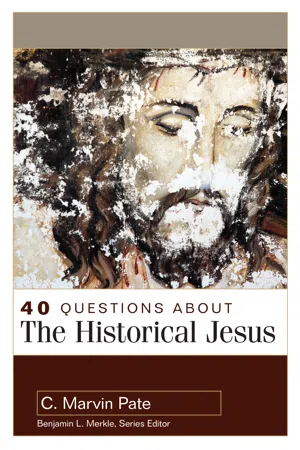
- 408 pages
- English
- ePUB (mobile friendly)
- Available on iOS & Android
eBook - ePub
40 Questions About the Historical Jesus
About this book
Information
Topic
Theology & ReligionSubtopic
Biblical StudiesPART 1
BACKGROUND QUESTIONS ABOUT THE “HISTORICAL” JESUS
SECTION A
Questions Related to the Quest for the Historical Jesus
QUESTION 1
What Is at Stake Regarding the Four Gospels?
What is at stake concerning the four gospels is nothing less than historic Christianity. No Gospels, no Jesus; no Jesus, no Christianity. This chapter offers a rationale for the first part of this book since it is rather technical in nature, yet of extraordinary importance. Accordingly, two questions undergird Part 1 of this work: Are the four gospels reliable and why are only those gospels included in the New Testament? Because the first question has been bandied about for centuries we will spend the bulk of our time in this chapter introducing the second question, since it was unanticipated by many.
Are the Four Gospels Reliable?
One of my students approached me recently, obviously upset. The student had just finished a class in which the professor cast doubt on the reliability of the Gospels by comparing them to the game of whispering in a person’s ear a statement, and then having that person whisper the same statement to the individual next to him or her—continuing around the circle until it came back to the first person who started the statement, with the humorous result that the original statement nowhere matched the statement at the end. The professor said that is how the four gospels came into being. Jesus made his statements and performed his deeds in the AD 30s, but that these were passed along only in oral form and not written down. By the time the four gospels were composed in the 60s and later, based on the traditions of Jesus passed along for decades, they nowhere matched what Jesus actually said and did. Thus, the Gospels dare not be trusted. This story could be repeated hundreds of time, upsetting the faith of the unsuspecting.
But most Christians have not read their gospels in that fashion. Rather, for centuries, the laity in the churches read the Gospels as trustworthy accounts of the life and ministry of Jesus of Galilee. The Gospels were authored by some of those who followed Jesus and therefore provided eyewitness accounts of what Jesus actually said and did. For them, the story line of the canonical gospels goes something like the following: Jesus was miraculously conceived by the Holy Spirit in the womb of Mary (the virgin birth). He was born in Bethlehem and then later moved with his family to Nazareth of Galilee. At the age of about thirty years old, Jesus was baptized by John the Baptist in the Jordan River, a sign of the beginning of Jesus’ public ministry. Jesus then went into the Judean desert to be tempted by Satan but prevailed over the tempter by being obedient to his heavenly Father. After that, Jesus called twelve men to be his disciples. These men witnessed firsthand the many miracles that Jesus performed, heard his declaration that the kingdom of God had arrived, marveled at his teaching with authority, joined him in prayer, observed the opposition to him by the religious establishment of the day, followed him as he entered Jerusalem to be received as Israel’s Messiah-King, participated with him in a Passover meal/Lord’s Supper, stood by as he was arrested by the temple police and Roman escort, watched him die a cruel death on the cross (at least John did), and celebrated his bodily resurrection from the dead.
But such a straightforward reading of the four gospels has been greatly challenged by liberal theologians since the late eighteenth century. It is that skeptical mentality that appeals to the circle game referred above. Two biblical scholars especially expressed their mistrust of the Bible in general—and in the Gospels in particular—over two centuries ago. The first theologian to protest the reliability of the Bible was J. P. Gabler. Gabler championed three points about the Bible: (1) the Bible should only be read for what it reports rather than what it prescribes; (2) the Bible is filled with contradictions; and (3) it is natural in origin, not supernatural. The net result of these three claims was to deny that the Bible is the Word of God, thereby destroying its historical reliability. This new approach to the Bible that Gabler fostered was called the historical-critical method.1
If Gabler called into question the dependability of the Bible in general, then H. Samuel Reimarus called into question the reliability of the four gospels. Writing about the same time as Gabler, Reimarus put a wedge between the Jesus of history and the Christ of faith by asserting that the latter was the portrait that emerged from the canonical gospels, but which was a fabrication of the early church. Consequently, the former—the historical Jesus—has been lost to posterity, never to be recovered. In specific, Reimarus scurrilously claimed that the historical Jesus never called himself to be the Messiah. Rather, Jesus was an ordinary Jew who died without seeing the Messiah or the kingdom of God arrive in history. But after Jesus’ death, according to Reimarus, the disciples made up the legend of the resurrection thus making Jesus into a supernatural being who should be worshipped as on par with God.2 Since Reimarus’s essay, many a scholar came to deny the reliability of the four gospels.
Though both Gabler and Reimarus’s arguments have been resoundingly defeated in the years that have passed, the die had been cast regarding the historical reliability of the Bible and the Gospels in particular. Armed with the historical-critical method, liberal biblical scholars now offered a considerably paired down account of the life of Jesus: Jesus was a Jew who was baptized by John the Baptist, lived a controversial life in his relationship with the Jewish and Roman authorities, and was accordingly crucified under the governorship of Pontius Pilate. And that’s it! No miracles; no kingdom of God; no atoning death; nor resurrection; no matter. Such a skeptical attitude even affected one of the greatest presidents in American history—Thomas Jefferson. Jefferson famously doubted the supernatural and miracles reported in the Gospels, so he extracted everything miraculous in them thereby producing a miracle-less version of the four gospels. I have read “Jefferson’s Bible” and one will find no miraculous Jesus therein, only his moral teachings.
While this skeptical portrait of Jesus of Galilee was the favorite of much of academia, it has only been rather recently, in the last twenty years or so that the laity has latched onto this understanding of Jesus and the Gospels. The first part of this book is devoted to re-establishing the reliability of the four gospels, critiquing the usual tactics of the historical-critical approach as well as highlighting the newest developments in the discussion. Thus, we will discuss oral tradition and the Gospels, the authorship of the four gospels, and non-biblical testimonies regarding the historical Jesus. Assuming that we can discover the historical Jesus, what portrait of Jesus best characterizes him—apocalyptic, Gnostic, Cynic, or what? When we have dealt with these issues and more related to the four gospels in Part 1, the reader will have reached great confidence about Jesus, in specific, that the historical Jesus (the Jesus who really lived) is none other than the Christ of faith (the Jesus presented to us in the Gospels).
Why Are Only the Four Gospels in the New Testament?
Once some of the contemporary laity rejected the reliability of the four gospels, it was ripe for wrestling with a second question rather recently posed by liberal biblical scholars, namely, why should only the traditional four gospels have a monopoly on the New Testament? Should not other gospels written at the time of the New Testament and beyond—the apocryphal gospels—be included in the New Testament? Such a question goes hand in hand with the pluralistic society America, and indeed most of the western world, has become. Thus, a politically correct culture such as we live in today wants to read today’s religious pluralism back into the New Testament. If there are conflicting views toward the Gospels today, some reason, then why could not there have been similar conflicts back then? Could it be that the traditional gospels were embraced by the church (the majority), whereas the apocryphal gospels—those as, if not more, reliable—were discounted because those who affirmed them were in the minority? But why should this be? Today, one of the most widely read novels of our time has argued precisely that—The Da Vinci Code, by Dan Brown.3 This work makes the case for the inclusion of non-traditional gospels in the New Testament, if not to replace them. Its formula for success is the mixture of a conspiracy theory, a potent long-held secret, and a good dose of vilifying historic Christianity, especially the Catholic Church.
The basic plot of The Da Vinci Code is as follows: Robert Langdon, the hero of the book, is a professor of religious symbology at Harvard whose skill at cracking codes puts him on the trail of a long-held secret by the Priory of Sion. The latter supposedly is a guild (that included people like Sir Isaac Newton, Victor Hugo, and most importantly, Leonardo Da Vinci) with origins back to the Crusades whose task it is to protect the Holy Grail, the chalice from which Jesus drank at the Last Supper. That, however, is but a diversion from the real truth which is that Jesus of Nazareth and Mary Magdalene were lovers who married and bore children. Thus, the real Holy Grail was Mary Magdalene.
However, the ire of the church ...
Table of contents
- Cover
- Title Page
- Copyright
- Dedication
- Contents
- Introduction
- Abbreviations
- Part 1: Background Questions About the “Historical” Jesus
- Part 2: Questions About Jesus’ Birth and Childhood
- Part 3: Questions About Jesus’ Life and Teaching
- Part 4: Questions About Jesus’ Crucifixion and Resurrection
- Select Bibliography
Trusted by 375,005 students
Access to over 1.5 million titles for a fair monthly price.
Study more efficiently using our study tools.
Frequently asked questions
Yes, you can cancel anytime from the Subscription tab in your account settings on the Perlego website. Your subscription will stay active until the end of your current billing period. Learn how to cancel your subscription
No, books cannot be downloaded as external files, such as PDFs, for use outside of Perlego. However, you can download books within the Perlego app for offline reading on mobile or tablet. Learn how to download books offline
Perlego offers two plans: Essential and Complete
- Essential is ideal for learners and professionals who enjoy exploring a wide range of subjects. Access the Essential Library with 800,000+ trusted titles and best-sellers across business, personal growth, and the humanities. Includes unlimited reading time and Standard Read Aloud voice.
- Complete: Perfect for advanced learners and researchers needing full, unrestricted access. Unlock 1.5M+ books across hundreds of subjects, including academic and specialized titles. The Complete Plan also includes advanced features like Premium Read Aloud and Research Assistant.
We are an online textbook subscription service, where you can get access to an entire online library for less than the price of a single book per month. With over 1.5 million books across 990+ topics, we’ve got you covered! Learn about our mission
Look out for the read-aloud symbol on your next book to see if you can listen to it. The read-aloud tool reads text aloud for you, highlighting the text as it is being read. You can pause it, speed it up and slow it down. Learn more about Read Aloud
Yes! You can use the Perlego app on both iOS and Android devices to read anytime, anywhere — even offline. Perfect for commutes or when you’re on the go.
Please note we cannot support devices running on iOS 13 and Android 7 or earlier. Learn more about using the app
Please note we cannot support devices running on iOS 13 and Android 7 or earlier. Learn more about using the app
Yes, you can access 40 Questions About the Historical Jesus by C. Marvin Pate in PDF and/or ePUB format, as well as other popular books in Theology & Religion & Biblical Studies. We have over 1.5 million books available in our catalogue for you to explore.