- 502 pages
- English
- ePUB (mobile friendly)
- Available on iOS & Android
eBook - ePub
The Letter to the Colossians
About this book
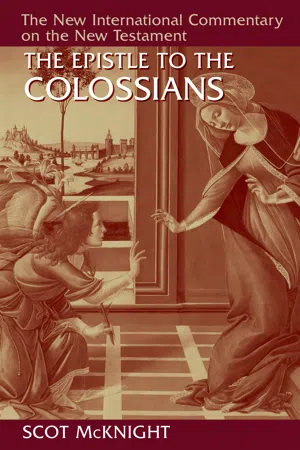
The Letter to the Colossians offers a compelling vision of the Christian life; its claims transcend religion and bring politics, culture, spirituality, power, ethnicity, and more into play. Delving deeply into the message of Colossians, this exegetical and theological commentary by Scot McKnight will be welcomed by preachers, teachers, and students everywhere.
Information
Print ISBN
9780802867988
Text and Commentary
Why, one might ask even this late in the game called church history, write a commentary? Paul’s letter to the now nearly forgotten city of Colossae is ancient, after all; not only is it ancient, there are endless debates about everything important and even more about what is not so important. The number of commentaries on Colossians itself proves the point. I could perhaps turn this around to ask, Why read a commentary? Let me offer a few observations. I hope you are not reading this only to get stuff for your sermon or for what you are teaching or simply to resolve some debate. To read a commentary only (I emphasize) for such utilitarian aims is crass, if not irreligious. Of course, we all dip into commentaries for what we can get out of them, but I did not write this commentary for that purpose alone. The point of writing this commentary is existential or ontological. I read Colossians to hear from God in order to become more Christlike, and I would ask any reader to redirect any reading of this letter (and then to read this commentary) to Christlikeness.
My prayer is that you and I will read in order to love God and to love others more. Participation in truth, then, is the aim of writing and reading the Bible. Who cannot now quote the wondrous words of Francis Bacon?1
But howsoever these things are thus in men’s depraved judgments and affections, yet truth, which only doth judge itself, teacheth that:
The inquiry of truth, which is the love-making or wooing of it,
The knowledge of truth, which is the presence of it,
And the belief of the truth, which is the enjoying of it
Is the sovereign good of human nature.
I write with the aim that the truth of Colossians will woo us to the presence of truth and joy in its very presence. It is, Bacon continued, “heaven on earth, to have a man’s mind move in charity, rest in providence, and turn upon the poles of truth.”
Truth, however, exacts its price. That price is the pain of listening through our sinful condition to the glistening truth, the pain of enduring time well spent on our knees and faces before God as God speaks, and the pain of letting this text teach us what to know and how to live, even if that requires the pain of altering our mental and behavioral maps. Every time I sit down to Colossians I expect this text to reshape my mind and my life. Sometimes this text will take you to places you probably do not even care about, but patient, humble listening will turn our cares toward what God through Paul cares about. Sometimes Colossians is painfully irrelevant, but our task is not to make it relevant but to bend our world toward the glistening light of what God reveals in Christ. This is how Paul opens up this letter—with the simple claim that he has been sent by Jesus the Messiah by God’s will, and this letter is what God is speaking through him to them. This is the only right way to begin reading Colossians.
I. INTRODUCTION (1:1–2:5)
A. SALUTATION (1:1–2)
Paul, an apostle of Christ Jesus by the will of God, and Timothy our brother, 2To God’sa holy people in Colossae, the faithful brothers and sistersb in Christ: Grace and peace to you from God our Father.c
a. NIV adds “God’s.” Below, I will compare the NIV and the CEB; for the best discussions of translation differences, I recommend Harris and Moo.
b. Both NIV and CEB add “and sisters” because the Greek word ἀδελφοί is generic. Dunn, 43n4, observes: “In a historic text, however, it is better to retain the original usage, while noting that women within these congregations would have understood that the term included them.”
c. Some early MSS add, as in every other Pauline letter in one form or another, “and from the Lord Jesus Christ.” The omission of “Jesus Christ” here is thus the more difficult and preferred reading. See Omanson, 410. While omission of these words makes it a more difficult reading, one might come back with the observation that its constant use in other Pauline salutations makes it the more original. See Gal 1:3; 2 Thess 1:2; 1 Cor 1:3; 2 Cor 1:2; Rom 1:7; Phil 1:2; Phlm 3.
Paul’s letters were longer than ordinary letters of the ancient world. In addition, Paul’s letters have predictable sections, including a salutation or greeting,2 a thanksgiving,3 and the main body. We ought to remind ourselves that “grace and peace” in Paul’s salutations are, after all, the apostle’s way of saying “hello” or “greetings.”4
The opening to this letter identifies salient features of both the authors and their audience, with the rhetorical intent of creating an impression of trustworthiness.5 Too, a letter functioned as the personal presence (parousia) of the letter writer.6 The Letter to the Colossians was written by both Paul and Timothy, which raises the important topic of how letters were written.7 A brief word description is all that is possible here: we are to imagine Paul at work sketching ideas, talking to his companions, composing drafts of his letters,8 hiring at considerable cost a secretary/scribe for the more official writing with a copy or two for himself, and then hiring or finding a letter carrier to deliver the letter. At work in this sketch is the reality that Paul probably did not write out by hand any of his letters, that each of his letters reflects the grammar and style and contribution of his secretary and companions in the process, that his letters were drafted in conversation and debate with his companions in a home or under a shaded tree. This scenario leads to two negatives: Paul did not dictate his letters to his secretary, and he probably did not write them out in one sitting. Timothy, in other words, contributed to this letter in content, which is why his name follows the word “and.”9
1:1Letters of the first century began with the author, the recipients, and a brief word of greeting.10 A good example of a typical greeting is found in Acts 15:23:11 “The brothers, both the apostles and the elders, to the believers of Gentile origin in Antioch and Syria and Cilicia, greetings.” In Paul’s case the name “Paul” is sometimes said to be his missionary name, though this is probably mistaken. Roman citizens had two or three names, and apparently Paul’s were “Saul” and “Paul,” his Hebrew and perhaps a Roman name that sounded like the Hebrew. According to the book of Acts, he was Saul until he entered into his Gentile mission (13:9), at which time his name shifts to Paul. Paul never calls himself Saul. It is, then, as likely that the name shift is more to his Roman name, since he was now a missionary to Gentiles in the Roman world, as it is that he, like Peter, acquired a new name as an apostle. Paul describes himself (1) as an apostle of King12 Jesus, and this apostolic mission came (2) through the will of God.
Paul identifies his missional calling as an “apostle.”13 Jesus himself formed a nucleus for the church around twelve apostles (Mark 3:13–19; Matt 10:2–4; Luke 6:13–16; Acts 1:13), and the term “apostle” no doubt was related to the Jewish concept of the shaliach, that is, the “ambassador.”14 By the time of Paul the term “apostle” was being used for more than the Twelve,15 and so it could be technical for the Twelve (as in Mark 3:13–19), it could be generic (Phil 2:25; 2 Cor 8:23), or it could refer to a missionary or church-planter (Rom 16:7; 2 Cor 11:13; Acts 14:14; Rev 2:2). Junia, a woman, is called an apostle at Rom 16:7 in this latter sense. Paul combines the original sense of the twelve apostles (1 Cor 15:5–9) along with the third sense with a prophetic-calling dimension because Paul has been commissioned by Jesus and is a church-planting Gentile missionary. To be called an apostle in this sense requires that one was an eyewitness of Jesus (1 Cor 9:1; Acts 1:21–22), that one had a commission from the Lord to represent and speak for him, and that one had performed miracles. Apostles are ranked at the top of the spiritual gifts by Paul (1 Cor 12:28; Eph 2:20; 4:11). Most important, Paul’s apostleship is described as grace, a gift from God, a theme developed in Col 1:25–27. As such, to be an apostle is to claim a Spirit-given authority (see 1 Cor 15:5–11 and 1 Tim 2:7: “a true and faithful teacher”). The authority of an apostle, to be sure, emerges not from a title or authority assumed but from the source (God, Christ, Spirit) and also from the power of his or her charismatic giftedness (Col 1:11, 29).16 Alongside belief in his calling from God comes opposition to that very calling on the part of others (see 1 Cor 9:1–18; 2 Cor 2:17–3:1; 11–12), which may well be a reason for Paul here calling himself apostle. That Paul claims his apostolic ministry with respect to the Colossians, a church he did not personally establish (Epaphras did), reveals his conviction that he is called to supervise Gentile churches, including also those established by his associates.17
Paul was sent by King Jesus.18 Some think “Christ” is not so much Jesus’s role as Messiah but more a second name with barely a whiff of that historic role. This view has its supporters, but more recent studies have concluded that whenever Paul uses christos, he never loses touch with the historic claim that Yeshua (Jesus) is the Messiah of Israel.19 To call Jesus “Messiah” is to tell Israel’s story as fulfilled in the story of Jesus. But this title cuts in two directions at once—into Israel’s story and against the grain of Rome’s honor. Remember that the Romans despised having a king (rex), so from the days of the idealistic but ever-central notion of Rome as ...
Table of contents
- Title Page
- Copyright
- Dedication
- Contents
- General Editor’s Preface
- Author’s Preface
- Abbreviations
- Bibliography
- INTRODUCTION
- TEXT AND COMMENTARY
- Index of Subjects
- Index of Authors
- Index of Scripture and Other Ancient Texts
Trusted by 375,005 students
Access to over 1.5 million titles for a fair monthly price.
Study more efficiently using our study tools.
Frequently asked questions
Yes, you can cancel anytime from the Subscription tab in your account settings on the Perlego website. Your subscription will stay active until the end of your current billing period. Learn how to cancel your subscription
No, books cannot be downloaded as external files, such as PDFs, for use outside of Perlego. However, you can download books within the Perlego app for offline reading on mobile or tablet. Learn how to download books offline
Perlego offers two plans: Essential and Complete
- Essential is ideal for learners and professionals who enjoy exploring a wide range of subjects. Access the Essential Library with 800,000+ trusted titles and best-sellers across business, personal growth, and the humanities. Includes unlimited reading time and Standard Read Aloud voice.
- Complete: Perfect for advanced learners and researchers needing full, unrestricted access. Unlock 1.5M+ books across hundreds of subjects, including academic and specialized titles. The Complete Plan also includes advanced features like Premium Read Aloud and Research Assistant.
We are an online textbook subscription service, where you can get access to an entire online library for less than the price of a single book per month. With over 1.5 million books across 990+ topics, we’ve got you covered! Learn about our mission
Look out for the read-aloud symbol on your next book to see if you can listen to it. The read-aloud tool reads text aloud for you, highlighting the text as it is being read. You can pause it, speed it up and slow it down. Learn more about Read Aloud
Yes! You can use the Perlego app on both iOS and Android devices to read anytime, anywhere — even offline. Perfect for commutes or when you’re on the go.
Please note we cannot support devices running on iOS 13 and Android 7 or earlier. Learn more about using the app
Please note we cannot support devices running on iOS 13 and Android 7 or earlier. Learn more about using the app
Yes, you can access The Letter to the Colossians by Scot McKnight in PDF and/or ePUB format. We have over 1.5 million books available in our catalogue for you to explore.