Can a neuroscientist help a theologian interpret a medieval mystical text? Can a historian of religion help an anthropologist understand the effects of social cooperation on human evolution? Can a legal scholar and a theologian help each other think about how fear of God relates to respect for the law?
In this volume leading scholars in ethics, theology, and social science sum up three years of study and conversation regarding the value of interdisciplinary theological inquiry. This is an essential and challenging collection for all who set out to think, write, teach, and preach theologically in the contemporary world.
CONTRIBUTORS:
John P. Burgess
Peter Danchin
Celia Deane-Drummond
Agustín Fuentes
Andrea Hollingsworth
Robin W. Lovin
Joshua Mauldin
Friederike Nüssel
Mary Ellen O'Connell
Douglas F. Ottati
Stephen Pope
Colleen Shantz
Michael Spezio
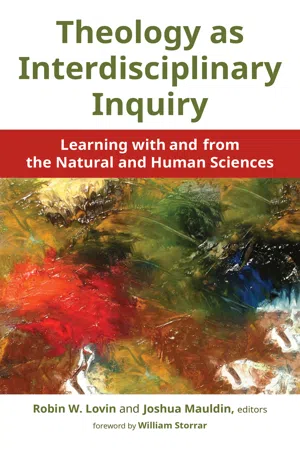
eBook - ePub
Theology as Interdisciplinary Inquiry
Learning with and from the Natural and Human Sciences
- 202 pages
- English
- ePUB (mobile friendly)
- Available on iOS & Android
eBook - ePub
Theology as Interdisciplinary Inquiry
Learning with and from the Natural and Human Sciences
About this book
Information
Subtopic
Théologie chrétienne1
Looking at Humans through the Lens of Deep History
A Transdisciplinary Approach to Theology and Evolutionary Anthropology
Why should theologians be concerned about evolutionary anthropology when coming up with a theological treatise on what it means to be human? The history that theologians are most likely to address stems from that related to the last two thousand or so years, focusing specifically on texts of the New Testament or early church history. Given the uncertainties in that more recent history, once we move back many millennia to the dawn of human emergence, “history” becomes ever more fragmented, a series of puzzles hinted at through patchy yet elusive archaeological clues that require almost an artistic sensibility for their interpretation. Some have called such a period prehistory, since it is before any written records, even if hints at inner mental transitions begin to show up in the form of dye markings or scratches on the surfaces of rock or bone.1 In this essay I tackle the question of early human origins by beginning with a discussion of the biblical narrative in Genesis from two contrasting perspectives, namely, that of Roman Catholic theologian Karl Rahner and that of Jewish philosopher Alan Mittleman. Both scholars raise interesting questions about the significance of what it means to be human in light of humanity’s gradual emergence. Evolutionary biologists who have considered early human history are divided as to the extent to which biological and cultural aspects of human becoming are most significant. How far and to what extent scientists might be able to engage with any theological and philosophical interpretations depends on prior epistemological commitments. Wentzel van Huyssteen has charted an interdisciplinary approach that deliberately brings theology and science together in a common transversal space. There are, however, some risks associated with his preferred methodology that I flesh out in more detail through a discussion of evolutionary anthropology using the lens of theo-drama and niche construction, both of which, I argue, are relevant to understanding the history of early human origins. I end up arguing that such analogies in a transdisciplinary mode of thinking are more like artistic appreciations or resonances, where scholars in each discipline retain their disciplinary integrity but are prepared to shift their perspectives through that exchange.
In one sense theologians are already familiar with deep history, in that the prehistory of the human race is read into the early chapters of the book of Genesis, leading to a trend within the more conservative Protestant and Roman Catholic traditions at least, to insist on a claim for the literal historicity of Adam and Eve. Coming to terms with that historicity in a way that still makes sense in an evolutionary context is a perennial challenge for serious and philosophically minded evangelical scholars.2 At the same time, more explicitly in the Catholic tradition, any resistance to the view that there was an originating human couple, otherwise known as monogenism, could threaten a belief in original sin, and so, the argument goes, would potentially threaten both human responsibility for evil and the narrative of salvation. Karl Rahner explains the logic of this position lucidly when he claims that
original sin simply means that man, because he is a descendant of Adam, belonging to this historical, human, family, ought to possess divine grace but does not do so. Grace is conferred on him only if he is also one who has been redeemed by Jesus Christ. But both things are based on this bodily community of shared descent: the fact that according to God’s plan man was to be endowed with sanctifying grace, divine life, divine nearness and divine glory; and the fact that he does not actually have all this.3
For that reason, Rahner devotes a whole chapter in the first volume of his major theological treatise, Theological Investigations, to a discussion of monogenism, concluding towards the end of this chapter that “polygenism as an object of divine action is impossible.”4 Yet talk of impossibility for God might incur some nervousness on the part of the reader, especially in view of the research emerging from evolutionary sciences. Rahner believed, of course, that he was writing at a time when the research in this aspect of human history was extremely hazy. So, for him, “since the beginning of mankind is primordial history, it lies outside the scope of natural science, it has a certain historical transcendence and cannot be examined as if it were one element among others in our history.”5 Primordial history therefore has the same kind of haziness as the distant future expected at the end of history, and in that sense he insists that “[o]f their very nature, the reality of primordial history and eschatology is farthest removed from our idea of them.”6
There are two aspects that are worth considering here. The first is a more general claim about whether the early chapters of Genesis really do say something significant about human origins. The second claim has to do with evolutionary anthropology, how far the prehistory that Rahner assumes really is as unknown as he implies. It is worth considering the first in more detail by examining in particular the work of a Jewish philosopher, Alan Mittleman, who has worked on the question of human origins in the light of contemporary science in a way that is highly illuminating for the broader discussion within Christian theological debates. Mittleman argues that the early part of Genesis is not intended to be a human origin story at all. Rather, the narratives are about a cultural phenomenon, how human beings fit in the natural world and their ethical responsibilities.7 Yet, even in this qualified view there is still a clash between the naturalistic view and that of Judaism and other Abrahamic faiths, for in the biblical text human beings are always purposeful creations of God. Mittleman is correct to flag briefly the debates about the role of purpose in evolutionary theory; but it is often a functional sense of purpose, rather than an overarching or grand narrative about ultimate purposes. The language of the ultimate, if it is used at all, more often than not collapses back into forms of genetic essentialism. In the Jewish tradition humans do not just appear, as in a moment of emergence from other animals, but their appearance reflects a deliberative act of God, so “what is unmistakably clear is that God takes a moment for deliberation. He does not just command. He considers.” The result is that “[t]he human being is a product of reflection and choice.”8
But, rather than work out how such a view might cohere with evolutionary perspectives, he sees such a text as pointing to something significant about ourselves, so “[r]ecursive thought is distinctly human.” Nonetheless, he is not arguing for a strong account of human exceptionalism, since “[h]uman beings are at best contingently not categorically superior to other beings.”9 The combination of both human nobility along with humanity’s pathetic or even negligible aspect provides an ambivalence that is common to human experience. He then makes the somewhat surprising claim that image also means literal physical resemblance, functioning as God’s presence, in the same way that Adam passes on his likeness and image to his son, Seth. Humans become co-creators with God through propagation. But the rabbinic speculation on this text interprets the form that Adam shares with God as “energetic and radiant” rather than concrete or palpable, and it is this that is passed down the generations.10 The common ancestor assures the moral equality of all humans. After Adam’s sin, looking like God is no longer possible—what remains is acting like God, imitating the divine, which implies the exercise of responsibility. And such responsibility includes procreation and taking responsibility for the next generation.
Mittleman includes this and other rabbinic speculation about the moral ambiguities of human nature; some even arguing that, given human propensity for evil, it might have been better if humanity had not been created. And more fascinating is the idea that the evil force or inclination is a “divinely created force” that can be overcome by study of the Torah. Human rule over the animals is therefore a God-given mandate. Cain mixed up the command and thought that humans were the same as animals, which led to the murder of his brother. Through the rabbis of the Talmud, Jewish thought parsed “all present animals as cognitively diminished versions of human beings”11 rather than humans as cognitively enhanced animals. Animal liability as moral agents is therefore common in the Talmud. But most importantly, the tendency to do wrong comes from our human nature, rather than hybridity with animals. The Jewish tradition thus cuts to some extent both ways; on the one hand humans are encouraged to rule the natural world, but in a manner that reflects God’s rule; on the other hand the evil that they do is their own responsibility, rather than stemming from their animalistic tendencies. Mittleman carefully navigates his way through these sources by pointing to the ambiguities in the literature about human beings, especially that relating to the soul and the self, the formation of Adam as a living creature, and soul and body as both fragile and fleeting. Yet while the soul is not “trapped” in the body, there is room for a notion of a temporarily separated soul at death, whose final destiny is with a restored body. It is Jewish philosopher Joseph Albo’s view on the soul that is perhaps the most interesting; that the most distinctive capacity of the human soul is not so much pure intellection, but loving service of God.12
The history of interpretation of the Genesis text presses beyond its particular meaning in either a Jewish or Christian context, so the question that has to be resolved is how far and to what extent such claims are justified. Does the whole pillar of Christian salvation, or even belief in the goodness of God, fall like a house of cards once Adam and Eve are no longer historical figures, the originators of human history? Is the significance of Adam and Eve often understood in Christian theology in terms of their role in instigating right moral action fully satisfying in the light of the long Jewish history of interpretation that claims much more than this? Until at least some account is taken of contemporary evolutionary anthropology, these theological puzzles remain unresolved.
Evolutionary Science and Theological Foundations
With respect to Rahner’s second claim of the impossibility of reaching into this historical period with the tools of natural science, many evolutionary scientists are not averse to making strong claims about what it means to be human in the light of early hominin evolution. One key unresolved debate remains the precise relationship between human biological endowment and cultural influences in shaping the emergence of the modern human mind. Evolutionary psychologists like Steven Pinker resist the idea that the human mind is simply a blank slate, while philosophers such as Jesse Prinz challenge such seeming biological reductionism, favoring the importance of cultural and social influences.13 Dichotomies such as these seem wooden to many evolutionary anthropologists, who prefer to put forward the idea that, in those societies that display “culture,” there is a much more blurred boundary of “natureculture” that resists presupposing either of the above alternatives.14
Ever since Wentzel van Huyssteen presented the case for interdisciplinarity as critical for understanding the human person, the concept that there might be what he terms illuminating “transversal spaces” between different disciplines has been clearly on the horizon.15 In his own words, van Huyssteen claims that
transversal reasoning does not imply that scientific data, paradigms, or worldviews, can be transported into theology to there set the agenda for theological reasoning. Transversal reasoning does mean that theology and science can share concerns and converge on commonly identified conceptual problems such as the problem of human uniqueness. These mutually critical tasks presuppose, however, the richness of the transversal moment in which theology and evolutionary anthropology may indeed find amazing connections and overlapping intersections on issues of human origins and uniqueness.16
His view resists foundationalism of all kinds in the interest of open discussion between scientists and theologians, where at least some common ground can be established. By foundationalism he means “the thesis that all our beliefs can be justified by appealing to some item of knowledge that is self-evident or indubitable. Foundationalism in this epistemological sense therefore always implies the holding of a position inflexibly and infallibly, because in the process of justifying our knowledge-claims, we are able to invoke ultimate foundations on which we construct the evidential support systems of our various convictional beliefs.”17 While this perspective is often rejected in favor of a relativistic nonfoundationalism, van Huyssteen presses for what he terms a postfoundationalist view, analogous to the rise of postmodern discourse.18...
Table of contents
- Title Page
- Copyright
- Table of Contents
- Foreword, by William Storrar
- Acknowledgments
- Introduction: Theology as Interdisciplinary Inquiry
- 1. Looking at Humans through the Lens of Deep History
- 2. The Moral Life and the Structures of Rational Selves
- 3. In the Divine (Mental) Image
- 4. Nicholas of Cusa’s Mystical Theology in Theological and Scientific Perspective
- 5. Religious Persecution and Religious Freedom
- 6. Law, Theology, and Aesthetics
- Conclusion: A Collaborative Manner of Theological Reflection
- Contributors
- Center of Theological Inquiry Research Fellows, 2012–2015
- Index
Trusted by 375,005 students
Access to over 1.5 million titles for a fair monthly price.
Study more efficiently using our study tools.
Frequently asked questions
Yes, you can cancel anytime from the Subscription tab in your account settings on the Perlego website. Your subscription will stay active until the end of your current billing period. Learn how to cancel your subscription
No, books cannot be downloaded as external files, such as PDFs, for use outside of Perlego. However, you can download books within the Perlego app for offline reading on mobile or tablet. Learn how to download books offline
Perlego offers two plans: Essential and Complete
- Essential is ideal for learners and professionals who enjoy exploring a wide range of subjects. Access the Essential Library with 800,000+ trusted titles and best-sellers across business, personal growth, and the humanities. Includes unlimited reading time and Standard Read Aloud voice.
- Complete: Perfect for advanced learners and researchers needing full, unrestricted access. Unlock 1.5M+ books across hundreds of subjects, including academic and specialized titles. The Complete Plan also includes advanced features like Premium Read Aloud and Research Assistant.
We are an online textbook subscription service, where you can get access to an entire online library for less than the price of a single book per month. With over 1.5 million books across 990+ topics, we’ve got you covered! Learn about our mission
Look out for the read-aloud symbol on your next book to see if you can listen to it. The read-aloud tool reads text aloud for you, highlighting the text as it is being read. You can pause it, speed it up and slow it down. Learn more about Read Aloud
Yes! You can use the Perlego app on both iOS and Android devices to read anytime, anywhere — even offline. Perfect for commutes or when you’re on the go.
Please note we cannot support devices running on iOS 13 and Android 7 or earlier. Learn more about using the app
Please note we cannot support devices running on iOS 13 and Android 7 or earlier. Learn more about using the app
Yes, you can access Theology as Interdisciplinary Inquiry by Robin W. Lovin, Joshua Mauldin, Robin W. Lovin,Joshua Mauldin in PDF and/or ePUB format, as well as other popular books in Théologie et religion & Théologie chrétienne. We have over 1.5 million books available in our catalogue for you to explore.