A fresh, inviting text on the content of Christian faith in our contemporary context.
This one-volume systematic theology presents an accessible, orthodox overview of the Christian faith for students, teachers, pastors, and serious lay readers. Cornelis van der Kooi and Gijsbert van den Brink not only cover all the traditional themes—creation, sin, Jesus Christ, Scripture, and so on—but also relate those classical themes to contemporary developments like Pentecostalism, postmodernism, and evolutionary theory.
Consisting of sixteen chapters, the book is ideal for classroom use. Each chapter begins with engaging questions and a statement of learning goals and concludes with a list of recommended further reading. Written in a student-friendly tone and style and expertly translated and edited, van der Kooi and van den Brink's
Christian Dogmatics splendidly displays the real, practical relevance of theology to the complexities of today's world.
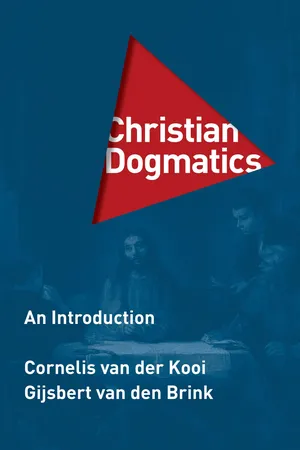
- 820 pages
- English
- ePUB (mobile friendly)
- Available on iOS & Android
eBook - ePub
About this book
Information
Topic
Theology & ReligionSubtopic
Christian Theology1Dogmatics as Disciplined Thinking about God
Definitions and Aims
AIM
In this chapter you may expect a number of things. Specifically, we intend to:
- define what Christian theology is all about and where it differs from religious studies (1.1)
- explain the target audience for theology (1.2)
- dispel possible fears about the adjective “systematic” in “systematic theology” (1.3)
- explain the relationship between systematic theology and dogmatics (1.4)
- show how (un)systematic dogmatics is (1.5)
- indicate how dogmatics is related to other disciplines (1.6)
- provide a survey of the major tasks of dogmatics (1.7)
- present a typology of concrete forms of contemporary theology (1.8)
- argue that theology is, ultimately, not a scholarly discipline but a mode of existence (1.9).
This chapter will not deal with the question of the content of faith, why people believe, or what is unique to the Christian faith. We will address these questions later in the book, beginning with chapter 2.
MAKING CONNECTIONS
- Take two minutes to write down a list of the associations that emerge in your mind when you hear words like “dogmatics” and “doctrinal.” Then note whether those associations are neutral, positive, or negative. What happens when you repeat this exercise with the term “systematic theology”?
- People of faith might have their suspicions about theology and theologians. What might these be? And what do you think—what kind of help do you expect from theology?
1.1.Theology as Reflecting about Faith
We might define theology, in a preliminary way, as “reflecting about God.” Admittedly, theologians also think about a range of other things—for instance, about humanity, about evil, about the world and its future. But in theology our thinking about such themes happens in the context of faith in God. It then deals with the consequences of this faith for the issues that confront every human being. “Thinking about faith” in this broad sense provides a description of theology that will suffice for the moment.
This book is specifically about Christian theology. That is, Christian theology is reflection on the Christian faith. It presupposes that there is something like “the” Christian faith. This immediately raises a question, for many people nowadays argue that Christianity is so pluralistic that one cannot lump all forms of it together. Looking at what Christians believe and have believed, they are impressed by the enormous pluralism they see—and rightly so. This observation leads them to the conclusion that it is impossible to formulate a definitive core of what it means to be a Christian. It appears that, looking at Christian faith in different cultures, times, and contexts, it is impossible to detect a single common denominator. If so, there is not something like “the” Christian faith but only a large number of quite diverging forms and interpretations of what Christians believe. Others, however, think that the search for Christian theology is precisely the attempt to discover what may, within this great variety, justifiably claim the Christian label. They see this as the fascinating question that lies at the basis of everything: what statements and practices of faith are truly Christian? And which ones are, in the terms we use today, sub-Christian instead?
At this stage we do not yet have to answer the question of whether we can point to something like “the essence of Christianity.” For now, then, we formulate our definition without a definite article, leaving a number of options open: Christian theology is thinking about Christian faith.
In 1973, when H. Berkhof had to choose a title for his book on dogmatics, he consciously decided to omit the definite article. He opted for Christelijk geloof (Christian faith). In so doing, Berkhof referred to the great nineteenth-century German theologian Friedrich Schleiermacher, who called his survey of Christian dogmatics Der christliche Glaube (1821–22)—with the definite article. Later, Adolf von Harnack underlined a similar essentialism in his book Das Wesen des Christentum (The essence of Christianity, 1900). However, the discussions that followed Harnack’s book showed, at the very least, the difficulty of pinpointing the essence of Christianity or of the Christian faith. Nonetheless, theologians continue to search, perhaps not so much for the essence of Christianity as for what might be labeled genuinely Christian on the basis of its sources. John Webster is a good example of a contemporary dogmatician who is passionately engaged in this quest (see his brief theological autobiography in Marks 2002, 129–36).
It is important to understand the word “reflecting” in our definition in a literal way. Faith precedes, and thinking follows. It could be said that theologians pursue faith by thinking about it. This statement presupposes that they themselves are believers. Or in any case, they must be ready, willing, and able to try to step into the shoes of believers. This exact attitude is probably rare, for normally we see a theologian as someone who speaks from the inside, from the basis of faith. Thus, theology more typically is reflecting on the faith in which the theologian himself or herself participates. To use a term that has become common: one can do theology only from a “participatory perspective.”
We do not mean that only believers can be involved in the study of faith. Whether one does or does not believe, one can study questions and themes regarding faith in a nontheological manner. The same also applies to any non-Christian faith. In that case one opts for the so-called exterior, or nonparticipatory, perspective. That is, the observer looks at a particular religion—it may even be one’s own religion—from the outside and poses questions such as, how did we get the Bible? What do Buddhists believe about nirvana? How do Shiite and Sunni Muslims differ? Obviously, such questions may be answered without oneself being a believer. The discipline that studies this type of questions is usually referred to as religious studies. The plural here indicates that it is an umbrella term that covers various subdisciplines: religious psychology, the history of religion (or more specifically: the history of Judaism, Islam, etc.), sociology of religion, philosophy of religion, biblical studies, and so forth.
The difference between theology and religious studies is such that often the two fields are not offered at the same institution, or in any case, not as part of the same department. Educational institutions that deal with religion tend to make a definite choice between the participatory and nonparticipatory perspectives—or if they combine the two, to study them in separate programs. Theology from a particular faith perspective is usually offered at theological institutions that have been established for that purpose. Religious studies may form an independent program at a university, but nowadays it is usually placed with the humanities. A third option may be that an institution offers the opportunity for theological reflection from more than one faith perspective. This usually happens at a divinity school or department of theology, where a serious attempt is made to allow for as constructive a theological dialogue as possible between the various forms of theology without reducing or ignoring the often immense differences between them.
The authors of this book work at an institution that belongs to this third category. Though this type of educational institution is rare in the Netherlands, we consider its approach quite productive for the academic study of religious questions and themes, and very instructive for our students. On the one hand, no one is expected to leave one’s faith (or its absence) at the door when entering the university or to put it on a back burner. That requirement would create a very artificial situation in which believers will feel shortchanged. On the other hand, this approach precludes students from focusing only on their own tradition, unaware of what happens outside of it. One of the competencies that may be expected from theologians, as well as from religious scholars, is to constructively deal with the major differences between faith traditions in our Western culture.
It should be noted that, in the past, the picture differed somewhat further, with an educational model that, with some adaptations, still exists. Theological faculties in various Dutch universities took a religious-studies approach to the Christian faith in particular. The student took courses in, for instance, the history of the religion of Israel, New Testament exegesis, or church history of the twentieth century. These subjects were ideally taught in an impartial manner, that is, from a nonparticipatory perspective. At the same time, they provided an excellent basis for the so-called ecclesiastical courses, which were facilitated by various faith communities. In this domain such courses as dogmatics, theological ethics, and practical theology were offered—that is, disciplines that presuppose a faith perspective. In this duplex ordo (dual arrangement) the participatory and nonparticipatory perspectives are carefully linked, but without any fusion.
It is important not to overemphasize the differences between theology and religious studies, however real they may be. They need each other. Theology needs to be informed by the wealth of data, theories, and methods that are found in the field of religious studies. We will see how theology has its own mandate and methods, but without the input from the subdisciplines of religious studies, it runs the risk of becoming “fuzzy,” out of touch with empirical reality. Practical circumstances demand this approach too, since a large percentage of the students who choose to study the phenomenon of religion do so because of existential personal questions. As a matter of principle, however, the object of their study requires something like theological reflection as well. To give an example: We can never do full justice to the Gospel of John by a thorough study of its text-critical, exegetical, religion-historical, and theological background, without considering the main aim of the author or redactor of the book, namely, that we as readers will believe that Jesus is the Messiah, the Son of God (John 20:31). It would certainly be artificial to avoid all discussion about whether the claim of the gospel writer is justified. In practice, where one tries to follow this approach, we often see that, in a hidden way, all kinds of theological judgments play a role. Or we see an attempt to talk about the meaning, the interrelatedness, and the aim of the branches of religious studies in a nondenominational (or even interreligious) theology. The question of truth is, however, not that easily disposed of.
1.2.The Three Audiences of Theology
Much more fruitful than the endless discussion about theology versus religious studies is the approach that takes its point of departure from the question of who in fact constitutes the audience for our theological work. Well, first of all, theology is useful for every believer. All believers do well to reflect on the nature, the content, and the scope of their faith, which most of them realize. Martin Luther (1483–1546) said, “All of us are theologians; that is to say: every Christian is a theologian” (WA 41:11). But we may also state that, from a professional angle, both theology and religious studies must target three user groups (or “fora,” or “publics”): academia, the faith community, and society. Each of these three groups includes people who are, albeit in various ways, deeply interested in religious matters. The academic world wants to see a critical-scholarly approach to the questions that concern religions. Here a temporary inner distance from one’s own religious views will often be useful. Faith communities attach much value to an approach that does not avoid the hot issues but also wants to address the question of truth. Here it is useful not to bracket one’s own faith but rather to stake out one’s convictions. Finally, our society will benefit if representatives of various religious traditions are not so ignorant that they deal with each other by way of reflex, as strangers, and in a hostile manner. It is impossible to appreciate what you know little or nothing about, and we can effectively prevent the dangerous mechanisms of excluding and demonizing only if leaders and members of the various religions (and other worldviews) are not led by caricatures but are well informed about what characterizes those who believe differently.
Theological seminaries, institutions for religious studies, and theology departments may be expected to place different accents, but they have a responsibility toward all three of these audiences. University theologians and seminaries will primarily target their own faith community, but in doing so they should take great care not to ignore the scholarly criteria that academia and society impose on university-level education. Experts in religious studies, however, must not assume that faith is merely an object of detached academic study. They should realize that for many people it is a flesh-and-blood reality that puts its stamp on all aspects of life. Moreover, in their relationship with society, theology departments must never overlook academic standards. But they should also move beyond a mentality of simply providing the answers that their supporters are looking for.
Whatever their type of educational institution, students should be able to give a reasoned account of their faith—and look at things from different perspectives. On the one hand, they must be capable of adequately expressing what they themselves believe and why; on the other, because they have acquired the necessary scholarly distance, they must be able to put themselves in the shoes of people with different religious convictions and worldviews, enabling them to interact with integrity with those who have a belief system other than their own.
In accordance with what has just been said, the emphasis in this book is on the perspective from within; we want to think about religious matters from within the Christian faith tradition. We will do so, however, with the critical approach of every academic context, that is to say, with arguments that separate sense from nonsense, choosing between the pros and cons of various convictions and presentations of faith. Whether one may call the kind of theology we introduce here scientific in the broad sense (here note the German term Wissenschaft) is largely a matter of definition. In particular, the jury is out on the question whether theological statements are open to independent verification (see Leonhardt 2001, 70–75). But even when this statement is denied, we have sufficient parallels with scientific methodology to justify calling theology a scientific—or in any case a properly academic—discipline (see Brink 2009, 96–98, 193–209).
David Tracy (1981) speaks of the three “fora” of theology, and we are indebted to David Ford (1999) for the way he developed this idea in terms of the “three publics of theology.”
1.3.Systematic Theology
Above we defined theology as “reflecting about faith in God.” Such a definition is rather rudimentary. We may define theology a little more precisely as the attempt of thinking believers to clarify the nature and content of their faith. Etymologically, theology has to do with a logos about theos. The Greek word logos has been extremely important in the Christian tradition, and we will regularly encounter it in what follows. Briefly put, it means an intellectually responsible discourse, a rational explanation. We are dealing with theology when such an explanatory discourse has God as its object. To underline the rational and ordered character of theology, we often refer to systematic theology.
We may well ask ourselves whether that expression does not suffer from an internal contradiction. Is it possible to speak in a rational, systematically ordered way about things that far surpass our human understanding? For if there is one thing that we can say about God, it is that “God” represents the mystery under, behind, and above all the visible reality that surrounds us. His reality cannot be charted systematically in the same manner in which we would describe the operation of molecules and atoms. Do we not at the very most catch only some glimpses of the divine secret behind our reality? And besides, even if God is more than such a glimpse for us, we cannot simply locate that experience in a system. On the contrary, such an experience will often question some of our convictions and relativize them. It is said that Thomas Aquinas (1224–74), one of the greatest thinkers of all times, after a mystical experience in December 1273, declared that he considered all his theological writing as “a bushel of straw.” After this experience he never again touched systematic theology, and his daunting Summa theologiae remained unfinished.
It does not take a Bible scholar to discover from reading the Bible that the faith of Jews and Christians is indeed less a matter of rational reflection and more one of experiences, visions, and emotions, calling and obedience, bewilderment and amazement, sin and grace, trust and worship. If so, why does faith need that rational, systematic reflection? We should not too readily dismiss this question. By approaching the mysteries of faith in a systematic manner, we may even destroy our faith with our arguments. Rational thinking about faith may even be a way to keep God at a distance and to evade the appeal that God directs to us. The Danish philosopher Søren Kierkegaard (1813–55) ridiculed theology professors who behave like a kind of merchant in theological concepts, while, in spite of all their learning, they have hardly understood what the Christian faith, what concrete discipleship of Christ, means. And the British author C. S. Lewis (1898–1963) said that there will be theologians at the bottom of hell who were more interested in their ideas about God than in God himself. Do not these prospects make all detached, rational, and systematic discourse about God rather risky?
Indeed, we face a risk that theologians, in particular, must be aware of. However, this does not imply that we should therefore give up all systematic theology or harbor a constant suspicion toward it. It does mean that we must constantly consider two things.
1. Good theology has its source in faith. In this connection we do not speak of having “faith” as having...
Table of contents
- Title Page
- Copyright
- Contents
- Preface to the English Edition
- Preface to the Original Edition
- 1. Dogmatics as Disciplined Thinking about God: Definitions and Aims
- 2. Is There a God?: Prolegomena
- 3. God as Three in One: The Doctrine of the Trinity
- 4. “Great Is Thy Faithfulness”: The Names, Attributes, and Essence of God
- 5. Encountering God: The Doctrine of Revelation
- 6. Existence Given: The Doctrine of Creation
- 7. Human Beings and the Image of God: Theological Anthropology
- 8. Existence Ravaged: Sin and Evil
- 9. Israel, the Raw Nerve in Christian Theology: The Doctrine of the Covenant
- 10. The Person of Jesus Christ: Christology
- 11. “What a Friend We Have in Jesus”: Jesus Christ as Victor, Redeemer, and Mediator
- 12. Holy Spirit, Giver of Life: Pneumatology
- 13. The Book of God and of Humans: The Doctrine of Scripture
- 14. Renewal of God’s Community: Ecclesiology
- 15. Renewal of the Human Being: Justification and Transformation
- 16. Renewal of God’s World: Eschatology
- Bibliography
- Index of Names
- Index of Subjects
- Index of Scripture References
Trusted by 375,005 students
Access to over 1.5 million titles for a fair monthly price.
Study more efficiently using our study tools.
Frequently asked questions
Yes, you can cancel anytime from the Subscription tab in your account settings on the Perlego website. Your subscription will stay active until the end of your current billing period. Learn how to cancel your subscription
No, books cannot be downloaded as external files, such as PDFs, for use outside of Perlego. However, you can download books within the Perlego app for offline reading on mobile or tablet. Learn how to download books offline
Perlego offers two plans: Essential and Complete
- Essential is ideal for learners and professionals who enjoy exploring a wide range of subjects. Access the Essential Library with 800,000+ trusted titles and best-sellers across business, personal growth, and the humanities. Includes unlimited reading time and Standard Read Aloud voice.
- Complete: Perfect for advanced learners and researchers needing full, unrestricted access. Unlock 1.5M+ books across hundreds of subjects, including academic and specialized titles. The Complete Plan also includes advanced features like Premium Read Aloud and Research Assistant.
We are an online textbook subscription service, where you can get access to an entire online library for less than the price of a single book per month. With over 1.5 million books across 990+ topics, we’ve got you covered! Learn about our mission
Look out for the read-aloud symbol on your next book to see if you can listen to it. The read-aloud tool reads text aloud for you, highlighting the text as it is being read. You can pause it, speed it up and slow it down. Learn more about Read Aloud
Yes! You can use the Perlego app on both iOS and Android devices to read anytime, anywhere — even offline. Perfect for commutes or when you’re on the go.
Please note we cannot support devices running on iOS 13 and Android 7 or earlier. Learn more about using the app
Please note we cannot support devices running on iOS 13 and Android 7 or earlier. Learn more about using the app
Yes, you can access Christian Dogmatics by Gijsbert Van den Brink,C. Van der Kooi in PDF and/or ePUB format, as well as other popular books in Theology & Religion & Christian Theology. We have over 1.5 million books available in our catalogue for you to explore.