Over the course of his multivolume
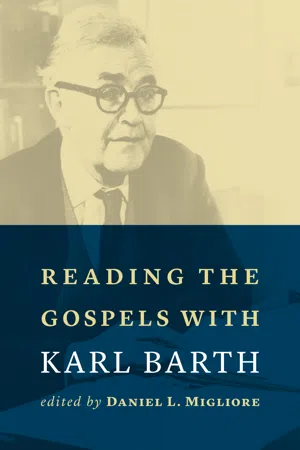
Church Dogmatics, Karl Barth not only cites thousands of Scripture texts but also offers extensive exegetical discussion of numerous passages. In this book twelve leading theologians and biblical scholars examine Barth's exegesis of particular passages in the Gospels.
How does Barth's practice of theological exegesis play out in his reading of the Gospels? What are the fundamental features of Barth's interpretation of Gospel texts, and to what extent do they enliven theology, biblical studies, and ethics today?
Reading the Gospels with Karl Barth explores answers to such questions and offers fresh stimulus for further study and discussion.
CONTRIBUTORS
Richard Bauckham
Kendall Cox
Beverly Roberts Gaventa
Eric Gregory
Willie James Jennings
Paul Dafydd Jones
Bruce L. McCormack
Daniel L. Migliore
Jürgen Moltmann
Paul T. Nimmo
Fleming Rutledge
Shannon Nicole Smythe
- 254 pages
- English
- ePUB (mobile friendly)
- Available on iOS & Android
eBook - ePub
Reading the Gospels with Karl Barth
About this book
Information
1The Election of Grace
Barth on the Doctrine of Predestination
JÜRGEN MOLTMANN
In 1942, in his preface to vol. II/2 of the Church Dogmatics Karl Barth wrote:
I would have preferred to follow Calvin’s doctrine of predestination much more closely, instead of departing from it so radically. . . . [But] as I let the Bible itself speak to me on these matters, as I meditated upon what I seemed to hear, I was driven irresistibly to reconstruction. And now I cannot but be anxious to see whether I shall be alone in this work, or whether there will be others who will find enlightenment in the basis and scope suggested.1
Between 1950 and 1952, I worked on my dissertation on the seventeenth-century Calvinist doctrines of predestination in Calvin, Beza, Gomarus, and Moyse Amyraut,2 and ever since I have been among the “others” who greeted Karl Barth’s “reconstruction” gratefully and with deep relief, and who have been “enlightened” by the reasoning and scope of his christological renewal of the doctrine of predestination.
In this chapter I propose to consider Barth’s section 32 under the heading “Predestination or Election of Grace?” and shall then look at section 33 in the light of the question “Double Predestination in Jesus Christ?” I shall emphasize Barth’s reconstructions, and shall then draw on Martin Luther and the Lutheran Paul Gerhardt in order to reinforce the Barthian doctrine of the election of grace. Finally, I shall deal with God’s electing and rejecting in the reign of Christ, to bring Barth’s theology and political theology into dialogue.
Predestination or God’s Election of Grace? The Decretum Horribile3
Ever since Calvin and Theodor of Beza, the Reformed doctrines of predestination have given rise to many misunderstandings and have done a great deal of mental and spiritual damage. Max Weber called the doctrine “emotional inhumanity.”4 “I may go to hell, but such a God will never command my respect,” was already John Milton’s cry.5 “It represents the most holy God as worse than the devil, as both more false, more cruel, and more unjust,” John Wesley disgustedly complained.6
And it is true: the idea that the almighty God should from eternity choose some persons and damn the others is a hellish message. What it evokes is not faith; it is fatalism. This is a cruel, arbitrary God, who plunges his human beings into the torments of hell by making them ask: Am I among the elect, or am I damned?
Yet according to Theodor of Beza, Calvin’s successor in Geneva, God actually shows his “sublime glory” by predestining the one to eternal bliss and the other to eternal damnation; and out of this idea he developed a whole dogmatics on a single page, not on ten thousand, like Barth.7 It begins with divine election and rejection, and finishes with human blessedness and damnation. It begins by affirming that God’s ways are unfathomable, and ends: “How incomprehensible are his judgments! Who has given him and repaid him anything beforehand and requited him?” (Rom. 11:33, 35). That is the Calvinist doctrine of decrees which Barth struggles with and which he formulated afresh in his doctrine of the election of grace.
What experience lies behind the ancient doctrine of predestination? It is the experience that one and the same proclaimed Word of God awakens faith in one person and unbelief in another.8 The believer hears the call of the gospel, and knows that he is chosen, justified, and sanctified. The unbeliever does not hear any call from God, so he is necessarily not chosen, not justified, and not sanctified. Just as the believer owes his faith not to himself but to God’s gracious election, in the same way the unbeliever has to put his unbelief down to God’s non-election. That is the conclusion of the circular argument of double predestination: The believer has been elected—whoever has been elected, believes. The person who is damned does not believe—whoever does not believe is damned.
This dualism of belief and unbelief is rather harmless in our liberal and secular societies, and without consequences. Everyone can believe or not believe what he wants. We have the “freedom of religion.” In the Islam-interpretation of the terror-organization ISIS in Iraq and Syria this division of the world into believers and unbelievers has murderous consequences: Whoever does not believe must die.
It is the invaluable merit of Karl Barth to have overcome this dualism of belief and unbelief in Christian theology. Islamic theology can also overcome this dualism, if they start with Allah, the “All-merciful” (ar-Rahman) instead of debating the true identity of a “good Muslim.”9
However: Before we speculate about the election of the one and the rejection of the other we have to look at God and at God’s self-determination. Before God elects and condemns human beings, God elects himself. That is God’s election of grace. Before God says, “You shall be my people,” he says, “I will be your God.”
Election as the Sum of the Gospel
At the beginning of II/2, Barth starts his chapter 7, “The Election of God,” with a section (§32) titled “The Problem of a Correct Doctrine of the Election of Grace.” The introductory paragraph comprises these four sentences:
[1] The doctrine of election is the sum of the Gospel because of all the words that can be said or heard it is the best: that God elects man; that God is for man too the One who loves in freedom. [2] It is grounded in the knowledge of Jesus Christ because He is both the electing God and elected man in one. [3] It is part of the doctrine of God because originally God’s election of man is a predestination not merely of man but of Himself. [4] Its function is to bear fundamental testimony to eternal, free and unchanging grace as the beginning of all the ways and works of God.10
I have inserted numbers for these four sentences because I now propose to look at each of these sentences as Karl Barth intended them to be understood, interpreting them in his own words.
1. Barth shifted the discussion of predestination from the explanation of why there are believers and unbelievers into the universal proclamation of the gospel. Unbelievers do not need a theological explanation of why they are not believing or why they cannot believe; they need only the testimony of the gospel. Believers do not condemn unbelievers; they pray for them because God is the God of hope for unbelievers as well as believers.
The gospel of Jesus Christ proclaims God’s election of grace: God turns toward human beings in Christ. That is pure grace, merciful love, patient hope. It is the overflowing love that accords with God’s being. It is founded on God’s primal decision to live in community with another than himself. Barth calls this an “election,” thereby basing the Reformed doctrine of decrees on this one primal divine decree. “God in His love elects another to fellowship with Himself. First and foremost this means that God makes a self-election in favour of this other. He ordains that He should not be entirely self-sufficient as He might be. He determines for Himself that overflowing, that movement, that condescension.”11 This “election of grace” is the gospel in a nutshell. It has its sole foundation in God’s freedom and is not a reaction on God’s part to human sin. In this sense Barth’s doctrine of the election of grace is in dogmatic terms supralapsarian. Just as the word “grace” describes God’s commitment, the word “election” describes God’s freedom. Barth is so acutely aware of his “revision” that he devotes many pages of small print to a discussion of the Reformed tradition—a rarity with him.
2. God’s election of grace is manifest only in Jesus Christ. In accordance with the doctrine of the two natures, Barth calls Jesus Christ “the electing God” and “the elected human being” in one. Jesus Christ is “God in His commitment to the human being” or, to be more precise, to all human beings represented by the one human being, Jesus of Nazareth. Here Barth does not yet distinguish between Israel and the nations, but talks about “das Menschenvolk” (all people). What Barth says is dominated by strict christocentricism: “Everything which comes from God takes place ‘in Jesus Christ.’”12 This is “the primal history which is played out between God and this one man”: “The general (the world or man) exists for the sake of the particular,” i.e., Jesus Christ.13
3. God’s election of grace belongs to the doctrine of God, and only after that to human soteriology. God is not only “almighty” as the Reformed doctrines of predestination stress; he is first of all determinative of himself. Barth expresses this through the concept of God’s primal self-determination. In choosing the human being, God first of all chooses himself on behalf of the human being. It follows: God’s Yes to the world is based on God’s self-affirmation. He desires this creation as truly as he wills himself. He affirms human beings with the power of his self-affirmation.
4. That means, fourthly, that the function of the doctrine of predestination is nothing other than to be “the fundamental testimony to free and enduring grace as the beginning of all God’s ways and works.” At this point Barth does not as yet say anything about the end of all God’s ways and works.
No one has brought out better or in a finer way what Barth develops theologically in CD II/2, §32 in discussion with the Reformed tradition than the Lutheran theologian Paul Gerhardt in his well-known Christmas hymn:
Als ich noch nicht geworden war,
da bist du mir geboren
und hast dich mir zu eigen gar,
eh ich dich kann erkoren.
Eh ich durch deine Hand gemacht,
da hast du schon bei dir bedacht,
wie du mein wolltest werden.
Thy love, O Lord, before my birth
Thou didst elect to show me,
And for my sake didst come to earth
Before I e’er did know Thee.
Yea, long before Thy gracious hand
Created me, Thy grace had planned
To make Thee mine forever.14
The election of grace—“and ...
Table of contents
- Title Page
- Copyright
- Contents
- Acknowledgments
- Abbreviations
- Introduction
- 1. The Election of Grace
- 2. Revelatory Word or Beloved Son?
- 3. The Gospel within the Commandment
- 4. A Rich Disciple?
- 5. The Compassion of Jesus Christ
- 6. The Journey of God’s Son
- 7. Parabolic Retelling and Christological Discourse
- 8. The Riddle of Gethsemane
- 9. The Passion of God Himself
- 10. The Self-Witness of the Risen Jesus
- 11. The Sum of the Gospel
- 12. What’s in Those Lamps?
- Contributors
- Index of Authors
- Index of Subjects
- Index of Scripture References
Trusted by 375,005 students
Access to over 1.5 million titles for a fair monthly price.
Study more efficiently using our study tools.
Frequently asked questions
Yes, you can cancel anytime from the Subscription tab in your account settings on the Perlego website. Your subscription will stay active until the end of your current billing period. Learn how to cancel your subscription
No, books cannot be downloaded as external files, such as PDFs, for use outside of Perlego. However, you can download books within the Perlego app for offline reading on mobile or tablet. Learn how to download books offline
Perlego offers two plans: Essential and Complete
- Essential is ideal for learners and professionals who enjoy exploring a wide range of subjects. Access the Essential Library with 800,000+ trusted titles and best-sellers across business, personal growth, and the humanities. Includes unlimited reading time and Standard Read Aloud voice.
- Complete: Perfect for advanced learners and researchers needing full, unrestricted access. Unlock 1.5M+ books across hundreds of subjects, including academic and specialized titles. The Complete Plan also includes advanced features like Premium Read Aloud and Research Assistant.
We are an online textbook subscription service, where you can get access to an entire online library for less than the price of a single book per month. With over 1.5 million books across 990+ topics, we’ve got you covered! Learn about our mission
Look out for the read-aloud symbol on your next book to see if you can listen to it. The read-aloud tool reads text aloud for you, highlighting the text as it is being read. You can pause it, speed it up and slow it down. Learn more about Read Aloud
Yes! You can use the Perlego app on both iOS and Android devices to read anytime, anywhere — even offline. Perfect for commutes or when you’re on the go.
Please note we cannot support devices running on iOS 13 and Android 7 or earlier. Learn more about using the app
Please note we cannot support devices running on iOS 13 and Android 7 or earlier. Learn more about using the app
Yes, you can access Reading the Gospels with Karl Barth by Daniel L. Migliore in PDF and/or ePUB format, as well as other popular books in Theology & Religion & Biblical Criticism & Interpretation. We have over 1.5 million books available in our catalogue for you to explore.